Your 1st for Philippine Defense

Austal leads Philippine Navy's OPV Acquisition Project!

SecDef Lorenzana confirms Austal is still the preferred OPV supplier for the PN

The Philippine Navy commissions its 2nd Jose Rizal-class frigate!

The Philippine Navy welcomes BRP Antonio Luna (FF-151), its newest frigate!

The Philippine Navy selects Shaldag Mk. V for Fast Attack Interdiction Craft!

The DND has awarded the FAIC-M Acquisition Project to Israel Shipyards

The Philippine Air Force wants more Black Hawk helicopters!

The Philippine Air Force asks for more Black Hawks to allow the retirement of their Bell UH-1 Huey fleet

The Philippine Army orders the Sabrah Light Tank System from Israel!

Israel's Elbit Systems was declared the winner to supply light tanks to the PA

The Philippine Air Force receives full order of Hermes 900 and Hermes 450 UAVs!

All 9 Hermes 900 and 4 Hermes 450 MALE UAVs have been received by the PAF!


Showing posts with label Huey. Show all posts

Saturday, March 3, 2018

Philippine Air Force May Consider ex-JGSDF UH-1H Hueys as Short Term Solution for CUH Project Delays.

With the Philippine Air Force (PAF) not proceeding with the acquisition of more Bell 412EPIs combat utility helicopters from Bell Helicopter Textron after the problems encountered with the Canadian government, other options are being considered for short to long term solutions.

Based on information MaxDefense received this past few days, as a short term solution, the PAF is actually considering the possibility of acquiring surplus Bell-Fuji UH-1H Huey combat utility helicopters from the Japanese government, as the type has been retired from the Japan Ground Self Defense Forces (JGSDF) for a few years now. It would be worth noting that the Philippines and Japan has agreed to transfer their stock of UH-1H parts to the Philippine Air Force in a separate agreement, and it would be expected to be easy to possibly approve a request to transfer surplus working airframes as well.

Take note that this is still a proposal and not an actual project.

A Bell-Fuji UH-1H Huey of the Japan Ground Self Defense Force. The JGSDF retired all its UH-1H and are currently stored in their bases.
Photo credited and taken from Airliners.net.


According to a source from the PAF, these surplus Japanese Hueys are in even better condition that those actively used by the Philippine Air Force. And even if the PAF decides to only bring a few into service, it would definitely be a big boost for the fleet as the PAF's Hueys and other utility helicopters are dwindling in numbers despite the addition of 13 Bell-Dornier UH-1D Delta Hueys and Super Delta Huey helicopters delivered by Rice Aviation Services Inc (RASI) a few years ago (2 Deltas Huey helicopters crashed in separate incidents since then). It was mentioned years ago that the PAF needs at least 100 readily available CUHs, which means a fleet of at least 150 CUHs for the entire fleet.

An example of a Bell-Fuji UH-1H Huey.
Credits to Rico Swytech and Air-Britain Photographic Images Collection.


It is also worth noting that these Bell-Fuji UH-1H Hueys are different from the Bell-Fuji UH-1J Hueys, The Bell-Fuji UH-1H are similar to the bread and butter Bell UH-1H Hueys used by the PAF, while the Bell Fuji UH-1J are similar to the PAF's own Super Hueys and Super Delta helicopters. The JGSDF has not yet retired their UH-1Js, which will only happen a few years from now once a replacement becomes available.

MaxDefense also received confirmation that at least 2 other options previously discussed in our earlier blog were requested to submit a formal offer to the Combat Utility Helicopter (CUH) Technical Working Group (TWG). One involve a brand-new offer from a larger helicopter company. Since we believe the formal offer is yet to be provided, MaxDefense will keep the information for now until it is clear and confirmed good for public consumption.

Until then, keep tab of this blog entry which we will also use should this plan become a reality.

Wednesday, March 11, 2015

The Philippine Air Force Gets Dornier UH-1D Helicopters, and Technical Clarifications on the Project's Alleged Issues

The recent articles by the Manila Times reported by Joel M. Sy Egco circulating lately regarding the irregularities on the Department of National Defense's (DND) acquisition of refurbished UH-1 helicopters has caught MaxDefense's eye due to a lot of errors and total disregard of facts. As the topic was discussed in our Facebook page, MaxDefense noticed a lot of its readers have difficulty understanding the issue, or understanding the errors on the allegations made by the Manila Times.


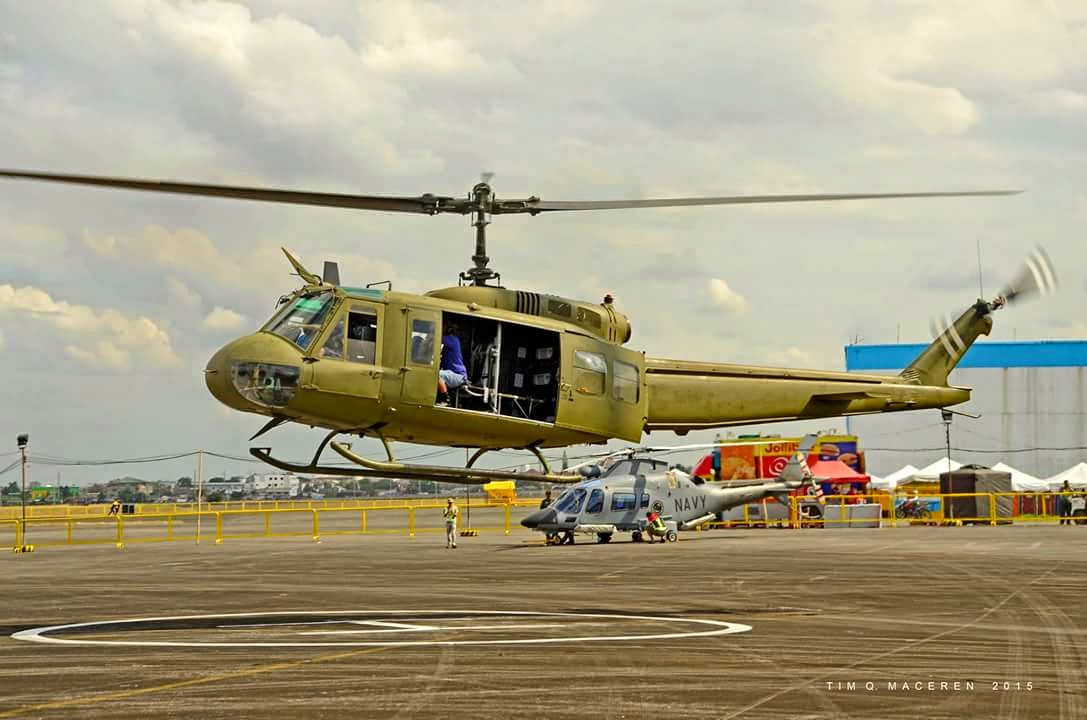
The Dornier UH-1D Super Delta upgraded version while undergoing flight testing at Clark Air Base, Pampanga. The Fastfin system is visible from this angle.
Photo by Tim Q. Maceren, taken from his FB page.


One of the UH-1D delivered by Rice Aircraft Services undergoing testing at Clark Air Base.
Photo taken by Tim Q. Maceren, taken from his FB page.


So, it was decided that MaxDefense will answer some of the technical issues, as well as obvious issues in this blog entry. MaxDefense suggests that further research be made by its readers to fully understand the issue and avoid bias.

So, first of all, we discuss the product itself, the Bell Model 204 & 205, otherwise known as the UH-1 series in US military language.


Short History of The Bell UH-1 Iroquois Helicopter:
The Bell Model 204 Helicopter
The Bell Helicopter company produced the Model 204 helicopter, with the first prototype flown in the late 1950s. As the US military accepted the helicopter, it was initially called the HU-1A, officially named "Iroquois" after an American Indian tribe, but HU-1A was pronounced "Huey" which is its more famous name. When the US military changed its aircraft naming standard, the HU-1A became the UH-1A powered by the Lycoming T53-L-1A engine. Bell later on improved the helicopter by increasing the engine size and power using the Lycoming T53-L-5, and lengthening the fuselage to accommodate more passengers, which was later called the UH-1B. 


The Bell UH-1A Iroquois, which is the original name of the Huey. Take note of the short fuselage as compared to what Huey helicopters the Philippine Air Force uses.
Photo taken from Wikimedia.


The US military used the UH-1B for utility and armed missions, and this is where Bell addressed aerodynamic deficiency of armed UH-1B by replacing the engine again with the Lycoming T53-L-11, increasing the fuel capacity, and installing an improved rotor system. This was later on called the UH-1C, a gunship variant with rocket and gun pods installed. Further improvements of the UH-1C to increase power resulted to the UH-1M. The US Marine Corps have their own variant of the UH-1B/C called the UH-1E, with differences on the avionics used. Further developments of the UH-1C for the US Air Force resulted to the UH-1F, which used the General Electric T58-GE-3 engine, but only a few units were built. Many other minor variants were released.


The Bell Model 205 Helicopter
With the US military wanting to have a helicopter that can carry more troops, Bell proposed to stretch the UH-1B by 41 inches, enabling them to increase the seating capacity of the helicopter to 15 people. Modifications were also made on the doors and windows in accordance to the changes Bell made to the design. The rotors and tail boom were also lengthened, and the engine of the UH-1C was used. This ultimately became what was known as the Bell UH-1D. 


The UH-1H, like those used by the Philippine Air Force (above), are part of the Model 205 series.
Photo taken from Airliners.net, photo copyright @ Carlos A. Morillo Doria.


In 1966, Bell again made modifications on the UH-1D, by replacing the engine with the Lycoming T53-L-13 with 1,400shp, and shifting the pitot tube from the nose to the roof of the helicopter to avoid damage during landings. This was later known as the Bell UH-1H, the most famous of the entire Bell UH-1 series. A civilian version was also made, under the name Model 205A with minor differences including a different position of the tail rotor.


Foreign and Licensed-Built Bell 205 / UH-1:
Due to its popularity, several countries chose the Bell 205 series for their own military and civilian applications. Industrially capable countries like Italy, Germany, Japan, and Taiwan all manufactured their requirement for UH-1 helicopters.

Italy is among the most successful in manufacturing the Bell 205 locally, under a joint venture between Bell Helicopters and Italian aviation company Agusta as the Agusta Bell. They used the designation AB.205, which is similar to the UH-1H. Agusta Bell continued to produce several other variants of the Model 205, and went on to produce their version of the Model 212, 214 and 412 known as the AB.212, AB.214 and AB.412, respectively.

Germany was also able to acquire a license to build the Bell UH-1 helicopter by Dornier Flugzeugwerke. This would later be called the Dornier UH-1D, and in spite of having the "D" series label, is actually standard UH-1H. According to online sources, more than 350 units were built from 1967 to 1981,and majority have undergone Service Life Extension Program and upgraded avionics for night capability. 


Japan built its UH-1 series, with the license given to Fuji Heavy Industries. Originally they built the UH-1H series, but later on made in improved version called the UH-1J, with a more powerful 1,800shp Allison T53-L-703 turboshaft, night vision goggle cockpit compatibility, infrared countermeasures and vibration reduction system.


The Japanese-built UH-1J variant of the Huey. Based on its improvements, it may have similar features as the Philippine Air Force's UH-1H Huey II.
Photo taken from Wikimedia.

Later Improved Models Based on the Bell Model 205 Helicopter:
Bell later on came up with further improvement on the UH-1H specifically for the Canadian Armed Forces by making it a twin engine variant instead of the single engine used for the Model 204 and Model 205. It was designated as the Bell 212 series in the civilian sector, and was called the UH-1N Twin Huey in US military service. It used the Pratt & Whitney Canada PT6T engines and was first introduced in 1970.

Bell also released an improved Model 212, called the Model 214, which uses the more powerful Lycoming LTC4B-8 engine while retaining the twin-blade rotor, and was called the Huey Plus. Another development was made by Bell by using a 4-bladed rotor, which later on became the Bell Model 412. Its current variant, the Bell 412EP, was chosen recently by the Philippine Air Force to become its latest Combat Utility Helicopter model and is expected to replace the UH-1 series in its inventory.


A CH-146 Griffon of the Canadian Armed Forces together with a UH-1H Huey of the Philippine Air Force. The Griffon is actually a militarized Bell 412EP helicopter customized according to the needs of the Canadians.

The latest iteration of the UH-1 was again made by Bell, this time by working again on the UH-1N design by lengthening its cabin, increasing the engine power and size using General Electric T700 engines used in the Sikorsky S-70/UH-60 Black Hawk, and having a 4-bladed rotor for improved lift and performance. This resulted to the UH-1Y Venom, currently the combat utility helicopter of the US Marine Corps. This variant is still in production until now.


The latest variant of the UH-1 series is the Bell UH-1Y Venom, which is currently used by the US Marine Corps.
Photo taken from Airliners.net, copyright @ Kevin Whitehead.


Background on the DND's UH-1 Helicopter Acquisition Project:

This project was regarding the acquisition of 21 refurbished UH-1 helicopters for the Philippine Air Force. 13 units will be standard models, while 8 will be upgraded models. All are expected to be used and refurbished by the winning bidder before delivery. 

The PAF decided to acquire more UH-1 helicopters as funding to acquire new helicopters are scarce, with the government only providing enough to acquire 8 new combat utility helicopters from 2013 until 2017. With only a budget of more than a billion pesos, the acquisition of more UH-1, being the PAF's premier combat utility helicopter model, was still found to be the best solution, as the platform still have potential for effective use for another 10 to 15 years after proper maintenance and continued refurbishing and modernization. 

Aside from this, there is an urgent need to beef up the helicopter fleet as many of the PAF's UH-1H helicopters have not entered refurbishing works and modernization, ending up as non-flying assets after reaching a certain period. Although there are plans to refurbish current PAF helicopters, it might take long before this can fully take place. Acquiring readily available units is still considered the fastest way to acquire additional assets.


An illustration of the fastfin system as installed on a Canadian Armed Forces CH-146 Griffon (Bell 412)
Photo taken from Canadian American Strategic Review website.


Apparently, the units delivered by Rice Aircraft Services are German-made UH-1D helicopters by Dornier. According to MaxDefense sources, 8 are to be upgraded to "Super Delta" standard, which is said to be almost similar to the Huey II the PAF is currently using. It features a more powerful engine, a fastfin system, night vision goggle-compatible cockpit, and other features not present on the standard UH-1D or UH-1H. The remaining 13 will be standard "Delta" models.


A UH-1D undergoing testing at Clark Air Base. Note the fastfin installed at the tail end of the helicopter. This could be one of the UH-1D Super Delta, which is an upgraded version of the UH-1D.
Photo taken by Tim Q. Maceren, taken from his FB page.


Answering the Technical Allegations of the Report:
MaxDefense will be answering the news report released last March 8, 2015 by Manila Times in a part-by-part manner. You may refer to the link below to see the sources of the topic outlines:

"Choppers bought for P1.2B defective"
http://www.manilatimes.net/choppers-bought-for-p1-2b-defective/168066/


1. "Delivery of Old, Refurbished Units":
The project was meant to acquire used and refurbished UH-1 helicopters from the very beginning. The UH-1 series has long been out of production with Bell or any of its license-production holders like Agusta, Dornier, Fuji Heavy Industries and AEDC. So it is already expected that the helicopters would not be new due to unavailability of any new UH-1 helicopters.


2. "Contract Was for UH-1H Helicopters":
This is completely untrue. The project was actually called "Acquisition of UH-1 Helicopter Project", without specifying the exact variant. So the bidder could actually bid using other variants of the UH-1 series aside from the standard UH-1H being used by the PAF. 


The document above used by the DND to invite bidders for the project already shows that the project is for REFURBISHED UH-1 HELICOPTERS. There was no emphasis on the "Hotel" variant as well. So there is no violation on this part. There are many other documents on the bidding that is available to the public at the DND-BAC's website.
Document snipped from DND-BAC website.


But does that mean the PAF will accept any variant? No. The PAF already have extensive experience with the UH-1H, and would definitely prefer the UH-1H or any similar variant. This would make the maintenance, training, spare parts acquisition, and parts recycling possible. Which brings us to the next question.


3. "The Age of the UH-1D is older than the UH-1H...":
As discussed earlier, the German-made Dornier UH-1D were built between 1967 and 1981. The US-made Bell UH-1H were built starting 1966 until the late 1970s. In general, the German UH-1D and the US UH-1H are almost the same age. But this is also an inaccurate way to determine the age of an aircraft. 


Two Dornier UH-1D helicopters used by the German military.


The most important detail is, when was the specific aircraft manufactured? It is impossible to compare the age of aircraft without this detail, and by just using a 15-year range. With this system, we might be comparing a 1968 model UH-1H with a 1975 model UH-1D. Based on the range alone, it would only be possible to generalize the age of the Dornier UH-1D and the Bell UH-1H as on the same range, +/- a few years.

Technically, the Dornier UH-1D and the Bell UH-1H are one and the same. This can be verified in numerous online sources, as well as by helicopter databases like helis.com. Dornier obtained the license to build the Bell Model 205 initially based on Bell's UH-1D, but opted to use a more powerful and newer engine, the Lycoming T53-L-13. The same engine was being considered by Bell to install on their own UH-1D for improved lift performance during those times, and when they eventually used the same engine a year later, the new variant was then officially called the UH-1H. 

Thus, the UH-1D made by Dornier is essentially one and the same as the UH-1H made by Bell. Also, Dornier's UH-1D is far superior to Bell's UH-1D, in the same manner that the Bell UH-1H is superior to the Bell UH-1D. 


4. "UH-1D are not reliable and their parts are obsolete...":
Being new doesn't necessarily mean reliable. Although newer products tend to be generally more reliable than older products, using this in a general statement like that of the report can be considered as totally inaccurate and misleading statement.

Since the Dornier UH-1D is essentially one and the same as the Bell UH-1H, maintenance and parts for both helicopters are the same too. MaxDefense sources indicated, and several online sources also confirmed, that parts for the UH-1D and UH-1H are actually interchangeable. Although Dornier probably does not make new spare parts for these helicopters, Bell does, and Bell can provide parts and support for both helicopters, aside from the fact that both can use the same original and compatible aftermarket parts from other companies but are accepted by Bell itself, which means the supply chain is not affected by the difference in the helicopter's designations. This was confirmed by the DND's Fernando Manalo an interview a few days ago. If the UH-1H parts is acceptable to the PAF, then the same is true for the Dornier UH-1D's. There are also many companies with large stocks of spare parts for most Model 205/UH-1 helicopters, as aside from the Philippines, there are still a lot of countries using the UH-1 helicopter, including the US military, national guard, and police forces. Examples include Dakota Air Parts, Timken, AirTechnology Engines Inc., and many others. 

It would be worth noting that the Philippine Air Force actually uses both the Bell UH-1H and civilian Model 205A, as well as the newer Bell 412EP. It also had experience in operating the a very few Bell 212s in the past, all of which are different from one another. But this did not negatively affected the supply chain of the PAF as well. 

(Add to that the possibility that Japan might provide the PAF some of their Fuji Heavy Industries-built UH-1H and UH-1J, will that become another issue that the media will come up again in the future?)


The PAF's 505th Search and Rescue Squadron operates around 8 Bell 205A helicopters, similar to the photo shown above. These have minor differences with the UH-1H, but is said to be less similar to the UH-1H, as compared between the Dornier UH-1D to the Bell UH-1H.
The PAF previously operated the twin-engine Bell 212 / UH-1N Twin Huey, although they are now said to be stored and there are currently no plans to put them back in service.
Photo taken from Wikimedia.
Another Huey derivative being operated by the PAF is the Bell 412EP, currently used by the 250th Presidential Airlift Wing, although the PAF's 205th Helicopter Wing is expected to get a few within this and next year as Bell Helicopter Textron delivers the first batch before November 2015.
Photo taken from Wikimedia.


5. "If the DND awarded the contract to a supplier...and those helicopters should have been used during the Mamasapano incident..." 
This is a non-technical phrase that MaxDefense could not stand to leave unanswered. The PAF, with or without these new helicopters, currently has air assets that could have been used to assist the Philippine National Police Special Action Force (PNP-SAF) commandos during the operation in Mamasapano, Maguindanao on January 25, 2015. It was assumed by the reporter's so-called source that the PAF doesn't have any air assets available at all! 

It was clear that the military, more so the PAF, was not given any instruction from higher ops to use their air assets to assist the PNP-SAF in any way before and during the operation, be it for close air support, insertion, extraction, and rescue. So the 21 new helicopters would not be of any help to the PNP-SAF even if they were delivered before January 25. This statement by the report's source, now called "Joey" by a later article posted on March 11, 2015, actually reveals a lot on his real intention for bringing out this issue to the spotlight. Being wrong on technical matters can be acceptable if the source is a non-technical person. But bringing this out in poor reasoning just to give more reason to grill the project is uncalled for.


6. "Helicopters delivered....were not yet operational...":
This was confirmed by the DND recently, as reported by the Inquirer on March 9, 2015. Only 8 of a total 21 helicopters were accepted by the PAF, while the rest are still being assembled, checked, tested, and will undergo acceptance later on. The DND already confirmed that they have given Rice Aircraft Services and its partner Eagle Copter up to April 15 to complete the turnover for the balance units. So there is nothing wrong with this.


Some of the UH-1D helicopters are still awaiting completion of assembly, so it is obvious that they are not yet flying.
Photo taken by Tim Q. Maceren, taken from his FB page.


7. "President [Benigno] Aquino [3rd] was hoodwinked into believing that the aircraft delivered were UH-1H models..."
The President previously said in his previous public statements including previous State of the Nation Addresses that the helicopters coming are refurbished UH-1 helicopters, not specifically UH-1H helicopters. 

Here is the link to the President's previous SONA wherein he stated that UH-1 helicopters are being acquired. So far the text only says "UH-1", without the "H".


8. "The age of the UH-1D is older than the UH-1H....":
This was answered in Item # 3.


A Dornier UH-1D used by the German armed forces.
Photo taken from Airliners.net, copyright @ Jakub Nanowski/EPGD Spotters.


9. "...the manufacturer [Dornier] is no longer existing and no helicopter parts are being manufactured specifically for the UH-1D...."
Although Dornier has already folded years ago after a failed venture with American company Fairchild (yes, the manufacturer of the A-10 Thunderbolt), they were able to successfully turn-over the rights of Dornier products production, sales, and support to RUAG Aviation, a Swiss company with facilities in Germany and many other countries. They even continue building some Dornier aircraft products until now like the Do 288 New Generation. Their website also indicates that they provide Life Cycle Support Services to Dornier military aircraft like the UH-1D and Alpha Jet. 

As with the spare parts, this was answered in Item # 4.


The DND, through its undersecretary Mr. Fernando Manalo, confirmed a few days ago that at least 8 units were already accepted by the PAF. MaxDefense sources confirmed this information, and that PAF pilots were dilligently doing their job to see if the helicopters are indeed in tip-top shape before they signed the reports prior to release of acceptance papers. 

Also, Pinoy Aviators, a group page in Facebook with members from the civilian and military aviation community, confirmed that a batch of helicopters were formally accepted this morning (March 11, 2015). These are composed of 2 standard "Delta" and 4 "Super Delta" upgraded helicopters. Source apparently came from one of the PAF Huey pilots included in the testing phase. It is unclear though if this is in addition to earlier reported acceptance of Delta and Super Delta helicopters.


MaxDefense is unsure if there are indeed corruption issues involved in the acquisition of these German birds. But MaxDefense believes that all the technical issues raised by Manila Times recently unto the project might either be a product of intentional or unintentional misinformation, poor understanding of the product, lack of research, or just laziness. A short hop on Google can give the writer tons of information on the helicopters. Using these reasons to build-up a case against the project is uncalled for, and probably have other intentions that are directed to the people involved in the project and the President himself. We will not be touching those issues, and we will leave that to the DND, PAF, Rice Aircraft Services, and the government to answer.


To cap-off, here is a video posted in Youtube during the testing of the helicopters, uploaded by RecSpin.com:


During tests in the US prior to delivery to the Philippines:


During testing @ Clark Air Base, Pampanga:


===========
UPDATES:
===========
March 16, 2015:
The Manila Times has again posted a new article, part of their continued accusation against the UH-1 acquisition deal between the DND and Rice Aircraft Services-Eagle Copter venture. The link is provided HERE.

This time, the article indicated that there are officers from the Philippine Air Force that are covering-up the deal, and that the PAF only showed 2 helicopters to the media during the presentation to the press last week. News video from UNTV is available HERE.

This is a serious allegation made by the source, the so-called "Joey" in Manila Times report by Mr. Joel Sy Egco, as even if they were unnamed by the report, these officers have confirmed to the public via media reports that the helicopters are working perfectly. This includes those in the posted video news report above, Lt. Col. Enrico Canaya, Director, Public Information Office, PAF; and Maj. Aristedes Galang, Operations Officer, 210th Tactical Training Squadron, PAF. It may also include Capt. Bryan Dofie, Huey test pilot of the PAF, who shared information in Pinoy Aviators Facebook page that all UH-1D accepted by the PAF are working in perfect order. There are many unnamed officers who is affected by this allegation.

What MaxDefense is curious to know is, how come these PAF officers, who themselves will be using the said helicopters in their day to day work as pilots, will risk theirs and their friends and colleague's lives to accept the helicopters and confirm that they are working perfectly? MaxDefense does not personally know these officers, but who is more believable at this point in time, "Joey" & Manila Times, or the pilots & PAF? How about the enlisted men who are among those involved in the testing, does the allegation involve them as well?


Another point of discussion is the allegation that only 2 helicopters are flying because out of all those accepted, only 2 helicopters can fly. As previously said and even emphasized to MaxDefense's recent Facebook reply to Mr. Sy Egco, MaxDefense will definitely need to correct the errors in military technology information. And although this is not directly a MilTech issue, continuous monitoring of the issue can actually debunk may of the accusations.

During the Media Presentation, only 2 UH-1D helicopters were shown. The video below shows the 2 helicopters:


Both are actually standard model UH-1D, with body number 502 and 186. If these are the only ones flying, then how come there are photos and videos of UH-1D Super Deltas flying scattered around the internet and social media sites? See the photo below from Mr. Tim Maceren:


Photo copyright @ Tim Maceren.


This is one of the UH-1D Super Delta upgraded helicopters. Although the body number is not yet painted as of this photo, this is definitely not among those shown to the media. So that makes it 3 flying aircraft. Also, the Manila Times reported that there are actually 4 UH-1D in Villamor Air Base that day. So how did the 3rd and 4th helicopter reach Villamor Air Base in Pasay City from Clark Air Base in Pampanga?

The presence of a photo of a 3rd unit flying, plus the presence of 4 UH-1D in Villamor Air Base makes the report from Manila Times wrong. We have not yet even included many other aircraft that are already reported accepted and working/flying in very good condition by MaxDefense and other sources.

With time moving, it would be best if the PAF can show that the aircraft they accepted are flying, which according to MaxDefense sources, is happening soon. Meanwhile, with Mr. Sy Egco indicating that "Joey" is coming out soon, let's see what's in store from his allegations.


==========
UPDATES:
==========
April 1, 2015:

The Philippine Daily Inquirer posted on their website a video wherein Defense Secretary Voltaire Gazmin and AFP Chief of Staff Gen. Pio Catapang took a ride on one of the recently accepted Dornier UH-1D helicopters. This is the standard model, which can easily be identified by not having the Fastfin system. This was after the formal acceptance ceremonies of the Airbus Military-CASA C-295M tactical transport aircraft from Airbus this week.

The link is provided below:

LOOK: Gazmin, Catapang ride UH-1D chopper


==========
April 11, 2015:

MaxDefense noticed that the sources of accusations against the UH-1D acquisition is either using 2 different aliases, or are 2 different people.
  1. Manila Times' source, a.k.a. "Joey", was defined by their latest report as a "he", or a male. 
  2. Meanwhile, GMA News' source, only known as "Source", can be heard in an interview with a lady's voice. 
  3. ABS-CBN's source, a.k.a. "Alex", was interviewed with a distorted voice which will not allow listeners to determine his/her actual voice. But the report disclosed that the supplier is accusing "Alex" of extortion. 
  4. In a report by the Tribune, Rice Aircraft Services Inc. (RASI) named a certain Rhodora Alvarez, an employee of the Bureau of Internal Revenue (BIR) as the person extorting the company. 
So the question now: is BIR's Rhodora Alvarez = Alex = Joey?

MaxDefense is trying to make a database of the Dornier UH-1Ds that are part of the 21-helicopter deal with the DND and PAF. So far MaxDefense was able to do a partial list, but further data needs to be added. If there are people who can assist, please PM me in the MaxDefense @ Facebook page.

==========
April 13, 2015:

For those insisting that the Dornier UH-1D is older than the Bell UH-1H. Here is a sample of Manufacturer's Serial Number (MSN) plate from a Bell UH-1H and a Dornier UH-1D. It indicates the serial number of the aircraft as well as the accepted date (in month and year) for release from production.

Here is the Bell UH-1H:
Photo taken from Scramble.nl.

And here is from a Dornier UH-1D:


Photo taken from Scramble.nl.


If you look at the "Accepted" portion at the lower right portion of the plates of both aircraft, you can see that the Bell UH-1H sample was accepted on "11-68", or November 1968. The Dornier UH-1D sample has an accepted date of "8/70", or August 1970.

This only proves that the Dornier UH-1D is not an older model than the Bell UH-1H, but were actually from almost the same timeline. This specific Dornier UH-1D sample is even younger by 2 years than the Bell UH-1H sample!

If you are still in doubt and have access to the helicopters or have friends/contacts with the Philippine Air Force, try to ask them a photo of the MSN plate located in the helicopter's cockpit. It is near thr pilot's foot area, on the left hand side of the central control panel and is visible from the outside.


==========
April 18, 2015:

Manila Times released a news report saying that the deal between Rice Aircraft Services - Eagle Copter joint venture and the Department of National Defense has been "axed", and only 7 aircraft were accepted by the Philippine Air Force. MaxDefense's sources also confirmed that there are indeed 7 helicopters already passed testing and accepted into service with the Philippine Air Force. It is unconfirmed though if the how many are Super Delta standards among the 7 accepted units.

Since the source of this news is questionable, MaxDefense is still verifying the report with other media organizations and from people involved in the deal.

The link on the news report can be accessed HERE.

If this is true, it would be a loss for the Philippine Air Force. Sources confirmed that aside from the 7 helicopters already with the PAF, another 6 helicopters already passed the acceptance test by the PAF several weeks ago, and are only awaiting for the PAF to accept them. While the balance 8 helicopters have already undergone internal testing by RASI and are only awaiting for the PAF to test them. With only 7 helicopters accepted, the PAF will not meet its required numbers, and according to MaxDefense sources, there are no immediate alternatives available that can catch the deal's downfall.


==========


Tuesday, November 26, 2013

Building-up the AFP's Equipment Needs for Disaster Response and Military Operations

It took a massive storm and devastation in the Visayas region to expose the government's inability to respond and provide government services and delivering massive volumes of personnel, humanitarian assistance and disaster relief (HADR) goods, light and heavy equipment and temporary facilities to a wide coverage area due to several reasons. One of them is the Armed Forces of the Philippines' (AFP) lack of these necessary tools and equipment, which is an issue that has not been given much attention for several decades now.

The scale of devastation brought by Super Typhoon Haiyan (local name Yolanda) was unprecedented in Philippine history, and is nowhere near the dozens of storms the country experiences in a year. Normally the Philippine government has contingencies and preparations for disasters, and this includes bringing in the capabilities of the AFP with its men, materiel, experience and capability in rapid deployment and handling rescue and relief operations. But as the sheer coverage of the disaster was known, so is the inability of the AFP to reach out on these areas all at the same time.


The typhoon showed how military forces can be used in humanitarian assistance and disaster relief operations. Shown above are USMC MV-22 Osprey tilt-rotor aircraft bringing in relief supplies from Cebu to Tacloban then returning to Cebu with evacuees.
Photo taken from Lt. Col. Francis Neri's Facebook page.

It exposed the AFP's capabilities, or the lack of it, to the general public, and brought it closer to the attention of our citizens and lawmakers alike. People became aware on the military's lack of assets to transport large amounts of aid to a large area of responsibility like almost the entire Visayas region.


What does the AFP have?
Currently the Philippine Air Force (PAF) only has 3 C-130B/H Hercules heavy tactical transport planes, 3 units of the smaller Fokker F-27 Friendship tactical transports and N-22B Nomad light utility aircraft, and a few dozen UH-1H Huey and W-3A Sokol utility helicopters in its inventory, and not all of these assets can be used for a single air operation due to requests for air assets for other purposes. The Philippine Navy has the same dilemma, with only a handful of naval transports in the form of the 2 Bacolod City-class logistics support vessels (LSVs), a few World War 2-era landing ship tanks (LSTs), and a couple of large landing craft utilities (LCUs), and a few BN-2 Islander and BO-105 utility aircraft at its disposal. In this type of situation, these assets are not enough.

PAF's lack of C-130s was exposed during the relief operations after Typhoon Haiyan hit the Visayas, The 3 units were working hard for 2 weeks now, and was lucky to be reinforced by more C-130s and C-17s from several foreign air forces.
Photo taken from Lt. Col. Francis Neri's Facebook page.

Not only is the military lacking in air and naval transport capabilities, it also lack the ground assets and support facilities that are both needed for normal military operations as well as humanitarian and disaster relief missions. The Philippine Army and Marine Corps, like the rest of the Armed Forces, does not have enough trucks and utility vehicles, engineering and construction equipment, and amphibious vehicles It also does not have or only have minimal temporary facilities like power generation, water treatment equipment and tanking, mobile hospitals, temporary airfield facilities, and communications equipment. It is surprising that there are still calls by many people to bring in relief aid to communities accessible by land transport until more than a week after the storm hit, but was not aided due to lack of these assets.


The AFP recently received several ex-US Army surplus trucks, like those above still in desert paint scheme after being used in Middle East campaigns. The AFP can continue getting more of these, or even new trucks, classified as civil defense equipment that can also be used for military operations.
Photo taken from IPMS Philippines website.

Thankfully, all these shortages were filled-in by the international community's contributions to the relief effort, as seen on the capabilities they brought in to assist the AFP and the Filipino people as a whole (a special MaxDefense blog article was made specifically to showcase the international help provided, see HERE). But this international aid is a temporary solution and will only be available until the Philippine government musters enough capability to stand alone to provide its people the necessities and return to normalcy. The capability brought upon by the international community can be a template for the Philippine government, the National Disaster Risk Reduction and Management Council (NDRRMC), other related government agencies, and by the AFP as it build up its own capability for future disasters. The Philippines cannot always just rely on foreign aid every time a similar unfortunate event happens; it must be prepared to face similar threats in the future, and it must also be prepared to answer the call to aid of other countries in need just as they answered our call for help.


Lawmaker's Questionable Solutions?
There are already earlier calls by a certain congressman who used to be the AFP's Chief of Staff to purchase more helicopters and transport planes in expense of purchasing fighter jets and territorial defense assets like the KAI FA-50 Fighting Eagle, and recent calls by another neophyte senator calling for the same route of purchasing more transports for the AFP by cancelling the FA-50 and AW109 acquisitions.

MaxDefense believes that both lawmaker's intentions of increasing the capability of the AFP to respond to civil defense duties is correct and commendable, but the plan to cancel the procurement of fighter jets and other territorial defense assets to divert the funds is absolutely wrong and irresponsible. These lawmakers did not take into consideration the importance of having a minimum deterrent that will give the Philippine government some semblance of capability to enforce its territorial and foreign affairs policies. The fighter jets are not just for shooting down enemy aircraft, but are also meant for air policing duties and enforce our territorial jurisdiction from foreign aircraft. It's not about the numbers, but the willingness of the Philippines to be responsible of its territorial integrity that matters.


Purchasing the FA-50 should be left untouched by those pushing for more dual-use military equipment that can be used in military and disaster relief operations. Both are equally important and must be funded by the national government altogether.
Photo taken from koreaaero.com.

The Compromise:

The best compromise to avoid undermining every AFP capability from another is to increase funding of the armed forces, as well as strengthening the mandate and capability of the NDRRMC (which is also under the Department of National Defense). This can be done through separation of the systems being procured by the AFP: defensive weapons systems like fighter aircraft and frigates can be financed through the AFP Modernization Program, and dual-use equipment like transport planes, trucks and utility helicopters can be classified as HADR equipment and financed by a separate funding scheme, reinforced by the AFP Modernization Program budget. It is expected that public opinion will be calling for the improvement of disaster relief capability of the government, and although lawmakers are not very keen on military capability improvement but will have no choice but to definitely support improvements in the military's ability to respond to HADR operations.


Recommended HADR Purchases for the AFP: The following are MaxDefense's recommendations on what the government and AFP must improve to cope up with similar disasters in the future. Instead of relying on the AFP Modernization Program budget, the DND and AFP must push for another funding scheme that will solely focus of acquiring capabilities that can be used for both military and civil defense/disaster response purposes. Due to the special nature of disaster response, the DND and AFP can make use of this loophole to request for further funding using alternative sources to improve disaster response capability while also improving the military's overall transport and mobility capability. This can be divided into several sub-programs:

Philippine Air Force:
  • The PAF can request for expanding the aerial transport capability improvement, which includes increasing the budget for its current procurement on the following projects: Combat Utility Helicopters (CUH), Light & Medium Fixed Wing Transport Aircraft, Search and Rescue Seaplane, and used UH-1H Helicopters. The PAF currently has a standing requirement for at least 100 CUH available at any time, and will require more or less 130 units of CUH in their inventory. There are plans to increase the number of air assets in the next round of AFP Modernization Program budgeting for 2017 and beyond, these programs can be accelerated by increased funding. The PAF can also make use of procuring more interim UH-1H helicopters from US military stocks which can be made available faster than new helicopters. The PAF could opt to go for more than 21 units.
  • The PAF could also include the request for the following: Procurement of additional new or used (or both) C-130 Hercules transport planes and procurement of Medium Lift Utility Helicopters which can be used to enhance the transport capability of the PAF; Emergency Airport Facilities (mobile air traffic controllers and radar systems, temporary lighting and signalling equipment, and mobile air monitoring radar systems) which can be deployed to immediately re-activate damaged or disabled airports and air bases; Cargo handling ground equipment like rough terrain and heavy forklifts; and even Firefighting Buckets and slinging equipment for helicopters. 
Additional C-130 aircraft, which are used not only for military transport but also for bringing in supplies and relief goods, and evacuation of victims and even trapped OFWs abroad. The operations after the typhoon are testaments to the importance of C-130s and other transport aircraft even in peacetime operations.
Photo taken from Lt. Col. Francis Neri's Facebook page.
  • Modernization of current assets can also be included, which may include installation of rescue winches on the W-3A Sokol helicopters (which are already transferred to the 505th SAR Group) and remaining S-76 helicopters; upgrading of several CUH to be able to carry firefighting water buckets;
One of the PAF's W-3A Sokol helicopter delivering food aid to affected citizens. The PAF require at least 100 combat utility helicopters operational at any point in time. The current numbers are far from that requirement.
Photo taken from Lt. Col. Francis Neri's Facebook page.
 

Philippine Navy:
  • The PN can opt to request for a separate funding to accelerate the purchase of more landing platform docks (LPD) or strategic sealift vessels (SSV) in addition to the 2 units already on the pipeline. Originally the PN plans to have at least 4 SSVs in its future inventory and accelerating this program can hasten the availability of these ships as early as possible. It can also do the same for the LCU acquisition project, which also requires more that a dozen more in the next Modernization Program phases.
  • To support the SSV/LPDs, the PN must also request for medium lift helicopters to be procured at the same time as the ships they are intended to be used with. 
Additional assets that can bring in supplies and disaster relief aid like amphibious vessels (photo shows PN's LSV) can be funded by a separate program that focuses on disaster preparedness.
Photo taken from US Navy.


Philippine Army and Philippine Marine Corps:
  • The need for more mobility assets like cargo and utility trucks to bring in troops, people, goods and for other purposes can be requested through this funding. These can either be used assets from the US military, or new trucks similar to the ones bought from Korea recently;
  • Amphibian transport vehicles, similar to the GKN Aquatrack that  the PMC and NDRRMC currently operates. These vehicles can be used during floods and has a large capacity for carrying people or goods; 
The GKN Aquatrack being used by the PMC is an example of equipment that can be used for HDMR operations, as shown above. The PMC is operating 2 units of behalf of the NDRRMC.
  • Rescue equipment like search robots, personal protection equipment for rescuers, additional K9 units, first aid kits, heat signature scanners, and other related equipment that are also not available or not enough numbers within the Philippine ground forces;
Search and Rescue robots similar to the one above, can be used to look for victims underneath rubble and debris, and can reach areas that are inaccessible to humans. They can also be fitted with camera to access dangerous places.
Photo taken from Robocup 2009 website.
  • Requirements for field hospitals, power generators, water filtration systems, field kitchens, satellite and high frequency communications, tents and field shelters, portable water and oil storage facilities, first aid kits, meals ready to eat (MRE), and water supplies.These items are actually needed by our ground forces during long deployments outside major camps, and are also not even available on minor army and marine camps. It would be best to acquire such capability and to allocate enough for HADR operations;
The lack of field hospitals in operation areas are always brought out whenever there are major military operations involving the AFP, resulting to unnecessary deaths. It can be improved if these are provided to the AFP via funding for civil defense and dual-use equipment as they can also be used for peacetime operations like disaster relief.
Photo taken from Wikipedia.
  • Engineering and construction equipment like payloaders, backhoe, loaders, dump trucks, and also mechanical handtools like chainsaws. These can be used in clearing and rebuilding, and even during normal civic-military operations which the Philippine military already specializes even in non-crisis times. It would be best to expand and improve in this matter;
  • Combat engineering equipment like pontoon bridges can also be classified, and also materials for erecting temporary bridges to replace destroyed ones.
Water filtration equipment similar to those used by the Canadian Forces in Iloilo, are actually needed by military ground units even for military operations outside major camps.
Photo taken from Combatcamera / Canadian Forces website.
Engineering equipment like backhoes and loaders are also necessary for disaster relief and reconstruction operations, and are also needed by the army's engineering and construction battalions for their usual missions.
Photo taken from Combatcamera / Canadian Forces website.


Government Response:
Although its too late for the government to react for this specific calamity, it is not too late for the government to prepare for the future. There is already a call from Senator Ralph Recto to include the funding of reactivation of at least 3 mothballed C-130s of the PAF with the 2014 National Budget, and even considering the purchase of new C-130 aircraft using multi-year funding schemes. He also supported the purchase of more naval vessels including strategic sealift vessels and logistics support vessels. 

The DND has also recently announced the purchase of 2 more used C-130 aircraft from an "unspecified source" with a budget of Php 1.6 billion, and has plans to start a acquisition program for a new Combat Utility Helicopter to replace the W-3A Sokols. And there is mounting support from the public as well as local government units for the national government to increase funding for the purchase of more military equipment that can be used for HADR operations. There are even calls by some lawmakers to create a separate Cabinet Office for Emergency Response.


These C-130s in Mactan, Cebu, previously discussed in another MaxDefense blog, can be the proposed candidates for refurbishing as brought out by Senator Ralph Recto.
Photo taken from Mr. Jake Nelson @ Pinoy Daily Journal.

But these plans are not enough. It must be pursued immediately without being caught up with the usual red tape and politics affecting military and civilian expenditures, as these are emergency items that are needed as soon as possible without waiting for a new crisis to arrive. The Philippine government has the capacity to fund for these requirements if it wants to, and will only need political will of the national government and cooperation from the different sectors of government. Money can't be a reason anymore for the government, as disasters won't wait for a chance for the Philippines to be wealthy enough before it strikes again. Not only will it improve the AFP's capability to respond to HADR, it will also improve the AFP's capability to respond to the internal security and territorial defense posture of the country. 


Opportunity to Return the Favor:
It must also be taken into consideration that the Philippines now owes the world for the aid and assistance they gave to the country in this time of need, even if they do not ask anything in return. The best way for the Philippines to return the favor is for it to be better prepared in the future to minimize the need for another massive foreign assistance. At the same time, the country must be prepared to assist other nations that will encounter similar crisis in the future. 


The PAF's C-130s working hand-in-hand with C-130s of other nations. It would be best if the PAF could return the favor in the future by participating in delivering aid and support to other countries should the need arise.
Photo taken from Lt. Col. Francis Neri's Facebook page.

Having a well prepared and well equipped military and disaster response teams that has the ability to be deployed in times of calamity anywhere in the world would bolster the Philippines' relations with the international community, improve its foreign policy standing, and can be a source of pride to the Filipino people. Just look at Indonesia: In 1963 the Philippines provided them with aid and medical assistance delivered by several C-47 transports of the PAF when Mount Gunung Agung erupted. Now they have returned the favor by sending several tons of relief aid brought in by several TNI-AU (Indonesian Air Force) C-130s, a shipload of Red Cross aid, equipment and personnel, and an LPD from the TNI (Indonesian National Armed Forces) is on the way to bring in more aid and more medical teams with their respective equipment (further discussed HERE) This is a source of pride for Indonesians to be able to help a friend in need even if they are also facing disasters in their own country and is also coping with financial issues. Can the Philippines do the same in the future? Yes, it can.


Indonesia is not a wealthy country as compared to its Western counterparts, and is almost in the same political, economical and military dilemma as the Philippines. But it has the willingness to help a friend in need, whatever it's situation it is. We are indebted to the international community, and must be ready to stand up to assist others in need in the future as well.
Photo taken from Liputan6.com website.


Philippine Navy Modernization Projects

Philippine Air Force Modernization Projects