Your 1st for Philippine Defense

Austal leads Philippine Navy's OPV Acquisition Project!

SecDef Lorenzana confirms Austal is still the preferred OPV supplier for the PN

The Philippine Navy commissions its 2nd Jose Rizal-class frigate!

The Philippine Navy welcomes BRP Antonio Luna (FF-151), its newest frigate!

The Philippine Navy selects Shaldag Mk. V for Fast Attack Interdiction Craft!

The DND has awarded the FAIC-M Acquisition Project to Israel Shipyards

The Philippine Air Force wants more Black Hawk helicopters!

The Philippine Air Force asks for more Black Hawks to allow the retirement of their Bell UH-1 Huey fleet

The Philippine Army orders the Sabrah Light Tank System from Israel!

Israel's Elbit Systems was declared the winner to supply light tanks to the PA

The Philippine Air Force receives full order of Hermes 900 and Hermes 450 UAVs!

All 9 Hermes 900 and 4 Hermes 450 MALE UAVs have been received by the PAF!


Showing posts with label philippines. Show all posts

Tuesday, May 5, 2015

Is the Philippine Navy's BRP Gregorio del Pilar (PF-15) having its Mk.38 Mod.2 guns installed soon?


One of our MaxDefense reader recently confirmed that the BRP Gregorio del Pilar (PF-15), the Philippine Navy's flagship, is currently dry-docked in Subic Freeport. According to him (who wishes to remain anonymous), the ship has already been in dry dock for the past 2 to 3 months, and was docked for some time in Subic before entering dry dock. 


The BRP Gregorio del Pilar (PF-15), the Philippine Navy's flagship. The Navy is planning to have Mk.38 Mod.2 secondary 25mm autocannons fitted on the ship soon.


Below are photos he took recently, and although the dry dock is far from his point of view, it is very obvious that the ship inside the dry dock is indeed a Gregorio del Pilar-class / Hamilton-class ship. To the untrained eyes, the double mast can be clearly seen on the first photo.


Both photos taken recently were taken at Subic Freeport. Although very small, it shows the BRP Gregorio del Pilar (PF-15) dry docked.
Photo taken and shared by one of MaxDefense readers.


Several months ago (last year), MaxDefense posted a news article from PTV-4 and Philippine News Agency (PNA) regarding the BRP Ramon Alcaraz and its new Mk.38 Mod.2 25mm remote weapons station. In that article, it confirmed that the BRP Gregorio del Pilar was scheduled for dry docking betweem February and June of 2015. This might be the scheduled dry docking indicated in the said news report. It is also impossible for its sistership, the BRP Ramon Alcaraz, to be dry docked this time as it just recently had its turn late last year.

The interesting part is that the report confirmed that the BRP Gregorio del Pilar is also scheduled to have Mk.38 Mod.2 25mm RWS installed during its dry docking. Originally, reports surfacing about the Philippine Navy acquiring Mk.38 Mod.2 guns from BAE was only for 2 units. So far, 2 units were already installed on the BRP Ramon Alcaraz last year.


The BRP Ramon Alcaraz (PF-16) already got its Mk.38 Mod.2 guns last year, and both guns were visible during its port visit to Cebu early this year.
Photo above taken from Timawa.net, photo below taken by an anonymous MaxDefense reader.


So did the Philippine Navy receive 2 more Mk.38 Mod.2 guns from the US? If yes, are the guns being installed on the PN's flagship now?

Only time will tell. It is expected that the PN will be bringing out the ship to the public again once it goes back to sea. And by then we can confirm 100% if such upgrade is indeed made on the ship.


==========
UPDATES:
==========
May 11, 2015:
The Philippine News Agency released an updated, as reported here by PTV News, confirming the undocking of BRP Gregorio del Pilar within this week. But it did not confirm the installation of any new system to the ship other than "preserve hull condition and servicing of machineries" which is typical to any drydocking activity.

MaxDefense will wait for any new information or photos after the drydocking which will confirm if there are anything new on the ship or not.

Friday, March 20, 2015

Updates on the 155mm Towed Howitzer with Ammunition Acquisition Project (Horizon 1) for the Philippine Army and Marine Corps

On February 2015, the Philippines' Department of National Defense (DND) released a new Invitation to Bid for the 155mm Towed Howitzer with Ammunition acquisition project for the Philippine Army and Philippine Marine Corps. This is actually the 3rd attempt to bid the project after the last attempt made last year failed after Elbit Systems Land & C4I failed to pass the post-bid qualifications. This is also the 3rd time that MaxDefense released a blog regarding the project with the 1st and 2nd bid attempt can be accessed HERE and HERE, respectively.


Elbit Systems Land & C4I of Israel previously won the tender to supply the 155mm Towed Howitzer and Ammunition. But was disqualified after failing the post-bid qualifications. They are expected to join the project bidding again this time.


The contract remains the same as the previous tender attempt, which includes the supply and delivery of 12 brand new 155mm towed howitzer systems, 240 rounds of high explosive (HE) cartridge, and an integrated logistics support (ILS) package for the entire system. The Approved Budget for the Contract (ABC) remains at Php 438,620,000.00. The pre-bid conference was scheduled last March 5, 2015, and the bid submission and opening was originally scheduled on March 19, 2015 but was moved to March 26, 2015 as per a new supplemental bid bulletin released on March 10, 2015.

So far, MaxDefense has not determined the interested bidders for the project, although it is expected that previous interested entities will be trying their chance to bag the project. This includes Elbit Systems Land & C4I, who won the tender last year but was eliminated after failing the post-bid qualifications. 

Among the requirements released by the DND are for the product to be in use with the origin country's armed forces or by at least 2 other foreign armed forces, and that the bidders must be the manufacturer of the goods (howitzer system and ammunition). Changes in the requirement now is that the bidders should have also completed a similar project within 5 years from date of submission of bid. Previously the requirement was for 10 years, which could have been one of the reasons why the previous tender was only participated by a few bidders, and probably also the reason why Elbit did not got the project.

A supplemental bid bulletin released on March 17, 2015 made changes also on the requirements regarding the major parts of the howitzer system. Previously the requirement allowed subcontracting to a number of parts except for the barrel, breach lock, and central structure of carriage. This requirement reinforces its earlier requirement that the bidder must be the manufacturer of the goods itself. 


MaxDefense hopes that many other suppliers that did not participate in the previous bid attempts, like Hyundai WIA and it's KH-179 towed howitzer, will participate this time.
Photo taken from KDN website.


Failure of bidding for this project will enable the DND to do a negotiated bid with possible suppliers, which was the same process applied with the acquisition of UH-1 helicopters for the Philippine Air Force.

# # # # # #

MaxDefense will be updating its readers on this project through this blog entry and at MaxDefense @ Facebook community page. It is expected that this project's bid submission and opening schedule will not move as much as the other projects of the DND. Hopefully more bidders will be interested in this project than before.


==========

UPDATES:
==========
April 4, 2015 (morning):
The DND released a Supplemental Bid Bulletin Nr. DND-PA/PMC-155-2015-003 last March 26, 2015, wherein there were changes on the specifications regarding the outsourcing of components, which now allows for all parts EXCEPT the barrel, breech block, and central structure of carriage. It also changed the bid submission and opening schedule from March 26, 2015 to April 14, 2015.

But due to the late release of this supplemental bid bulletin, it appears that the bidders did not know of the changes and 2 interested bidders, Elbit Systems Land & C4I of Israel and local company Stone of David, were present last March 26. MaxDefense is still confirming if the claim of an anonymous reader that Stone of David made known their intention to drop out of the contest last March 26, and only Elbit Systems Land & C4I is the only firm bidder that remain in the contest. Otherwise, the bid submission and opening on April 14 appears to be final. MaxDefense will closely monitor this project as it is already in its 3rd attempt, and any failure will allow the DND to go for a negotiated bid.


April 4, 2015 (afternoon):
It was confirmed by a source that Stone of David cancelled their participation in the 155mm Towed Howitzer Acquisition Project. Stone of David's principal for the 155mm Towed Howitzer, BNT-Tvornica Masina i Hidraulike, d.d. based in Bosnia-Hercegovina, provided 2 reasons for their cancellation:

1. The specified test and acceptance procedures indicated in the project's technical specifications "are not adaptable with the National Military Standard Testing Procedure being used (by their principal), BNT-TMiH".

2. Their principal for the 155mm HE ammunitions, Israel Military Industries (IMI), cannot open their production line as the quantity required by the contract is not within the acceptable quantity.

With this, then Elbit Systems Land & C4I remains the only other bidder for the project. It remains to be seen what will be the outcome of the bid opening on April 14, 2015, as anything can still happen if documentation becomes a problem again. MaxDefense hopes that there won't be any hook-ups from now on as the losing side on these delays are the Philippine Army and Philippine Marine Corps, and the Filipino people in general.


==========

April 24, 2015:

This project has finally moved forward again, as the bid submission and opening proceeded last April 14, 2015. Only one proponent submitted their bid, Elbit Systems Land & C4I, as expected from our previous update due to the withdrawal of Stone of David-BNT-Tvornica Masina i Hidraulike. 


Elbit Systems was declared the single lowest calculated bidder with a bid amount of Php 410,849,184.00, with all their documents and requirements found to be complying to the tender requirements. Their offer is the Soltam M-71 39-caliber 155mm towed howitzer. According to MaxDefense sources, the budget allocated (ABC) for the project could not afford to acquire 12 units plus ammo of the Soltam Athos, which is the foremost 155mm towed howitzer product of Elbit Systems-Soltam and is more automated than the M-71.

Post bid qualifications is expected to be made soon in Israel by next month. If Elbit Systems passes the post bid qualifications, they can be awarded with the project and a contract may be signed soon.


==========
May 12, 2017:


Finally after several years, the first batch of 3 Soltam M-71 155mm towed howitzers were delivered to the Philippines, arriving on the last week of April 2017. MaxDefense received confirmation that the howitzers are now in Philippine Army custody and are being tested somewhere in Central Luzon. Ammunition and ILS-related parts were included in this delivery.

9 more units are for delivery in the next few months, with the Philippime Army receiving 6 units (1 battery), and the Philippine Marine Corps with 6 units (1 battery).The Philippine Army will be the first recepient of this delivery.

Despite being similar to the Soltam M-71 155mm towed howitzers already in service with the Philippine Army since 1978, the new units are provided with the following changes:

1. The Travel Lock is now located on one trail only;
2. The new guns are equipped with LED lights
3. Improvements were made on the Breech Opening Mechanism

Once the guns pass the acceptance tests, it will be formally handed over to the Philippine Army and commissioned.

MaxDefense will provide more updates once news becomes available.

Thursday, March 5, 2015

The Philippines Should Immediately Consider Acquiring MRAP Vehicles for the AFP and PNP

The increased activities of the communist terrorist group New People's Army (NPA) and the Islamic terrorist groups Abu Sayyaf (ASG) and Bangsamoro Islamic Freedom Fighters (BIFF) against Philippine government forces have seen several fatalities and major injuries obtained from ambuscades. Military convoys of mostly unprotected trucks are the usual targets, the most favorite being the Kia KM450 and M35 trucks of the Armed Forces of the Philippines (AFP), and the Toyota Hi-Lux pickup trucks of the Philippine National Police (PNP). These vehicles lack the armor protection from small arms fire and shrapnels, and also lack the protection underneath to protect from roadside improvised explosive devices (IED) which is now the favorite weapons of the terrorists.

The Oshkosh ATV, an example of a mine resistant ambush protected (MRAP) vehicle used by the US military.
Photo taken from armystrongstories.com website.


Recent ambush attacks are as follows:

Last February 26, 2015, 5 soldiers from the Army's 81st Infantry Battalion were killed in the town of Quirino, Ilocos Sur after military trucks were ambushed by NPA terrorists at night time. 6 other soldiers were also wounded. 

In a separate incident, troops from the 50th Infantry Battalion were ambushed by the NPA last February 28, 2015 in the town of Pinukpuk, Kalinga. A trooper was killed while 3 other soldiers were injured.

This Land Rover Defender used by the PNP's Special Action Force (SAF) was destroyed by a landmine planted by the NPA in along a road in Antipolo, Rizal in 2010. 4 SAF policemen were killed, and 5 more were injured, all coming from the 3rd SAF Battalion. 


Just yesterday, March 4, 2015, another report of an ambush and IED attack against a Philippine Army convoy resulted to 3 troopers killed, 2 of which were officers, and several others wounded. MaxDefense sources said that an IED struck a Kia KM-450 light truck, and the convoy was pinned down by small arms fire from hidden terrorists.  

Precious lives wasted by being killed not in encounters, but defenseless in a vehicle without armor protection. In comparison, the current offensive against the BIFF has even less fatalities on the government forces as compared to a single IED ambush attack on a convoy.

The Kia KM-450 light truck used by the AFP is among the favorite target vehicles of terrorist groups. The example above was ambushed by NPA in Cotabato resulting to 9 soldiers dead.
Photo taken from GMA News website.
This Toyota Hi-Lux utility vehicle of the Philippine National Police was ambushed by NPA terrorists in Sta. Rita, Samar in 2007. Land mines or IEDs were used, followed by small arms fire on the pinned down convoy.
Photo taken from Samar News website.


The Mine Resistant Ambush Protected (MRAP) Vehicle:
To improve protection of mobile troops, the best way is to use armored vehicles with added protection against IEDs planted along the road. Specifically by having troops use mobility assets like armored personnel carriers (APC) or Mine Resistant Ambush Protected (MRAP) vehicles.

MRAP concept was first introduced by the South African Defense Forces during their numerous encounters of landmines in the Rhodesian Bush Wars. They developed the Casspir, which is an armored vehicle with a raised body, large wheels, a V-shaped hull, and good armor protection for the passenger compartment. This became the inspiration for developing the MRAP of the Americans. 

The Casspir, developed by South Africa and is considered to be the inspiration for developing the current generation of MRAP vehicles. The example above is an early variant of the model.


The MRAP  was widely introduced by the US military and its allies during military operations in Iraq and Afghanistan after experiencing high casualties to its troops coming from roadside bombs, IEDs, landmines and small arms fire ambush. The favorite targets of militants were the US Humvee, which is also being used by the Philippine military and police forces. Even after armoring, the up-armored Humvees were still no match against powerful IEDs, which usually explode underneath the vehicles were armor is non-existent. 

MRAPs differ from normal armored vehicles by being designed not only with armor protection on the front and sides of the vehicle, but also by designing the entire vehicle to protect its occupants from IEDs, landmines and explosives from below the vehicle. Innovations like V-shaped hull, compartmentalized armoring and using off-the-shelf parts made the vehicle not only effective, but also affordable compared to armored fighting vehicles.

MRAPs are not really indestructible, but they are protected enough to keep its occupants safe from harm. This example of a Cougar H MRAP was able to protect all its occupants despite the terrible damage the vehicle received. In this time and age, lives are more important than vehicle assets.
Photo taken from Wikimedia.


It was also designed to be a cheaper alternative to armored personnel carriers and armored fighting vehicles which were designed for optimized used on medium to high intensity conflicts. This allows the military to acquire more of the vehicle for use on low intensity and counter insurgency operations while maintaining their standard armored vehicles for other purposes. 


Possible Sources of MRAP:
There are now numerous sources of MRAP vehicles in the world market, which means the Philippines will not have a problem sourcing them. There are several alternatives in which the Philippine government can go with regards to acquiring MRAPs for its security forces.

1. Used MRAPs from the US Military and other friendly countries:
With the US military reducing its footprint in Iraq and Afghanistan, there are literally thousands of MRAPs currently in service with the US military. There are even thousands more left behind in conflict areas that they could not bring home due to economic reasons. For the Philippines, it doesn't need to acquire those left behind in Afghanistan. An option is to acquire them directly from the US military, sourced in the continental United States.

The US is downsizing its MRAP fleet, with many either being sold or granted to friendly countries, distributed to interested police forces in the US, or are being stored for future requirements. Add to that the cost cutting measures the US military is currently undertaking, and also the upcoming new fleet of vehicles called the Joint Light Tactical Vehicle project that are meant to replace the Humvee and early models of MRAP. About 7,000 MRAPs are being divested based on current US government plans.

The Cougar H MRAP. The US is divesting several of its Cougars and other MRAPs, which can possibly be made available for the Philippines.
Photo taken from Wikimedia.


The US has several types of MRAP, from the small RG-31 Nyala 4x4 to the large Cougar 6x6 (incidentally both examples were actually designed in South Africa) in which the Philippine security forces can choose from. Not only are they possibly cheap or even free, they are also readily available and can be immediately distributed to operating forces upon delivery.


2. Buying new MRAPs from foreign sources:
This is the most common practice, to acquire new-build MRAPs from friendly countries. There are many sources nowadays, from the original makers in South Africa, to the commonly seen variants from the United States, and from new MRAP players from Israel, India and even Thailand. 

Costs can become an issue, as it is expected that if the Philippines acquire MRAPs, it would definitely consider acquisition and operating costs, performance in Philippine vegetation and setting, size, and probably economic advantages, local manufacturing and technology transfer. Politics can also be another reason of choosing a certain country's offering.

TATA of India released this Mine Protected Vehicle (MPV) recently and is now being offered for export.

This is an indigenous MRAP design from Thailand, the Chaiseri First Win 4x4. It is also being offered to the Malaysian armed forces by Malaysian company DRB-Hicom (Deftech) as the Gempita.
Photo taken from malaysiandefence blog site.

Currently there are offers being made to both the Armed Forces of the Philippines and the Philippine National Police. One example is the Tiger Mk.II 4x4 vehicle from MDT Armor. A US company, MDT Armor's product is actually based on a Ford or Dodge large pick-up trucks, and is built in Israel. MaxDefense chose to discuss this as the AFP and PNP previously conducted tests on the vehicle which was brought by MDT Armor's local distributor Spectec Trading. Based on their Facebook page, it appears that further tests were made by the Philippine Army, although it is still unclear if local tests on live fire and mine and IED resistance were made. Compared to contemporary MRAPs, the Tiger Mk.II is considered smaller and might be suitable for initial local requirements.

 
MDT Armor's Tiger Mk.II protected vehicle loaded in a Philippine Army truck for testing. The vehicle is also being offered to the Philippine National Police although no decision has been made by both armed services yet.
Photo taken from Spectec Trading's Facebook page.


3. Producing a Locally Made MRAP:
The most difficult approach is for local companies, or even the Armed Forces of the Philippines itself, to build an indigenous MRAP vehicle. This is because there are no entity in the Philippines with extensive experience in designing or manufacturing an armored vehicle, even more with an MRAP-like capability.

The closest effort being made is the Philippine Army's Security and Escort Armored Vehicle (SEAV), which is still undergoing tests. Made by a local company, the vehicle is practically a small armored vehicle that was designed to escort military convoys and provide machine gun fire support if necessary. But MaxDefense sources indicate that the vehicle is not really designed to take on blasts from underneath the vehicle, and has not undertaken any destructive test to validate its protective capabilities.

The Philippine Army's Security and Escort Armored Vehicle (SEAV) in 2013.
Photo taken from Research & Development Center, ASCOM Philippine Army FB page.
The SEAV in 2014. It appears that the underneath of the vehicle does not have a V-shape hull and was not really designed to consider mine protection from the beginning.
Photo taken from screengrab of the video "Pagbigay Katuparan sa AFP Modernization Program" posted by PCOO Creatives in Youtube. 


Although this is a good option to develop the Philippine defense industry, it could also be the longest way for the AFP and PNP to have an effective protected vehicle. With time running out, this is not the first priority.


####

MaxDefense suggests that the Philippine government go for a multi-pronged approach in acquiring MRAPs. To immediately fill up its needs, the Department of National Defense (DND) should work together with the US Department of Defense to see if there are ways for the Philippines to tap excess defense articles or grants for MRAPs and more armored vehicles for both the PA and PMC. They could immediately be provided within the next few months should an agreement be made early on.

For a longer term solution, the Philippines must start to plan acquiring new MRAPs for both the AFP and PNP. It would be best to look at models that can be acquired at a lower cost, and with an option for a local production with technology transfer. This could benefit the local industry as well by bringing in technology and manufacturing capabilities. Local companies can tie-up with foreign manufacturers to represent them in the local assembly or manufacturing of the vehicles. 

Whatever the path the government takes, in the end it would benefit the security forces of the Philippines by reducing the risks of fatal or major injuries during operations against communist and Islamic terrorists that are now actively playing the deadly IED-ambush path. 

Sunday, September 21, 2014

Philippines-France Defense Cooperation Agreement - Easing the Supply of Military Equipment for the AFP

Philippine president Benigno Aquino III's official visit to France from September 17 to 19, 2014, concluded with several discussions and deals with the French government and France-based multinational companies. In relation to defense and security, Aquino was able to push for the signing of an updated Defense Cooperation Agreement between France and the Philippines, as well as meeting with Airbus top officials.


President Aquino meets French president Francois Hollande in Paris.
Photo taken Mr. Christian Hartmann c/o Reuters.


France-Philippines Defense Cooperation Agreement (DCA)
The 2 countries already have a previous DCA and the one signed in France this week updates and further strengthen this defense agreement. This paves the way for the the French government to assist the modernization program of the Armed Forces of the Philippines (AFP), and for allowing French companies to supply the Philippines with weapons platforms, systems, and defense-related goods and services. This also allows the Philippines to tap French assistance in other defense-related issues like training and education, warship visits and military aircraft stop-overs, and others.

Previously, the Department of National Defense (DND) indicated that a DCA is important in paving the way for defense acquisitions with certain companies and governments where the supplier is based. Such examples of previous DCA signed by the Philippine with other countries are those with Canada, South Korea, Indonesia, and the United States. This paved the way for the AFP and DND to acquire military assets from the said countries, with the Bell 412 CUH and VIP helicopters from Bell Textron Canada, FA-50 Fighting Eagle jets from Korea Aerospace Industries, and Strategic Sealift Vessels from PT PAL of Indonesia.


What the French are (and possibly) offering:
Current defense acquisitions and awards made by the DND and AFP include the C-295 medium lift tactical transport aircraft from Airbus Military, based in France. Aside from Airbus Military, French or part-French companies like MBDA Systems, Thales Group, STX France, Dassault Aviation, Airbus Helicopters (formerly Eurocopter), Nexter Group, and DCNS have shown interest, are offering, or are competing for contracts to supply various defense systems to the AFP.

Airbus Military, aside from its offer to supply the Philippine Air Force's (PAF) requirement for Long Range Maritime Patrol Aircraft (LRPA), has reportedly offered "a newly designed aircraft for disaster management", which can be provided by the French government through a possible Official Government Assistance loan to the Philippine government. MaxDefense sources, and analysis of previous plans of the AFP points to an offer for 2 units of the Airbus A400M Atlas transport aircraft, which can be considered as a dual-use asset for combat support and humanitarian Assistance and Disaster Relief (HADR) operations. MaxDefense previously tackled the need to more dual-use military assets for this requirement in a previous MaxDefense entry. Airbus has also recently won to supply the PAF with medium tactical transports with its C-295 aircraft.


Airbus was reportedly offering the A400M Atlas to the Philippines through the French government assistance.


STX France is one of the shipbuilders qualified to bid to construct the Philippine Navy's (PN) 2 new light frigates. Aside from that, STX France and other French shipbuilders like DCNS are offering or preparing for a possible tender for the long awaited Offshore Patrol Vessel requirement and other combat and support vessels for the Philippine Navy.


DCNS and other French shipbuilders are interested in upcoming projects for the Philippine Navy. Photo above shows DCNS' Gowind-class Offshore Patrol Vessel design.


MBDA Systems are currently offering assorted missile systems to the Philippine Navy for their upcoming and current naval and air assets, the Philippine Air Force, and to the Philippine Army (PA) for air defense systems. According to MaxDefense's PN sources, MBDA has a strong chance of getting some or all the missile system requirements for the upcoming new frigates. MaxDefense believes that the offers include the MM40 Exocet anti-ship missile, and any of their 3 naval anti-aircraft missile systems: the Mistral short range man-portable air defense missile, the vertical launch (VL) version of the longer ranged Mica missile, and the newer Common Anti-Air Modular Missile system (CAMM).

The Mistral is also being offered to provide air defense systems for the PN's current major naval assets; and the Lightweight Multirole Missile and Sea Viper for their AW109 Power naval helicopters and the upcoming ASW helicopters. They are also offering the Exocet anti-ship missile coastal battery version and Mistral to the PA for their missile system requirements. The PAF was also being offered to use the air-launched version of the Exocet missile for its upcoming LRPA acquisition.


A computer generated illustration of an AgustaWestland AW159 Wildcat fitted with both the Lightweight Multirole Missile (LMM) and the Sea Viper missile.
Photo taken from IHS-Jane's website.


The Thales Group has been also actively involved in offering its defense and security products, mostly on electronics, radars, sensors and surveillance systems, command and control systems, system integration and subsystems. It is involved and actively pushing its products for several of the AFP's current and upcoming projects, including the PAF's LRPA, surveillance systems, and aircraft subsystems; PN's new frigates & SSV, and ship upgrades for its current assets, GHQ-AFP and PA's C4ISR and battlefield radars system, and many others.


Thales' Captas towed array sonar might be one of the products being offered to the Philippine Navy.


Aside from new defense systems, the agreement paves the way for the French government to also possibly offer excess defense articles to the AFP. As a major military power that is experiencing some economic downhill like other European countries , it is expected that France has a lot of EDAs or systems that are about to be taken out French military service that they can offer at a lower price or as grants should the Philippines not be able to afford brand new systems.


A Georges Leygues-class frigate, which are to be withdrawn from French Navy service as more Aquitaine-class (FREMM) frigates come online. Used ships like this can boost the Philippine Navy's combat fleet in the face of Chinese aggression.
Photo taken from Wikipedia. 


This deal definitely helps the Philippine government pursue its plans to modernize the Armed Forces of the Philippines, and provide a closer defense relationship between the two republics.


Airbus A400M Atlas being offered?:


Comparing the 3 foremost large transport aircraft of the Western world: the Boeing C-17 Globemaster III (left), the Lockheed Martin C-130J Super Hercules (middle), and the Airbus Military A400M Atlas (right).
Photo taken from Key Publishing website.


This can be considered as a surprise move by Airbus and the French government. If confirmed as offered through official French government loans, this could actually be a win-win situation both for the Philippines and France for several reasons. Aside from the announced reason of assisting the Philippine government in increasing and improving its HADR capability, the move can actually be considered as both economically and politically for the French government for the following reasons:

1. Accepting the offer means a successful sale for France. By loan or not, the Philippines will still be paying for them, thus can still be considered a positive economic news and export for France and Airbus. This will definitely make a small share of revenue and jobs for France. 

2. With lowered sales numbers for the A400M from its original buyers like Spain, Germany and the UK, and South Africa cancelling their previous orders, Airbus and the French government together with its partners are looking for ways to find other customers to acquire the aircraft and re-build the numbers it needs. Getting the Philippines to join its current customers is one way of reducing the burden of reduced sales and growing unit costs to cope up with the projected profit and cover development costs of the aircraft. If France decides to offer those it previously committed to buy but decided to cancel, it definitely helps France to share its burden to the Philippines.

3. Getting more customers to have A400M in their inventories will help market the aircraft further to other countries. This is a proven sales strategy that is also applicable to military aircraft. Being considerably more expensive than the smaller Lockheed Martin C-130J Super Hercules and the soon available Embraer KC-390 from Brazil, only a few countries showed actual interest on the Atlas. Making it easy for countries to afford the aircraft by providing financial assistance may help increase the the number of users of the A400M. 

4. Airbus might be betting that having the A400M in PAF's inventory will definitely allow the Airbus to possibly get additional orders later on should the PAF replace the legacy C-130 Hercules in its fleet, or if money becomes a non-issue to enlarge the heavy transport fleet from its current numbers. 

5. The deal gives France the moral and political vote of confidence and support from the Philippine government and its people, while also gaining positive points to President Francois Hollande, his administration, and the French people for its generosity. 


If France really wanted to just assist the Philippines to have a reasonable capability to airlift goods and services during HADR operations, there are several other alternatives they could have offered instead of the hulking A400M. For ODA, they can offer the Airbus Military C-295 transport aircraft similar to what what the PAF ordered recently, although technically the C-295 is more of a Spanish product (being from CASA, now part of Airbus Military). France can also offer larger helicopters than what the PAF currently uses like the Airbus Helicopters EC725 Super Cougar which have good range and capable of airlift operations from hard to reach areas, although these are also expensive. The French government could also provide alternative means to aid the Philippines aside from ODA, like granting retired but still usable and immediately available assets like ex-Armee de l'Air C-160 Transall transport aircraft or Puma helicopters. 


Instead of the Airbus A400M, why not more of the smaller, more practical and already upcoming Airbus C-295? Although being a Spanish product, the French may prefer to sell something that they really can say as theirs.

Whatever the real reason is, the A400M is still a well-desired asset of any air force, and having them in PAF service is better than nothing at all. 


=============
MaxDefense is happy to report to its readers that it reached 2 million views last September11, 2014, or after 16 months and 9 days from its beginning. Thank you for your continued support of MaxDefense blogs!!
=============


=============
UPDATES:
=============
September 22, 2014:
To clarify MaxDefense readers: Official Development Assistance (ODA) is not applicable to warfighting equipment. It is only applicable to promote economic development and welfare assistance. HADR operations can be considered a welfare assistance, thus only dual-use military equipment can be considered, which includes airlifters like the Airbus A400M. Fighter aircraft, frigates, and the like can't be considered for ODA loans.

============
September 26, 2014:
MaxDefense realized that there are a lot of readers who are not familiar with the Airbus Military A400M Atlas. With this, MaxDefense refers you to these websites for further reading:

- Airbus Defense and Space website (official Airbus website for A400M)
- Military Factory website;
- Global Security website;
- Military Today website;
- Flight Global website (news related to A400M)

MaxDefense suggests its readers to read more about the aircraft, its capabilities, and comparison to other similar aircraft like the Lockheed Martin C-130B-H and C-130J, Boeing C-17 Globemaster III, etc.

============
September 27, 2014:
Project Philippines strikes again, copying some of the contents of this blog almost word per word. Any idea on who runs this copycat blog? 

Saturday, August 2, 2014

Military Convoys in Metro Manila - Not a Coup preparation but probably something better

An unannounced rumble of Army and Marine convoys of fully armed troops in military lorrys backed by a couple of armored vehicles along the main thoroughfares of Metro Manila last Tuesday until Thursday, July 29 to 31 2014, gave some jitters to a curious but weary public. An earlier announcement by former navy officer and now Senator Antonio Trillanes III of reports of an emerging plans for a coup d'etat against the administration of President Benigno Aquino III has been publicly circulating for days, and the convoy's appearance strengthened speculations from the public that the senator might be telling the truth.


A V-150 armored vehicle from the Philippine Army's Mechanized Infantry Division as seen along EDSA together with other military vehicles. Take note of the lorry in the background carrying what appears to be crates that are usually used for ammunitions. Photo taken from GMA News website.


The AFP was quick to dismiss the rumors even before the convoy rolled the city streets, saying that the AFP will not be involved im such actions. The AFP also announced that the recent sight of military convoys in the capital was just a normal logistical movements from Northern Luzon Command in Tarlac City and Southern Luzon Command in Lucena City, to military installations in Metro Manila. The Philippine Army's spokesman also confirmed that the convoy carried weapons and ammunition to Fort Bonifacio in Taguig. Eyewitness accounts said that the trucks were loaded with crates, possibly a cargo of arms and ammunition. But MaxDefense have reasons to believe that aside from a possible logistics run, there might be something else


A Philippine Army V-150 armored vehicle (foreground), and Kia KM450 utility truck (background) are among the vehicles in convoys seen along Metro Manila streets recently.
Photo taken from European Pressphoto Agency website.


This V-300 Fire Support Vehicle from the Philippine Marine Corps was also part of one of the convoys seen recently in Metro Manila.
Photo taken from European Pressphoto Agency website.

Some reports and eyewitness accounts spotted a joint Army - Marine convoy headed to the port area in Manila last July 31, and came out with cargo inside shipping containers and headed back to AFP Headquarters in Camp Aguinaldo, Quezon City. The AFP did not elaborate the said logistics run, but MaxDefense believes that the convoy picked-up a delivery of weapons or ammunition from the port area.


The joint Army-Marines convoy spotted in the Tondo district near the port area.
Photo taken from GMA News website.


MaxDefense have reasons to believe that the cargo was actually the first batch of Remington R4 carbine for the Philippine Army, wherein the first batch were expected to arrive by August 2014. The AFP and the DND has been vocal on this specific program of the AFP Modernization, and transporting a large yield of high powered firearms is a good reason for a need for such a large armed escort force from the military. It might also be possible that the convoys from NOLCOM and SOLCOM will also be carrying back the new rifles to their respective command headquarters when they head back within a few days, to distribute the rifles to line units. MaxDefense covered the acquisition of the Remington R4 as the next new rifle of the Philippine Army in a separate blog entry.


The Remington R4, their version of the M4 series carbine, was ordered by the AFP recently, with the first batch of deliveries from a total of more than 63,000 rifles expected to arrive on August 2014. Photo taken from Remington Defense website. 


MaxDefense is still confirming the results of the said logistics run, although it is expected that if the MaxDefense opinion in this blog entry is correct, the AFP and DND will happily announce it formally to the public very soon.

==========
UPDATES:
==========
August 4, 2014:
Philstar just confirmed what MaxDefense thought of the quick runs by the army and marines to the Manila port area. The first major shipment of Remington R4 (M4) carbines were delivered to the AFP.


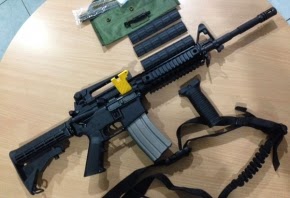
The Remington R4, their version of the M4 carbine, as shown to the media by the AFP.
Photo taken from the Philippine Army c/o Philstar.com.

It is worth noting that based on the photo above, the rifle comes with a Picatinny rail for future mounting of rifle accessories, rail covers to protect the rails, a cleaning kit, and a rifle sling. MaxDefense suggests for the Army's investment on higher quality ammunition magazines, and gradual acquisition of optical sights to aid the Army's riflemen to improve their aiming time and accuracy when firing compared to the standard iron sights.

Aside from Philstar, Rappler has also confirmed the rifle deliveries and the use of heavy armed escorts in its latest news reports.

Philippine Navy Modernization Projects

Philippine Air Force Modernization Projects