Your 1st for Philippine Defense

Austal leads Philippine Navy's OPV Acquisition Project!

SecDef Lorenzana confirms Austal is still the preferred OPV supplier for the PN

The Philippine Navy commissions its 2nd Jose Rizal-class frigate!

The Philippine Navy welcomes BRP Antonio Luna (FF-151), its newest frigate!

The Philippine Navy selects Shaldag Mk. V for Fast Attack Interdiction Craft!

The DND has awarded the FAIC-M Acquisition Project to Israel Shipyards

The Philippine Air Force wants more Black Hawk helicopters!

The Philippine Air Force asks for more Black Hawks to allow the retirement of their Bell UH-1 Huey fleet

The Philippine Army orders the Sabrah Light Tank System from Israel!

Israel's Elbit Systems was declared the winner to supply light tanks to the PA

The Philippine Air Force receives full order of Hermes 900 and Hermes 450 UAVs!

All 9 Hermes 900 and 4 Hermes 450 MALE UAVs have been received by the PAF!


Showing posts with label offshore combat force. Show all posts

Friday, April 30, 2021

Philippine Navy interested in acquiring another Hamilton-class cutter as stop gap measure

Back in March 2021, we mentioned in one of our social media posts  that the Philippine Navy is was offered by the US to transfer ships and boats as part of its Military Assistance to the Philippines. 

These offers were among those said to be listed in the US document sent to the Philippine Ambassador to the US Babes Romualdez, which in turn was sent to President Rodrigo Duterte as proof of US commitment to assist the improvement of the Philippines’ defense capabilities.

We previously said that we would not provide further details as requested by sources, but we confirmed in our blog entry released last 05 April 2021 that the Philippine Navy has been offered the Cyclone-class large patrol boats of the US Navy, some of which were already decommissioned by the US Navy recently.


But so far, we have not confirmed the “ships” portion of the offer. These Cyclone-class are covered by the “boats” offer.

Photo credits to Wikipedia.

Ship on offer to the Philippine Navy:

With the Philippine Navy announcing its intent to acquire the Cyclone-class patrol boats, it would be also worth noting that the service actually has an impending scheduled Joint Visual Inspection (JVI) of a larger ship in the US mainland, with the invitation released as early as 2020.

But the inspection was not conducted yet by the Philippine Navy Technical Working Group (TWG) due to the COVID-19 pandemic affecting both countries.

The offer was actually for another Hamilton-class high endurance cutter of the US Coast Guard, the former USCGC Mellon (WHEC-717)
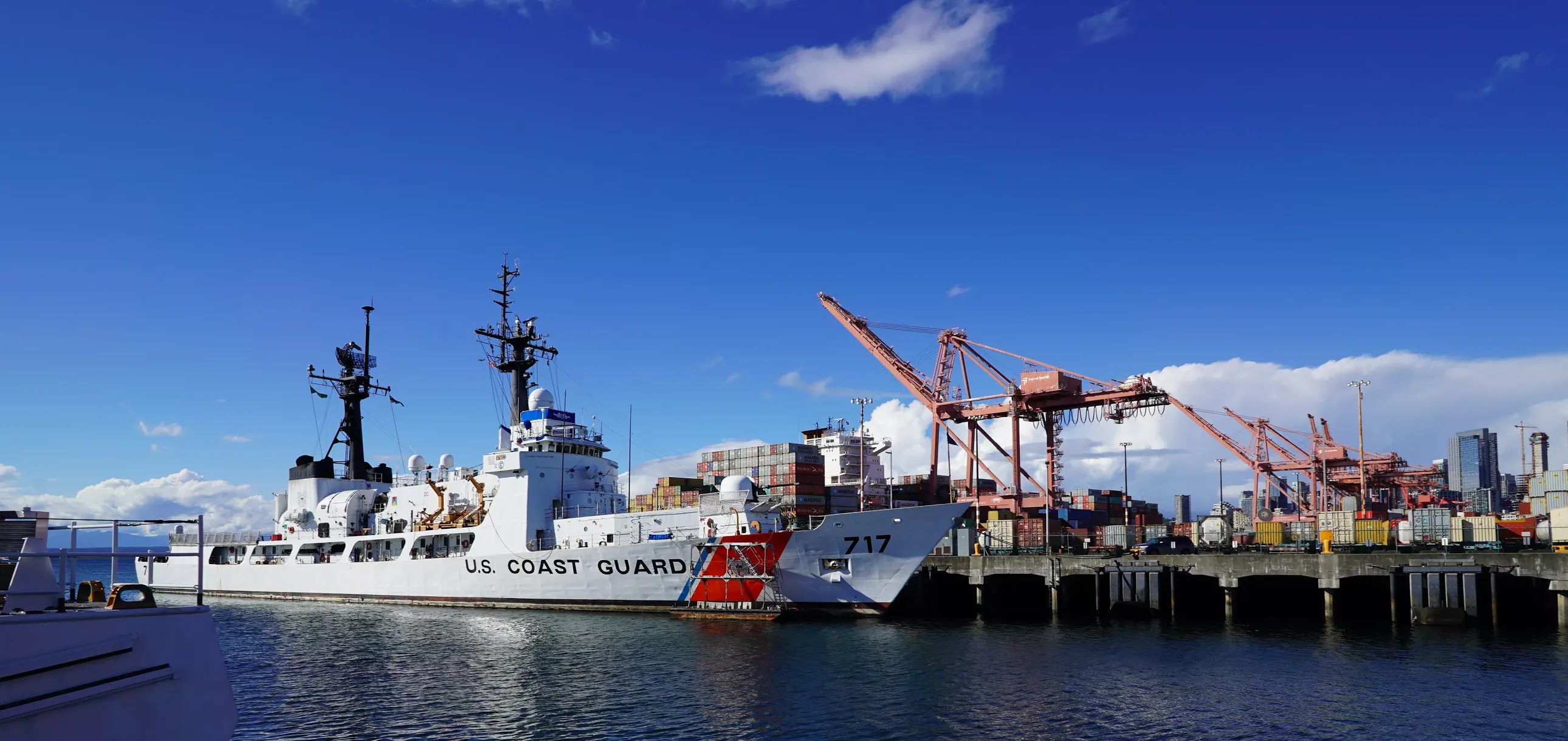
The USCGC Mellon (WHEC-717). Photo credits to Wikipedia.

The former USCG Mellon is the sistership of the Philippine Navy’s three Del Pilar-class patrol frigates, and was decommissioned from the USCGC on 20 August 2020.

It remains the only Hamilton-class ship still with the US government that has not been taken by a new enduser. Previously, it was believed that the ship was offered to the Royal Bahrain Naval Force, but it appears that even as early as 2019, the Bahraini government has already shown less interest in the ship.

The USCGC Mellon (WHEC-717):

The USCGC Mellon is the 3rd Hamilton-class high endurance cutter of the US Coast Guard, completed in February 1967, and commissioned with the US Coast Guard on January 1968.

The USCGC Mellon (WHEC-717) firing a Harpoon anti-ship missile during exercises. Photo credits to Wikipedia.

While it is true that the ship is already old at more than 50 years old, the Philippine Navy itself can attest the capabilities of the ship, with the type remaining as one of the fleet’s most capable ships despite the arrival of new frigates lately.

The USCGC Mellon showing its high sea state capability as it overcomes a swell. Photo credits to original source.

The Philippine Navy requested for a 4th Hamilton-class ship as early as late 2018, after realizing that the BRP Gregorio del Pilar (PS-15) will only be ready for service by 2020 after damaging its propellers and propeller shaft assembly in an accident in the West Philippine Sea.

The US made an official offer to the Philippines by 2019, although an invitation was only made to inspect the ship in 2020.

Being an existing operator of the ship class since 2011, it was only logical for the Philippine Navy to take in another ship of the class, which could benefit from the service’s existing supply and maintenance chain for the ships.

Stop Gap Measure:
 
The Philippine Navy believes that the ship would still be good to use for another 10 years, long enough for the service to be able to obtain a replacement for it as part of its Capability Upgrade Program (CUP).

This means the former USCGC Mellon would only serve as a stop-gap measure while the Philippine Navy tries to build up its fleet after decommissioning World War 2-era ships and delays in its Horizon 2 acquisition plans.

It is also noted that the addition of the former USCGC Mellon would help the Philippine Navy sustain naval operations while its sisterships undergo the Del Pilar-class Upgrade Project which is slated to start later this year.

It should be noted that BRP Gregorio del Pilar (PS-15) and BRP Andres Bonifacio (PS-17) are both in dry dock for different reasons, thus affecting fleet availability.

In the longer term and if the Philippine Navy decides to retain the ship despite new ships already available, the platform becomes a force multiplier for the service, as it can still conduct patrol missions or even be used for training purposes similar to how other navies make use of older ships for training cadets and new seamen.

BRP Andres Bonifacio (L) and BRP Gregorio del Pilar (R) on drydock for repairs and maintenance works. Photo credits to community member sharing to MaxDefense PH.

Why Old Hamilton-class ships again?:

To those asking, so why not get something much younger, much modern warships like the Oliver Hazard Perry-class or the Littoral Combat Ships (LCS), rather than old Hamilton-class ships with not much firepower and combat capability?

First of, the US has been offering the Oliver Hazard Perry-class frigates to the Philippine Navy for more than 20 years now since the late 1990s, with MaxDefense PH even reporting that the US made its offer again during the RIMPAC 2020 exercises in Hawaii. 

USCGC Mellon (WHEC-717) with Oliver Hazard Perry-class frigate USS Robert G. Bradley (FFG-49) during an exercise in Indonesia in 2010. Photo credits to DVIDS.

But it appears that the Philippine Navy is uninterested in the ships due to its lack of a diesel engine and its utilization of gas turbine engines which are most costly to operate than diesel engine-powered ships.

In short, it was PN's decision to skip on Oliver Hazard Perry-class frigates.

A GE LM2500 marine gas turbine engine. Despite the PN having this type of engine, ships without diesel engines remain as the PN's "kryptonite" up to this day. Photo credits to original source.

Secondly, while the US Navy is planning to retire the first batches of the Freedom-class and Independence-class Littoral Combat Ships, it has not done so yet.

Also, there are fears from the Philippine Navy leaders and planners that they would cost a lot not just to acquire (despite expected to be offer for cheap), but could be expensive to sustain and maintain due to its complicated systems.

But based on previous information we received from sources, the Philippine Navy is indeed expected to receive an offer for either of the LCS classes under US Foreign Military Sales (FMS) of Excess Defense Articles.

The Freedom-class LCS. Photo credits to Wikipedia.

Cyclone-class littoral patrol vessels:

In the meantime, the Philippine Navy appears to be gunning to acquire several Cyclone-class littoral patrol vessels from the US Navy, with PN FOIC Vice Adm. Bacordo even confirming that there is an outstanding offer from the US government under its Excess Defense Article (EDA) program, and that they are waiting for the official approval from the State Department on the authority to transfer the ships to the Philippines.

Also being waited are the approval on the PN’s request for Price & Availability (P&A) which would allow the PN to prepare for the planning and programming of the acquisition, including preparing the costs for its transfer.

Cyclone-class littoral patrol vessels of the US Navy. Photo credits to Wikipedia.

The FOIC has mentioned at least twice that the PN wanted to get at least 5 units, which will allow them to have a total of 6 including the BRP Gen. Mariano Alvarez (PS-38) already with them since 2004. 

But there is also possibility that the PN may get more, but that would depend on the avaiaibility of ships for transfer from the US government, as well as results of inspections that make it acceptable for the PN to receive them, as well as financial capability of the Philippine government to pay for them.

The Philippine Navy's sole Cyclone-class patrol vessel BRP Gen. Mariano Alvarez. Photo credits to Peter @ Flickr.

The acquisition of these additional ships would also allow the Philippine Navy to bridge the gap left by retiring older littoral patrol ships like the Gen. Emilio Aguinaldo-class, and also allow them to retire old remaining ships like the Kagitingan-class.

=========================

In the end, while the Philippine Navy goes for old ships again, they are replacing much older ships that were retired or in need for immediate retirement. 

Also, these are only stop gap measures considering the PN already has a program to acquire new combat and patrol vessels as part of their modernization efforts.

These old ships may stay with the PN fleet beyond the arrival of new ships, but that is not something bad especially if the PN can afford their sustainment.

===============
===============
First release: 30 April 2021
Copyright MaxDefense Philippines


Sunday, August 25, 2019

The Philippine Navy's Pohang-class corvette, and plans to acquire more from South Korea


After MaxDefense posted bits and pieces of information and dropping hints in the past year on the plans to acquire more surplus Pohang-class corvettes from the South Korean government, Defense Sec. Delfin Lorenzana finally confirmed what we have been saying all along - that the Philippine government is indeed negotiating with its South Korean counterparts to transfer at least two (2) more surplus Pohang-class corvettes.

This was confirmed by Sec. Lorenzana during the arrival ceremonies of the Philippine Navy's first Pohang-class corvette, the BRP Conrado Yap (PS-39), considered as the Philippine Navy's first purpose-built corvette.


The first Pohang-class corvette of the Philippine Navy, the BRP Conrado Yap (PS-39), formerly the ROKS Chungju (PCC-762). Snipped photo originally from the Philippine Navy.

The Introduction of the Pohang-class to the Philippine Navy:

The BRP Conrado Yap (PS-39) is the first Pohang-class corvette of the Philippine Navy. It was approved for transfer to the Philippine Navy since 2016, but due to delays and funding issues, the Philippine Navy was only able to start the actual transfer process in 2019.

The ship, formerly known as the ROKS Chungju (PCC-762), is a Pohang-class Flight III corvette formerly used by the Republic of Korea Navy. The Flight III were configured for anti-submarine warfare (ASW), equipped with two Oto Melara 76mm/62 cal. Compact naval guns, two Otobreda twin 40mm L/70 naval guns, two Mk.46 triple torpedo tubes, 2 Mk.9 depth charge racks, and at least four 12.7mm heavy machine guns. It also has a mount for a MBDA Simbad launcher for the Mistral VSHORAD missile system, although the PS-39 do not have the mount as it was taken out by the ROKN before handing over the ship to the PN.

The ROKS Chungju was the replacement provided by the South Korean government after the Philippine Navy rejected the acceptance of another Pohang-class corvette offered to them in 2011, the Flight II corvette formerly known as ROKS Mokpo (PCC-759). The PN rejected the ship after inspections by the PN in 2014 found the ship in very poor condition, and would not be beneficial since many of its subsystems were non-operational and would require a lot of work and money to refurbish.

Meanwhile, when the PN inspection team checked the former ROKS Chungju, many of its subsystems are obsolete but are still in good working condition, and the ship require minimal work to refurbish. The Philippine Navy spent Php250 million to repair, refurbish and fit-out the ship to acceptable standards, although the South Korean government agreed to pay for the drydocking works at STX Shipyard as part of the grant.

The ship was formally handed-over to the Philippine government, and commissioned with the Philippine Navy on 05 August 2019 in Jinhae Naval Base in South Korea.

Three more Flight III ships were built aside from the ROKS Chungju, although all of them were transferred to other countries with two going to Vietnam, and one to Egypt.

Currently, the Republic of Korea Navy (ROKN) still has fourteen (14) Pohang-class Flight IV and V corvettes that are available for transfer once retired from service.

Aside from the Philippines, some other countries received surplus Pohang-class corvettes from South Korea, including Peru (1 x Flight II), Vietnam (2 x Flight III), and Egypt (1 x Flight III)


More on the Philippine Navy's Pohang-class Corvette Transfer Project can be found on the Resource Page on MaxDefense's AFP Modernizastion Portal:

"Pohang-class Corvette Transfer Project of the Philippine Navy"


Changes from ROKS Chungju to BRP Conrado Yap:

Several items were removed by the ROKN prior to hand-over, including:

* Simbad MANPADS firing station for MBDA Mistral and/or LIGNex1 Chiron VSHORAD missile system;
* Several low frequency radios used for secured communications;

* Beacon distress radio;
* Satellite navigation system;
* ULQ-12(V)1K electronic support measures (ESM) suite;
* Electronic Position Indicator Radio Beacon;
* RFID receiver


Left Photo: BRP Conrado Yap. Right Photo: ROKS Chungju. Color Legend: Red- removed; Orange - changed; Green - added.
Credits to Iohanssen Kamputhaw for the infographic and information.

Refering to the photo above, the following were among those noted as changes when the ship was delivered to the Philippine Navy (Thanks to one of our naval contributor Iohanssen Kamputhaw for providing these infographic and info):

1. Midship satcom antenna removed;
2. Forward (above bridge) dome-type navigation radar installed;  
3. RHIB crane was changed. New RHIB was also procured;  
4. A secondary S-band was added and mounted on new skeleton tower.  

5. Primary S-band may have also been replaced (if Bid Documents for Lot 2 was followed)

Refurbishing works on the ship prior to official hand-over included the following:

* W6 level overhaul of the MTU main diesel engines;
* W6 level overhaul of the MTU ship diesel generators;
* HF Radio, UHF Base and Handheld Radios;
* Marine and Airband Radios;
* Navigational Equipment


First Purpose-Built Corvette:

The BRP Conrado Yap (PS-39) was considered by the Philippine Navy as its first purpose-built corvette, since previous ships identified as corvettes were originally built for a different purpose.

The Rizal-class and Malvar-class patrol vessels, which were previously considered and counted as corvettes by both local and international publications, were actually originally the Auk-class ocean minesweepers and Patrol Craft Escorts (PCE) of the US Navy, respectively. Due to the change in role they received while in service with the Philippine Navy, they were considered as corvettes based on size and weight class. Back when these ships were introduced, the term "offshore patrol vessel" was not yet used to describe navy patrol vessels, and corvettes were usually armed with the same gun complement as these ships.

The Jacinto-class patrol vessels were also considered as patrol vessels by the UK Royal Navy during their service with the Hong Kong Naval Squadron. Being more capable than the Rizal-class and Malvar-class "corvettes", these ships were also classified as corvettes being less capable than corvettes of its time which were equipped with anti-submarine, anti-aircraft, and missiles for surface warfare.

While the BRP Conrado Yap is not armed with missiles, it is considered a corvette, with emphasis of surface warfare and anti-submarine warfare. It was designed to combat North Korean gunboats and small ships by high volume of gunfire from its 76mm and 40mm guns, while also equipped with a hull-mounted sonar, torpedoes and depth charges for rudimentary ASW operations working in tandem with more capable ASW platforms.


A Flight IV Pohang-class corvette.

Training Ship:

The BRP Conrado Yap (PS-39)is also expected to be a training and transition ship for future ship crew of the upcoming Jose Rizal-class frigates, which are expected to start delivery to the Philippine Navy by 2020.


Along with the Del Pilar-class ocean patrol vessels and Jacinto-class offshore patrol vessels, the PS-39 would allow crew members to operate subsystems that are the closest thing that the Philippine Navy has in its fleet to those installed on the new frigates. This is especially true for the hull mounted sonar system, as the PS-39 has the only working ship-mounted ASW sonar in the fleet.


Personnel from the PN's Naval Sea Systems Command led by its chief Rear Adm. Rommel Galang conducts checks on the BRP Conrado Yap (PS-39) to orient personnel on the ship's subsystems. Photo taken from the NSSC's Facebook page.

Plans to Acquire 2 More Pohang-class:

Defense Sec. Delfin Lorenzana confirmed that they are negotiating with the South Korean government for the transfer of two more surplus Pohang-class corvettes to the Philippine Navy. Based on how he mentioned it to the media, it appears that the South Korean government was actually offering to transfer these ships to the Philippines.

But this is not the case.

It was known within the DND and Armed Forces of the Philippines (AFP) that the BRP Conrado Yap (PS-39) was meant to be a "sweetener" for the acquisition of twelve (12) KAI FA-50PH Fighting Eagle light combat aircraft for the Philippine Air Force (PAF), and eight (8) Hanwha Defense KAAV-7A1 amphibious assault vehicles for the Philippine Marine Corps (PMC).

Originally, the Philippine Navy already requested for the transfer of another one or two Pohang-class corvettes since 2017 after the contract for the Frigate Acquisition Project was signed in October 2016. Back then, the DND and PN were hoping that the South Korean government will give them the ships as a "sweetener" for buying not just the HDF-2500 frigates from Hyundai Heavy Industries, but also for including several Korean-made defense products like the LIGNex1 SSM-700K C-Star anti-ship missile, and later on the finality to use the Hanwha Systems Naval Shield Integrated Combat Management System (ICMS).

Surprisingly, if the proposal to transfer two more Pohang-class corvettes are indeed being pushed as "sweeteners", having them come before closing a deal means that the Koreans are being safe in making sure a deal is indeed closed first before any promised sweetener can be actually delivered.

According to MaxDefense sources, among the promises made by Hyundai Heavy Industries to the DND and PN was that they would assist in the transfer of surplus Pohang-class corvettes to the Philippine Navy. So the two ships could be from this commitment.


Remember when MaxDefense posted if there will be a BRP "Fidel Ramos" in the future? That was in reference to the ongoing negotiations to transfer more Pohang-class corvettes to the Philippine Navy, since Pres. Fidel V. Ramos was actually a Korean War veteran as well, and the Philippine Navy is expected to name Pohang-class corvettes it receive after distinguished Filipino soldiers who serviced during the Korean War in the 1950s.

So expect additional Pohang-class corvettes to be named after Korean War heroes or distinguished soldiers or officers.


The BRP Conrado Yap (PS-39) is shown here with two other Pohang-class corvettes, most likely recently retired Flight IV ships which can be identified by the different radar dome on the mast (more circular which are found only on Flight IV and V ships of the class). Surprisingly, the Otobrerda 40mm twin gun mount at the B position was removed for both ships, with one even have it replaced with an old 20mm gatling gun mount found only on Chamsuri-class patrol boats. Photo taken from the Philippine Navy website.


Flight IV and V Pohang-class Corvettes:

Since there are no more Flight III Pohang-class corvettes available for transfer to the Philippine Navy or any other navy, it is expected that the South Korean government will be using Flight IV and V ships of the class. The ROKN has started retiring Flight IV ships with the former ROKS Jinhae (PCC-766) already retired from service since December 2017. Another famous Flight IV ship is the ROKS Cheonan (PCC-772) which was sunk by a North Korean submarine on March 2010.

Compared to the Flight III Pohang-class corvette like the BRP Conrado Yap (PS-39), the Flight IV and V ships of the class are improved versions and are armed with two twin Harpoon anti-ship missile launchers in addition to the standard weapons of the Flight III.

The Flight IV and V also has the following difference from the Flight III ships:

* Radamec 2400 optronic director instead of the Signaal LIOD;
* Addition of a Marconi 1810 surface search radar replacing the Signal WM-26 fire control radar on the main mast dome;
* Two twin Harpoon anti-ship missile launchers between the rear Otobreda 40mm mount and funnel;
* Installing a Marconi 1802 fire control radar on a pedestal between the two Harpoon ASM launchers.


Above is an infographic on the different Pohang-class variants, with Flight II, III, IV and V shown. Flight I is not actually a Pohang-class corvette so it was not included here. The Pre-upgrade infographic was provided to MaxDefense by 40niner.


Other updates made on the Pohang-class Flight IV and V corvettes by the ROKN in recent years include the following:

* Replacement of the AN/SPS-64 surface search radar with the Radartech SPS-300K surface search radar
* Installation of SLQ-261K torpedo acoustic countermeasures
* Upgrade of the Raytheon AN/SQS-58 hull-mounted sonar
* Installation of SLQ-201K Electric Support Measures suite

While these improvements were made on the Pohang-class Flight IV and V corvettes, MaxDefense does not expect the ROKN to include the SLQ-261K torpedo acoustic countermeasures and the SLQ-201K ESM suite should they transfer the ships to anyone. These are ROKN-only items that they could re-use in other ships, although the SPS-300K radar could be retained as it does not cost too much for them to re-acquire.


The Rule of Three:

The Philippine Navy currently has a rule on ship acquisitions which includes the Rule of Three, which means the organization has to have at least 3 ships of similar class in the fleet.

This is to make sure that there is at least 1 ship of the class available to operate anywhere in the country 24 hours a day, 7 days a week.

While it is possible that all three ships of the class can be operational all at the same time, there are times when 1 ship will need to be in service, while the other is being prepared to replace the one that is currently on station.

Philippine Navy Flag Officer in Command (FOIC) Vice Adm. Robert Empedrad confirmed this during media interviews during the arrival ceremonies of BRP Conrado Yap last 20 August 2019, wherein he mentioned that even the South Korean government knows that the Philippine Navy usually operate 3 ships of the same class, like in the case of the Del Pilar and Jacinto-class ships.

This gives the PN a reason to indeed ask the South Korean government to allow the transfer (or even sale) of at least two more Pohang-class corvettes, to allow the PN to have at least 3 ships of the class.


The three Jacinto-class patrol vessels. Photo taken from Kalasag Ng Lahi defense page.

Potential Problems on Acquiring 2 More Pohang-class Corvettes:
It should be remembered that it took 2 years for the Philippine Navy to make a Horizon 2 Priority Project like the Pohang-class Corvette Transfer Project turn from funding request, pre-procurement, procurement phase, and completion. The main reason why the BRP Conrado Yap only arrived in August 2019 when it other countries took possession of the their granted corvettes later than the Philippines but were able to bring it home to their respective countries quickly.

Since there is no budget allocation within Horizon 2 Phase Priority Projects to cover the costs related to the transfer of two more Pohang-class corvettes, it means the Philippine Navy will have to resort to including it in the 2nd List of Horizon 2 Phase Projects that is still being formed by the AFP and PN.

Another faster option is to consider it as an emergency procurement and for the Philippine Navy, with assistance from the DND, to go straight to Pres. Duterte to request for funding. All the president has to do is ask the Department of Budget and Management (DBM) to find ways to fund the transfer, which would most likely cost between Php500-600 million depending on the ship's condition.

Possibly More Pohang-class Corvettes in the Future?

Aside from the two additional ships being negotiated by the DND and PN with their South Korean counterparts, it is highly possible that the Philippine Navy may acquire more Pohang-class corvettes in the future.

This was also highlighted by PN FOIC Vice Adm. Robert Empedrad, who mentioned to reporters last 20 August 2019 that aside from the commitment to provide 2 more Pohang-class corvettes, he also asked the Koreans if they can provide more and, we quote, "there was a positive response".

With more Pohang-class corvettes on the way to retirement in the next few years, it is not impossible for the Philippine Navy to receive more, considering a sweetener for the two new corvettes reported earlier as being planned to be awarded to South Korea's Hyundai Heavy Industries. 

Despite old, these ships are obviously far more capable than the World War 2 era warships still used by the Philippine Navy.

MaxDefense hopes that three more Pohang-class corvettes to form another squadron can be acquired.


South Korea still has more than a dozen Pohang-class corvettes that could be provided or transferred to other countries like the Philippines. Chances are, the Philippine Navy could get more on top of the two already being negotiated. Credits to original sources of the photos.

Wait, What "Corvette Squadron"?

Just to add a new development in the Philippine Navy:

Last June 2019, PN FOIC Vice Adm. Empedrad proposed for the creation of squadrons within the Philippine Fleet, which means ships would be formed into squadrons of two or three ships, similar to what other countries have in their fleets. An example of regional navies that do this is the Royal Malaysian Navy (RMN), the Republic of Singapore Navy (RSN), and the Republic of Korea Navy (ROKN).

Example, if the PN has three Pohang-class corvettes, it means all three could be lumped together to form an "Anti-Submarine Warfare Corvette Squadron". Since the Jacinto-class and Del Pilar-class already have three ships each, it is expected that all the Jacinto-class patrol vessels would be lumped into a single squadron. The same is true for all Del Pilar-class ocean patrol vessels.


Three Pohang-class corvettes of the ROKN, most likely forming a squadron.

Another possibility is mixing one or two types or classes of ships to form a TEMPORARY or task force squadron, which is already being done by the Philippine Navy for some time. Example, a Jose Rizal-class frigate can be paired with a Jacinto-class patrol vessel and a Del Pilar-class ocean patrol vessel to form a squadron of different capabilities. Or a Jacinto-class patrol vessel can be paired with two Tomas Batilo-class fast attack crafts. Normally this is the case in the ROKN, wherein a more capable ship is paired with less capable ones to form a patrol squadron.


An example of a mixed ship squadron, this one showing a Flight III Pohang-class paired with a Gomdoksuri-class large patrol boat and a Chamsuri-class fast patrol boat. 

It remains to be seen if this would be approved by the General Headquarters, Armed Forces of the Philippines, and be implemented soon.

If yes, this further increases the reason why the acquisition of two more Pohang-class corvettes is inevitable and should be pursued.

Sunday, March 3, 2019

The Del Pilar-class Frigates: Upgrade Recommendations to Avoid Reclassification as OPV

In an article by the Manila Bulletin published on 24 February 2019, it included excerpts from an interview with Philippine Navy Flag Officer in Command (FOIC) Vice Admiral Robert Empedrad discussing about the Del Pilar-class frigates.

The FOIC mentioned that the Del Pilar-class frigates are actually not classified as frigates, due to the absence of certain combat features that can be found on frigates from other navies.

Emphasis was given by the FOIC on the lack of heavy weapons, including anti-ship and anti-aircraft missiles and torpedoes. Currently, the Del Pilar-class frigates are only armed with guns, with the most capable being the Mark 75 Oto Melara 76mm/62 caliber naval gun.

So does it mean to say that the Philippine Navy's Del Pilar-class frigates will not be considered as frigates anymore, and will be downgraded into something else?


BRP Andres Bonifacio (FF-17), one of the Del Pilar-class frigates of the Philippine Navy, as it enters Joint Base Pearl Harbor-Hickam in Hawaii to participate in Rim of the Pacific 2018.
Photo taken from DVIDS.


What Does the Philippine Navy's Own Classification Standard Say about Frigates?

In 28 April 2016, the Philippine Navy released a new Classification, Name, Number, and Categorization of PN Ships, Crafts, Aircraft and Ground Equipage. This is now considered as the Philippine Navy's standards for asset classification. (MaxDefense will discuss more of this new classification standard in a later blog).

In it are the following descriptions:

"Frigate (FF) - it is a surface warfare ship designed for either anti-submarine or anti-air warfare. It has a displacement of 2,000 to 5,000 tons. A frigate can operate beyond the EEZ and participate in naval operations in a high threat environment."

Based on the above description, the Del Pilar-class was designed to allow the conduct of anti-submarine warfare, but it currently lacks the features. Also, it is currently not designed for anti-air warfare. While it has a displacement within the range provided to describe a frigate and also can operate beyond the EEZ, it cannot participate in naval operations in a high threat environment due to its lack of necessary sensors and weapons for offensive and defensive purposes.

Thus, based on the PN's own classification standard, the Del Pilar-class is indeed not a frigate. And thus, PN FOIC Vice Adm. Robert Empedrad is correct. But does being correct based on the ship classification system mean that it is a logical move?


Is a Downgrade on the way?

Last February 2019, MaxDefense found out that the Philippine Navy leadership has already directed the implementation of re-categorizing the Del Pilar-class ships from being "Frigates" to "Offshore Patrol Vessels".

Currently there is no specific category for Offshore Patrol Vessels in the PN Ship Classification Standard, but based on how things were made in other ships, it is expected that the upcoming changes will be made:

* BRP Gregorio del Pilar: from FF-15 to PS-15.
* BRP Ramon Alcaraz: from FF-16 to PS-16.
* BRP Andres Bonifacio: from FF-17 to PS-17.


It is just a matter of time for the Philippine Navy to announce the changes in its classification of the three ships, which MaxDefense expects to happen within the year.

Once this happens, the Philippine Navy will officially have zero frigates, which is a first since the Philippine Navy continuously maintained similar-type vessels (classified as destroyer escorts) in 1967 (the RPS Datu Kalantiaw).


Is a Downgrade Unavoidable?
Was it really necessary for the Philippine Navy to downgrade the Del Pilar-class from frigates to offshore patrol vessels?

From a technical standpoint, it appears to be logical for the PN to reclassify the ships as Offshore Patrol Vessels.

But the real question here is, can the deficiencies be solved or not to avoid such downgrade from happening?

Currently, the Philippine Navy has an ongoing upgrade project for the Del Pilar-class frigate, which is simply called as the Del Pilar-class Frigate Upgrade Project. It is part of the Horizon 2 phase of the Revised AFP Modernization Program, and has an allocated budget worth Php1.54 billion. 


Infographics on the Philippine Navy's ongoing Del Pilar-class Frigate (DPCF) Upgrade project. Photo shared exclusively to MaxDefense.


Currently both MaxDefense sources and FOIC Vice Adm. Empedrad confirmed that the lowest bidder is a UK-based company. Of the 3 invited bidders under the Limited Source Bidding mode of procurement, only Ultra Electronics is UK-based (the others being Sweden-based Saab Group, and South Korea-based Hanwha Defense Systems). Based on our information, Ultra Electronics is scheduled to undergo a Post-Qualification Inspection (PQI) in a few weeks time. Until an award is made on any proponent, MaxDefense won't be discussing much as it as there is no basis on who wins the job.

The point of this project is to improve the Del Pilar-class frigate's ability to see and hear, which is the most important upgrade for any military ship. A warship cannot fight what it cannot properly see or hear, so this is an important step prior to any modernization of a warship's firepower. But having the sensor upgrade is not enough for the ships to be considered as frigates.

Once its done with the sensors, it is more logical to undergo an upgrade that would improve its capability to fight. A weapons upgrade should follow next.

But even Vice Adm. Empedrad mentioned that it would take a lot of money for the Philippine Navy to invest in weapon systems for the Del Pilar-class frigate. Which means that the issue is a now a monetary problem rather than anything else.

So, can the dilemma of the Del Pilar-class frigates be solved? YES, IT CAN BE SOLVED. It's only a matter of giving priority in providing funds to upgrade the ships to include long range and accurate weapon systems, hard


BRP Ramon Alcaraz (FF-16) together with Pakistani Navy tanker PNS Nasr and Royal Australian Navy frigate HMAS Newcastle in Exercise KAKADU 2014. 


MaxDefense's Recommendations:

Once the frigates are upgraded to allow them to see and hear air, surface, and sub-surface targets better than ever before, there is no doubt that weapon system upgrades should be considered and made. In fact, a weapons upgrade can be made almost simultaneously with the sensors upgrade, which will allow for the savings in drydocking costs instead of doing such upgrade in another timeframe.

Among those weapons that MaxDefense believes could help improve the capabilities of the Del Pilar-class and keep them classified as frigates are the anti-submarine lightweight torpedo tubes, anti-ship missiles, and at least a short range air-defense system. A gun-based close-in weapon system (CIWS) is optional.

But this means some subsystems that were not included by the PN in its upgrade of the Del Pilar-class frigates will need to be updated to support some of the weapon systems.

MaxDefense believes that the best template that the Philippine Navy could follow is the Colombian Navy's upgrade of its Almirante Padilla-class frigates, which are close in capability as the PN's own Del Pilar-class frigates.

Greek naval blogger D Mitch of Naval Analyses has an extensive discussion on the Almirante Padilla-class frigate upgrade, which can be found in their page.


Among those that MaxDefense recommends to be done of the Del Pilar-class ship are actually very similar to the upgrades made on the Colombian Navy frigates, which are as follows:
1. Replace the OTO Melara Mk.75 Compact 76mm/72cal. main gun with the new OTO Melara 76mm Super Rapid with STRALES system

This enables the ship to improve the firepower delivery of the ship by increasing the rate of fire the main gun can do. But the main reason is because of the STRALES system. This new system allows for all-weather engagement of multiple surface and aerial threats with high accuracy by combining the stand-alone guidance system with the new DART guided munition family.

The STRALES was designed to allow more accurate firepower that is not only effective against ships at short ranges, but also against fast small boats, aircraft, and even as a close-in weapon system against incoming sea-skimming anti-ship cruise missiles. The STRALES upgrade makes the standard OTO Melara 76mm Super Rapid gun into a multi-purpose weapon system for almost all types of threats except subsurface ones.


2. Replace the ageing Mk. 92 Fire Control Radar with a new model. 

The Mk.92 is already ageing and would need a replacement to support new weapon systems. Currently it is supporting the OTO Melara 76mm Compact gun, and if the gun is replaced with the new Super Rapid STRALES gun, using a new FCR would definitely allow the PN to maximize the use of the new gun.

The new FCR could also support other recommended gun and weapon systems, including the OTO Melara 76mm Super Rapid STRALES gun to improve its accuracy and response times.


An example of Fire Control Radar that could be considered is Saab's CEROS 200 FCR, since the Del Pilar-class frigates will be using Saab's Sea Giraffe 3D radar which would be a better match for the FCR.


3. Install a new anti-ship missile system.

A warship's primary purpose is to fight other warships. And in this day and age, the best way to do it is by using anti-ship cruise missiles that can engage enemy ships from more than 100 kilometers away.

The Philippine Navy already has the South Korea-made SSM-700K C-Star anti-ship cruise missile prepared for ordering soon to arm the new Jose Rizal-class frigates. It is also currently in talks with another missile supplier to build up the Philippine Navy's land-based anti-ship missile batteries (which MaxDefense will discuss in a separate blog). 


Having a minimum of two twin missile launchers (for a total of 4 missiles) would be the minimum recommended quantity for the Del Pilar-class although it is better if the Philippine Navy can afford two quadruple launchers instead. The Philippine Navy planners should consider that in any war, the perceived enemy is expected to have more ships to fight against, and it would not take long for these missiles to be expended, thus the recommendation for more missiles.

Since the Del Pilar-class were originally armed with the Harpoon anti-ship missiles during its service with the US Coast Guard, MaxDefense doesn't find any problem in installing anti-ship missiles again, even if its not necessarily the Harpoon.
The MBDA Exocet MM40 Block 3 anti-ship missile was originally the favoured anti-ship missile system of the Philippine Navy for its Jose Rizal-class frigates, before shipbuilder HHI overrode the decision. It is still among the best choice in the market today.
Photo taken from MBDA's website.


4. Install a new twin or triple lightweight anti-submarine torpedo launchers.

With the upgraded Del Pilar-class frigates having a new hull mounted sonar for use to detect submarines, while also working with other ASW-capable ships and aircraft of the future Philippine Navy fleet, it is only logical for the Philippine Navy to arm the Del Pilar-class frigates with anti-submarine torpedo launchers.

The Philippine Navy will need a lot of platforms that can conduct anti-submarine warfare since it appears to be the core competency that the Philippine Navy is being formed into. Even if the Del Pilar-class frigate's ASW detection capability is not very impressive, the ship still needs a weapon to allow it to hunt submarines without relying on helicopters or aircraft.


Like anti-ship missiles, the Del Pilar-class doesn't have any problem with having the trainable triple torpedo tubes, since they were used to be armed with such system at a certain time during their service with the US Coast Guard.


A triple torpedo launching system like the one above was already installed on the Del Pilar-class frigates at a certain period of their service with the US Coast Guard. As the ships are being upgraded to have anti-submarine detection capability, it is only logical to arm the ships with anti-submarine weapons to allow for hunting.
Photo taken from Seaforces.org.


5. Provide for even a short-range air defense system:

While it is expensive for the Philippine Navy to provide a new air defense missile system for the Del Pilar-class, it is still relatively cheap and reasonable to provide at least a short range air defense system (SHORAD) as a minimum to defend the ship not just from helicopters or aircraft, but most of all from anti-ship missiles. While the presence of the OTO Melara 76mm Super Rapid with STRALES is already a good solution, having a SHORAD as a redundant system allows for the ship to have more options in defending itself especially on cases where the STRALES won't be available.


A good example here would be MBDA's Simbad-RC with Mistral SHORAD missiles, which is a standard system in the Jose Rizal-class frigates. Installing 2 of these in each Del Pilar-class frigate would allow for better air defense than totally nothing at all.


The Simbad-RC with Mistral SHORAD missiles is among the most affordable and easiest to install air defense solutions in the market today. It would be better for the Del Pilar-class to have these for air defense and to counter anti-ship missiles than having nothing at all.
Photo taken from MBDA's website.


Is spending on million dollar upgrades logical?

There are concerns from some groups within the Philippine Navy, and also from groups outside the organization who question the logic of spending millions of dollars worth of weapon systems on 50-year old ships. Why would the PN spend that much on ships that are expected to retire in less than 15 years from now? What would the PN do with these upgrades if the platform itself is already on the way to the scrapping yard?

Makes sense actually.

But MaxDefense believes that unless the Philippine Navy plans to acquire other used warships that are newer or younger than the Del Pilar-class frigates, the PN actually has no choice but to make do with what they have.


Why would we compare the Del Pilar-class frigates to ships that the Philippine Navy doesn't have, and doesn't intend to acquire?


Now, if the Philippine Navy does intend to acquire used warships that are younger than the Del Pilar-class, then that is another story. If this is the path the PN wanted to go to, then MaxDefense agrees on just downgrading the Del Pilar-class frigates into Offshore Patrol Vessels, and not have the weapon upgrades that were mentioned in this blog.

Instead, the upgrades should be made on these younger used warships, as they are expected to serve the Philippine Navy longer than the Del Pilar-class.


If the Philippine Navy decides to acquire younger used warships than the Del Pilar-class, then it makes sense for any upgrades to be made on these ships as they are expected to serve longer than the Del Pilar-class. MaxDefense previously received information that the PN is planning to inspect one or two Maestrale-class frigates in Italy within 2019, most likely the Aliseo, Euro, or Espero.
Photo taken from Navy Today.


It remains to be seen though if the Philippine Navy with proceed with its plans to consider used warships from friendly countries, especially that there appears to be scheduled inspections to Italy and other countries within this year.

Conclusion:

To sum everything up, while the Del Pilar-class frigates currently lack the firepower and capability to be considered as frigates, up-arming them can be done to meet the requirements of the Philippine Navy. It requires a large financial investment, which could be debatable considering the age of the ships.

But it can be done. Its just a matter of how the Philippine Navy and the Philippine government can provide support especially financial support for the organization to allow itself to meet its requirements. 


While MaxDefense believes that the Del Pilar-class frigates are still capable assets, MaxDefense also believes that it would be better for the Philippine Navy to instead consider acquiring younger used frigates from friendly countries, like the Adelaide-class from Australia, Maestrale-class from Italy, among others, and spend the upgrades for these ships instead.

Also, changes should be made on the Philippine Navy's classification standard. The system should differentiate an Offshore Patrol Vessel from a Corvette. It should also allowing to differentiate older gun-armed ships from missile-armed ships (i.e. gun armed frigates as "FF", missile armed frigates as "FFG").

Philippine Navy Modernization Projects

Philippine Air Force Modernization Projects