Your 1st for Philippine Defense

Austal leads Philippine Navy's OPV Acquisition Project!

SecDef Lorenzana confirms Austal is still the preferred OPV supplier for the PN

The Philippine Navy commissions its 2nd Jose Rizal-class frigate!

The Philippine Navy welcomes BRP Antonio Luna (FF-151), its newest frigate!

The Philippine Navy selects Shaldag Mk. V for Fast Attack Interdiction Craft!

The DND has awarded the FAIC-M Acquisition Project to Israel Shipyards

The Philippine Air Force wants more Black Hawk helicopters!

The Philippine Air Force asks for more Black Hawks to allow the retirement of their Bell UH-1 Huey fleet

The Philippine Army orders the Sabrah Light Tank System from Israel!

Israel's Elbit Systems was declared the winner to supply light tanks to the PA

The Philippine Air Force receives full order of Hermes 900 and Hermes 450 UAVs!

All 9 Hermes 900 and 4 Hermes 450 MALE UAVs have been received by the PAF!


Saturday, March 20, 2021

Is Philippine Army leaning on Thailand's Chaiseri First Win 2 MRAP for its Light Tactical Vehicle requirements?


The recent news regarding the signing of a Defense Industry Memorandum of Understanding (MOU) between the Philippines and Thailand was an important milestone for the two neighbouring countries, as Thailand's local defense industry takes off and is looking for partnership with other countries to allow the export of its products, while also allowing potential joint ventures to improve its own technology and industrial capabilities.

This is definitely good news for both countries, considering the Philippines is considered to be Thailand's closest friend in the region. Both countries are expected to gain from this Defense Industry MOU.

It would be remembered that the Philippines is pushing hard to restart its Self Reliance Defense Posture (SRDP) program, which used to be the most advanced in Southeast Asia, but failed to take off due to the reduced investment in the Armed Forces of the Philippines over the years from the early 1980s up to 2013.

Thailand's Chaiseri First Win is among the Thai products offered to the Philippines. Photo credits to Chaiseri Defence. 


Benefits of  Philippines-Thailand Defense Industry MOU:

A Defense Industry MOU between Thailand and the Philippines allows a framework to be made to allow for a more complex agreement between the 2 countries. In the end, this would allow the 2 countries to engage in bilateral defense trade, joint research, development and production of defense equipment and technology.

From our point of view, Thailand appears to be in a better position to take advantage in its agreement with the Philippines, being the one with a more advanced local defense industry and technology.

It stands to gain by using its capabilities to sell its products to the Philippines, which is currently undertaking a defense modernization program that includes importing defense products that it cannot produce on its own.

Thailand definitely wins in an agreement with the Philippines, as it means a higher chance of exporting its defense products to a country that needs them a lot.

While at a disadvantage, the Philippines will also benefit as it could take advantage of Thailand's capabilities by using its current acquisition plans to get Thailand to share its knowledge and technology at a price.

At a price means the Philippines paying for it as part of acquisition of Thai defense products and materiel. In these cases, technology transfer could be part of a contract to export products, and may even include a requirement for the seller to jointly produce some of the the products in the Philippines.

Now that its clear that this agreement paves a way for a defense acquisition by the Philippines from Thailand, what is the Philippines probably after?

Thailand's Major Defense Products:

Unlike the Philippines, Thailand has its own government agency overseeing the development of military and defense technology and products. Thailand's Defence Technology Institute (DTI) is an agency under the Thai Ministry of Defence handling Thailand's own version of our SRDP. 

Thailand DTI's cover photo. Photo credits to DTI.

While not the same as South Korea's Defense Acquisition Program Administration (DAPA) or Singapore's Defence Science and Technology Agency (DSTA) which have acquisition management oversight in addition to research and development, the Thai DTI is already a good start that the Philippines should have.

Thailand's DTI does not directly handle development projects of local private companies, but it helps in pushing for their improvement and development as part of an overall scope covering the Thai defense industry.

The Thai defense industry has quietly been moving forward in developing its own defense materiel and technology, at it also gained technology from transfer agreements it had with other countries.

In the naval forefront, Thailand received technology to produce Offshore Patrol Vessels from UK's BAE Systems. This allowed Thailand to locally produce a derivative of the BAE Systems' River-class OPV, which is now called the Krabi-class in the Royal Thai Navy. It was already confirmed that Bangkok Dock and BAE Systems are jointly offering the Krabi-class design to the Philippine Navy for its Offshore Patrol Vessel requirements.

The Krabi-class OPV is being offered to the Philippine Navy, competing with Australia's Austal for the OPV Acquisition Project. Photo credits to BAE Systems.

Another company making waves in Thailand is Marsun Public Company Limited, which is engaged in designing and constructing boats and crafts for defense and security requirements. This includes assault boats similar to the Philippines' own Multi-Purpose Attack Craft (MPAC), patrol boats of different sizes, landing crafts, and other models. MaxDefense PH already received confirmation that Marsun plans to offer its products to the Philippine Navy, Philippine Coast Guard, and other security agencies.


Marsun's M36 patrol boat (top) and M58 patrol gun boat (above) are just among their products that could be offered to the Philippine Navy. The M36 patrol boat is larger than the PN's Jose Andrada-class, while the M58 is slightly longer than the PN's Cyclone-class littoral patrol vessel.

In the rocketry field, Thailand has benefited a lot from technology transfer from China, and recently it has signed agreements with Israel. 

DTI has been handling most of the development of rocketry programs and this is something that the Philippines' Department of National Defense, Department of Science and Technology (DOST) and the AFP could be interested in partnering with. This is considering the DOST and DND are sponsoring development of rocketry technology, which includes the program supervised by DOST Balik Scientist CDR. Leo Almazan USN (ret) featured previously in MaxDefense Philippines' Facebook page.


The DTI-1 300mm rocket system (top) and the DTI-2 122mm multiple-launch rocket system (MLRS) (above), both developed by the Thai DTI. Photo credits to original sources.


In land defense systems development, Thailand has achieved much due to the active participation of private companies like Chaiseri Defence, which started as a repair company for armored and military vehicles. Chaiseri Defence is known for their First Win family of wheeled 4x4 armored vehicles, which includes the First Win and First Win 2 MRAP, the smaller First Win E light armored vehicle, and the First Win amphibious vehicle.

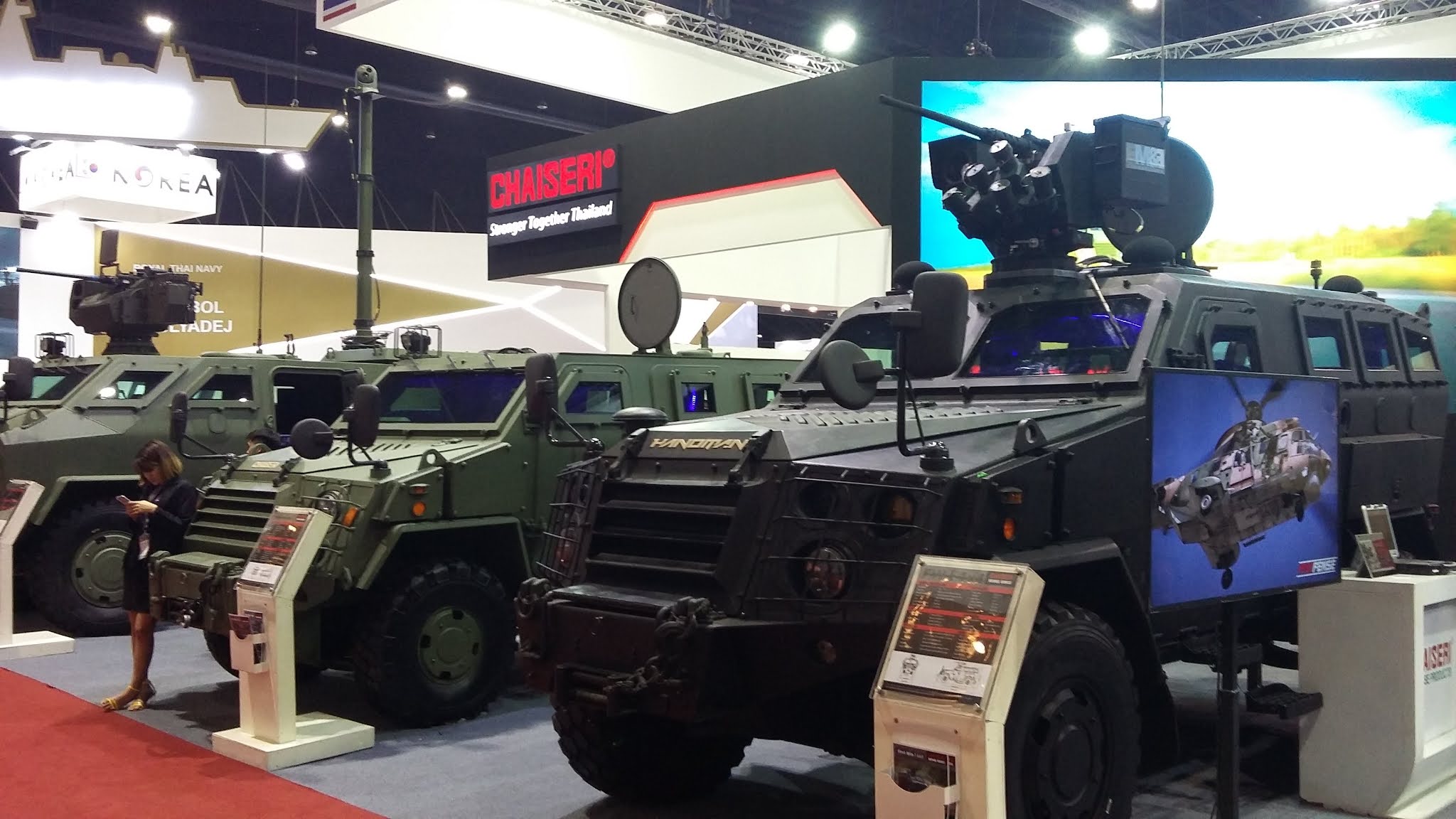
Chaiseri's stand at Defense and Security Thailand 2019 defense expo featuring the First Win family of armored vehicles. Photo credits to Lacroix Defence.


Another company, Panus, is developing the R600 8x8 armored vehicle it intends to market to the Royal Thai Marine Corps and Royal Thai Army, and the Phantom 380X-1 wheeled armored vehicle.

Also, DTI is developing its own armored vehicles including the Black Widow Spider 8x8 armored vehicle which is being pushed for the Royal Thai Army.

Of all the products featured above, the two most prominent that are being actively marketed to the Armed Forces of the Philippines and DND are the Krabi-class OPV from Bangkok Dock-BAE Systems, and the Chaiseri First Win armored vehicles.

MaxDefense Philippines sources from the DND and Philippine Navy did confirm that the Krabi-class OPV is indeed among those being considered for the Offshore Patrol Vessel Project, but at the moment, Australia's Austal OPV is said to be leading the pact due to its confirmed ability to build the vessels at their Balamban, Cebu shipyard.

Even Defense Sec. Delfin Lorenzana, during the commissioning of BRP Antonio Luna (FF-151) last 19 March 2021, confirmed that Austal is currently leading the selection.

The Light Tactical Vehicle Acquisition Project:

Which brings us to Chaiseri.

Chaiseri is said to be among those leading in the selection for the Philippine Army's Light Tactical Vehicle Acquisition Project.

The project, which aims to deliver new 4x4 wheeled armored vehicles with mine resistant ambush protected (MRAP) capabilities, is now being prioritized by the Philippine Army as it already awarded major projects like the Light Tank, Wheeled APC, and Self Propelled Howitzer projects.

Based on the original submission made by the DND to Malacanang, at least 200 vehicles are eyed by the Philippine Army. These vehicles would be used for infantry transport and support, convoy escort, base and facility defense, and fire support on checkpoints and other emergency situations. This would also take out the Philippine Army's wheeled armored personnel carriers assigned for such duties and return them for mechanized missions.

As indicated in the Technical Specifications of the LTV Acquisition Project which was not made available to the public due to the project being acquired through Government-to-Government (G2G) process rather than public bidding, the basic requirements are the following:

* Crew Capacity: 11 crew and dismounts
* Engine: diesel with at least 300ps
* Drive Mode: 4x4 with Automatic Transmission
* Length: maximum of 6,250 meters
* Gross Weight: maximum 14 tons
* Ballistic Protection: STANAG 4569 Level 2
* Mine Protection: STANAG 4569 Level 2
* Main Weapon: 7.62mm GPMG on Manned Turret and RCWS (on some vehicles), option for 12.7mm heavy machine gun.

MaxDefense Philippines won't be posting all other specifics as requested by sources.

Aside from Chaiseri's First Win, MaxDefense Philippines was informed that other competitors for the project are companies from Israel, Turkey, South Korea, Ukraine, India and a few others.


Both the Daeji DAPC-2 Promoter (top) and the Hanwha Barracuda (above) were said to have been offered by South Korea for the Philippine Army's LTV Acquisition Project. Photo credits to Daeji P&I and Hanwha Defense.


But why Chaiseri First Win could be the preferred model?

1. The signing of the Defense Industry MOU is actually a clue on its own. 

So far, the Philippines already have similar agreements with Israel, Turkey and South Korea. Which means that selecting their offered light tactical vehicle / armored vehicle will not require a new agreement to be signed.

And since the Krabi-class OPV is currently not the leading choice for the Philippine Navy's OPV requirement, it doesn't warrant the need for a rightly-timed signing of Defense Industry MOU.

Meanwhile. the timing of the Defense Industry MOU between the Philippines and Thailand appears to be spot on with the planned push to select a winner for the LTV Acquisition Project.

The Chaiseri First Win 2 MRAP. Photo credits to original source.

2. Aside from that, some sources also confirmed that the Philippine Army is indeed interested in the First Win 2 4x4. The local company appointed by Chaiseri Defence to be its representative in the Philippines has been active in promoting the First Win not just to the Philippine Army, but also to the Philippine Marine Corps (PMC) and Philippine National Police Special Action Force (PNP-SAF).

Chaiseri Defense has developed an amphibious-capable version of the First Win, which can be used up to Sea State 2 and can cross rivers and streams without installing additional accessories. This could be a potential product for offer to the Philippine Marines. Photo credits to Thai Armed Force defense page.

3. There was also a previous report from Thailand wherein it was mentioned that the Thai government is nearing a G2G agreement with the Philippines to supply 200 units of First Win 2 wheeled armored vehicles. This obviously pertains to the Philippine Army's requirement which is also at 200 units.

These are the reasons why MaxDefense Philippines believes that the Philippine Army is leaning more on Chaiseri's First Win 2 for their LTV requirements.

But since the Philippine Army's Technical Working Group for the Light Tactical Vehicle Acquisition Project has not finalized their selection, it remains to be seen of Chaiseri's lead could be maintained. As our sources confirmed, other companies are polishing their offers too.

It remains to be seen what model will be finally selected, which MaxDefense Philippines would definitely discuss in a separate blog or in its Facebook page.

Chaiseri Defence in the Philippines:

The Philippine Army's Light Tactical Vehicle Acquisition Project is not the first time Chaiseri Defence has tried to enter the Philippine market.

Back in 2015, it was reported that Chaiseri's First Win 4x4 was selected for a requirement by the Clark International Airport Authority for airport security. This was later cancelled for still unknown reasons. This could have been Chaiseri's first First Win vehicles in left-hand drive variant.

Another attempt was tried, this time with the PNP-SAF as they tendered for a total of 16 vehicles. Chaiseri offered the First Win, which lost to Stoone of David Corporation representing Gaia Automotive of Israel with its Gaia Amir 4x4. The vehicles are currently for delivery as of this writing.

The LTV Acquisition Project of the Philippines is the third attempt by Chaiseri, and now it hopes to win the project, considering this is the biggest of the several attempts made with 200 vehicles up for grabs.


What's Delaying the Project?

With the selection phase ongoing, the next question is the availability of funding. Is money already there for at least the initial requirement of the project?

The Philippine Army's Approved Budget of Contract (ABC) for the project is Php4 billion. 15% of that amount is Php600 million. This is probably the minimum amount the DND should have once it starts awarding the project to the winning manufacturer.

But based on the FY2021 AFP Modernization Fund allocation as submitted by the DND to the Senate last year, no amount has been allocated for the Philippine Army LTV Acquisition Project. This means that, either it would be funded by Unappropriated Funds, or it would only be funded in the following year FY2022.

If the later is the case, then we can't expect an awarding of the project to anyone within the year. Funding allocation is necessary as this would make sure that the Philippine government can afford to buy the armored vehicles.

x x x x x x x 

Until then, we could only watch what happens regarding this project. MaxDefense Philippines will continue monitoring the project, especially since 2021 could be an interesting year for this project as we expect other companies and countries to improve their offers while the DND has not signed a contract with anyone.


Project Summariy

Light Tactical Vehicle Acquisition Project:

Note: Edited as of 20 March 2021.

* End User: Philippine Army (different frontline units)

* Quantity: 200 units


* Modernization Phase:
 Horizon 2 Phase of RAFPMP


* Project ABC:
 Php4,000,000,000.00


* 
Acquisition Mode: Government-to-Government (G2G) deal between Philippine DND and still undetermined country.

* Source of Funding: Multi-Year Contractual Authority for still unspecified number of years, using General Appropriations Act (GAA) from still undetermined year.

* SARO Release/s: 
TBA


* Winning Proponent: TBA


* Product for Delivery: TBA


* Contract Price: TBA


* MaxDefense Searching Hashtag: #PALTVAcquisition 


* Status: Project pre-procurement process ongoing. Officially, the Philippine Army has no decision yet, although MaxDefense Philippines believes that a decision was already made but not announced.

===============
===============
First release: 20 March 2021
Copyright MaxDefense Philippines

Sunday, February 14, 2021

How the Philippine Air Force plans to acquire additional Black Hawk helicopters to replace its ageing Huey fleet

 
The recent announcement made by Malacañang on the approval to acquire 15 new combat utility helicopters based on the Sikorsky Black Hawk helicopter, as well as Defense Sec. Delfin Lorenzana's announcement that 32 helicopters were actually being pushed for acquisition, have been good news for the AFP Modernization Program.

Both announcements were made in relation to the planned retirement of the Bell UH-1 Huey helicopter family of the Philippine Air Force, which has been in service since 1969 and needs to be replaced soon after being involved in several deadly accidents since July 2020.

But questions arise on where the funds would be coming from considering there has been no allocation for additional combat utility helicopters under the FY2021 defense budget, as well as on what the project is really about.

This blog entry discusses the Philippine Air Force's plans to acquire additional Black Hawk combat utility helicopters, including details about the project.

PAF pilots and crew show their approval on the acquisition of S-70i Black Hawk combat utility helicopters. Photo credits to Frances Mangosing.

Dissecting the Plan to Acquire Additional Black Hawk Helicopters:

Prior to the announcement made by Cabinet Sec. Karlo Nograles on Pres. Duterte's approval to acquire 15 new S-70i Black Hawk combat utility helicopters, the Philippine Air Force (PAF) was already in discussion with US defense giant Lockheed Martin on the supply of additional Sikorsky Black Hawk helicopters.

This move was meant to get replacements for the ageing Bell UH-1D/H Huey which have been in service with the PAF since 1969.

A mix fleet of Bell UH-1H and Bell 412EP combat utility helicopters during relief operations in Cagayan province this year. Photo credits to PAF.

It turns out that the US government has already made a proposal to supply more S-70i Black Hawks as early as 2020 when Lockheed Martin became more active in the Philippines due to its other proposals to the PAF including the F-16 Block 70 Viper fighter aircraft and the C-130J Super Hercules tactical transport aircraft, as well as the Sikorsky S-92 medium helicopter for the PAF and Philippine Navy, and S-70i Black Hawk for the Philippine Army.

Defense Sec. Delfin Lorenzana mentioned in an interview lately that Pres. Duterte actually approved 32 additional Black Hawks and that they are planning to sign a contract with Sikorsky this year, although he did not give any timeframe on the plan. It is assumed though that it would happen between 2021 and 2022 since that is the only remaining time the Duterte administration is in power.

32 helicopters also match the information received by MaxDefense Philippines from industry and PAF sources, citing documents from the PAF and Lockheed Martin's official offer.

The question now are, why did Sec. Nograles say that only 15 helicopters were approved for acquisition, when Sec. Lorenzana claims it is actually 32 helicopters? Who has the correct information?

It turns out, both cabinet members were correct. It just happen that Sec. Nograles' info was not complete, while Sec. Lorenzana's information was more general.

Remember during the induction of the first 6 new S-70i Black Hawk combat utility helicopters last December 2020, Sec. Lorenzana mentioned that they have ways to fund another 16 helicopters, which he did not explain how or where it would be coming from.

Defense Sec. Delfin Lorenzana with one of the PAF's new S-70i Black Hawk during their induction last December 2020. Photo credits to Sec. Delfin Lorenzana's Facebook page.

The 15 helicopters Sec. Nograles mentioned in his recent press conference was actually a different batch from what Sec. Lorenzana was saying. Adding them together puts it at around 31-32 new helicopters in total.

Funding Problem - Where is the Money?

We at MaxDefense Philippines have always been watching closely on funding of projects for the Armed Forces of the Philippines.

And based on the approved Fiscal Year 2021 Defense Budget, there is nothing for the acquisition of even a single Combat Utility Helicopter.

So far, no budget for additional Black Hawks or combat utility helicopters for FY 2021 AFP Modernization Program. This version is the publicly-available one, although MaxDefense Philippines has a more detailed copy which we cannot post publicly. 

So where will the money be coming from to acquire the additional Black Hawks?

According to our sources from the DND, the 15 or so helicopters Sec. Nograles mentioned will be funded through the AFP Modernization Program Fund as part of Fiscal Year 2022 GAA allocation. But the DND is looking for ways to make funds available earlier, either through Unprogrammed Fundings or with assistance from Malacañang and DBM.

Meanwhile, the 16 or so helicopters Sec. Lorenzana mentioned back in December 2020 will be coming in from a separate funding source.

The DND was already in advanced stages with its Heavy Lift Helicopter Acquisition Project, which the DND selection already fixed with the Mil Mi-171 Hip, and plans to award the project to the Russian government soon considering the initial funding was already released by the Department of Budget and Management (DBM) back in November 2020. 

But according to our sources from the DND and PAF, the Philippine government has not overcome the problem on Countering America's Adversaries Through Sanctions Act (CAATSA) last year, or even up until this blog entry's writing. And the funds need to be used ASAP or it will be returned to the DBM.

And because of this, the DND is planning to use the funding for the Mil Mi-171 acquisition to fund the acquisition of additional Black Hawk helicopters. It is highly possible that the DND would defer the Heavy Lift Helicopter Acquisition Project until the CAATSA issue especially transferring payment from the Philippines to Russia can be settled by both sides.

The acquisition of Russian-made Mil Mi-171 Hip medium helicopters are said to still have issues regarding CAATSA, especially with regards to funds transfer from the Philippines to Russia. Photo credits to Aviation Times.

In short, the Mil Mi-171 would be probably be sacrificed for now in favour of additional Black Hawks, although Russia might continue deliveries of the helicopters even without the Philippines paying them immediately.

Based on the information we received from several sources, the DND could order less than 10 new Sikorsky S-70i Black Hawk combat utility helicopters through US Foreign Military Sales (US FMS) Program, including all necessary accessories, spares, training and logistics support.

Apparently, Malacañang is keen to find ways to provide funding to increase the total to 16 units by adding more funds taken from other sources.

This is the reason why Defense Sec. Lorenzana was hopeful that a contract may be signed this year.

US Foreign Military Sales:

Contrary to what most defense and mainstream press reported over the last month, the US government was said to have offered US-made Sikorsky S-70i Black Hawk helicopters, not Polish-built S-70i from Sikorsky's subsidiary PZL Mielec.

The American-made S-70i are the basis of the current UH-60M Black Hawk delivered to the US Army, although it does not have the same subsystems installed by the Americans on their UH-60M.

A US Army UH-60M Black Hawk. Photo credits to Defence Blog.

This, as well as being a US FMS program, are the reasons why the current Black Hawk offering to the PAF are more expensive than the 16 S-70i ordered by the DND in 2019, which were made through Direct Commercial Sales (DCS) program.

As discussed previously in MaxDefense articles and social media posts, US FMS are more comprehensive in nature as it is a deal sanctioned and involving the US Department of Defense itself. The US DOD makes sure that the helicopters would be well supported through its life cycle, and would include a compete support package as part of its package.

This increases the unit cost of the helicopters as the Philippines is required to acquire more spare parts than usual, and would also pay for US DOD administrative charges for their involvement in the project.

The current US FMS program offer for the Black Hawk helicopters were confirmed by DND and PAF sources to be a total of 32 helicopters, which is in line with Sec. Lorenzana's statements. We were asked not to mention the total cost of the offer as negotiations are still ongoing.

Why Go for More Expensive US FMS Program?

So if the S-70i Black Hawk helicopters cost more under US FMS Program, why is the DND keen on going to that direction rather than doing another DCS Program with Sikorsky-PZL Mielec?

According to DND and industry sources, Lockheed Martin is open to go through DCS Program with the next batch of Black Hawks, but the DND prefers to go with US FMS Program as the Philippine government's way of political manoeuvring with the new Biden administration.

The US was said to have offered US-made S-70i Black Hawks, similar baseline model to those used by the US Army's latest UH-60M Black Hawks.


It would also be remembered that the US has several FMS Program negotiations with the Philippines involving Lockheed Martin, including the C-130J Super Hercules and F-16 Block 70 Viper aircraft projects.

But in addition, the Polish government has also been lobbying the acquisition of Polish-made S-70i Black Hawks which are said to remain the cheapest option should PAF decide to go with Black Hawks.

Other Helicopters Aside from Sikorsky Black Hawk:

We also received confirmation that aside from Lockheed Martin  - Sikorsky, other companies are still trying to get the Combat Utility Helicopter Acquisition Project.

These include AgustaWestland (Leonardo) and Bell Helicopters.

Just to update, AgustaWestland is now being represented by a different group in the Philippines. Its previous local representative was already replaced by Italy's Leonardo after several failures in its dealings in the Philippines involving the support of the AW109E and AW159 helicopters acquired by the Philippine Air Force and Philippine Navy.

Leonardo promised to provide better sales and aftersales support to the Armed Forces of the Philippines with this move to have Leonardo's Southeast Asian office handle the Philippine market. But it appears that they are not promising to open facilities in the Philippines should the PAF decide to go with the AW139M.

AgustaWestland is said to be offering the AW139M helicopter as an alternative to the S-70i Black Hawk. According to our sources, the AW139M is being offered for less the price of the American-made S-70i Black Hawk, but is a little more expensive than the Polish-made PZL Mielec S-70i.

The AgustaWestland AW139M from Italy's Leonardo. Photo credits to Wikipedia.

The AW139 is also being offered to the PAF to meet its requirement for new "Command and Control" helicopters to replace its fleet of Bell 412HP and 412EP helicopters that are planned for conversion to Combat Utility Helicopters and transferred to the 250th Tactical Helicopter Wing.

Meanwhile, Bell Helicopters is still offering their Bell 412 helicopter, this time using the latest Bell 412EPX variant. 

To avoid the issues surrounding the involvement of the Canadian government like what happened in 2019, Bell Helicopters have offered to either go for US FMS Program as well with the US DOD being the middleman, or involving Subaru of Japan, which is Bell's partner in the development of the Bell 412EPX to meet the Japan Ground Defense Force's requirement under its UH-X program.

The Subaru Bell 412EPX during demonstrations in Singapore. Photo credits to Sebastian Ng through V1 Images.


The Bell 412EPX is said to cost less to procure, and also costs 40% less to operate than the S-70i Black Hawk due to its smaller airframe and smaller engine. The smaller airframe also allows it to be an alternative for missions that do not require larger-sized helicopters like the S-70i. 

Selecting the Bell 412EPX also allows the PAF to have 2 combat utility helicopter models which would allow the PAF to avoid grounding the entire fleet should an accident happen.

The Bell 412EPX which will replace the Bell UH-1J Huey with the JGSDF under the UH-X Program. Photo credits to Andrei Shmatko through Jetphotos.net.

The PAF already uses the Bell 412EP and 412HP, and is planning to consolidate all as Combat Utility Helicopters once the PAF's 250th Presidential Airlift Wing receive new helicopters.

More Helicopters is always Better:

Whatever the decision is, MaxDefense Philippines welcomes plans to replace the UH-1 Huey helicopter as they are really in need of replacement. We hope that the Duterte administration would be serious in hastening the acquisition of new helicopters to allow the PAF to quickly have a replacement for its ageing Hueys.

Personally, MaxDefense Philippines believe that a mix fleet of S-70i Black Hawks and smaller Bell 412EP/EPX would be a better combination as it would allow the PAF to have a mix fleet that could complement its requirements. This is since the PAF already has the Bell 412HP/EP in its fleet, and are not expected to be removed from service anytime soon.

Should a Bell 412 or Sikorsky S-70i get involved in an accident, ground one model would not ground the PAF's entire CUH fleet.

But it would be best if the DND and the Philippine government could have a 1:1 replacement of the UH-1D/H Huey fleet, and even have more helicopters to meet the AFP's total needs for at least 100 available utility & transport helicopters at any given time.

Project Summary:

Combat Utility Helicopter Phase 4 Acquisition Project:

Note: Edited as of 14 February 2021.

* End User: Philippine Air Force (205th Tactical Helicopter Wing)

* Quantity: between 15 to 32 units, depending on funding availability


* Modernization Phase:
 2nd List of Horizon 2 Phase of RAFPMP


* Project ABC:
 TBC, at least Php32 billion


* 
Acquisition Mode: TBC, but US Foreign Military Sales (US FMS) Program is said to be preferred if going with Lockheed Martin.

* Source of Funding: Multi-Year Contractual Authority for still unconfirmed number of years

* SARO Release/s: 
TBC


* Winning Proponent: TBC


* Product for Delivery: assumed to be Sikorsky S-70i Black Hawk but still depends on final decision


* Contract Price: TBA


* First post by MaxDefense: 10 December 2020


* MaxDefense Searching Hashtag: #PAFCUHPhase4Acquisition 


* Status: 
Project still being negotiated between the DND/PAF and Lockheed Martin and the US government. DND hopeful to sign a contract within 2021.

===============
===============
First release: 14 February 2021
Copyright MaxDefense Philippines


Sunday, February 7, 2021

The Philippine Army will have new mine detection and emergency bridging capabilities soon

 
The Philippine Army (PA) is expected to gain a new capability soon as it acquires new assets as part of its modernization program.

Mine Clearing Operations have been part of the Philippine Army's capabilities for decades, but has been limited in terms of  scale, complexity, and scope. It has not been given enough focus due to the limited cases on uses of mines in the Philippines after World War 2.

With the experience in the Battle of Marawi in 2017 against ISIS-inspired terrorists that used IEDs and mines in urban combat operations, the Philippine Army may have realized the importance of having improved battlefield mine clearing capabilities to protect its troops in combat and non-combat / post-combat, and peacetime support operations.

Major emergency bridging capabilities is another non-existent capability within the Philippine Army.

This was also evident during the Battle of Marawi where the Philippine Army was pinned down in crossing a river as terrorist snipers and machine gunners were position near an existing major concrete bridge, when the Philippine Army could have crossed the river somewhere else and create another front.

A WFEL Dry Support Bridge launcher using an Iveco-made platform, with a simplified demonstration unit for the system. Photo credits to original source.

Mine Detection Capabilities:

The intention  to improve mine detection capabilities, as well as emergency bridging capabilities were evident in the acquisition plans the Philippine Army has forwarded for priority implementation under the Horizon 2 phase of the Revised AFP Modernization Program covering years 2018 to 2022.

It was included in the Combat Engineering Equipment Acquisition Project, which includes 2 lots for mine detection capabilities, and 3 lots for bridging capabilities.

1. First is the Lot 7 - Mini Mine Detector (MMD) Acquisition Project which will provide handheld mine detection systems for small scale and space-restrained environments. The project is currently in the procurement phase but has encountered delays. This project has been discussed in our extension's resource page which can be accessed on the link below:

"Combat Engineering Equipment Lot 7 - Mini Mine Detectors Acquisition Project" - first posted at Philippine Defense Resource on 25 October 2019.

2. The second one, which is one of the main topics of this blog entry, is the Lot 6 - Vehicle Mounted Mine Detector (VMMD) Acquisition Project, which intends to bring in a mine detection capability to cover larger areas to protect operators.

Four (4) vehicle systems are planned, including all necessary accessories, integrated logistics support (ILS), and support for the vehicles, 
with a budget of Php138 million. This is very important since the PA does not have experience operating similar or same vehicles or equipment in the past.


According to MaxDefense Philippines sources from the Philippine Army, the Department of National Defense (DND) has awarded the project last month to UK-based Armtrac Ltd under a Philippines - United Kingdom Government-to-Government (G2G) deal supported by the UK's Ministry of Defence.

While no specific model was mentioned by our sources, Armtrac actually has four mine detection vehicles in its product offerings, only different from each other in terms of size and overall capability.

But based on the technical specifications from the DND and Philippine Army, we believe that the closest product to it is the Armtrac 100-350 Mk. 2 vehicle mounted mine detector.

The Armtrac 100-350 Mk.2 (above) is the closest to the specs of the specs of the project provided by PA sources to MaxDefense Philippines. Photo taken from Armtrac's website.


According to the product information of both equipment, the Armtrac 100-350 Mk. 2 is armored and have protected cabins, can be operated manually or via remote controlled system. It uses a Ground Probing Radar (GPR) for search and detection of IED, mines, and bombs. The GPR is used with a robotic arms, and also includes a vegetation cutter.

An example of how the Armtrac 100-350 Mk. 2 is utilized for mine detection using 2 robotic arms. Photo taken from Armtrac's website.

Aside from mine detection, the vehicle can actually be used also for route proving and clearing against mines, IEDs and bombs, and create safe passage ways for combat troops and vehicles. This can be done by installing the system's 3-meter Tiller and Flail header, as well as the Armtrac C-IED mine roller system.


Emergency Bridging Capabilities:

1. For emergency bridging capabilities, one of the projects that was previously discussed in our blogs and social media post was the Lot 1 - Armored Vehicle Launched Bridge (AVLB) Acquisition Project, which was awarded to the Joint Venture of Elbit Systems and IMI Systems Ltd on 26 December 2019. This project has been discussed in our extension's resource page which can be accessed on the link below:

"Combat Engineering Equipment Lot 1 - Armored Vehicle Launched Bridge Acquisition Project" - first posted at Philippine Defense Resource on 24 October 2019.

An example of an AVLB using a Leopard 2 chassis. Photo taken from Defpost.com.

The project aims to provide a quick-deployment steel bridge capable of carrying loads up to Military Load Classification MLC 50 (50 tons) and a span of at least 18 meters long. 

But the product to be delivered by the winning bidder, which is based on the Leonardo DRS-IMI Joint Assault Bridge, would be providing is said to be capable of loads up to MLC 85 (85 tons), which includes main battle tanks and other heavy combat vehicles.

The AVLB would be suitable for rapid crossing of rivers and obstacles due to its short deployment and recovery times.

The Joint Assault Bridge being deployed across a wide trench during demonstrations. Photo taken from Leonardo DSI's website.

2. The second bridging capability equipment being acquired is the Lot 2 - Floating Support Bridge (FSB) Acquisition Project, which is still in procurement phase and has not been awarded yet. The system involves a bridging system that can float over water and can also be used like a raft to cross equipment over wider bodies of water.

These are capable of carrying main battle tanks and other heavy equipment, although its more suitable for calm bodies of water like rivers or lakes.

MaxDefense Philippines believes that the project is being negotiated with the UK Ministry of Defence as it is also planned to be acquired via G2G with the UK government, although there were also indications that DND officials close to the so-called Davao Group composed of close people to Pres. Duterte, are pushing for a Chinese solution which the Philippine Army is said to be against of.

According to sources from the Philippine Army who are involved in the project, the Chinese offering is far cheaper, but is believed to be less robust and have issues regarding longevity and quality.

A Ribbon Bridge, this example from General Dynamics European Land Systems, is an example of a floating support bridge. Photo taken from Contact Air Land Sea's webiste.


3. The third project, which is also one of the main topics of this entry is the Lot 3 - Dry Support Bridge (DSB), a tactical military bridging system that allows for use on longer spans, usually at least 45 meters long, at a very short period of time.

According to MaxDefense Philippines sources from the Philippine Army, the Department of National Defense (DND) has awarded the project last month to UK-based WFEL Ltd. under a Philippines - United Kingdom Government-to-Government (G2G) deal supported by the UK's Ministry of Defence.

Two sets of Dry Support Bridges, complete with the transport trucks, handling systems and all other accessories plus the Integrated Logistics Support (ILS) are part of the deal, which is estimated to be worth Php1.25 billion.

The WFEL Dry Support Bridge is an interesting system, which includes a launching system usually using a 10x10 military truck that builds a gantry that would allow the support and slinging of the bridge to the other end of the river or obstacle. It spans at around 49 meters, has a Military Load Classification of MLC 120 (around 120 tons), and can be completely deployed in less than 90 minutes.

The launching vehicle is being prepared to build the gantry, which is being assembled before expanding. Photo taken from Australian Defence Magazine.

The gantry has been assembled and extended over the obstacle. Once the gantry is extended, it would be deployed to support and sling the bridge. Photo taken from Australian Army's Twitter account.

The bridge components are slinged while supported by the extended gantry. Photo credits to original source.


Status of Projects:

The Vehicle Mounted Mine Detector and Dry Support Bridge Acquisition Projects were said to have the Notice of Award (NOA) released only in early January 2021, and it remains to be seen when the contract would be signed and the Notice to Proceed (NTP) released. But it is expected that partial deliveries would be made by 2022, and full delivery can be done by 2023.

As for the Floating Support Bridge Acquisition Project, we are expecting the procurement process to proceed this year, although it remains to be seen if it would be acquired through public bidding or negotiated procurement / Government-to-Government process.

The Mini Mine Detector Acquisition Project is already in procurement stage, and is expected to restart the bidding process in 2021.

So far, the Armored Vehicle Launched Bridge Acquisition Project is the only Combat Engineering Equipment project that has moved beyond NTP release and contract signing, which was made in 2020. 

Nonetheless, all these new acquisitions would provide the Philippine Army with expanded Combat Engineering capabilities, many of which are capabilities and assets they would be having for the first time.

As proven in several cases, these new assets would not just be helpful to support combat operations, but also provide support during emergencies and natural disasters, and in HADR operations during peacetime.

Project Summaries:

Vehicle-Mounted Mine Detector Acquisition Project:

Note: Edited as of 06 February 2021.

* End User: Philippine Army (Combat Engineering units)

* Quantity: 4 units


* Modernization Phase:
 Horizon 2 Phase of RAFPMP


* Project ABC:
 Php138,000,000.00


* 
Acquisition Mode: Government-to-Government (G2G) deal between Philippine DND and UK Ministry of Defence.

* Source of Funding: Multi-Year Contractual Authority for 3 years, using General Appropriations Act (GAA) from FY2020 to FY2022.

* SARO Release/s: 
TBA


* Winning Proponent: Armtrac Ltd.


* Product for Delivery: assumed to be the Armtrac 100-350 Mk.2 VMMD


* Contract Price: TBA


* First post by MaxDefense: 2019


* MaxDefense Searching Hashtag: #PACEEVMMDAcquisition 


* Status: Project was implemented through G2G with UK government. Armtrac Ltd. received NOA on January 2021, contract and NTP release expected by February or March 2021.

X X X X X X X X X X

Dry Support Bridge Acquisition Project:

Note: Edited as of 06 February 2021.

* End User: Philippine Army (Combat Engineering units)

* Quantity: 2 units


* Modernization Phase:
 Horizon 2 Phase of RAFPMP


* Project ABC:
 Php1,250,000,000.00


* 
Acquisition Mode: Government-to-Government (G2G) deal between Philippine DND and UK Ministry of Defence.

* Source of Funding: Multi-Year Contractual Authority for 3 years, using General Appropriations Act (GAA) from FY2020 to FY2022.

* SARO Release/s: 
TBA


* Winning Proponent: WFEL Ltd.


* Product for Delivery: WFEL Dry Support Bridge


* Contract Price: TBA


* First post by MaxDefense: 2019


* MaxDefense Searching Hashtag: #PACEEDSBAcquisition 


* Status: Project was implemented through G2G with UK government. WFEL Ltd. received NOA on January 2021, contract and NTP release expected by February or March 2021.


===============
===============
First release: 06 February 2021
Copyright MaxDefense Philippines

Wednesday, January 6, 2021

Philippine Navy starts procurement of torpedoes and countermeasures for Jose Rizal-class frigates

 
The Philippine Navy (PN) has finally started the acquisition process of torpedoes and countermeasures that will be for use on the service's new Jose Rizal-class frigates that were introduced starting mid 2020.

This has been highly anticipated, considering the first frigate of the class, the lead ship BRP Jose Rizal (FF-150) has already entered service with the Philippine Navy since June 2020, while the second ship of the class, the Antonio Luna (FF-151) is on its way for delivery in early 2021.

These acquisition would allow the new frigates to gain offensive capabilities against submarines, and defensive capabilities against torpedoes and missiles.

A torpedo launched from a US Navy destroyer. Photo credits to US Navy.

Frigate Equipment:

The Jose Rizal-class frigates are equipped with two triple trainable 324mm lightweight anti-submarine torpedo tubes from UK's SEA. , as well as two C-Guard DL-6T chaff dispensers from Denmark's Terma A/S.


The SEA triple torpedo tubes (top) and C-Guard countermeasures dispenser (above). Photo credits to original sources.

The torpedo tubes are meant as the offensive weapon of the frigate against submarines, with three ready to fire tubes located on each side of the frigate. Western frigate designs usually use the lightweight 324mm torpedoes for surface ships, which work as part of the ship's anti-submarine warfare suite.

Among common examples of torpedoes that can be used in this tube caliber are the Franco-Italian EuroTorp MU90 Impact, the American Mark 54 from Raytheon, the Italian WASS A244S, the British Stingray from BAE Systems, and the Korean K745 Blue Shark from LIGNex1.

Most of these torpedoes have a typical range of less than 15 kilometers, and are guided to their targets with a combination of active and passive acoustic homing systems.

The torpedo tubes found on the BRP Jose Rizal.

Also, the Jose Rizal-class frigates are equipped with  two C-Guard DL-6T chaff dispensers from Denmark's Terma A/S.

The C-Guard was designed to provide coverage against threats like small range gate Radio Frequency (RF) guided missiles, imaging infra-red (IR) seeker missiles, and torpedoes. It utilizes the standard 130mm NATO decoys.

Chaffs were fired from naval ships during an exercise by the Republic of China Navy (ROCN). Photo credits to ABC News.

The decoy launcher is part of a system that includes integration with the ship's combat management system (CMS), which are also interfaced with the ship's radar, electronic support measures (ESM), and other sensors.

Procurement of Torpedoes and Countermeasures:

Currently, these systems are unused due to lack of munitions and countermeasures, respectively. And this is what the Philippine Navy is trying to cover with their Frigate Lot 3 Acquisition Project. 

While the Frigates Lot 1 for the platform, and Lot 2 for the gun and missile ammunitions were procured under the Horizon 1 phase of the Revised AFP Modernization Program, this Lot 3 is actually part of the 2nd List of Horizon 2.

It was among those proposed in the original Php650 billion 2017 Horizon 2 Phase Shopping List, but was among those that were taken out of the finalized Php300 billion Horizon 2 Phase priority list approved in principle by President Rodrigo Duterte in June 2018.

But due to its urgency and the reliance on Multi-Year Contracting Authority (MYCA) procurement process which did not require the full amount of the project to be paid within the year, the Department of National Defense (DND) and the Philippine Navy were able to squeeze this project in as part of its 2nd List.

With a total of Php1,700,000,000.00 as its Approved Budget for Contracting (ABC), the Frigate Lot 3 Acquisition Project was divided into 3 sub-lots: the Lot 3A for Torpedoes with a budget of Php900 million, Lot 3B for Chaffs with a budget of Php350 million, and Lot 3C for Acoustic Decoys with a budget of Php450 million.

Lot 3A for Torpedoes will be acquired through Negotiated Procurement, which MaxDefense believes is with the South Korean Ministry of National Defense (ROK MND). This means that the procurement would be for the K745 Blue Shark torpedoes from LIGNex1, which is the only Korean-made lightweight torpedo model.


The K745 Blue Shark torpedo. Photo credits to LIGNex1 website.


This could be a practical approach for the Philippine Navy, which already has the K745 Blue Shark torpedoes in its inventory, but are actually air-launched variants that arms its AgustaWestland AW159 Wildcat ASW helicopters. These helicopters are to be deployed on the same frigates, which means commonality between the ship and its complementing helicopter's munitions.

MaxDefense PH is still trying to find out what stage of procurement is the Frigate Lot 3A already in, but our sources mentioned that so far, no contract has been signed yet as of this writing.

The PN's AW159 Wildcat are also armed with the air-dropped K745 Blue Shark torpedoes from LIGNex1. Photo credits to original source.

For Lot 3B and Lot 3C, both will be procured through Limited Source Bidding. In fact, the DND already posted the Invitation to Bid and Bid Documents at PhilGEPS Government Procurement Website on December 2020, and at the DND website on January 2021.

This means it still remains to be seen what brand and model of chaffs and acoustic decoys will be used as this would be dependent on the result of the bidding.

A US Navy serviceman loading chaffs on a countermeasures dispenser. Photo credits to US Navy.


MaxDefense is still trying to find out who are the invited bidders for the project, but based on the Supplemental Bid Bulletins released by the DND, South Africa's Rhinemetall Denel Munitions is one of the participants on the Lot 3B tender, while France's Naval Group is also participating on the Lot 3C tender.

We also found that Chemring Group was also invited to the Lot 3B, while unnamed companies from the US, Israel, and UK were also invited aside from Naval Group for Lot 3C.

Naval Group has recently been offering the CANTO acoustic torpedo decoy to regional navies like the Royal Australian Navy, which is compatible with the Terma C-Guard, as shown on the photo below.

The Naval Group's CANTO 130mm torpedo countermeasures as fitted on a Terma C-Guard decoy launcher. Photo credits to Naval Group.

Bid submission deadline for the Lot 3B Chaffs tender will be on 12 January 2021, while the Lot 3C Acoustic Decoy will be on 16 February 2021.

Due to the project being a limited source bidding, tender documents are only provided to invited tenderers, so it is expected that it won't be made available to the public. So far, the PhilGEPS and DND websites has not posted the Bid Documents that includes the technical requirements and specifications.

But what we know so far on the Chaffs and Acoustic Decoys is that they are suppose to fit into the Terma C-Guard's mortar launcher which is around 130mm diameter, standard NATO size. 

For now, all we can do is wait for the tender results, and see which company will win so we can try to find out what will potentially be ordered for the Philippine Navy.

Project Summaries:

Frigate Lot 3A - Torpedo Acquisition Project:

Note: Edited as of 06 January 2021.

* End User: Philippine Navy (Offshore Combat Force)

* Quantity: classified


* Modernization Phase:
 2nd List of Horizon 2 Phase of RAFPMP


* Project ABC:
 Php900,000,000.00


* 
Acquisition Mode: Government-to-Government deal with South Korean Ministry of National Defense.

* Source of Funding: GAA Funds through AFP Modernization Program Trust Fund


* SARO Release/s: 
TBA


* Winning Proponent: LIGNex1 (South Korea) (not yet awarded)


* Product for Delivery: TBA


* Contract Price: TBA


* First post by MaxDefense: 31 December 2020


* MaxDefense Searching Hashtag: #PNFrigateLot3ATorpedoAcquisition 


* Status: Project is being undertaken through G2G with South Korean MND. Product of interest is K745 Blue Shark lightweight torpedo from LIGNex1. No contract has been signed although it is expected to be done before mid 2021.

X X X X X X X X X X

Frigate Lot 3B - Chaff Acquisition Project:

Note: Edited as of 06 January 2021.

* End User: Philippine Navy (Offshore Combat Force)

* Quantity: classified


* Modernization Phase:
 2nd List of Horizon 2 Phase of RAFPMP


* Project ABC:
 Php350,000,000.00


* 
Acquisition Mode: Limited Source Bidding

* Source of Funding: GAA Funds through AFP Modernization Program Trust Fund


* SARO Release/s: 
TBA


* Winning Proponent: TBA


* Product for Delivery: TBA


* Contract Price: TBA


* First post by MaxDefense: 31 December 2020


* MaxDefense Searching Hashtag: #PNFrigateLot3BChaffAcquisition 


* Status: Project is being undertaken through Limited Source Bidding. Bid submission and opening scheduled on 12 January 2021.

X X X X X X X X X X

Frigate Lot 3C - Acoustic Decoy Acquisition Project:

Note: Edited as of 06 January 2021.

* End User: Philippine Navy (Offshore Combat Force)

* Quantity: classified


* Modernization Phase:
 2nd List of Horizon 2 Phase of RAFPMP


* Project ABC:
 Php450,000,000.00


* 
Acquisition Mode: Limited Source Bidding

* Source of Funding: GAA Funds through AFP Modernization Program Trust Fund


* SARO Release/s: 
TBA


* Winning Proponent: TBA


* Product for Delivery: TBA


* Contract Price: TBA


* First post by MaxDefense: 31 December 2020


* MaxDefense Searching Hashtag: #PNFrigateLot3CAcousticDecoyAcquisition 


* Status: Project is being undertaken through Limited Source Bidding. Bid submission and opening scheduled on 16 February 2021 after requested to be moved by Naval Group.

===============
===============
First release: 06 January 2021
Copyright MaxDefense Philippines


Philippine Navy Modernization Projects

Philippine Air Force Modernization Projects