Your 1st for Philippine Defense

Austal leads Philippine Navy's OPV Acquisition Project!

SecDef Lorenzana confirms Austal is still the preferred OPV supplier for the PN

The Philippine Navy commissions its 2nd Jose Rizal-class frigate!

The Philippine Navy welcomes BRP Antonio Luna (FF-151), its newest frigate!

The Philippine Navy selects Shaldag Mk. V for Fast Attack Interdiction Craft!

The DND has awarded the FAIC-M Acquisition Project to Israel Shipyards

The Philippine Air Force wants more Black Hawk helicopters!

The Philippine Air Force asks for more Black Hawks to allow the retirement of their Bell UH-1 Huey fleet

The Philippine Army orders the Sabrah Light Tank System from Israel!

Israel's Elbit Systems was declared the winner to supply light tanks to the PA

The Philippine Air Force receives full order of Hermes 900 and Hermes 450 UAVs!

All 9 Hermes 900 and 4 Hermes 450 MALE UAVs have been received by the PAF!


Wednesday, June 5, 2013

Delayed Purchase of 21 used UH-1 Hueys - A Glimpse of Slow AFP Modernization?

The Philippine Department of National Defense (DND) has, for the second time, failed in its bid to deliver 21 used Bell UH-1 Iroquois (more popularly known as the "Huey") for the Philippine Air Force (PAF). After DND found Rice Aviation Services, Inc. as eligible to submit an offer on the second bidding, the deal fell through as Rice Aviation reportedly failed to satisfy some financial requirements. This now gives the DND a free hand to do a negotiated procurement with suppliers.


UH-1 Hueys at Rice Aviation's facility in the US. 2 units on the left side already have PAF nose markings.
Photo taken from Rice Aviation website.
This UH-1 purchase project is actually considered as a "piecemeal" compared to the other projects of the DND like the Surface Attack Aircraft / Lead-in Fighter Trainer (SAA/LIFT), (Light) Frigate, Multi-Role Vessel (MRV), Strategic Sealift Vessel (SSV), Medium Lift Aircraft, Maritime Patrol Aircraft (MPA), etc. But with the earliest possible delivery date now pushed to the the 3rd quarter of 2013 instead of the original plan to have them before the 2013 Mid-Term Elections, there are now questions raised on the capability of the Philippine government and the DND to push through with this program and with the AFP Short-Term Modernization Program (2013-2016) as a whole.

So why is the project taking too long to complete? We are not yet talking about delivery here. The program is still in the stage of choosing who will supply the aircraft. Getting the supplier alone already took two years.


PROGRAM OVERVIEW:

A separate project from the Combat Utility Helicopter (CUH) wherein the AgustaWestland-PZL W-3A Sokol won, the PAF has requested for 21 units of Bell UH-1 Huey helicopters specifically 13 UH-1 standard models, and 8 UH-1 upgraded models including an Integrated Logistics Support (ILS) package. The DND initiated a public bidding in late 2012 with a budget of Php 1,264,977,615.52. A delivery of 45 days after opening the letter of credit.


PAF's W-3A Sokol. A separate project but was intended to fulfill the same requirement.

There has been a continuous requirement for more UH-1 for several years now, but this specific requirement was raised by the PAF on 2011. The PAF tried to acquire the used helicopters from US and foreign stocks, with DND and PAF officials inspected several UH-1H air frames and spare parts for possible use as flying or non-flying air assets and parts hulk. Such inspection was raised in a Philippine defense forum in 2012, showing DND personnel inspecting UH-1H air frames and parts from a Bell-approved facility in Washington, USA. So far no further news came out until the decision of DND to initiate a public bidding for the requirement.


UH-1H airframes taken during an inspection sortie by DND and PAF officials  on a Bell-approved facility in the US on January 2012.
Photo taken from Timawa.net c/o Adroth.

So, is it indeed a glimpse of how slow the AFP modernization is and will become? Actually yes. 

To be fair to the DND, MaxDefense believe that they are trying their best to thread the rightful path of stamping out corruption in their procurement system, which in my point of view and even from MaxDefense sources, has indeed improved compared to the previous administrations. The DND decided to go for public bidding instead of a government-to-government (G2G) transaction as a step to comply with the government's drive against graft and corruption.

But how about the pressing needs of the armed forces for their needed materiel? 

According to MaxDefense sources, financing is not a problem for this specific project. But the process of procurement itself is too slow because of too much politicizing in the formulation of plans and choosing of suppliers, indecisiveness in the decision making within the DND and even the AFP, red tape, and reportedly "fear of failing to comply on graft-free procurement processes". But with the PAF needing the helicopters too badly, the DND must make extra efforts to speed-up the process of choosing a supplier and finalizing the contract. The ball is currently with the DND on this project. 


PAF Hueys preparing for a send-off at Villamor Air Base.

A "small" project like this taking too much delay is a proof that modernizing the AFP is really difficult and will take too much time. Although not all projects are the same, it would not stop the public from doubting the DND and the Aquino administration as a whole especially in this period when threats from China and other neighboring countries is becoming more pressing.


MaxDefense Opinion:

Since the DND has already opted to go for a negotiated deal, MaxDefense' opinion is to continue with the plan,but the DND and the AFP must make quick but firm decisions to avoid hold-ups. The DND and AFP already knows that indecisive action only delays their programs, and affects the Aquino administration's plans and promises to provide the necessary arms to the AFP immediately. Thus, DND should adjust and improve on these deficiencies. If the Aquino administration is serious in its thrust to immediately modernize its armed forces, President Aquino himself must look into the political interference in the whole purchasing and bidding process.

In addition, since the DND and PAF already know that they require more assets, they should already be preparing another program to fulfill the transport capability of the PAF. MaxDefense believes that the DND should secure more cheap and available UH-1H from the US and its other security allies, both flying and non flying air frames as well as spare parts. It is still the fastest and cheapest alternative to have more flying assets. Simultaneously, the DND and PAF should already formulate and start a program to purchase new assets to replace the UH-1H and other ageing air assets for a medium to longer goal. The CUH program should be re-started and extended, and the program re-started as early as possible.

Are the news true that the PAF only have 16 mission-capable Hueys? Actually no. There are more, very far from 16 birds, but that will be discussed later on.

Tuesday, June 4, 2013

The Everchanging Plans for Acquisition of Amphibious Transport Vessels for the PN

Recently a news report came out quoting an unnamed DND official on the procurement of 2 Service Support Vessels (SSV), which was described as "mission capable ship" and "smaller than the MRV (multi-role vessel, a.k.a. Landing Platform Dock), and is worth around P2 billion.

Before we attempt to discuss this new program, MaxDefense would like to go back in time.

Previous attempts by the Philippine Navy to purchase replacements or complements for its old and mostly World War 2-era amphibious vessels date back before the Ramos-era AFP Modernization Program. Most have not been implemented, except for a few new assets.

From 1991, the Philippine Navy planned to have at least 8 units of Logistics Support Vessels (LSV), of which 2 units were bought from the US government and were delivered between 1993 and 1994. The US-made LSV were based on a helicopter-capable design of the US Army's Frank Beeson-class, known in the Philippine Navy as the Bacolod City-class. These were envisioned to replace and complement the ex-USN Landing Ship Tank (LST) and decommissioned Landing Ship-Medium (LSM) that were decimated in the PN's fleet due to obsolescence and lack of funding to support maintenance and operation. Besides the first 2 units, no additional units were ordered.

The 1995 AFP Modernization Act included a requirement for 4 amphibious transport vessels, although it did not specify which type it plans to acquire. But it was very much possible to still be  US-made LSVs similar to the Bacolod City-class or an LST design. Between 1995 and 2010, no new amphibious transport vessel was purchased or inducted to the PN.

The plans to purchase Multi-Role Vessels (MRV) actually started in 2005, when the PN's delegation at IMDEX Asia 2005 in Singapore visited and reportedly "evaluated" a Singapore Navy (RSN) Endurance-class landing ship tank/LPD for possible acquisition. *Initially the price quoted to the DND and PN was within the budget, but it appears that the unit price of the Endurance-class increased afterwards, even in the less-automated version. The DND and PN's slow action to push for the program's success was overtaken by commercial and costs issues that ultimately stopped the deal from progressing further .*


RSS Persistence, an Endurance-class LST/LPD. Was the first chance of the PN to obtain a modern LPD.
Photo taken from Wikimedia Commons c/o jimmyweeee

After the failed attempt at the Singaporean Endurance-class, the DND and PN looked for a cheaper alternative, and found an answer from South Korea's Daesun Shipbuilding and Indonesia's PT PAL, with the Makassar-class LPD or its derivative. The Makassar-class was built by Daesun for the Indonesian Navy (TNI-AL) following civilian specifications. Some of the ships of the class were built by Indonesia's PT PAL under a technology transfer agreement. 

Initially, the PN aired its desire to obtain at least two units, with each ship costing around Php 5 billion. Negotiations for the deal included a possible financing by the South Korean government as part of a loan package for military equipment (which the Philippine government did not opt to use), freezing the price against escalations to avoid the same mistake as the Endurance-class project, and bundling each ship with an appropriate number of support crafts and vehicles including the Samsung Techwin KAAV7 (a Korean licensed-built AAV7) and a mobile hospital.

As late as 2010 on the closing days of the Arroyo administration, the PN was reportedly close to completing the deal for at least 1 unit for Php 5 billion. This was the closest attempt by the PN to have its first ever new large amphibious vessel, but this was later cancelled by the current Aquino administration citing re-evaluation for possible contract-detail issues, specifically on suspicion of graft and corruption. 

The PN's MRV plan based on the Makassar-class, packaged with several support craft and vehicles.
Photo taken from Timawa.net forum c/o Adroth


The Makassar-class is still reportedly being considered for the MRV project, either made by Indonesia's PT PAL or by South Korea's Daesun Shipbuilding.

An Indonesian Navy (TNI-AL) Makassar-class LPD

Reports also came out that the PN was interested in the Spanish Galicia-class, and even the expensive and advanced San Antonio-class LPD from the US. Spain's Navantia also confirmed that the PN was indeed offered the Athlas-class LPD family, which the Galicia was based.

Navantia's Athlas LPD 8000
Photo taken from Navantia website.

In 2009, another transport vessel program was brought up for the PN which was called the Strategic Sealift Vessel (SSV), which is a proposal to purchase a used Roll-on, Roll-off (Ro-Ro) ferry from Japan, and its purchase will be supported by DBP Maritime Leasing Corporation Inc. (DMLC), a subsidiary of Development Bank of the Philippines, more widely known as DBP. 

The original SSV is a typical Ro-Ro ferry built to commercial Ro-Ro standards, with no helicopter deck or helicopter facilities, no heavy weapon mounts (although machine gun mounts can be added by the PN), and cannot conduct amphibious operations. In short, it is just a sealift vessel to transport vehicles and men between developed ports or piers.


A typical Japanese-made Ro-Ro. The original SSV project was to purchase a similar ship.
Photo taken from MarineTraffic.com

Although the request for budget was submitted to the Philippine Congress, delays mounted and this program fizzled after budget allocation was not provided immediately. The specific ship offered to the government was sold to another buyer.

Afterwards, the PN and DND decided to change the technical specifications of the SSV project, moving away from the civilian Ro-Ro type ferry to a small MRV-looking ship, and although still built according to civilian specifications, it would be built according to the navy's requirement, is better armed and more capable than the earlier proposal.


PT PAL's proposed SSV based on reduced Makassar-class

Indonesia's PT PAL came out with a scale model and specifications of a Strategic Sealift Vessel which it claimed was offered to the PN, and appears to be smaller and shorter than the original Makassar-class based MRV they offered earlier.


PT PAL's specifications for their SSV offer.

It was later reported that the PN was indeed looking into purchasing SSVs, with offers from Japan, Singapore, South Korea, France and Italy, and admittedly smaller than the MRV but is also priced less with a budget of only Php 2 billion each or less than half of that the original MRV. MaxDefense sources have so far only confirmed three of the said offers: Singapore ST Engineering's Endurance 120 series of multi-role vessel; Indonesia PT PAL's SSV-LPD which is a smaller derivative of the Makassar-class; and a special model from Spain's Navantia which is based on Athlas LPD 8000 but is much simpler and smaller.


ST Engineering's Endurance 120 series.
Photo taken from ST Engineering's product brochure.

Although not a real replacement for the old PN LST, another amphibious vessel program was brought out and was successfully completed, the Landing Craft Utility (LCU) program, which is a smaller class than the SSV and MRV. The project was completed as the BRP Tagbanua (AT-296) and the "mysterious" BRP Manobo (BU-297) (to be discussed separately). These are small vessel programs and are not intended to replace the LSTs, but rather fill-in a different requirement.


The BRP Tagbanua (AT-296), the result of the PN LCU project.
Photo taken from Wikimedia

So why did the PN abandoned the MRV program, and instead replaced it with the SSV program?

It appears that the reason for the change of heart by the navy is, again, budgetary issues.

MaxDefense sources indicate that the PN is not really abandoning the MRV program, but will not be pursued for now due to budgetary issues. The budget is available, but is not enough to pursue at least 2 units of the MRV. Operation tempo and availability was considered in opting to have at least 2 units, which actually makes sense to make sure that there is a ship available at any given time.

As of 2012, the DND and PN have already allocated Php 5 billion for the purchase of a single MRV, and was expecting another Php 5 billion for a second unit as it find the need for at least 2 units to complement each other. But with the PN now actively pursuing new surface combatants that can fight opposing forces (OPFOR) warships and patrol the Philippines' EEZ and territorial waters, the second Php 5 billion originally planned to be allocated for another MRV was diverted to fulfill such plans. The second Php 5 billion was instead allocated to the new frigate program. Also, there is no allocated budget for another MRV from the recently approved 2012-2016 Php 75 billion AFP Modernization short term budget, although the government (specifically the President) can provide special allocation to revive the MRV project if necessary.

With only budget for one MRV, the PN decided that it would make use of the allocated Php 5 billion budget to still pursue two ships, thus moving to the cheaper SSV. As the SSV is just a tad smaller and less capable than the MRV, only a few of the original requirements of the PN might be lost, but most of the major functions of the MRV can still be done by the SSV.

Also, the PN will be actively pursuing the construction of more LCUs similar to the already commissioned BRP Tagbanua to fulfill smaller transport requirements. The PN already released a study based on the Desired Force Mix, and it includes the requirement for around 18 LCUs. 

MaxDefense sources have also confirmed the possible purchase of more LSVs similar to the Bacolod City-class in PN service, or new Landing Ships - Tank (LST) from a still undisclosed country, possibly South Korea, giving the PN several options for transport duties should the MRV project fail. These LSVs and LSTs are far cheaper than even the SSV, although are less capable but can still do its job of transporting troops and vehicles. This will all be dependent on the capacity of the government to allocate funds for the PN.


The PN's Bacolod City-class LSV. More can be obtained due to its cheaper cost should budget be a problem for the MRV or even the SSV.
Photo taken from Wikimedia

With the transport capability of the PN depleting rapidly as the old LSTs are getting harder to maintain and becoming less capable, getting new transport and amphibious assault ships is equally as important in getting new fighting ships. Whatever the choices are, the PN will be able to replace its old assets and improve its transport capability in the next few years.


Thursday, May 23, 2013

Taiwan Conducts Naval Exercises - A Direct Provocation to the Philippines?

After a shooting incident just off the northern islands of the Philippines between a Philippine Coast Guard (PCG) crewed but Bureau of Fisheries and Aquatic Resources (BFAR) owned patrol boat and 4 Taiwanese fishing boats, tensions have risen between the 2 countries. Taiwan has been noted in an earlier blog here at MaxDefense (MD) to have shown over-reaction by both in its citizenry, media and the government under President Ma Ying-jeou in its actions against the Philippines.

After imposing massive amounts of economic and cooperative sanctions, the Taiwanese government also approved the conducting of military exercises by their navy and air forces just off the Batanes Island's waters in the Bashi Channel. According to the Taiwanese government, this is a show of their strength and resolve to protect their fishermen. At the same time Taiwanese hawks see this as a showoff to the Philippine government that they can crush the relatively weaker and "chihuahua" Philippine Navy and Philippine Air Force.

In response, Philippine president Aquino did not yield to Taiwan's show of strength, and instead let the Taiwanese have their exercises without interference or presence of nearby Philippine naval assets.

ROCS Ma Kong (DDG-1805) shows off its RIM-66 Standard  AAM
(photo taken from Associated Press)

According to most news sources, the Republic of China Navy (ROCN) aka Taiwanese Navy deployed ROCS Ma Kong (DDG-1805), a Kidd-class destroyer (known as Kee Lung-class in Taiwan service), and the ROCS Chen De (FFG-1208), a Kang Ding-class frigate (modified Lafayette-class from France) together with their respective ship-borne helicopters, and 2 missile boats. The Coast Guard Administration deployed 4 patrol vessels, while the Republic of China Air Force (ROCAF) aka Taiwanese Air Force deployed a mix of Mirage 2000 and Ching Kuo F-CK-1 fighters, plus an E-2K Hawkeye airborne early warning aircraft.

An S-70C Seahawk helicopter taking-off from a Lafayette-class frigate  during the exercises  on May 16, 2013.
(photo taken from Associated Press)

This military exercises, according to the Taiwanese Navy, was meant to assist the CGA in protecting Taiwanese fishermen. But to do this they sent their most capable warships assisted by scores of ROCAF fighter and surveillance assets. Was it really necessary to send these military assets for a fishermen protection exercise?


ROCAF Mirage 2000-5. One reportedly crashed in another exercises last week.

It appears that the exercise includes scenarios on detection of enemy air and naval forces, as well as search and rescue scenarios. But was it really their intended exercise scope?

MaxDefense sources say that the Taiwanese military was not really able to carry out its original intentions for the military exercises, which is to use live ammunition in a simulated attack on hostile enemy naval forces by joint naval and air assets. This is because of "strong external pressure" from a "common ally" not to do so, or face sanctions against their already struggling military ammunition support and equipment spare parts and supply line. Although no external pressure was applied, the Aquino administration also received "friendly advices" to avoid biting on any provocation from Taiwan in exchange for further support in strengthening the armed forces during President Aquino's remaining 3-year term.


ROCS Ma Kong crew using fire fighting hoses as part of the naval drills
(photo taken from Reuters)
Later on Taiwan would declare that it did not use live ammunition in the entire exercises as not to provoke the Philippines. It only means that if not for such external pressure, it will indeed provoke the Philippines.

Covering such attempted actions will be useless as it only shows that Taiwan does want to have to take military action against the Philippines, and it appears the Philippine government knows of the sudden change of plans by Taiwan. And these changes does and will not remove any doubt on the Taiwanese government's intentions, instead placing Taiwan as a perceived threat in any Philippine military and even economic planning in the future.


MaxDefense' opinion is that Taiwan was again over-reacting by making such provocations that further degrade the relationship between them and the Philippines. The Aquino administration's timidness on this issue is already a sign that the Philippines is not willing to make this issue more complicated that it already is but Taiwan's signals shows that Taiwan had its advantage in moral ground thrown down the gutter for its national gains without consideration of its implications to the friendly relations with a very supportive and a co-democratic neighbor.


Philippine Navy assets are aging but plans are underway for new ships to replace them.

Although militarily and economically weak, neighbors like Taiwan tend to forget that such actions against the Philippines will only push it further to strengthen itself, with a negative effect to Taiwan defense planners. Instead of counting on the Philippine military as an ally against a growing threat of communist Chinese aggression, now they need to consider their formerly friendly neighbor as a threat, to the joy of the Chinese communist government. With the expected rise of the Philippine economy and increases in yearly defense budget, one can only ask what the "puny and weak" Philippine military might be several years from now.


Whether all actions made by Taiwan up to now are because of selfish personal gains of Taiwanese president Ma or not, it would not matter anymore as President Ma's actions are officially Taiwan's actions.

Wednesday, May 22, 2013

Indonesian Armed Forces Exercise LATGAB 2013 Part 1: Marines Embark!

The Indonesian Armed Forces (TNI) is currently conducting a massive inter-services exercise dubbed LATGAB 2013, involving all the armed services. This started on April 15 and will end on May 29, 2013.

Due to the quantity of photos available, I will be dividing this thread into several parts, with this as Part 1: The Marines Embark their Landing Transports

Below are a collection of photos collated from different sources. Special mention to Ms. Audrey (aka onlyaudrey@timawa.net / Audreydefence @ milnuts / audryliahepburn@kaskus)


Korps Marinir (Indonesian Marine Corps) troops disembarking their troop carrier lorries
(photos taken from onlyaudrey@timawa)


KAAV7 on display prior to ship embarkment 
(photos taken from onlyaudrey@timawa)


BTR-50s parked beside KAAV-7s
(photos taken from onlyaudrey@timawa)
BMP-3 also getting ready for ship embarkment
(photos taken from onlyaudrey@timawa)


Korps Marinir troops awaiting their turn to embark
(photos taken from onlyaudrey@timawa)

Korps Marinir and TNI Special Forces start to board KRI Makassar (590) and KRI Surabaya (591)
(photos taken from onlyaudrey@timawa)


KAAV-7s, BTR-50s, and BMP-3s roll and embark on TNI-AL landing platform docks
(photos taken from onlyaudrey@timawa)

more photos on next posts...

Friday, May 17, 2013

Singapore Navy Open House 2013 - an open event to the public

The Republic of Singapore Navy (RSN) will have its Open House this weekend, May 18 & 19, 2013 at Changi Naval Base. Admission is free, and shuttle bus service to the naval base is available at the Singapore Expo Hall 3


According to the Ministry of Defence Website, the RSN will open several of their ships to public, which includes tours inside and on deck. There will also be a demonstration by Navy Commandos with a theme "Storm & Rescue", and some tour around the base waters using the LARC-V and Fast Craft Utility.

For more information about this event, you may check this website:

For those in Singapore on these dates, MaxDefense advices the blog readers to attend this event, as this showcases the navy's importance in the security, defense and development of a country. Get to know what the navy does to protect the interests and territory of a country.


Tuesday, May 14, 2013

Fishingboat Shooting Incident: Is Taiwan Over-reacting?

Since the shooting incident involving a Taiwanese fishing boat and a Philippine law enforcement boat, Taiwan has been in a rage to "bring justice" to the death of one of its fisherman. In the meantime, everything seems normal on the Philippine side, elections has just been concluded and all politicians are more concerned on the vote counting and winning than anything else.

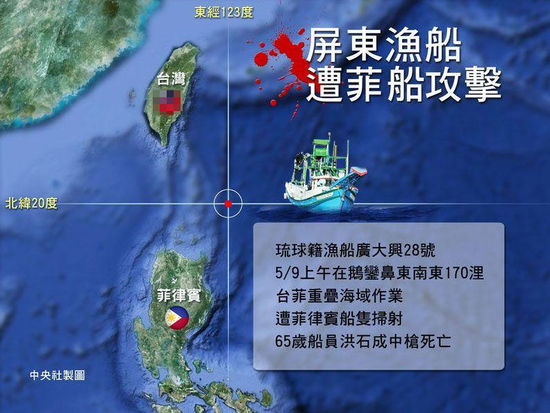
The Taiwanese fishing boat Guang Ta Hsin 28

BFAR patrol boat MCS-3001, jointly manned by PCG & BFAR crew

The Taiwanese are insisting that the Philippines do three things, as follows:
1. make a public formal apology for the "murder" of their fisherman;
2. speed-up of investigations and punishment for the perpetrators;
3. pay compensation to the family of the dead fisherman.

Other than that, they also demand the Philippines to enter into talks with Taiwan regarding fishing rights on overlapping EEZs.

So far the Philippine response as of writing this are:
1. they sympathize with the fisherman's death, but no apology is required;
2. Taiwan should not make matters worse;

Taiwan's 72-hour ultimatum ends this midnight, and if their demands are not met, they will will freeze hiring of Filipino workers and use their economic superiority against the Philippines. 

1. Setting the EEZ Boundaries

According to Searoundus.org, blue color shows Taiwan's EEZ. The green color shows disputed EEZ. The incident happened outside Taiwan's EEZ if based on this photo.

It should be noted that since Taiwan is not recognized as an independent country by the United Nations, they are not a signatory of the UNCLOS although the Philippines adheres to this international agreement as a UN signatory.


Following the laws on EEZ, the overlap of two country's EEZ will require both countries to agree on the boundary. So far it appears that both countries have not made any agreement on the boundary of their EEZ, so Taiwan insists that the waters of overlapping EEZ are disputed.

But most sources on EEZ show that the accepted boundary of both country's EEZ is somewhere mid-way of the overlap, or midway of Orchid Island (Taiwan) and Mavudis Island (Philippines). Basing on this, the general EEZ boundary should be within the middle of Bashi Channel.


2. Location of Incident:

The Taiwanese boat crew insist that they did not enter Philippine jurisdiction area, while the Philippine Coast Guard (PCG) - Bureau of Fisheries and Aquatic Resources (BFAR) joint crew insist that they were inside their jurisdiction. 

Philippines' Bureau of Fisheries and Aquatic Resources (BFAR) Director Asis Perez points at the monitor the exact location where Philippine Coast Guard (PCG) intercepted 4 Taiwanese fishing vessels at 43 NM east of Balintang Island, Luzon Strait, during a news conference in Manila May 10, 2013.
(caption and photo from Reuters)

On the Philippine side, the BFAR reported that 4 Taiwanese fishing boats were intercepted by BFAR boat 43nmi east of Balintan Island, well within the Philippine side of the EEZ boundary. Philippine news reports all point to 170nmi from Taiwan southernmost point.

An illustration with Chinese caption from News365 (China)
(photo posted by McKoyzz@PDFF)
Taiwanese and Chinese sources agree that the boats were operating between 164nmi to 180nmi from Taiwan's southmost tip at Erluanbi. A recent report from Taiwan's Coast Guard Administration (CGA) also points the incident to be outside Taiwan's "control border". Below is the said report, from http://www.cga.gov.tw/GipOpen/wSite/public/Attachment/f1368153033684.pdf


(Translation in English):

Boat Operation:
Time: 05.00
Coordinate: 19' 50" N; 123' 24" E
10 nm outside Taiwan control border

Incident:
Time: 09.45
Coordinate: 19' 58" N; 122' 58" E
1.8 nm outside Taiwan control border


Incident Reported to Taiwan Authority:
Time: 13.04
Coordinate: 20' 07" N; 123' 01" E
5 nm insider Taiwan control border

Take note that according to Taiwan's CGA, the Taiwanese control border is close to the northern-most island of Batanes group of islands rather than further north in the middle of the Bashi Channel. 
-----------

Foreign news sources like BBC reported the location as 170nmi from Taiwan, similar to most Philippine sources.

An illustration from AFP shows the incident happened at the Balintang Channel, or inside Philippine EEZ.
Judging from these compilation from Philippine, Taiwanese and 3rd country sources, it is generally accepted that the Taiwanese boats were indeed discovered well inside Philippine jurisdiction. 


3. The Shooting Incident

Using a combination of Taiwan's CGA report and Philippine Coast Guard sources, it appears that 4 Taiwanese fishing boats were spotted by BFAR patrol boat MCS-3001 on May 9, 2013 at around 5:00AM. The boats were hailed and approached by MCS-3001 for boarding and inspection. But instead of stopping to be boarded, all 4 boats moved away towards Taiwan's direction. 

A chase ensued for more than 4 hours, with the BFAR-PCG boat giving warnings to stop using alarms or sirens, and loudspeaker annoucements. The Philippine boat made several attempts to board one of the boats but while doing so other fishing boats attempt to ram the Philippine boat. They were able to avoid collision in all those instances. This chase went on until around 9:30AM when the BFAR-PCG boat made warning shots for them to stop, but the 4 fishing boats did not heed the warning and instead continue to move away.

Around 9:40AM, the Philippine boat decided to disable the machinery of one of the fishing boats, the Guang Ta Hsin 28, by shooting at its engine and machinery room. Several shots were made using its on-board machine gun, hitting the fishing boat in several areas. One of the bullets hit the neck of 65-year old Mr. Huang Shih-Cheng who was staying in the engine room of the fishing boat, killing him in the process.

The boats continued to press on until Taiwanese CGA vessels met them to escort back to Taiwan. During the entire chase, Taiwan CGA was already informed that they were being chased by Philippine law enforcement boat.


According to the son of the dead fisherman, they did not cross waters of Philippine jurisdiction, and that no warning shots were made by the Philippine group.


4. Taiwanese and Philippine Government Actions:

Taiwanese and Chinese media were quick to release news reports on the incident, initially accusing the Philippine Navy, while the Philippine side initially used these reports while awaiting for confirmation from the Philippine Government. The Philippine Navy later denied being involved, later on the Philippine Coast Guard admitted that they did indeed shot the Taiwanese fishing boat.

Taiwan later on released a 72-hour ultimatum demanding for a Philippine apology and action against the PCG-BFAR crew of MCS-3001, which ends at 12:00 midnight today. Philippine officials said they sympathize the death of Mr. Huang but no apology is expected to be given. President Aquino asked the Taiwanese government to calm on the incident while investigations are ongoing. 

With the deadline of the ultimatum nearing, the Philippine government announced that they are looking for possible alternative markets for Philippine labor in case of a clampdown in Taiwan. Taiwan announced to hold military exercises at the "overlapping" EEZ as a show of strength, with strong words indicating that the Philippine Navy is more than a match for their naval capability.

There are no major reactions from other countries, with their common ally, the United States, not making any condemnation remarks against the Philippines.

By around 3:00PM of May 14, the Philippine government imposed a news blackout regarding the issue. There were also reports from Filipino workers in Taiwan of being physically hurt by Taiwanese citizens especially near port areas.

A note from one of the OFWs in Taiwan appealing for restraint and assistance. Left side of the note shows the instructions from employment agency to avoid public exposure.
(photo from Facebook)

5. MaxDefense Opinion on what the Philippines should do:

MaxDefense (MD) believes that all actions made by the Taiwanese are over-reactions only, and were made by their government due to mounting pressure from the political opposition and the citizenry. It would be bad for the political careers of Taiwanese officials to stay mum and do nothing. 

It would be worth noting that Taiwanese President Ma has been under pressure in the homefront due to domestic issues like housing, cost of living, and job security. An indecisive action on this issue will spell doom on his political career.

MD believes that the Philippine government is aware and understands the Taiwanese government's actions, the situation of the ruling KMT party. But the Philippines' non-compliance  to Taiwan's demands is a move that we at MD agrees. So far only President Aquino knows the reason of his decision on this issue other than what are obvious.

As for the shooting, MD wonders - a more than 4-hour chase to reach Taiwan's control area at possibly high speed means that the Taiwanese are indeed deep inside Philippine waters. So the BFAR-PCG is indeed in the right place at the right time when they saw the Taiwanese flotilla.

The Philippines should not bow down to Taiwan's demands due to the following reasons:

a. If it believes that what the PCG-BFAR team did was necessary, then why agree to Taiwan? Although bigger than the fishing boats, ramming of the patrol boat while being hailed to halt is itself a show of disrespect to Philippine law enforcement and is a possible evidence of guilt on the Taiwanese part. Also, the Filipino patrol boat captain may have thought of his ship and crew's safety first above all, which is the right thing to do. Shooting the fishing boat's machinery is a way of stopping a runaway suspect, it just happened that somebody was in there who unfortunately died.

b. To maintain integrity its territorial jurisdiction. Apologizing to the Taiwanese will mean accepting that they are correct and our coast guard team was wrong. It also means agreeing that they were inside disputed waters instead of undisputed Philippine territorial waters. The Taiwanese can also start to dispute the sovereign rights of the Philippines in the Balabac Channel and the Batanes group of islands if the Philippines agree to apologize, and further claims of Taiwan to Batanes and the EEZ will strengthen in the process.

c. Philippine pride and prestige is at stake here. There were instances that South Korea, Japan, and Russia did not apologize to China when they shot Chinese fishing boats operating in their jurisdictions. Should the Philippines apologize, it will only make it appear weak and can be bullied by its neighbors and it is expected that Taiwan, China, and everyone else can poach again in Philippine waters in the future

d. The Philippines will lose some, but so is Taiwan. The Taiwanese labor market for the Philippines may be reduced and become less attractive, forcing many Filipinos to leave their jobs there to come back home. They might be jobless, but they can find work again either in the Philippines or in another country. In the mean time, Taiwan will lose cheap and english-proficient workers in the process, and this will affect their manufacturing industry.

e. A change in political strategy when dealing with neighbors will disrupt the usual expected "bow-down" reply streak of the Philippine government. This would be a good start in imposing the Philippines' foreign policies as well to other countries. Maybe this would be the start of an "upgrade" of perception on the Philippine foreign relations scene.

Other points that can be learned from this incident for the Philippines:

1. The Philippines has to give utmost importance to territorial control and integrity, and strict enforcement of its laws and jurisdiction must become a part of its long term national strategy and policy.

2. The importance of supporting its armed forces and civilian maritime law enforcement agencies. The Philippine government must put national defense in its top priority, be given support and budget to modernize and up-arm. For its size, MD believes that the Philippine military is manpower-short and poorly equipped for its economic capacity and population.

3. The Philippine government must strive hard to make further reforms in its economic policies. It should be less dependent on OFW remittances and instead diversify its economy. This includes more in-country industry and jobs for its citizens to minimize the need to send workers to other countries like Taiwan.

4. At least as early as now, the Philippines can show to the world that it can stand on its own without the need to appease its neighbors to survive and continue. Bowing down to Taiwan and losing its pride now will not bring back the lost pride, but this issue will fade and the Philippines can save face by surviving and knowing its neighbors well.


6. Taiwan's Threat of Military Exercises near the Philippines' EEZ

The recent threats of Taiwan to hold military exercises must be looked at by the Philippine government. Although it is not expected for the Taiwanese military to do something bolder than only having exercises, the Philippine government should not be lax and instead be alert for any further contingencies. 

This is where the lack of military capability of the Armed Forces of the Philippines shows. In the case of South Korea and Japan, any military exercises made by China in disputed areas are met by deployments of naval and air units as a bold display of capability to resist any possible Chinese action. The Philippine Navy can only monitor with its antiquated equipment, and even if they bring all their assets on the border it will not make the Taiwanese think twice. As they even said earlier, only one of their 22 frigates can annihilate the entire Philippine Navy if shooting starts. That should concern the Philippine government as threats like that should be taken seriously.

On the other hand, Taiwan should be wary of its threats and actions. They have forgotten that the Philippines is one of their few friends in the region against China. Although Taiwan-China relations are in all time high with the Chinese even cheering for the Taiwanese against the Philippines. But until the lines have been set and it continues to be under America's defense and security umbrella, the Philippines is its partner. The Americans are surprisingly silent on this situation, but  they are expected to be already making their moves deep within the Taiwanese and Philippine governments. 


7.  Possible American-supplied arms against an American treaty-ally?

Taiwan should also remember that the military assistance rendered by the United States to them is for them to defend from aggression from China. Using American military wares to hurt one of its treaty allies may have implications against Taiwan. Imagine Oliver Hazard Perry-class frigates, Kidd-class destroyers and F-16 and F-5 fighters being used against an American ally. Everyone is free to speculate the American reaction. The United States remains as Taiwan's single most trusted arms supplier, with the French reportedly abandoning them in supporting and maintaining the Mirage 2000 fighter planes and Lafayette-class frigates the Taiwanese bought from them.


MaxDefense will add more commentaries later on.

Philippine Navy Modernization Projects

Philippine Air Force Modernization Projects