Your 1st for Philippine Defense

Austal leads Philippine Navy's OPV Acquisition Project!

SecDef Lorenzana confirms Austal is still the preferred OPV supplier for the PN

The Philippine Navy commissions its 2nd Jose Rizal-class frigate!

The Philippine Navy welcomes BRP Antonio Luna (FF-151), its newest frigate!

The Philippine Navy selects Shaldag Mk. V for Fast Attack Interdiction Craft!

The DND has awarded the FAIC-M Acquisition Project to Israel Shipyards

The Philippine Air Force wants more Black Hawk helicopters!

The Philippine Air Force asks for more Black Hawks to allow the retirement of their Bell UH-1 Huey fleet

The Philippine Army orders the Sabrah Light Tank System from Israel!

Israel's Elbit Systems was declared the winner to supply light tanks to the PA

The Philippine Air Force receives full order of Hermes 900 and Hermes 450 UAVs!

All 9 Hermes 900 and 4 Hermes 450 MALE UAVs have been received by the PAF!


Thursday, May 10, 2018

The Philippine Army Receives a Kia KLTV Demonstrator Armored Vehicle, More to Come

For those who have been following MaxDefense Philippines' Facebook page, you may remember that we posted last 18th March 2018 about the presence of a Kia Light Tactical Vehicle (KLTV), in the Philippine Army ASCOM compound in Fort Bonifacio, which took part in the Philippine Army anniversary parade a few days later.

MaxDefense previously explained that the said vehicle was stuck in the Bureau of Customs (BOC) custody since March 2018 due to failure by the Philippine Army to pay the required customs duties for the vehicle, which was donated by Kia Motors of South Korea. And aside from this vehicle, there are 2 more KLTVs coming in together with deliveries of trucks ordered by the Philippine Marine Corps.


The Kia KLTV141 Armored Weapons Carrier Vehicle variant.
Credits to owner of photo. 


After 2 months, finally the Philippine Army will be getting the KLTV141 Armored Weapons Carrier vehicle released from the BOC's custody and be used for evaluation.

MaxDefense sources confirmed that the Philippine Army has finally made the necessary steps to pay the customs duties to release the vehicle in their favour. 


The 1st Kia KLTV delivered to the Armed Forces of the Philippines, as seen in ASCOM's compound a few days before the Philippine Army anniversary last March 2018. This same vehicle was still in the custody of the Bureau of Customs lately, and was only allowed to be released to join the Army Day celebrations for a week.
Photo credited to Louie Barth, who posted this on Facebook.


According to MaxDefense sources, the said KLTV141 Armored Weapons Carrier was donated by Kia Motors to the Philippine Army for their use, and in effect allow them to evaluate the vehicle. This is because the Philippine Army has an acquisition in line for similar vehicles. 


Acquisition of Light Tactical Vehicles:

It would be noted that the Philippine Army and the Philippine Marine Corps are both planning to acquire Armoured Light Tactical Vehicles as part of the Revised AFP Modernization Program's Horizon 2 phase.

The Philippine Army is looking to acquire 200 vehicles, while the Philippine Marine Corps is looking for 60 vehicles.


The Kia KLTV141 as seen in custody of the Bureau of Customs while awaiting the Philippine Army to claim it.
The photo was just quickly taken, thus the incompleteness.
Credits to our source who exclusively shared this to MaxDefense.


These vehicles are meant for use in combat areas, or as escort vehicles for military convoys. And because they are cheaper than proper armoured vehicles, they can be acquired in volume for a variety of missions that require the extra protection of the crew. In this case, the lessons of the Philippine Army and Philippine Marine Corps over the years may have allowed them to prioritize the acquisition of such vehicles instead of relying on non-armoured Kia K450 utility vehicles and larger Armoured Personnel Carriers (APC).

The introduction of armoured LTVs allows the PA and PMC to release their wheeled APCs like the Simba 4x4 and V-150 4x4 armoured vehicles from escort and outpost duties, and instead be used as a proper combat vehicle with the mechanized and infantry units in combat operations.


The introduction of LTVs also allow the PA and PMC to use them as pseudo-APC for smaller scale operations, or as reconnaissance vehicles for larger mechanized formations. Its light weight means it can be deployed quickly to combat operations anywhere in the country via tactical transport aircraft assets of the Philippine Air Force.

According to our sources, the Philippine Army and Philippine Marine Corps Technical Working Group (TWG) are still formulating the final Technical Specifications for the vehicles, and it is usual for these groups to use a preferred vehicle of choice in the formulation of the TechSpecs. In this case, since the KLTV is in their ownership and custody, Kia Motor's chances of being used as the base specs of the LTV acquisition project means they are at an advantage of winning the project too.


An M1114 Armored Humvee leads a platoon of combat police officers from the Philippine National Police-Special Action Force during the Zamboanga City crisis in 2013.
Credits to owner of the photo.


The Philippine Army and the Philippine National Police-Special Action Force are not new to armoured tactical combat vehicles, as both use the AM General Armored Humvee in their arsenal. The PA has both purpose built M1114 armored models, and upgraded armored units built from unarmored M1025 Humvee models, while the PNP-SAF received several M1114 Humvees previously used by the US Joint Special Operations Group - Philippines. MaxDefense believes that the Philippine Army is considering the acquisition of more M1114 from US Excess Defense Articles in the coming years.

MaxDefense will discuss more about the Light Tactical Vehicle Acquisition Project of the Philippine Army, and the Tactical Combat Vehicle Acquisition Project of the Philippine Marine Corps in future blogs, as more information becomes available.


A  Kia KLTV182 Armored Reconnaissance Vehicle was displayed by Kia Motors during ADAS 2016, seen here with an raised rear compartment for essential missions.
Photo taken by Steel Bamboo and shared to MaxDefense.


Wednesday, April 25, 2018

Philippine Navy Finally Receives Spike-ER Missiles and Launchers and RCWS for MPAC Mk.III Boats

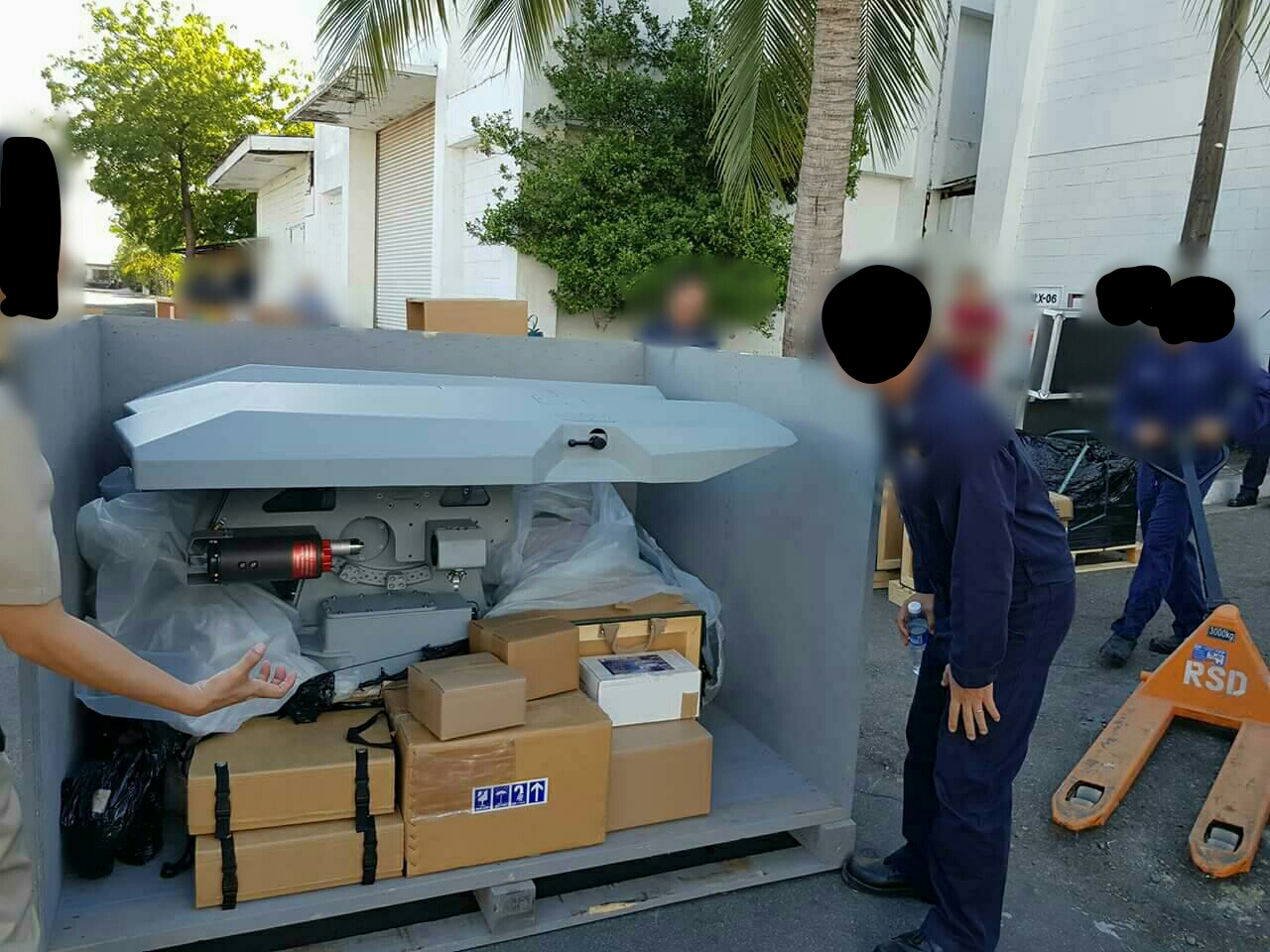
Finally, after several delays on the delivery, this week the Philippine Navy has finally received its shipment of Spike-ER short range surface-to-surface missiles, Typhoon MLS-ER missile launchers, and Mini Typhoon 12.7mm Remote Control Weapon Systems from Israeli defense company Rafael Advanced Defense Systems.

This would be an important milestone for the Philippine Navy as it marks its entrance to the missile age, with the Spike-ER being its first surface-to-surface missile system.


A Typhoon MLS-ER firing a Spike-ER missile.
Photo taken from Rafael's website.


The missiles, launchers and RCWS will all be equipped on the Multi-Purpose Attack Craft (MPAC) Mk.III, 3 units of which were activated last May 2017 and assigned with the Littoral Combat Force.

Each MPAC will get a Mini Typhoon armed with a Browning M2 50-caliber machine gun, and a Typhoon MLS-ER launcher. Each missile launching system can carry 4 ready-to-fire Spike-ER missile launchers and missiles, although the MPAC could carry more rounds due to availability of an ammunition storage.


Some photos during the delivery inspection of the missiles, launchers and RCWS to the Philippine Navy. Faces on photos intentionally blurred/blacked-out to protect identity of inspection team.
Photos shared by source to MaxDefense.


It would be remembered that the Philippine Navy had delivery issues with these products from Rafael, despite the contract making Rafael responsible for delivery from Israel to the Philippines.


The Philippine Navy even asked General Headquarters AFP for approval of their request to use C-130 heavy tactical transport aircraft from the Philippine Air Force (PAF) to pick-up the missiles and launchers from Israel, although these requests were denied several times due to the limited availability of the PAF C-130s in line with events in the country that require their lifting capability.

Due to these availability issues, the PN and Rafael decided to push through with the delivery through commercial shipping.


Project Recap:

The Multi-Purpose Attack Craft Mk. III acquisition project was part of the Revised AFP Modernization Program's HORIZON 1 phase covering 2013-2017, and was divided into 2 lots:  Lot 1 was for the acquisition of 3 MPAC Mk. III boats with a budget of  Php270 million, while Lot 2 was for the acquisition of the MPAC Weapons System with a budget of Php594.320 million.


The MPAC Mk. III during their delivery and acceptance with the Philippine Navy last May 2017. Currently they are not yet armed with the Typhoon systems, and currently they are temporarily armed with manually operated machine guns. That would change with the delivery of the RCWS and missile launchers.
Photo courtesy of a MaxDefense community member, exclusive to MaxDefense.


Lot 1 underwent public bidding, which was won by Propmech Corporation-Lung Teh Shipbuilding Co. Ltd. Joint Venture under a Php268,880,000.00 contract while Lot 2 was a Government-to-Government procurement between the Philippines and Israel. 

An inert version of the Rafael Typhoon MLS-ER missile launcher as shown by officers of the Philippine Navy to Pres. Duterte aboard BRP Davao del Sur last June 2017.
Credits to owner of photo.


The Rafael Spike-ER missile is eletro-optically guided multipurpose missile with a minimum and maximum effective firing range of 400 meters and up to 8.000 meters, respectively. It can also be operated as a fire-and-forget missile to allow the safe escape of the launching platform. The missile has a penetration capability of up to 1,000mm of rolled homogeneous armor, good enough against small surface targets to destroy small boats and armored vehicles, or damage small ships.


The Spike-ER multipurpose missile.
Credits to owner of photo.


The Rafael Typhoon MLS-ER is an remote controlled weapon system, lightweight and stabilized launching platform that could be installed to small boats including the PN's MPAC platforms It includes an Electro-Optical Director and fire control system, and could be used in day and night operations.

The Rafael Mini Typhoon, a variant of the Typhoon family of naval stabilized remote controlled weapon system, is used on a variety of naval platforms including small boats like the MPAC. It is made to support smaller caliber weapons including the 50-caliber 12.7mm machine guns used by the Philippine Navy. It can be operated as a stand-alone system with a remote firing system inside the boat, or as part of a combat management system. It also allows manual operation as required by the end-user, and is capable of day and night operation.


The Rafael Mini Typhoon RCWS during remote operation.
Credits to owner of photo.


Another Horizon 1 project is finally completed, as the Philippine Navy is still struggling to complete its acquisitions under this phase. The Philippine Navy, as of MaxDefense's last count, still has more than ten (10) Horizon 1 projects in different stages of acquisition, despite 2018 already part of the Horizon 2 phase.

MaxDefense will continue to update its readers once the launchers are installed on the MPAC Mk. III boats, which would probably take some time considering the boats are currently assigned away from the PN's main naval base in Cavite.

Saturday, April 14, 2018

M113 Armored Vehicles Offered by Jordan for Donation to the Philippine Army

In one of our previous MaxDefense blog entries, we discussed that the Jordanian government has offered to provide the Philippine government two (2) Bell AH-1F Cobra attack helicopters for the Philippine Air Force (PAF). This is Jordan's help to the Philippines in its fight against ISIS-inspired terrorists like the Maute Group and Abu Sayyaf Group, among others, who are still not considered totally defeated despite the Philippine government's success in killing its leaders and most of its members during the months of fighting in the City of Marawi.

The deal involves the donation of the 2 helicopters, but the Philippine government needs to have the helicopters repaired and refurbished through the Jordanian Armed Forces, and the work, plus shipping to the Philippines, paid for by the Philippine government.

In addition, several MaxDefense @ Facebook posts we made mentioned about updates on the planned donation, wherein the PAF already identified, inspected and evaluated the 2 helicopters before Christmas last year, and that they gave a positive recommendation for its acquisition and funding. 

Recently, Pres. Duterte himself, in his speech in a bridge ceremonial opening in Mindoro Island last 03 April 2018, mentioned that the Kingdom of Jordan was providing the Philippine government "2 gifts" that are expensive. 

In our Facebook posts dated 04 April 2018, MaxDefense interpreted the "2 gifts" from Jordan to be the 2 Bell AH-1F Cobra helicopters that MaxDefense announced in August 2017. But after more information coming in from sources for the last few days, MaxDefense now believes that the interpretation we made earlier was incorrect, or more accurately, incomplete.

Instead, it appears that the 2 Cobra helicopters are just part of Jordan's Gift #1.

For more information on the Jordanian offer for 2 Bell AH-1F Cobra attack helicopters, please refer the blog entry below:

"Is the Philippine Air Force getting Bell AH-1 Cobra Attack Helicopters from Jordan?" - dated 21 August 2017.


So What is Gift #2?

Gift #2 is actually something else. And based on several information from sources, it appears that Jordan is also providing the Philippine government dozens of M113 tracked armored personnel carriers. 

They would also be donated, although the agreement involves the Philippine government paying for the repair and refurbishing done through the Jordanian Armed Forces, plus paying for the shipping of the armored vehicles to the Philippines.


One the RJA's upgraded M113A2, designated as the M113A2MK2-1J. It is fitted with a modified armored cupola to protect the gunner from enemy fire or explosion blasts. It also has an external carrying compartment which could allow it to carry other equipment especially those for the infantry units.
Credits to owner of photo.


No exact variant or quantities were provided to MaxDefense as of yet, but it is said to be, at least, more than 60 units, and MAY even include specialized models of the M113 family. These vehicles are said to have been part of those already stored by the RJA as they receives newer armored vehicles from other countries. The RJA is also a strong buyer of used armored vehicles, as they wisely use their limited resources to build up a strong Army in a very volatile region.

The Royal Jordanian Army operates more than a thousand M113A2 and the Jordan-upgraded M113A2MK-2J, including specialized variants like M577 Command Vehicles, M163 Vulcan Air Defense System vehicles, M901 TOW-mounted anti-tank vehicles, M106 Mortar Carriers, and M806 Armored Recovery Vehicles, and has in storage hundreds of M113s including M113A1 and M113A2 armored personnel carriers.


The M113s the Jordanians might be offering won't include the uparmored cupola, and external storage boxes, and other upgrades made by Jordan. Instead, it is expected that the armored vehicles will be in its basic form, probably without even the machine gun, and will be upgraded by the Jordanian government and paid for the by Philippine Army.
Credits to owner of photo.


Status of the Jordan's Offers:

While MaxDefense reported last time in its earlier blog entry that the 2 AH-1F Cobra attack helicopters were already recommended by the Philippine Air Force for acquisition, it is said that the Philippine Army is still finalizing its recommendation to proceed with the acquisition. 


In our previous blog entry, MaxDefense mentioned that the Philippine Air Force already recommended the acquisition of the 2 Bell AH-1F Cobra attack helicopters that Jordan was offering for donation. The M113 offer is tied-up to this, and would probably be accepted by the Philippine Army as well.


But MaxDefense was already given a heads-up by a source from the Mechanized Infantry Division saying that the Philippine Army is expected to push for the acquisition of the vehicles, and funding request from the national government. It appears that the funding for both the Cobras and the M113 from Jordan are not covered by the programmed Revised AFP Modernization Horizon 2 budget.

MaxDefense sources confirmed that accepting the offer from Jordan, despite the need to spend for repairs and refurbishing, is still a cheaper way of acquiring more assets to increase the armored vehicle fleet instead of buying new ones that are expensive. 

It is also expected that the Philippine Army will provide the 50-caliber machine guns, which would be acquired separately, or will be coming from Philippine Army stocks.

The Philippine Army, as mentioned by several sources, is in need of at least 300 M113 armored vehicles to allow the Mechanized Infantry Division to have sufficient vehicles to fill in its mechanized nfantry units. Currently, the Philippine Army has a little over 200 M113A1, M113A2 and M113A2+ in different variants, and many of the older M113A1 are in need of rehabilitation and refurbishing due to lack of it. Many of the newer M113s will be undergoing uparming as part of the Horizon 2 phase of the Revised AFP Modernization Program, which will be discussed by MaxDefense in future blog entries.


The Philippine Army is in need of at least 300 M113 tracked armored vehicles to fill the requirements of the Mechanized Infantry Division, and free up its wheeled 4x4 armored vehicles for other duties.
Photo taken from the collection of the late Mr. John Chua, who was a MaxDefense community member.


Since this not yet finalized deal between the Philippines and Jordan, there is still a chance that either or both offers from the Kingdom of Jordan may not proceed. This option is still possible, especially with Pres. Duterte at odds with the United Nations' Human Rights Commissioner, who happens to be a close relative of the King of Jordan, King Abdullah II. But MaxDefense is hopeful that cooler heads will prevail, and any odds between personalities won't affect the deal from happening.

Proceeding or not, MaxDefense is thankful for the Jordanian government's offer to assist the Philippine military in fighting the ISIS-inspired terrorists despite their resources tied up in fighting the terrorist threat in their own homeland.

More updates will be posted here @ MaxDefense as information starts coming in, however good or bad it may be.

Monday, April 2, 2018

Comparing the Air/Surface Search Radar Options for the Philippine Navy's Future Frigate versus Technical Specifications

For the past 2 years since 2016, MaxDefense had been discussing the Frigate Acquisition Program for the Philippine Navy, including the fact that Hyundai Heavy Industries (HHI) submitted 2 options for the different subsystems of the frigates.

While the Combat Management System (CMS) was discussed too publicly to the point that it even became a nationwide issue, which we all know what happened next. MaxDefense also mentioned several times especially in our Facebook posts that the CMS issue is just the tip of the iceberg, as the CMS affects most of the important subsystems like the sensors and surveillance systems of the frigates.

Aside from the CMS, another subsystem where HHI submitted 2 options is the Air/Surface Search Radar (ASSR), which is the most important surveillance sensor of the frigates. MaxDefense will discuss about the ASSR in this blog entry.


The Airbus (now Hensoldt) TRS-3D, which is among the 2 options provided by HHI for the Air/Surface Search Radar (ASSR) requirement, and HHI's preferred choice.
Photo taken from Hensoldt's website.


The other option HHI submitted for the frigate's ASSR is the Thales Nederland NS100 series of 3D AESA naval radar, one of the latest naval radars in the market today.
Photo taken from Thales' website.


The Air/Surface Search Radar System:

The Philippine Navy released an initial version of the Technical Specifications prior to the 1st Stage Bidding of the Frigate held on 04 December 2013. MaxDefense was able to discuss it in a blog entry for the frigate:

"Philippine Navy Frigate Acquisition Project - An Anaysis of the 1st Stage Bidding Specifications" - dated 09 October 2013.


MaxDefense believes that the initial specs were too general and too basic, and shows total lack of understanding on the subsystem. It also separated the requirements for air search and surface search, despite current technology having a single radar system that covers both requirements.

This was later on replaced by a more specific Technical Specifications. Not only did it combined the air search and surface search requirements into a single system, but it increased the performance values too.

This new requirements was also discussed in a previous MaxDefense blog entry:

"The Philippine Navy's Frigate Acquisition Program Finally Moves in 2016! New Technical Specification Released And Tender Soon" - dated 07 February 2016


Below shows the Technical Specifications as of 2013 (left) and 2015 (right) for the Air/Surface Search Radar as shown on the Supplemental Bid Bulletin Nr. DND/PN-FAP-16-01 released on 02 February 2016. The same can be seen on Page 26 of the Statement of Compliance form as provided under Supplemental Bid Bulletin Nr. DND/PN-FAP-16-03 released on 17 February 2016.


This is the Technical Specifications for the Air/Surface Search Radar (ASSR) system. The left is the old specs used in the 1st Stage bidding, and the right one is the updated specs used in the 2nd (and final) Stage Bidding, which is the prevailing version of the technical specs. No additional capabilities were added later on.
Photo cropped from the SBB No. DND/PN-FAP-16-01 dated 2 February 2016.


Important Points of the ASSR Technical Specifications:

Among the most important points of the ASSR's Technnical Specs are as follows:

1. Instrumented Range - should be at least 100 nautical miles for air targets and 40 nautical miles for surface targets.

This means that the radar should, at its maximum capability in the best weather (clear) conditions, should be able to see air targets of any size 100 nautical miles away from the radar (or the ship in general), or a surface target of any size from 40 nautical miles away from the radar. Surface target could be anything in the sea surface or the ground surface. This the most common feature that is used to determine if a radar system is superior over the another system, although in reality this should not be the case.

Take note: Surface targets only require a smaller range as radars detection of surface targets is limited due to the Earth's curvature. Microwave beams travel in straight lines/path.

Converting to kilometers, 40 nautical miles = 74.08 kilometers, while 100 nautical miles = 185.2 kilometers.


2. Tracking Capacity - should be at least 750 tracks for air and surface tracks.

The radar should be able to detect and track (or see) at least 750 air and surface targets at any given time. This is very useful in areas with high volume of military and commercial sea and air traffic like the South China Sea/West Philippine Sea where large commercial and naval ships are mixed up with small fishing boats, plus a large volume of commercial airline flight routes mixed up with military aircraft. MaxDefense believes that 750 tracks is a decent capability considering most new surveillance radar systems can track more than that.


3. Detection Range - minimum of 200 meters up to a maximum of instrumented range 

This means that aside from the ASSR to be able to see naval and ground targets at 40 nautical miles away, and air targets at 100 nautical miles away from the ship, the ASSR should also be able to see such targets to as close as 200 meters away from the ship. Radar systems do not normally see any target very close to the transmitter itself (like a ship berthed side by side with the ship it is equipped), and detection can only be made from a certain distance.  Surprisingly, the 200 meter requirement is considered too much since most modern radars can have a minimum range of less than 100 meters.

4. Azimuth Coverage - 360 Degrees

This means that the radar's maximum detection coverage allows it to see targets in all directions, which also means that the radar antenna has the capacity to turn at 360 degrees to be able to do this. This is standard in today's radar technology although it is right to include it in the technical specs.


5. Transmitter - Solid State

Solid state refers to the technology used for the radar system to transmit microwave signals. It is the current technology used in radars, replacing the old Magnetron-based technology whose performance is not as good, is less reliable, requires more power to use, and is physically larger and heavier, among others.


6. The Radar is primarily used for air and surface surveillance and acquisition and must be capable of quickly detecting and accurately locating air and surface contacts, and detection of sea skimming missiles at a minimum altitude of 10 feet to allow fire control resources sufficient time to lock-on and engage

This is a specification forgotten by many other discussions online about the Frigate's ASSR. The desciption is actually divided into two parts. First is the description of the ASSR, while the second part (underlined) is the actual specification, which is for the ASSR to be able to detect sea-skimming missiles at a minimum altitude of 10 feet.


MaxDefense believes that despite these requirements in the technical specification, it still lack enough information that allows it to be more specific to what it really requires. Among them include the lack of requirement on the radar's detection chance of specific targets with a given Radar Cross Section in a certain environment model, or the maximum elevation azimuth coverage of the radar system, both of which are also very important requirements.

This photo above was cropped from the Computer Generated Image provided by Hyundai Heavy Industries (top) of what the Philippine Navy's future frigate may look like once completed. Surprisingly, the ASSR antenna is strikingly the same as the antenna of the Thales Nederland NS100. Anyone could compare the antenna profile since there are numerous online photos of what the antennas of TRS-3D and NS100 look like.
Photo taken from Hyundai Heavy Industries' website.


 The Options Submitted by Hyundai Heavy Industries:

During the Submission and Opening of Bid Envelopes (SOBE) for the Frigate Acquisition on 17 March 2016, only two bidders were declared to be able to proceed with the acquisition process. Among them was Hyundai Heavy Industries (HHI), which was declared the 2nd lowest bidder after Garden Reach Shipbuilders and Engineers (GRSE) of India. HHI  submitted 2 options for the Air/Surface Search Radar Systems: The Thales Nederland NS100 series AESA radar system, and the Airbus TRS-3D series radar system.


While other defense pages condemn MaxDefense, saying that our posts and information are half lies and innuendos, long-time MaxDefense readers and community members know that those accusations are false made by biased groups with vested interests in criticizing MaxDefense. The photo below was cropped from the actual Makers List submitted by HHI and included in the FAP's Contract signed last October 24, 2016. It clearly shows that HHI did offer 2 options for the ASSR. MaxDefense believes that no other defense page

The above shows the options submitted by HHI for the Air/Surface Search Radar (ASSR), which are the TNL (Thales Nederland) NS100 and the Airbus TRS-3D. Confirmation was made to MaxDefense that the specific versions being offered were the NS106 and the TRS-3D Baseline D. It also shows that HHI did offer 2 options for the CMS, although there is only 1 option for the Navigation Radar. MaxDefense decided to blur the other items for now and focus more on the ASSR.
Photo cropped from the FAP Contract's Annex F.


MaxDefense was lucky enough to be among the few who got access to the actual submissions made by GRSE and HHI, which allowed us to discuss them thoroughly through the years fro 2016 until the present.

Thales Nederland NS106 is a derivative of the newly developed but already successful NS100 series of AESA naval radars, and was said to be the actual model HHI is offering from the series. It takes improved performance over the older Thales Smart-S Mk. 2 radar, and uses Active Electronically Scanned Array (AESA) technology which is the latest technology in radar systems due to its ability to control beamed radio waves without the need to move the antenna, or require moving parts for the antenna.

The NS106 is a smaller version of the NS100, designed specifically for use on smaller warships from Offshore Patrol Vessels to small frigates. Its latest user is the Republic of Singapore Navy's Independence-class Littoral Missions Vessels.

The Thales Nederland NS100 series, which includes the NS106, uses AESA technology, and is among the latest naval radars in the market today. Despite being new, it is already in service with different navies.
Photo taken from Thales Nederland's website.

The latest user of the Thales Nederland NS100 (NS106) 3D AESA Radar is the Republic of Singapore Navy, installing them on the new Independence-class Littoral Missions Vessels. It would be noted that Singapore is among the most stringent in defense procurement, making sure that they get the best military technology to compensate for their lack of manpower.
Photo taken from Singapore's Ministry of Defence.


Meanwhile the Airbus (now Hensoldt) TRS-3D radar is in the global radar market for almost 15 years now, and is a proven product in use by several navies. It is actual a direct competitor of the Thales Smart-S Mk. 2, and uses the older pencil-beam technology, which is already being replaced in the market by the AESA technology. The TRS-3D is now marketed by the German company Hensoldt, which originated from Airbus' electronics business unit. The TRS-3D's latest user includes the US Coast Guard's Legend-class National Security Cutter.

MaxDefense received confirmation that the actual variant being offered by HHI is the current Baseline D variant, the same variant used by the USCG Legend-class NSC.

The latest version of Hensoldt's TRS-3D, the TRS-3D Baseline D, is being used by the US Coast Guard's Legend-class National Security Cutters. The Baseline D is said to be the one being offered by HHI to the PN, being the variant being produced by Hensoldt.
Credits to source of photo.


Philippine Navy's Technical Specifications versus the Radar's Specifications:

Now we compare if the two radars comply with the technical specifications for the Frigate Acquisition Program, based on publicly-available information.

Spec #1. Instrumented Range - should be at least 100 nautical miles (185 kilometres) for air targets and 40 nautical miles (74 kilometres) for surface targets.

Based on Thales Nederland's own product data sheet found in their website, the NS100 has a Maximum Instrumented Range of 280 kilometres, and a Maximum Range of 80 kilometres for surface targets. These are way beyond the 185 kilometres (air search) and 74 kilometres (surface search) required as per technical specs. 

And based on Hensoldt's own product data sheet also found in their website, the TRS-3D has a Maximum Instrumented Range of 200 kilometers, also beyond the requirement provided by the technical specs.

Based on this simple requirement, both the NS100 and TRS-3D comply with the technical specifications.


But based on information not released to the public by radar manufacturers, the TRS-3D has deficiencies due to the older technology it uses. 

It appears that the TRS-3D only has the capacity to meet this requirement is the 6s mode, which is an update time of every 6 seconds. The TRS-3D has a corresponding update time between 1 to 6 seconds (6s, 3.5s, 3s and 1s) with the 6s only meeting the maximum range requirements. This is due to the use of older Pencil-beam technology which requires the operator to choose from different search modes or patterns during operation. Example, there is a different mode and performance values when the radar is required to do horizon search against sea-skimming targets, and in conducting target acquisition, and in conducting volume search. In short, there is a compromise whenever the operator requires to use a different mode of operation while using the TRS-3D.

This is where an AESA-technology radar shows its value and better performance, as AESA radars do not require such compromise as it can perform all modes simultaneously. Meaning, it can do volume search, target acquisition, and horizon search on sea-skimming targets all at the same time.

Since the technical specifications does not indicate this requirement, the TRS-3D would actually be compliant with the PN's specs, although it is apparent here that the NS100 (and NS106) performs way better due to use of superior technology.


Spec #2. Tracking Capacity - should be at least 750 tracks for air and surface tracks.

Based on the same sources, the Thales Nederland NS100 has an air/surface track load of up to 1,000 tracks at a maximum, while Hensoldt TRS-3D only a maximum tracking capacity of more than 400 targets.

Given that manufacturers do not fully disclose the real maximum capabilities of their products, MaxDefense can assume it could be +5% to +10% more than the posted values. This gives the TRS-3D a theoretical maximum tracking capability at 440 to 450 targets.

Despite the use of a 10% allowance, it shows here than the Hensoldt TRS-3D does not meet the technical specifications for the frigates, while Thales Nederland NS100 can track twice more than the its competitor, and easily surpass the technical specifications by 25% more, thus the NS100 meets the technical specs easily.

Here alone, it is easy to say that Hensoldt TRS-3D should be disqualified from being used as the ASSR for the Philippine Navy's future frigates for failing to meet a technical specification requirement.


Spec #3. Detection Range - minimum of 200 meters up to a maximum of instrumented range 

Still based on the same sources as the other specs, the Thales Nederland NS100 has a minimum range of 15 meters, and a maximum range of 280 kilometres. Meaning, the NS100 exceeds the required minimum range, and also exceeds the required maximum range.

Meanwhile, the Hensoldt TRS-3D has a minimum range of 200 meters, which meets the requirement, while having a maximum range of 200 kilometers. Thus, the TRS-3D meets both the minimum and maximum range required by the technical specifications.

This is very important especially in law enforcement duties, since the radar is capable of detecting small boats very close to the frigate. While 200 meters is visible to the eye, it could be different during the night when darkness could work well for the approaching boat if their intention is unfavourable for the frigate. 


Spec #4. Azimuth Coverage - 360 Degrees

Based on both the product specification data sheets of both radar systems, the Thales Nederland NS100 and Hensoldt TRS-3D are both compliant with an azimuth coverage of 360 degrees.


Spec #5. Transmitter - Solid State

Both the Thales Nederland NS100 and Hensoldt TRS-3D uses Solid State transmitter technology, thus both are compliant with the solid state requirements.

Solid State transmitter technology is the latest in radar technology, replacing the Magnetron-based technology that has been used since the 1940s.
Photo taken from Toshiba's website.


Spec #6. Detection of sea skimming missiles at a minimum altitude of 10 feet to allow fire control resources sufficient time to lock-on and engage

This requirement is something that were not indicated in the product data sheets available online for both products. Thus requiring MaxDefense to use information that are not available to the public.

MaxDefense won't be too specific on the actual minimum altitude range that both radars can detect sea-skimming missiles due to obvious reasons. But MaxDefense confirms that both the NS100 and TRS-3D can detect a sea-skimming missile at a minimum altitude of 10 feet above the sea surface.

This requirement is important as most anti-ship missiles fly towards the ship by flying as close to the sea surface as possible. Between 15 to 10 feet above sea level is actually a typical elevation used by many anti-ship missiles when sea-skimming.

Modern anti-ship missiles usually approach targeted ships at very low altitude, usually less than 20 feet from the sea surface.
Photo taken from Lockheed Martin's website.


But this again would be something where superior technology creates a difference. The TRS-3D can do detection of sea-skimming targets only in the 1s mode with a maximum detection range of 11.3 nautical miles (20.9 kilometers). Meaning, if the radar is being used at other modes (3s, 3.5s or 6s), the TRS-3D cannot detect sea-skimming targets.

Meanwhile, the AESA technology of the NS100 allows it to operate in all aspects without the need to change modes of operation to do sea-skimming detection and volume search, thus the NS100 can detect sea-skimming targets at all times.

These performance figures are very important in today's battlefield to allow the ship's crews to react faster from threats, considering that anti-ship missiles are now travelling faster than ever.


Conclusion:


Based on the technical specifications, it appears that Thales Nederland NS100 meets all the requirements, and even exceeded them with ease. 

Meanwhile, while Hensoldt TRS-3D met certain requirements, it failed to meet Specification #2, thus it automatically means that the TRS-3D does not meet the technical specifications of the project.

It would have been better if HHI offered the Hensoldt's newer and more capable ASSR, the TRS-4D AESA naval radar, which, after MaxDefense's own assessment versus the technical specifications of the project, complies with all requirements. TRS-4D is actually the direct competitor of the NS100, and uses the same technology and evenly matches in every aspect of capability and technology. Too bad HHI prefer to go cheap rather than fair.

Now, since based on the arguments pointed out by the Department of National Defense and the current leadership of the Philippine Navy is that Hyundai Heavy Industries will be the one who has the sole right to choose the subsystems for the frigate, MaxDefense believes that HHI will definitely use the Hensoldt TRS-3D radar for the frigates.

Not only is the TRS-3D cheaper by almost US$400,000 per unit compared to the NS106, but TRS-3D is compatible with the Hanwha Systems Naval Shield ICMS, this is due to the TRS-3D being in the market for almost 2 decades now, whereas the NS106 is not compatible yet due to NS106 being a newer product that has never been matched together with the Naval Shield and is not in service with the Republic of Korea Navy.

This is the bottom part of HHI's Makers List which is attached to the contract and signed by HHI and PN TWG Legal Officer Maj. Dayao. While it says that HHI has the sole right for the final selection for subsystems, the equipment shall fulfil the owner's requirements in building specifications and other design & build aspects. Since TRS-3D does not meet certain technical specification requirements, legally it should not be used for the frigate. But is NS100/NS106 compatible with Hanwha Naval Shield ICMS?
Photo cropped from HHI's Makers List as attached to the FAP contract.


But all parties, the PN TIAC and PMT, the DND and DND-Defense Acquisition Office, and HHI should remember that the clause also says "as long as equipment/sensor shall fulfill the owner's requirements in building specifications and other design & build aspects". So if HHI insists in using the Hensoldt TRS-3D, they are breaching the Technical Specifications, and in effect, breaching the contract of the project.

With the PN's TIAC already signed last 23 March 2018 according to our sources from the DND and the PN, its only a matter of time when a formal document will be made signifying the final equipment fit-out of the frigates. And MaxDefense would be there to cover that.


Saturday, March 24, 2018

Philippine Army's Planned Acquisition of Tanks and Armoured Assets for Horizon 2 Phase

With the Revised AFP Modernization Program under Republic Act 10349 now within the so-called Horizon 2 phase covering 2018 to 2022, the entire Armed Forces of the Philippines (AFP) has another acquisition program that was proposed for approval with the National Government.

As of our last check, the Department of National Defense (DND) headed by Defense Sec. Delfin Lorenzana, has already approved the latest Horizon 2 Priority Project List which is worth Php299,707,467,571.33. This covers the acquisition programs for the Philippine Army (PA), Philippine Navy (PN) which includes the Philippine Marine Corps (PMC); the Philippine Air Force (PAF), the General Headquarters - AFP, and the Government Arsenal (GA). Out of that, the Philippine Army was proposed to get Php47,993,429,694.00.

New acquisition list means new projects lined up for the next 5 years. And the Philippine Army has an interesting acquisition line-up in store. For this first blog entry for 2018 covering the Horizon 2 phase, MaxDefense will be discussing about the proposed acquisition of armoured assets for the PA, more specifically for the Mechanized Infantry Division (MID).

The FNSS-PT Pindad KAPLAN-MT medium tank, jointly developed by Turkish company FNSS and Indonesian company PT Pindad. The Kaplan is among those eyed for the Light-Medium Tank requirement of the Philippine Army.
Credits to owner of photo.


Marawi Campaign Experience:

The Philippine Army's experiences in combat against ISIS-inspired terrorists in an urban terrain in Marawi City provided basis for their requirements for new combat armoured vehicles. The tough terrain wherein concrete-poured building walls became good defensive barriers used by terrorists against advancing government forces, became a huge factor.

Among those lessons learned in Marawi City conflict include the following:

1. For fire support vehicles, the 76mm guns of the Scorpion CRVT and M113A2 FSV were insufficient in punching through or demolishing concrete walls and structures. The same is true for the 90mm guns used by the V-300 FSV of the Philippine Marine Corps. These guns are currently the largest calibers available in the AFP excluding the 105mm howitzer gun mounted on a few LVTH-6 armoured vehicles of the PMC which did not participate in the Marawi City crisis.

It was found out during the Marawi City crisis that the largest guns found on armored vehicles in the AFP, the 90mm gun on Philippine Marine Corps V-300 6x6 (top), and the 76mm gun on Philippine Army M113A2 FSV (below), were not enough to punch through structures especially on concrete walls and buildings.
Credits to owner of photos.


2. For armored fighting/infantry fighting vehicles, the 25mm M242 Bushmaster cannons mounted on M113A2 IFV, and the Oerlikon KBA-B02 25mm cannons mounted on the FMC AIFV armored vehicles were reported to be insufficient too in use against concrete structures, and 25mm ammo were reportedly not penetrating the concrete walls. Several M113A2 IFV armed with the Elbit UT25 unmanned turrets were used in Marawi City, and these are new acquisitions of the Philippine Army, only delivered in 2016.

The 25mm autocannons mounted on the M113A2 IFV were also said to be ineffective against concrete structures. The Philippine Army is now considering using a larger caliber for IFVs instead of continuing its plans for more 25mm armed IFVs.
Credits to owner of photo.


3. Unmanned turrets and remote-controlled weapons systems (RCWS) were proven to be effective in Military Operations and Urban Terrain (MOUT), as the system allowed cavalrymen to fire accurate shots using advanced sighting systems, and operate at night using night fighting systems, while also providing safety to gun crews and also improving the layout and space inside the armoured vehicle. The Philippine Army believes that investing in unmanned turrets and RCWS is the way to go for future armoured vehicles.

4. Tracked armoured vehicles were useful when operating in a very tight environment like in urban terrain, and its ability to turn on its own length is advantageous compared to the need to manoeuvre back and forth for wheeled vehicles. But the wheeled armoured vehicle is also advantageous in other purposes, being easier to travel in longer distances without the use of transporter trucks, faster on the road, and cheaper to maintain than tracked vehicles. So the Philippine Army believes that a proper balance of both tracked and wheeled armoured vehicles is needed depending on the requirement.

5. Heavy armour and not just firepower is needed to protect armoured and cavalry crew and troopers while operating in an MOUT environment like in Marawi City.


These lessons now appear to be among those used by Philippine Army Armor Development Office  planning teams, and has become the basis of their planned acquisitions.


Philippine Army's Planned Armoured Vehicle Acquisitions:


In previous announcements by the Philippine Army and the Department of National Defense, it was confirmed that the Philippine Army will be getting TANKS. Later on it was confirmed to be either a Medium Tank, or a Light Tank, depending on the source and date of the announcement.

MaxDefense confirms that there is indeed a plan to acquire tanks as part of the Horizon 2 phase of the Revised AFP Modernization Program. But as explained already by authorities, they are indeed light or medium tanks, and not main battle tanks as originally wanted by the Army's Armor Development Office planners a few years ago. To those who have been following MaxDefense for some time, you may remember when we were discussing about tanks, it was actually a time when the Army was considering main battle tanks.

This goes to show that there is indeed lack of continuity happening in the planning for acquisition of equipment not just with the Philippine Army, but with the Armed Forces of the Philippines as a whole.

As MaxDefense already mentioned before, and I believe was also confirmed by the DND, that the Philippine Army was eyeing 44 tanks as per the latest Horizon 2 proposed acquisition plan, with a proposed budget of Php9,484,332,000.00.

44 tanks would be enough to equip 3 tank companies, equivalent to a tank battalion based on current table of organization and equipment of the Mechanized Infantry Division.

No technical specifications has been released so far, but MaxDefense's initial information from sources mentioned that the following are to be expected for the light/medium tank:

 - could be tracked or wheeled;
 - armed with at least a 105mm gun;
 - would weigh up to a maximum of 35 tons, but weighing less than that would be preferred:
 - powered by a diesel engine

Originally, MaxDefense believed that the MID was looking for just tracked vehicles as platform for the light/medium tank. This was due to its ability to pivot or turn within its own length which is useful in urban terrain, and tracked vehicles have better off-road capability than wheeled vehicles. Therefore it was a surprise that the MID was actually looking at both tracked and wheeled platforms.

It is highly possible that the acquisition would now involve 2 companies of tracked light/medium tanks, and 1 company of wheeled tanks. Each company may have around 14 vehicles each.

The Light Tank is among those projects already for final approval by the President.
Croppd from the RAFPMP Horizon 2 documents sent to Pres. Duterte for approval.


Tank Destroyers:

First of, we discuss the requirement for a Tank Destroyer, which the Philippine Army describes as a "Wheeled Light Tank". MaxDefense believes that the name "Tank Destroyer" is the more appropriate description for such, and a better way to separate this type of vehicle from a "Light Tank" based on a tracked vehicle platform.

Based on the platforms offered to the Philippine Army, most tank destroyer platforms are based on 8x8 wheeled armored vehicles due to its capability to carry large turrets and remain stable when absorbing recoil from firing large caliber guns like a 105mm tank gun.

As of this blog entry's posting, MaxDefense was told that the offers they received were from South Korea, Turkey, and one from Europe. All of those alreadt proposed are using an 8x8 platform. Aside from these offers, its still possible for other options to be considered especially if the Army opens a public tender for the acquisition.

At the moment, MaxDefense gathered that the offers made to the Army's TWG include tank destroyers based on the following: Hyundai Rotem of South Korea with their KW2 (K808) Scorpion, FNSS of Turkey with their PARS, Otokar from Turkey with their ARMA 8x8, and an entry from Europe which is still unnamed. It was also mentioned to MaxDefense that Russian and Chinese options may be considered although less likely to be chosen.

MaxDefense believes that a company (around 12-14 vehicles) might be acquired, and would be deducted from the 44 tanks planned for acquisition.

Hyundai Rotem's Scorpion is a new product from the said company, and is available in 6x6 variant as the KW1 (K806 in Republic of  Korea Army) and the 8x8 KW2 (K808 in Republic of Korea Army) models. No confirmation was made with MaxDefense if the K808 model offered as a tank destroyer is a standard KW2 armed with a 105mm gun turret sourced from a 3rd party supplier, or the KW2 Jupiter, which is a special model designed specifically as a fire support vehicle armed with a 120mm gun similar to those used by the Rotem K1A1 main battle tank. The KW2 is currently in service only with the Republic of Korea Army starting 2016, although full production will only start this year.

The K808 KW2 weighs at only around 20 tons, and with the 105mm gun turret it could weigh in at less than 27 tons. It could be the lightest among the confirmed offerings made to the PA.

The Hyundai Rotem KW2 (K808) Scorpion in APC configuration. It is said that the vehicle can be configured to carry a 105mm tank gun turret. Another version, the Jupiter, is a specially designed vehicle although its prototype used the older design of the vehicle and may not be available anymore.
Photo taken from Tanknutdave's website, said to be originally taken from IHS Janes.


FNSS' PARS is a vehicle already well-heard before by the Filipino defense community, as Malaysia bought a fleet of 200+ vehicles a few years ago as the Deftech AV8. The Turkish-made armoured vehicle is also available in 6x6 and 8x8 configuration, and can be armed with a 105mm or 120mm gun turret, although no orders have been made so far on such configuration. The PARS is in service with 3 countries including its country of origin, Turkey.

The PARS 8x8, without the gun turret, already weighs in at 30 tons. With a 105mm gun turret, the vehicle is expected to kick-in at more than 36 tons, which could be a problem considering the PA wanted a potential tank destroyer to weigh as less as possible, possibly below the 30 to 35 ton bracket, if possible. Meanwhile, the smaller PARS 6x6 may fit the bill although it is not yet confirmed if the vehicle can be safely mounted with a 105mm gun turret.

The FNSS PARS 8x8.
Credits to owner of photo.


Another Turkish product, the Otokar ARMA, is also available in 6x6 and 8x8 configuration. It is physically smaller than the FNSS PARS 8x8, and also weighs less at around 24 tons without the 105mm gun turret. Adding a 105mm gun turret brings it up to almost 30 tons. It is service with at least 2 foreign countries, although it is surprising that Turkey is not operating the type since it lost to the FNSS PARS in a previous competition to supply 8x8 armoured vehicles to the Turkish Army.


The Otokar ARMA 8x8 with a 105mm turret, presumed to be from CMI Defense.
Photo taken from Otokar's website.


A European-made model was also offered to the Philippine Army. And according to our sources, this armoured vehicle is in service with at least 3 countries including its country of origin and an Asian country with very close ties to the Philippines. MaxDefense was asked to withhold the information for now.  It is confirmed to be capable of carrying a 105mm gun turret despite no country ordering the vehicle in such configuration, and also weighs less than 30 tons with the tank gun turret in place.

Apparently, the US has an offer that has been standing for some years now for the General Dynamics Land Systems Stryker 8x8 armoured vehicle. The last confirmation came from the time of former Philippine Army Commanding General Gen. Hernando Iriberri, who was personally provided with information on the Stryker during his visit to Pentagon. If this is still in place, it is also possible that the Philippine Army may consider the M1128 Stryker Mobile Gun System, which is armed with a 105mm tank gun and is used for fire support missions, or even as a tank destroyer.

The only problems with the Stryker are its price, and its manufacturer not likely to join public biddings. Apparently GDLS don't sell them cheaply, although it can be a possible candidate for Foreign Military Financing (FMF) through US Military Assistance program to the Philippines. And since they do not normally join biddings, if the Philippine Army decides to acquire tank destroyers through a public bidding, don't expect GDLS to join in, as they know they won't win by being the lowest bidder.

The M1128 Stryker Mobile Gun System.
Photo taken from Wikipedia.


There's no word yet to confirm if there is any offering from Russia or China, considering the president is very supportive of possible arms acquisition from both countries. More emphasis on China, since they have products which may match what the Philippine Army is looking for.


Light/Medium Tanks:

This is what most people are expecting when the Philippine Army and DND announced that they were acquiring tanks. A light or medium tank using a tracked armored vehicle platform, and is light enough to not need special equipment when crossing bridges in the Philippines. Around 2 companies worth (around 28 to 30 vehicles) are planned for acquisition.

To make it simpler, the Philippine Army actually considered also offers from the same companies who offered the Tank Destroyers. What the Philippine Army actually did was ask for offers from these companies for the two types of vehicles. Thus even without mentioning which vehicles were offered, probably a lot here may already know what to expect. But for discussion's sake, let us name them.

Since Hyundai Rotem does not produce a light/medium tank using a tracked armoured vehicle platform, the Koreans actually fielded the Hanwha Defense Systems K21-105 light tank. FNSS, in cooperation with PT Pindad of Indonesia reportedly offered the Kaplan MT, while Otokar is said to have proposed to use their Tulpar tracked IFV as a platform with a 105mm tank gun turret. Like the tank destroyer, there is also a European model being proposed for the Light/Medium tank and will also be equipped with a 105mm tank gun turret.

Hanwha Defense System's K21-105 light tank was derived from the K21 infantry fighting vehicle used by the Republic of Korea Army. It was formerly under Doosan DST until the company was acquired by Hanwha a few years ago. It is essentially the same base vehicle with its turret replaced with a CMI Defense Cockerill XC-8 with 105mm tank gun. The vehicle weighs around 25 tons and is considered a light tank. While it has already shown its capability to carry the 105mm tank gun turret, the ROK Army has not ordered the type. Apparently Hanwha's offer is within the budget of the Army for the said project.

The Hanwha Defense Systems (formerly Doosan DST) K21-105 being tested in South Korea.
Credits to owner of the photo.


Weighing at around 35 tons, the FNSS-PT Pindad KAPLAN MT/Harimau Hitam (Black Tiger) can be considered a medium tank, and is armed with a 105mm tank gun mounted on either a CMI Defense Cockerill XC-8 turret (similar to the one used on the K21-105), or the Cockerill 3105 turret, with a Cockerill 105mm hugh pressure gun. It uses a tracked armoured vehicle platform that was jointly designed by the 2 companies, and is actually a new vehicle that is not yet in service with any country. Indonesia is more of the target market for the tank, with FNSS providing technical expertise and technology. This actually is a disadvantage since the AFP procurement rules require a product to be in service with its country of origin, or at least 2 other foreign countries.

The FNSS/Pindad Kaplan MT (also called the Harimau Hitam in Indonesia), shown here in Indonesian Army colors and being tested by PT Pindad and Indonesian Army teams. The sole Turkish-made prototype is yet to be followed by an Indonesian-made prototype, and the vehicle is yet to be approved for full production. This is a main problem in its consideration for the Philippine Army since the vehicle itself is not considered as a proven product.
Credits to owner of photo.


The Otokar Tulpar is another new product, which was only released by Otokar a few years ago and has not been ordered yet by Turkey or any other country. Coming in at around 35 tons, it could also be considered as a Medium Tank. It was design to also be able to carry a 105mm tank gun turret although its yet to be identified which brand was it design to carry. But based on Otokar's use of CMI Defense Cockerill turret on the ARMA, it is expected that the same turret was considered for the Tulpar's "anti-tank vehicle" variant (which is how they call the tank variant). Although there is no confirmation yet, MaxDefense believes that other turret models can be used in place of those from CMI Defense.

The Otokar Tulpar, in AIFV configuration, as shown during IDEF 2013. A medium tank variant is also possible using a 105mm gun turret instead of the 25-30mm autocannon.
Photo taken from ArmyRecognition.com.


Like the tank destroyer, the European-made tracked light tank was offered by the same company. The light tank variant is not in service with any other country, but the base tracked armoured vehicle is in service with 2 European countries and a third European country preparing to put its derivative into service. With a 105mm tank gun turret, the vehicle is expected to weigh around 30 tons.

As with Russian and Chinese models, there is no confirmation if they are also offering or even willing to join a public tender should it become the mode of acquisition for these light/medium tanks. A G2G deal would definitely benefit both countries, as they are expected to offer a similar but definitely cheaper alternative, like China's Norinco VT-5 light tank, and Russia's 2S25 Sprut-SD airborne-capable light tank.

Another offer that was actually made a few years ago came from Elbit Systems Land & C4I of Israel. They previously offered refurbished and upgraded SK-105 Kurassier tank destroyers handled by their Belgian subsidiary Sabiex. The SK-105 retains their 105mm gun, and can be rebuilt to modern standards including a new fire control system and mechanical/electrical systems.

Elbit and Sabiex also offered the Philippine Army some of their SK-105A2 Kurassier stocks in an as-is, where-is option (no upgrades). Apparently both options were not given serious consideration by the Philippine Army as it prefers brand new, newer models rather than upgraded and refurbished old units. The SK-105 was first deployed in the 1960s and uses old Cold War-era technology. But they come in very cheap, even for the upgraded model.

Sabiex, through their parent company Elbit Systems, offered a refurbished and upgraded SK-105 Kurassier tank destroyer to the Philippine Army and other militaries. These vehicles are former Austrian Army models are can be modernized and tropicalized according to Sabiex and Elbit.
Credits to owner of the photo.


Turret Issues:

Previously, MaxDefense mentioned that Belgium is implementing an arms export restriction to the Philippines. It was later on confirmed by Shephard Media that the national government of Belgium is not imposing an arms export ban to the Philippines, but its Walloon regional government is implementing a strict control on arms export. It was later found out by MaxDefense through the AFP and from the local defense industry, that the Walloon regional government has indeed stopped a number of export license of arms, munition, and weapons spare parts intended for the Philippines, due to Human Rights concerns.

Already affected are the FN Herstal M3P machine guns, RMP gun-rocket pods, and HMP gun pods for helicopters of the Philippine Air Force and Philippine Navy, as well as FN Herstal Minimi squad automatic weapons for the Philippine Army and Government Arsenal.

While FN Herstal has nothing to do with the Tank Destroyers and Light Tanks, the Walloon Regional Government's decision to withhold export licenses of arms to the Philippines will affect the tank gun turrets for the vehicles.

CMI Defense, the makers of the Cockerill line of turrets, is also within the control of the Walloon Regional Government. Thus, even if CMI Defense wanted to supply the turrets to the Philippines, the regional government might defer its export, and CMI and the proponents cannot do anything about it.

The Hanwha K21-105 and the Rotem KW2/K808, the FNSS/Pindad Kaplan MT, the FNSS PARS, Otokar's ARMA and Tulpar, and the European 8x8 and tracked armoured vehicles all use CMI Defense's turrets.

Despite the availability of other suppliers of turrets like Oto Melara's Hitfact 105, or similar models from Denel and General Dynamics. But this would prove to be a problem since these vehicles were developed with CMI Defense turrets in mind. Any reconfiguration may require further development, which in turn means costs that might be shouldered by the Philippine Army.

So far, it appears that most of the offerings were able to find solutions. Apparently, the Koreans will continue to use CMI Defense turrets and are able to do so, while the Turkish companies especially FNSS are said to be hesitant to proceed with the projects if the Philippine government cannot settle its issues with the Belgian government. The European offers are willing to use a different turret model, which actually gives their offers an advantage over the others.

According to PT Pindad, FNSS' partner on the development of Kaplan MT, they have not used a different turret model for the Kaplan and any request to replace the turret with another model may require more time for product development and includes costs that PT Pindad or FNSS may be unwilling to shoulder on their own.

Otokar might be able to use a different turret model but this needs further confirmation.

The concern on the Koreans is that despite the capability to supply the tanks with CMI Defense turrets, support and spares could be an issue in the future, similar to what is happening with FN Herstal products ised by the AFP.

MaxDefense urges the Philippine government, particularly the Department of Foreign Affairs, to settle this issue with the Belgian government. It was also the recommendation of FN Herstal's local representative in the Philippines, Intrade Asia Pacific Corporation, as they are also having problems supplying parts for the AFP.


Lack of Heavy Armor:

Another issue that is worth discussing is the choice of getting light weight, lightly armoured tanks instead of heavily armoured with a heavier gun.

Marawi and Zamboang showed that armoured vehicles, especially those operating in urban operations/MOUT will be susceptible to heavy gunfire, high explosives, booby traps, and RPG/anti-tank fire.  Armoured vehicles are also used by troops as cover for their advance.

In these cases, heavy armour is extremely important to protect the tank crew, and also survive such extreme concentration of enemy fire and achieve their mission while also safely returning from it.

Based on the armor protection data from the vehicles mentioned above, most if not all (Kaplan, K21, and the European model) are only protected up to STANAG 4569 Level 4, which is good up to 14.5mm projectiles and 155mm shell splinters.

The K21 is said to also have a better frontal armor capable of protection from up to 30mm armour piercing projectiles as it was designed to fight BMP-3 from the North Korean Army.

The Tulpar is said to be capable only of STANAG 4569 Level 2 protection from small arms fire but can be upgraded to Level 5 protection up to 25mm AP projectiles as it has modular armour capability by adding composite armour.

MaxDefense believes that protection from RPG fire might still be a problem, which heavier tanks like MBT has a better chances of surviving multiple hits and remain operational.

Adding more armour protection on these light tanks will affect their weight and decrease its mobility as the mechanicals are given heavier loads.


Lack of Heavier Firepower:

While the main threat the Philippine Army has at the moment is terrorism and insurgency with the possibility of conducting wars in urban environment, the PA should also consider the need to be able to destroy or disable tanks from a perceived invasion force.

All of the light tanks offered are mounted with a 105mm tank gun. But most modern main battle tanks are already protected from 105mm AP projectiles, thus making the light tanks incapable of piercing enemy tank armour.

A 120mm or 125mm tank gun armed with modern AP shells would have a better outcome against enemy tanks. But it also comes at a price since heavier main battle tanks are the ones carrying such heavier gun caliber.

And if used on MOUT operations, a 120mm ammo is more expensive than a 105mm ammo. MaxDefense believes a 105mm projectile would be enough should another Marawi Crisis happens.


Wheeled Armored Personnel Carriers:

This is something that was not expected before, since the original plan by the Philippine Army was to upgrade and refurbish some of their existing V-150 Commando and GKN Simba 4x4 armoured vehicles, and equip them with RCWS systems.

Later on it was confirmed by sources that the Philippine Army was considering two options: either to refurbish and upgrade some of its existing 4x4 armoured vehicles, or acquire a new armoured vehicle. Most of those involved in the project within the Mechanized Infantry Division prefer the acquisition of new assets.

28 vehicles, good for 2 Mechanized Companies, are planned to be acquired with a proposed budget of Php2,265,200,000 as part of the Army's Horizon 2 modernization phase.

The technical specifications are not yet finalized by the project's TWG, but MaxDefense was given by MID sources an idea of what to expect:

- maximum budget is around Php80.9 million per vehicle including Integrated Logistics Support, training, and other requirements;
- wheeled, and probably 6x6 or 8x8;
- preferably the same platform or model as the Wheeled Tank Destroyers for commonality;
- armed with a 30mm unmanned turret.
- basic model can be upgraded with modular or improved armoring which can be done in the future.


The initial information MaxDefense received is quite tight considering the budget appears to be very small while specifying specs that may need more budget. For a base vehicle, Php80 million each may be enough, but the 30mm unmanned turret alone is already pushing too hard. MaxDefense confirmed this with a source from a major defense company, who confirmed that Php80 million per vehicle may not be enough for an 8x8 vehicle, more so an APC armed with a 30mm unmanned turret.

The choice of using at least a wheeled 6x6 platform means that experience with 4x4s may have already been considered. In both the Zamboanga and Marawi City crisis, tires are being shot at by terrorists to disable or reduce the armoured vehicle's mobility. This despite the armoured vehicles using run-flat tires that enable them continue running for a certain time or distance even after the tires are deflated.

Based on the requirement to be preferably similar vehicles to the tank destroyer, MaxDefense believes that the possible offers made came again from the same companies that offered the Wheeled Tank Destroyer. MaxDefense expects Hyundai Rotem to have offered the KW1 (K806) 6x6 and KW2 (K808) 8x8 Scorpion, FNSS with its PARS 6x6 and 8x8, Otokar with its ARMA 6x6 and 8x8, and the European model with a 6x6 and 8x8 version of its wheeled armoured vehicle.

MaxDefense also received confirmation that unsolicited offers were made by PT Pindad, probably with its Pansir Anoa 6x6, and Elbit System with the Amir 6x6 armed with a UT30 unmanned turret based on the UT25 used in the M113A2 IFVs they supplied a few years ago to the Philippine Army.

The Pansir Anoa 6x6 from PT Pindad of Indonesia. It actually looks like a Renault VAB APC from France.
Photo taken from PT Pindad's website.


Apparently Gaia Automotive Industry, an Israeli company represented by a local company, also made a separate offer using the Amir 6x6 armoured vehicle similar to what was being offered by Elbit Systems, but with a different unmanned turret possibly from Israel Military Industries (IMI). Gaia Automotive appears to be the Original Manufacturer (OEM) of the Amir, with Elbit carrying the model under its brand too.

A CGI of the Amir 6x6 wheeled APC armed with what appears to be an Elbit UT30 unmanned turret with 30mm gun.
Credits to owner and source of the photo.


Apparently the Elbit/Gaia Amir 6x6 appears to be the cheapest armoured vehicle platform being offered, followed by PT Pindad's Anoa 6x6. The only problem with the Amir 6x6 is its only a prototype at the moment, since both Gaia and Elbit only has the 4x4 version in actual production.

Actually MaxDefense believes it would be better if the Philippine Army will continue using Elbit System's unmanned turret for logistics, maintenance and support benefits due to its commonality with existing Elbit UT25 turret already in use with the Philippine Army. The use of a different Unmanned Turret model would not be a huge problem, but it would be best if the Army could reduce the number of types of similar systems in its inventory.

But budget remains the biggest obstacle. So far there are 3 solutions in this problem:

1. Increase the acquisition budget beyond Php80.9 million per vehicle;

2. Change the unmanned 30mm turret into a manned turret system, which is cheaper;

3. Settle for a cheaper remote weapon system, lets say a 12.7mm Remote Controlled Weapon System (RCWS) like the Dragon RCWS used in the M113A2s Elbit supplied earlier. This can be replaced later on as funds become available, and the RCWS reused for other existing vehicles like the Simba or V-150.


With the finalized Horizon 2 modernization proposal still awaiting Pres. Duterte's signature despite already being approved by the AFP and DND leaderships, it remains to be seen if there would still be changes in the program or budget of these projects. MaxDefense believes that no more changes might be made on the budget, although the quantity and specs may still change since all 3 projects are still in their pre-procurement stage. Everything can still happen, but hopefully its for the better.


Philippine Navy Modernization Projects

Philippine Air Force Modernization Projects