


With so many discussions made, and new updates coming from open sources, media and MaxDefense sources regarding the Philippine Air Force’s Attack Helicopter (Horizon 2) Acquisition Project, it is time for a new update to consolidate all these loose information into a single post that supports previous blog entries made on the project.
For those new to this topic, MaxDefense suggests reading our earlier blog posts first before proceeding, with the following links provided below to guide you through:
 |
| The top selections for the PAF's Attack Helicipter Project (from left to right): the TAI T129 ATAK, Boeing AH-64E Apache Guardian, and Bell AH-1Z Viper. Credits to original sources of photos. |
“Philippine Air Force Technical Group Picks TAI’s T129 ATAK as its Future Attack Helicopter” – posted first on 28 November 2018
This entry first entry was an exclusive report on the PAF Technical Working Group (TWG) selecting the TAI T129 ATAK as its top choice for the Attack Helicopter acquisition project.
“Purchase of T129 ATAK falls through, What’s next for the Attack Helicopter Project of the PAF?” – posted first on 29 June 2019
Due to the tensions between the US and Turkey, the T129 production was affected as the US stopped exporting US-made components for the T129 helicopter including the LHTEC engines and certain important avionics. The DND took notice of this and further negotiations with Turkey halted as it waits on what will happen.
“After delays, the DND finally selects the Philippine Air Force’s next Attack Helicopter” – posted first on 31 August 2019
Despite the issues surrounding the T129 ATAK helicopter’s production, the DND decided to continue dealing with Turkey on the Attack Helicopter acquisition project. This entry discussed the decision made by the DND to still stick to the T129 ATAK. This is the basis for the current decision of the DND to continue dealing with TAI and the Turkish government.
“Why the Philippine Air Force will be better-off with the Bell AH-1Z Viper for its AH needs” – posted first on 09 October 2019
With the issue on export licenses still unsettled, MaxDefense made an opinion piece on why the PAF should be better off with the Bell AH-1Z Viper rather than continuing the push with the TAI T129 ATAK.

Project Recap:
* On 4th quarter of 2018, the Philippine Air Force’s Technical Working Group (PAF TWG) for the project selected the TAI T129 ATAK attack helicopter as its primary choice.
* The Bell’s AH-1Z Viper was considered as the first alternative to the T129.
 |
| The PAF selected the T129 ATAK (above) as its primary choice, and the Bell AH-1Z (top) as its alternative. |
* On 2nd quarter of 2019, issues surfaced on the ability of TAI to deliver the T129 ATAK to the PAF, as the Turkish government was caught in a political and trade spat with the US government. The US decided to halt exporting certain components of the T129 ATAK, including the LHTEC T800 turbine engines, and certain avionics systems.
* The Turkish government objected to this and has asked the US government to reconsider its actions. By June 2019, the US has not lifted the restrictions against Turkey, and the Philippines’ DND has noticed this.
* The PAF started looking again at its options, and has decided to talk with Bell regarding their AH-1Z Viper. This is while the DND continues its discussions with the Turkish government and TAI on final pricing and inclusions, and updates on the supply issues with the US.
 |
| PAF included the T129 as their projected future AH in this PAF Magazine released last July 2019. Photo credited to MaxDefense contributor. |
* Bell’s original offer was too expensive, prompting to check with Boeing with the AH-64E Apache Guardian.
* By August 2019, the DND and PAF still believe that the T129 ATAK remains the best option, with Turkey promising to settle their issue by early 2020.
* Despite this, Bell and Boeing continued to market their products in anticipation that TAI will not be getting the components it needs from the US, and that the DND and PAF will need to reconsider its options.
 |
| A T129 ATAK. Photo credits to original source of photo. |
Notice of Award Released in favour of TAI’s T129 ATAK:
The DND released a Notice of Award (NOA) in favour of Turkish Aerospace Industries. But both sides were unable to reach a final contract as Turkey failed to get the US government to retract its restrictions on supply of aircraft components.
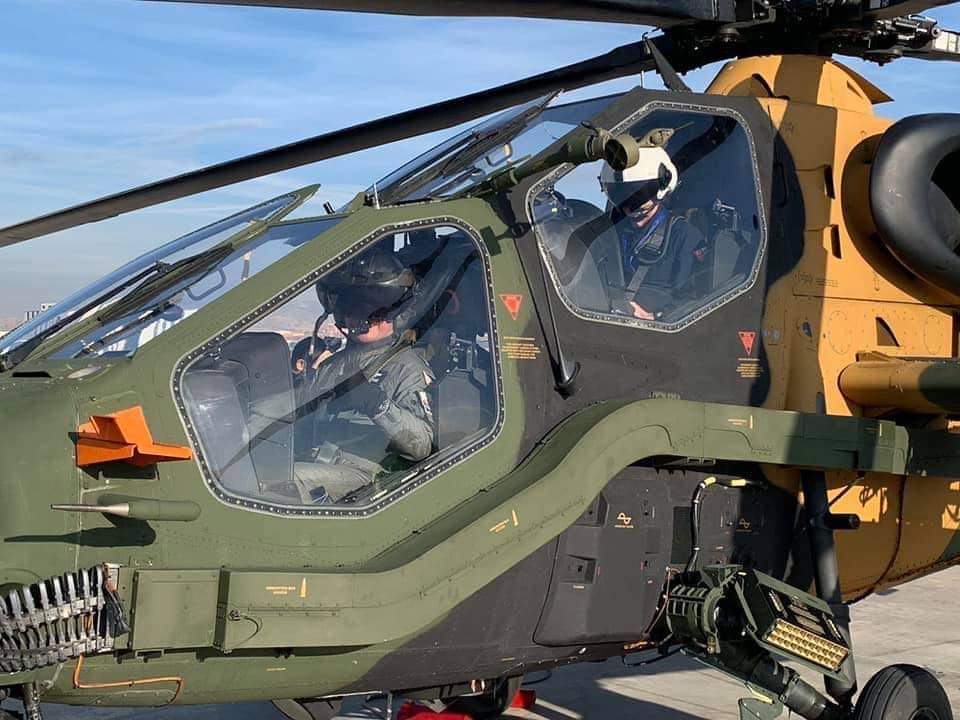 |
| PAF officer conducting flight tests with a T129 ATAK attack helicopter in Turkey. Photo shared to MaxDefense by one of our contributor. |
Despite the NOA, talks continued with other companies in case the Turkish deal fails to take-off.
Bell was able to improve its overall package for the AH-1Z Viper, and was able to commit that they could supply between 4 to 5 helicopters based on the PAF’s budget.
 |
| USMC Bell AH-1Z Viper attack helicopters escorting Bell UH-1Y Venom utility helicopters. Credits to original source of photo. |
While it has not gained much success in getting support from the PAF, Boeing was able to get the ears of officials from the General Headquarters, Armed Forces of the Philippines (GHQ-AFP), who agree that the Apache Guardian is the best option available.
 |
| The AH-64 Apache. |
According to MaxDefense sources, the insistence to also get approval for AH-64E sale is in anticipation also of a potential requirement for attack helicopters for the Philippine Army, and as a back-up plan in case both the negotiations by the DND and PAF with TAI and Bell end in failure.
DND Submits Letter of Request to US, TAI Requests for Time Extension:
By early 2020, both Bell and Boeing gained some ground when the DND decided to proceed with submitted a Letter of Request (LOR) with the US State Department for the potential sale of either the Bell AH-1Z Viper and the Boeing AH-64E Apache Guardian.
Meanwhile, TAI has requested the DND and PAF for changes to be made on the Implementing Arrangements of the project, to allow TAI an extra 1 year extension in delivering the Attack Helicopters compared to the original stipulated duration.
 |
| The AH-1Z and AH-64E. Credits to original sources of photos. |
MaxDefense believes that the delivery extension request was in anticipation that Turkey would get the US government to reconsider its export restrictions.
Extending by 1 year is not enough to allow an indigenous helicopter engine development to finish, and for type certification with the T129. These processes take at least 3-5 years, and continued use of the LHTEC T800 engine remains the best option for the T129.
 |
| The T129's 20mm guns and sighting system. Photo shared to MaxDefense by a contributor. |
US State Department Approves Potential Sale of AH-1Z or AH-64E:
By May 2020, the US Defense Security Cooperation Agency (DSCA) announced that the US State Department has approved the potential sale of both the Bell AH-1Z Viper and Boeing AH-64E Apache Guardian attack helicopters to the Philippines, and that the US Congress has been notified about this and would make its own approval of this plan.

 |
| The DSCA notice on the potential sale of AH-64E Apache Guardian attack helicopters to the Philippines. Photo taken from DCSA screengrab. |
The notices posted by DSCA shows an idea of the inclusions made by Bell and Boeing in their packages, considering both packages differ significantly in the inclusions, affecting the overall estimated price by more than 300%.

 |
| The DSCA notice on the potential sale of AH-1Z Viper attack helicopters to the Philippines. Photo taken from DSCA screengrab. |
MaxDefense posted these spreadsheets in our Facebook page to show the difference between the package inclusions, justifying why Boeing’s offer was far more expensive than the offer made by Bell.

 |
| Photo shared and credited to one of our contributor who wish to remain anonymous. |
Bell AH-1Z versus Boeing AH-64E:
MaxDefense posted another set of spreadsheets comparing the Bell AH-1Z and Boeing AH-64E in terms of certain parameters.
Data used came from and credited to Royal United Services Institute for Defence and Security Studies Australia, and Scott Lovell, used for the evaluation of both models for the Australian Army’s LAND 4503 ARH Replacement Project.


 |
| Data credited to RUSI Australia/Scott Lovell, edited and complied by one of our contributor who wish to remain anonymois |
Performance-wise, there are only small differences and MaxDefense has decided not to look into this anymore. Instead, we focus on more important details.
Based on the details above, MaxDefense believes that while the AH-64E Apache Guardian is considered the best attack helicopter available anywhere, the AH-1Z Viper is a better option for the PAF due to its speed, range, being navalized and corrosion resistant, lower acquisition and operating cost, and better leverage due to close relationship of the PAF with the AH-1Z’s biggest user the US Marine Corps.
 |
| PAF and USMC personnel with a USMC Bell AH-1W Super Cobra. Photo credited to origibal source. |
The biggest deciding factor is the AH-1Z being navalized and corrosion resistant, which enables it to survive the high salinity climate and environment of the Philippines that hounds military and civilian aircraft operating from our country. The AH-1Z was designed to operate from assault ships and conduct operates in coastal areas.
Another is the price factor. Generally the AH-1Z is somehow cheaper to acquire and sustain than the AH-64E based on an apples-to-apples comparison. Price has always been a major factor in any AFP Modernization Program acquisition, and the small savings actually is a big factor seriously looked at by the PAF.
Bell's outstanding relations with the PAF is another factor, considering Bell has been actively supporting the PAF's fleet, which is mostly equipped with Bell helicopters like the UH-1D/H Huey, Bell 412HP/EP, and AH-1S Cobra.

 |
| Majority of PAF's helicopter fleet is composed of Bell helicopters like the Bell 412EP (top) and Bell AH-1S Cobra (above). Credits to original source of top photos. |
Final Decision Rests on PAF Technical Team:
According to the latest statements made by Defense Sec. Delfin Lorenzana, the American helicopters are found to be expensive, and that the PAF decided to go with Turkey’s offer, and that Turkey as able to offer 6 helicopters while US companies can only offer 2 based on the PAF’s budget.
This reply from Sec. Lorenzana is simplistic, inaccurate, and could be based on old information considering Bell has been able to improve its offer. Even based on the US$450 million estimated package cost as per the DSCA notice, it shows that the offer can actually provide almost 4 helicopters, not 2 as Sec. Lorenzana mentioned.
 |
| Bell AH-1Z Viper. Credits to original source of photo. |
It is good to know though the Sec. Lorenzana confirmed his knowledge on Turkey’s issues with the US-soured components, although he mentioned that “it is Turkey’s problem” is a sign of lack of pro-activeness in the defense department to cut risks in deals that they entered into.
MaxDefense believes that the PAF has the ball on making the final decision if it is going to accept TAI’s request to extend the delivery date by 1 more year, or to move to its next best alternative which is the Bell AH-1Z Viper. If the PAF decides to stick with the T129 ATAK, it is expected that the DND would just do the same.
Even if there are powerful forces within the DND and the national government that are forcing the PAF to stick with the T129 ATAK, the PAF should show decisiveness in its decision making and must not allow itself to be pushed around.
 |
| Bell AH-1Z Viper firing AGM-114 Hellfire missile. Credits to original source of photo. |
As of this writing, the PAF has not officially changed its decision, although MaxDefense has received several confirmation from PAF sources that the PAF may not wait for TAI anymore and will instead move to go with Bell's AH-1Z Viper.
PAF sources also confirmed to MaxDefense that if they decide to drop the deal with TAI, it could take another 3 to 6 months to process. Thus, MaxDefense believes that a decision should be made ASAP.
The PAF needs to strongly consider the reality that TAI is not in a good position to solve its problems, and the PAF need not be dragged down too by their problems.
The Philippine Army Watches:
The Philippine Army (PA) is actually monitoring the developments of the project, as it may indirectly affect their own decision making on plans to have Attack Helicopters of their own.
The DND should consider that in their decision making too, that’s why this project is actually more complicated than everyone expect, even those from DND may not have realized the problems that may arise if the PAF and DND makes a bad decision.

 |
| The Philippine Army is eyeing the acquisition of possibly 2 classes of attack helicopters and is looking at the PAF project closely. Photos for reference only, credited to original sources. |
Deadline Looms:
Another problem is that the initial funds for the Attack Helicopter project was already subjected to a 1 year time extension by the Department of Budget and Management (DBM), and project’s funds should be used before 31 December 2020. That is just less than 7 months away.
The Covid-19 pandemic makes things even more difficult due to restrictions.
Also, the delivery of the helicopters are affected by further delays in concluding a contract for the project. If a contract can only be signed by September 2020, there is a possibility that the winning company would not be able to deliver a helicopter before Pres. Duterte leaves office in June 2022.
Take note that Pres. Duterte previously mentioned that he wants to prioritize projects that can be finished within his term. At this rate, the PAF Attack Helicopter Acquisition Project may not be one of them.
The US Government Also Waits:
Another factor that remains more clarity is what the US government's participation in the project, should the PAF and DND select an American attack helicopter model.
Previously MaxDefense mentioned that Bell has an indirect advantage due to the US government's willingness to provide additional attack helicopters in the form of used and refurbished Bell AH-1W Super Cobras currently operated by the US Marine Corps.
 |
| The Bell AH-1W Super Cobra |
MaxDefense's industry sources confirmed that Boeing has even made its displeasure known to the Pentagon due to Bell's advantage in such an offer, considering the Bell AH-1Z Viper is actually a direct replacement of the AH-1W Super Cobra.
This gives the Viper a better chance of getting selected should the US government provide a separate but related offer to either grant (donate) or affordably sell a squadron of AH-1W Super Cobras.

 |
| PAF pilots checking a USMC Bell AH-1W Super Cobra during joint exercises between the US and AFP. Photo taken from DVIDS hub. |
Despite its age, the AH-1W Super Cobra remains far better than any attack helicopter in the Philippine Air Force, and even better than attack helicopters of several regional neighbors. These are cheap but still useful assets that the PAF is very willing to accept based on our queries with PAF pilots and officers.
MaxDefense’s Opinion:
MaxDefense does not find any fault on the TAI T129 ATAK attack helicopter’s performance and capabilities. From the start, MaxDefense supported the decision of the PAF to select the T129 ATAK because it is a capable attack helicopter, while being a cheaper alternative to American or European models.
 |
| Philippine officials visiting TAI and the T129 ATAK in 2019. Photo credited to Philippine Embassy in Turkey. |
But the situation Turkey is facing with regards to obtaining the major components to manufacture the helicopter is something that is beyond the control of Turkish Aerospace Industries, and also beyond the control of the DND and PAF. The Philippine side cannot be faulted for any decision to ditch the deal with TAI because of the issues affecting the PAF's own timeframe.
MaxDefense believes that despite Turkey’s promises, it is risky to continue with the deal with TAI, and the DND should have been pro-active in checking the situation by coordinating with the US government regardimg the export restrictions to Turkey. Being a US ally, the Philippines should get a straight answer from the US government.
In simple terms, the T129 ATAK is indeed a cheaper helicopter. But how can its cheapness benefit the country if they do not have the engines and avionics to work?
As early as October 2019, MaxDefense made its voice heard when we said the Bell AH-1Z Viper would be the best solution for the PAF and DND rather than sticking with the uncertainty of Turkey’s ability to deliver the T129 ATAK.
The PAF and DND should look at Pakistan’s decision on how to go through with its T129 ATAK orders. Take note that Pakistan signed a contract in 2018 for the supply and delivery of 30 units of T129 ATAK attack helicopters for the Pakistan Army. As of 02 May 2020, the Pakistan government was reported to have given Turkey until July 2020 to confirm its ability to meet contract obligations, or the Pakistan government will cancel the contract and ask for damage reparations for the delays incurred on their own Attack Helicopter project.
 |
| Greece's Flight and Space Magazine correspondent Babak Taghvaee reported Pakistan's warning to Turkey regarding failure to start T129 production. Photo screengrabbed from Twitter. |
Despite recent political issues between the Philippines and the US including the plan to cancel the PH-US Visiting Forces Agreement (VFA), the fact remains: the US is still the Philippines’ foremost and only ally, and the country’s defense strategy hangs on the US military’s ability to support the Philippines.
It would be beneficial for the PAF to use attack helicopters used by its allies, as it also stand to benefit on maximizing its Defense Logistics Support agreement. This enables the US to provide spare parts and supplies of similar equipment from its own logistics chain in cases of emergencies, like what happened during the Battle of Marawi when the US provided munitions from its own inventory to the AFP.
Then there is the chance to potentially acquire excess AH-1W Super Cobras.
If the information is indeed true that PAF is dropping the T129 in favor of AH-1Z is true, do it swiftly and decisively.
 |
| PAF is said to be preparing to shift its plan to the AH-1Z due to Turkish issues on component supply. Photo credited to original owner. |
Project Summary:
Attack Helicopter (Horizon 2)Acquisition Project:
Note: Edited as of 05 May 2020.
* End User: Philippine Air Force (15th Strike Wing)
* Quantity: no specific quantity, cost dependent
* Modernization Phase: Horizon 2 Phase of RAFPMP
* Project ABC: Php13,800,000,000.00
* Acquisition Mode: Government-to-Government deal, originally with Turkish Ministry of Defense.
* Source of Funding: GAA Funds through AFP Modernization Program Trust Fund, to be paid via Multi-Year Obligation Authority (MYOA) process.
* SARO Release/s: TBA
* Winning Proponent: TBA
* Product for Delivery: TBA
* Contract Price: TBA
* First post by MaxDefense: TBA
* MaxDefense Searching Hashtag: #PAFAHAcquisition
* Status: TWG selected TAI T129 ATAK as basis for the Attack Helicopter project in 2018. Despite re-evaluation made in 2019 after Turkey had problems obtaining US and EU-sourced subsystems, NOA awarded to Turkish Aerospace Industries although PAF is looking at either Bell AH-1Z or Boeing AH-64E as alternatives to the T129. US State Department approval was confirmed for both American helicopters.
===============
===============
First release: 06 May 2020
Copyright MaxDefense Philippines


