Your 1st for Philippine Defense

Austal leads Philippine Navy's OPV Acquisition Project!

SecDef Lorenzana confirms Austal is still the preferred OPV supplier for the PN

The Philippine Navy commissions its 2nd Jose Rizal-class frigate!

The Philippine Navy welcomes BRP Antonio Luna (FF-151), its newest frigate!

The Philippine Navy selects Shaldag Mk. V for Fast Attack Interdiction Craft!

The DND has awarded the FAIC-M Acquisition Project to Israel Shipyards

The Philippine Air Force wants more Black Hawk helicopters!

The Philippine Air Force asks for more Black Hawks to allow the retirement of their Bell UH-1 Huey fleet

The Philippine Army orders the Sabrah Light Tank System from Israel!

Israel's Elbit Systems was declared the winner to supply light tanks to the PA

The Philippine Air Force receives full order of Hermes 900 and Hermes 450 UAVs!

All 9 Hermes 900 and 4 Hermes 450 MALE UAVs have been received by the PAF!


Sunday, September 15, 2013

Zamboanga City Crisis, a Photo Collection in Honor of the Officers and Men of the AFP and PNP


As the situation in Zamboanga City continues with the defiance of rogue MNLF units to stand down and surrender, it seems that this crisis will still take a few days, or even weeks more.

MaxDefense decided to tribute the people's champion, the soldiers and police officers of the Armed Forces of the Philippine and Philippine National Police, together with countless brave volunteers from the Philippine Red Cross, with this collection of photos taken from Zamboanga City.


Evacuating citizens of Zamboanga City trying to board vehicles bound for temporary evacuation centers. 

Residents running away for safety from the scene of fighting.

An army Simba armored vehicle positioned near Baranggay Rio Hondo in Zamboanga City.
Affected citizens evacuating after MNLF bandits burn their houses.
A Kia KM-450 vehcile from the Army's 32nd Infantry Battalion, troops responding on the first day of the crisis.

The first group of Philippine Army troops that responded on the first day. Note the number of onlookers.

Army troops securing the Zamboanga City General Hospital which is near the conflict zone during the 1st day of the crisis
1st group of Philippine Army soldiers deployed preparing to move in by foot to the conflict area. 
An Army soldier from Task Force Zamboanga armed with a recoilless rifle awaits instructions.
Army soldiers marching towards the conflict zone. Photo taken from TV11 Zamboanga.
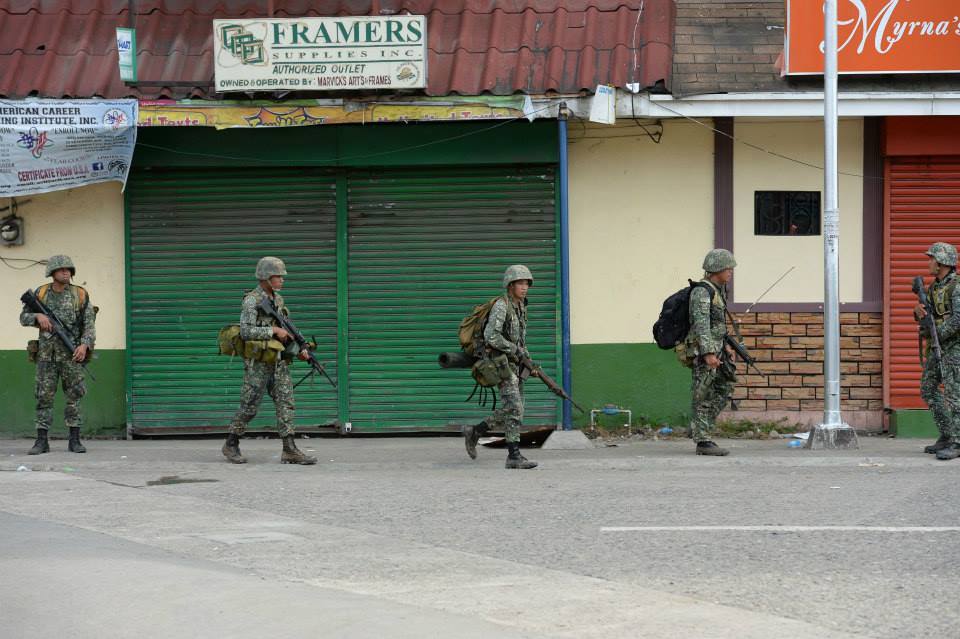
Philippine Army troops marching to the conflict zone after arriving in Zamboanga City on the 1st day of the conflict.

Philippine Marine troops marching towards the conflict zone after being offloaded near the city center. Photo taken from Associated Press.

Army soldiers with Simba armored vehicle.
Simba armored vehicles from the Philippine Army Mechanized Infantry Division mobilizing upon arrival at Zamboanga City. 
Soldiers and armored vehicles moving in.


A column of Philippine Army Simba armored vehicles from the Mechanized Infantry Division. 

A group of Philippine Marine troops discussing their plan of action before moving in. A Philippine Army Simba armored vehicle in the background. Photo taken from Reuters, dated September 12, 2013.
Marine troopers pray before moving in. Photo taken from Reuters, dated September 12, 2013.
One of the Marine troopers from MBLT-3 responding to the crisis. 
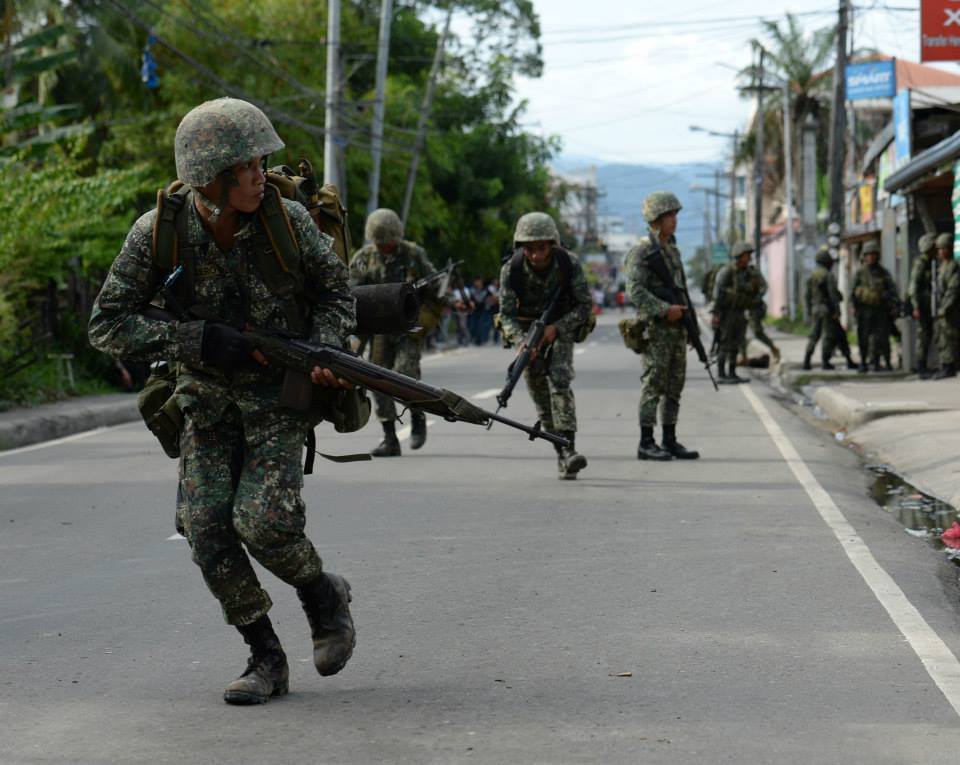
Philippine Marine Corps soldiers from Marine Battalion Landing Team 3 (MBLT-3) take positions along the city center area.
MBLT-3 Marine soldiers moving in.
Marines from Marine Battalion Landing Team 3 (MBLT-3) moving in.

PNP Regional Public Safety police officers secures and take position at one of the buildings near the MNLF bandit's strongholds.
Soldiers found some hidden weapons stored in rice bags being moved around, one of them is this. Photo taken from Reuters, September 11, 2013.

A Philippine Marine gunner positioning to secure a checkpoint. Photo taken from Reuters, dated September 11, 2013.
An army sniper armed with an M24 sniper rifle and M16 assault rifle takes position along Lustre Street in Zamboanga City.
An Army sniper armed with a Stoner SR-25 Mk. 11 sniper rifle scanning for targets.

Philippine Army troops positioned at the back of Simba armored vehicles while awaiting for signal to move in.
Simba armored vehicles from the Army take positions along Sta Catalina Road opposite to MNLF strongholds. Photo taken from Reuters, dated September 12, 2013.

Marines positioned on one side, Army on the other side.
Marines taking position. Photo taken from AFP.
Philippine National Police Special Action Force (PNP-SAF) troops march to the conflict area backed by armored Humvees from the Philippine Army and V-150 armored vehicles from the PNP-SAF. 
Fresh troops from the PNP Special Action Force together with Army armored Humvees and PNP V-150 armored vehicles.
PNP-SAF police commandos moving in while Zamboanga City police SWAT members looks. 
PNP-SAF police commandos moving in to the scene of fighting.


Residents scramble to fetch water to douse burning hourses. Photo and caption taken from Reuters, dated September 12, 2013.

Army soldiers at the intersection of Sta. Catalina Road and Lustre Street open fire on MNLF positions. Photo taken from Reuters, dated September 12, 2013. 


Army Scout Rangers preparing for an assault along Lustre Street. Take note of their appearance as compared to all other units from the Philippine military. 
Philippine Marine troops run across the street opposite positions of MNLF bandits. Take note of the M14 battle rifle carried by the soldiers.

Philippine Marine troops run across the street opposite positions of MNLF bandits. 


Inside the turret of a Simba armored vehicle.
A sniper armed with a Stoner SR-25 Mk.11 sniper rifle check for targets. Photo taken from AFP.
Philippine National Police Regional Public Safety police officers receives a surrendering MNLF bandit.
A Philippine Air Force MD-520MG gunship taking aerial reconnaissance of the conflict zone.
An Army UAV used during the conflict maneuvering for another pass at the enemy's positions.
MD-520MG gunships of the Philippine Air Force on ready for any sudden mission.
Bell UH-1H Huey combat utility helicopters stand ready at Edwin Andrews Air Base.
Army troopers secure chokepoints leading to the conflict zone.
Zamboanga City police officers securing the city center.
Zamboanga City police officers checking a vehicle as part of security measures.
Army soldiers and Simba armored vehicle posted near the conflict area.
Army soldiers take position at the intersection of Lustre and Evangelista Streets just near the combat zone. 
Some of the Philippine Air Force's UH-1H Huey combat utility helicopters providing support from Edwin Andrews Air Base.
Firefighters scrambling to take out the fire after MNLF bandits torched houses.
2 MD-520MG gunships at Edwin Andews Air Base, ready to fly in when needed.
A W-3A Sokol combat utility helicopter and a MD-520MG gunship on ready at Edwin Andrews Air Base while Zamboanga City's coastal baranggays are in flames.
PAF W-3 Sokol and MD-520MG attack gunship in Edwin Andrews Air Base while parts of the city burn after MNLF bandits torched houses. 


A Philippine Air Force C-130 Hercules cargo aircraft bringing in supplies at nearby Edwin Andrews Air Base.
Army troops and armored vehicles take position near Lustre Street in Zamboanga City, just opposite the MNLF bandit's positions. 
Residents evacuate as houses burn during the clashes. Photo taken from Reuters dated September 12, 2013.
A resident tries to douse water to burning houses. Photo taken from Reuters dated September 12, 2013.

Residents scrambling after houses were deliberately set on fire by MNLF bandits.

Residents desperately saving their houses from a fire using water buckets.
An army Scout Ranger giving instruction near burning houses.
An aerial photo showing parts of Zamboanga City in flames after MNLF bandits set these areas on fire intentionally. 
A Simba armored vehicle, with Baranggay Sta. Catalina burning. 
An Army Scout Ranger taking position under the cover of a Simba armored vehicle. Photo taken from Reuters dated September 12, 2013.
Snipers manning the roof take a shot at an MNLF target. Photo taken from Rappler.com
Philippine Marine troops engaged in a firefight with MNLF bandits. 
Army infantry (right) and Scout Rangers (left) with a Simba armored vehicle from the Mechanized Infantry Division. Photo taken from Associated Press.
Philippine Marine troops take cover, while a Simba armored vehicle gives cover fire. This is at the intersection of near Lustre Street. 
Army troops taking positions during a firefight with MNLF bandits.
Army troops and armored vehicles in a firefight with MNLF bandits. Photo taken from Reuters, dated September 12, 2013.
A Simba armored vehicle firing on MNLF positions at the end of Lustre Street in Zamboanga City. Photo from Reuters. 
Empty city streets of Zamboanga after citizens are forced to vacate their homes to safer areas until the situation settles down.
Police from PNP SAF and Regional Public Safety Office check on their colleague after being injured. 
Another injured army soldier awaiting medical attention. 
Philippine Red Cross volunteers moving in after taking a wounded volunteer after being injured from a nearby explosion. 
Philippine Red Cross volunteers evacuating an injured volunteer after being hit by a mortar round. Photo taken from Rappler. 


Philippine Red Cross volunteers evacuating wounded soldiers and fellow Red Cross volunteers after a mortar round was dropped in their location
An injured Army soldier awaiting evacuation after being hit by a mortar shrapnel. 
Soldiers evacuating injured troops and Red Cross volunteers. 

Army soldiers checking their injured companions while Red Cross volunteers move in to evacuate them.
An army soldier directing his companions after one of their comrades was injured. 


One of the injured Red Cross volunteers awaiting evacuation from the frontline. Photo taken from Rappler.


Soldiers carrying their injured comrade after being hit by mortar round from MNLF bandits. Photo taken from Rappler.
Mediamen taking cover behind a Simba armored vehicle from the Philippine Army to avoid being hit by MNLF snipers. Photo taken from GMA News.
A Scorpion light tank from the Philippine Army's Mechanized Infantry Division being loaded to a Philippine Air Force C-130 Hercules transport aircraft bound for Zamboanga City.
Philippine President Benigno Aquino III assisting in giving relief supplies for distribution to the affected citizens of Zamboanga City.
Philippine Marine Corps soldiers taking some snack and rest from a hectic day. Photo taken from Reuters, dated September 12, 2013. 
A Marine heavy weapons trooper resting. Photo from Reuters.
An army trooper taking a break a some snacks.
After heavy fighting these Marine soldiers take some rest while their comrades take over their duties for the moment. Photo taken from Reuters, dated September 12, 2013.
Army soldiers securing a street rests under a shade while awaiting further orders. 
Soldiers patrol the main boulevard in Zamboanga City to make sure the area is secured.
Let us remember the sacrifices of our soldiers and police officers, those who died and got injured during the course of the crisis, for their bravery and service to the country and people. Prayers and support for our men in uniform, and to the people of Zamboanga City.

Friday, September 6, 2013

Is the Philippine Navy experiencing fund shortage for it's new frigate program?

The cancellation of the option to purchase a third Hamilton-class WHEC from the US Coast Guard was announced by the Department of National Defense (DND) last week. Although this was not new since there was already an earlier announcement, the reason this time is different from the first.

Background:
Initially the DND decided to forego the purchase of another Hamilton-class vessel after it decided to instead use the ship purchase budget for capability upgrade for the 2 ships already in Philippine Navy (PN) service. These are the BRP Gregorio del Pilar (PF-15) and BRP Ramon Alcaraz (PF-16), both were stripped of their surface and air search radars, close in weapons systems, electronic surveillance measures (ESM) systems, tactical air navigation (TACAN) system, and other essential equipment before handing-over to the PN. The PN then installed new systems including additional light guns, a new commercial off-the-shelf (COTS) navigation and search radar, a new command and control suit with link with the Coast Watch System, VSAT and new satellite communications equipment and an Electronic Surveillance Measures (ESM) system. But the ships are still short on combat and surveillance capabilities, and the PN is contemplating of installing surveillance and combat systems that will increase the ship's war-fighting capabilities. But nothing much was done on this plan.


MaxDefense expected the USCGC Rush (WHEC-723) as possibly the 3rd PN WHEC.
Photo taken from USCG website.

Surprisingly the DND shifted back to the original plan of getting a 3rd Hamilton-class ship from the US, without mention of anything about the upgrade plan for the two ships already with the PN. This plan was also against earlier DND and PN statements on policy against buying "second-hand"ships, which according to them sealed the Maestrale-class frigate purchase plan's fate.

But again the new announcement to cancel the purchase of a 3rd WHEC is now directed on diverting the ship purchase budget to support the existing Php 18 billion budget for the PN's project for 2 brand new frigates.


Comparable Projects:
Previously MaxDefense brought out the issue of budgeting for the new frigates since there are doubts on what the PN can get based on comparable foreign warship project costs. For those unfamiliar with earlier MaxDefense blogs, please see these earlier posts for reference:

An In-Depth Look at the Philippine Navy Frigate Program of 2013
http://maxdefense.blogspot.com/2013/05/an-in-depth-look-at-philippine-navy.html

and

Proposed Designs Offered for the Philippine Navy Frigate Program 2013
http://maxdefense.blogspot.com/2013/05/proposed-designs-offered-for-philippine.html

Looking back on those previous assessments, it already shows that the PN budget is way lower than those of comparable regional frigate projects. MaxDefense provided some examples, but let us take another stab on the costing of the exemplified ships with the closest cost as the PN budget, as an update from last time:

Damen Schelde Shipbuilding's SIGMA-class
Based on earlier MaxDefense blogs, the Indonesian PKR Project based on Damen Schelde's SIGMA 10514 platform has the closest allocated budget as the PN at $220 million. But there are some information indicating that the Indonesian PKR SIGMA 10514 cost may only cover the hull, and the ship's mechanical and integral electronics systems plus technology transfer, and actual cost may reach closer to $280 million if including weapons and sensors. Also, the contract between Damen Schelde and Royal Moroccan Navy for 3 SIGMA ships (2 SIGMA 9813 version and 1 SIGMA 10513 version) was said to have cost $816 million as of 2008, or around $272 million per ship average although the 10513 version is expected to be more expensive than the shorter 9813 version due to the addition of an additional segment. Take note that the Indonesian PKR is slightly larger than those for Morocco.


Projected SIGMA 10514 frigate for Indonesia's PKR project.


Latest offer of Damen Schelde to Vietnam for 2 corvettes based on SIGMA 9814 was quoted by IHS Janes to probably reach $668 million, or $334 million per ship average, with one probably to be built in Vietnam and the entire contract may include technology transfer clauses.

(Note: The Damen Schelde SIGMA class is classified by a unique numbering system. The first 2 or 3 numbers signifies the length and the last 2 numbers signifying the beam, all in meters. Example: Indonesia's PKR based on 10514 means it is 105m length and 14m beam. Morocco's 10513 is 1m narrower than Indonesia's PKR.)

Hyundai Heavy Industry's Incheon-class:
Earlier information indicated that the price for the initial Incheon-class frigate for the Republic of Korea Navy (RoKN) costed $106.5 million for the hull made by Hyundai and a total cost of $232 million for the entire ship. It is still unclear if this includes Integrated Logistics Support (ILS) packages that is required by the DND/PN, and if Hyundai may opt for selected pricing premium for foreign clients like the Philippine Navy. It is expected that the amount does not include any form of technology transfer, although it is believed that the PN and DND are after this incentive.


Korea's Incheon-class frigate.

MaxDefense now expects the Philippine-offer price of the RoKN-standard Incheon-class frigate to be nearer to $250-$280 million. But the PN may always opt to remove certain items that may not be required, like RoKN-specific systems, and the land attack cruise missile Hyunmoo-3 option. The PN may also opt to replace some more-expensive systems with cheaper ones, like the installation of an OTO Melara 76mm Super Rapid gun instead of the larger and more expensive BAE 127mm Mk. 45 Mod. 4 gun.


So is there a funding shortage?

MaxDefense believes that the PN and DND may have found out that the budget they allocated for the 2 new frigates is not enough to get what they specified the ships to be capable of doing. MaxDefense sources say that the budget is already very tight as it is, and has not much allowance for the PN for additional systems that they may have overlooked. It is worth noting that the DND and PN already added Php 6 billion to the original Php 12 billion allocated for the 2 used Maestrale-class frigates without increasing the Php 75 billion allocated by the government for the Revised AFP Modernization Law for the first 5 years. 

Not only is the budget small, but it is also getting smaller everyday with the value of the Philippine Pesos falling against the US Dollar. The Php 18 billion budget for the frigate program was crafted early this year and was based on an exchange rate of $1 = Php42 ($214 million = Php 9 billion). Presently the exchange rate is around $1 = Php44.5 ($202 million = Php 9 billion), with the Peso down by more than 6% from its value a few months ago, and is still expected to fall in the next few months. It is expected that foreign shipbuilders and system providers will ask payment in US Dollars, and the PN has already lost $12 million per ship due to the declining value of the Peso.


Take note the exchange rate posted by MaxDefense on May 2, 2013 is at $1=Php41.19, while on September 6, 2013 is at $1=Php44.49, a sharp 7.5% fall of peso value already.
Photos taken from MaxDefense blog (top) and Bloomberg website (below).

Opinions and Options:
There are many ways to skin a cat, so they say. And MaxDefense sees three options for the Philippine government to solve this concern:

1. Increase budget allocation for the purchase of new frigate, to meet the budget as specified by the PN's frigate requirements.

This is actually the best solution, but the hardest to attain. The Philippine government may use Executive-sourced funding (so-called "Presidential Pork Barrel") like Fund 151 or Malampaya Special Account, which has been done before to fund AFP-related projects like the purchase of Hamilton-class cutters. There is even a growing consensus on both the government and private sector to use the Priority Development Assistance Fund (PDAF, aka "Pork Barrel") to boost modernization of the entire AFP, so if that happens this might be another source of funding.


An infographic from ABS-CBN shows what Php 10 billion from Legislative PDAF can do for the AFP (photo shows only for PN). Such amount could have given the PN enough room for improvements on the new frigate requirement.
Photo taken from ABS-CBN News website.

In some way, the cancellation of the 3rd Hamilton-class ship was another way to increase funding, this time by realignment of defense project priorities. MaxDefense does not see this as a good option, as we support the purchase of more Hamilton-class ships that are made available for the PN.


2. Avail of soft-loans offered by specific countries like South Korea to fund the ship's purchase.

There were reportedly standing offers for the Philippine government to avail soft loans, the most well-known is the offer from South Korea to avail their goods. Although a downside is the limitations to using that to buy the specific country's products, these countries have likely a strong defense industry and wide product range that the PN or the entire AFP can choose from. The only problem with this is President Aquino's previous statement from SONA 2013 of not availing loans that will become a problem of the next administration.


3. Remove or reduce expensive line items within the frigate program for separate budgeting, but building the ship to be fitted for but not with these items.

This is a common practice for military systems either to save on costs, or if a new technology still under development is expected to be placed on a certain platform. On our case it's the obviously the former. The PN may opt to build the frigate hull according to their expected capability, plus all the important items that will enable the ship to be minimally capable. Some major line items that can be separated are the surface-to-air missile systems, half of the expected anti-ship missile numbers, torpedo systems, anti-ship missile hard kill systems, and one of two possible sonar systems. 

These can already reduce the cost of the ship by around 30%-50%, and can be purchased separately should funding be available. The PN is familiar with this concept and is actually a policy for their purchase of Offshore Patrol Vessels (OPV), which has the option to be heavily armed in case of crisis or emergencies.


The Gregorio del Pilar-class frigates are actually examples of "fitted for but not with" ships. They have the capability to accept additional weapons and sensors when needed.
Photo taken from Philippine Embassy in Washington DC website.

A fourth option is possible, that is for the PN to decrease the specified requirements of the new frigate, either by decreasing its size, reducing the capability, or both, effectively making the ship more of a corvette or OPV rather than a frigate. But MaxDefense does not recommend this option at all as it does not make sense to do such option if the PN believes that they really need a frigate and not a smaller or less capable vessel.

Wednesday, August 28, 2013

A clearer picture on the Strategic Sealift Vessel of the Philippine Navy

The absence of enough information regarding the Philippine Navy's Strategic Sealift Vessel (SSV) has left the public blind on what we can expect on the ship's capabilities, features and aesthetics. But the recently released Supplemental Bid Bulletin (SBB) # 4 by the Department of National Defense (DND) has brought in enough relevant information on the project, as well as some hints of future procurement plans of the Armed Forces of the Philippines (AFP), to the point that we can now somehow see a clearer picture of what the SSV really is.


The SSV is said to be smaller than the earlier MRV requirement, which was supposed to be awarded to a Korean manufacturer before based on the Makassar-class LPD.

Based on the Supplemental Bid Bulletin # 4 for the SSV project, here are the basic information of the ship's specification based on MaxDefense' interpretation (a copy of the SBB can obtained here:  http://www.dnd.gov.ph/DNDWEBPAGE_files/BAC/2013/SBB/august/SBB-AFP-PN-SSV-13-04.pdf)

Type: Landing Platform Dock (LPD)
Displacement: approximately 7,300 tons full load, subject to shipbuilder's design
Length: 120 meters minimum, subject to shipbuilder's design
Beam: 21 meters minimum, subject to shipbuilder's design
Propulsion: at least 2 Diesel engines coupled to 2 controllable pitch propellers, subject to shipbuilder's proposal
Speed: at least 13 knots cruising, at least 16 knots maximum
Range: 7,500nmi @ 13 knots
Crew: between 100 to 130 officers and men

Boats Carried: 2 Landing Craft Mechanized/Utility at floodable well decks, 2 RHIB or LCVP on Boat Davits
Passengers: at least 500 troops
Decks: Tank (? sqm minimum) and Truck Deck (800 sqm minimum)
Payload: 2,800 tons minimum

Sensors: Navigation, Surface Search Radar, Air Search Radar, EW Suite, Electro-Optical Fire Control System (all separate items to be supplied by PN), Combat Management System

Weapons: Primary: 1 x gun (possibly between 40mm to 127mm), Secondary: 2 x 30mm automated cannons port and starboard sides (EO FCS controlled), ? x machine guns (all separate items to be supplied by PN)

Aircraft Accommodation  Helideck capacity for 2 x 10-ton helicopters (based on Sikorsky Black Hawk), Enclosed Hangar for 1 x 10-ton helicopter (also based on Black Hawk)

Surprisingly, the SSV's basic requirements are similar to the dimensions of PT PAL's SSV offer. This has been posted before in earlier MaxDefense blogs about this project.

Besides the basic information of the ship, there are also more information that MaxDefense finds interesting to discuss with, and here are the following points:

1. Presence of floodable wells and helicopter deck with hangar.
These features, plus the general information of the ship's details listed above, confirms that the SSV is indeed a Landing Platform Dock (LPD), a small one though as compared to typical Western designs. Larsen and Toubro's query even included a clarification on the ship's type being labelled as an SSV when in fact the ship is an LPD. The dimensions indicate that it has similar dimensions as the Indonesian Navy's Makassar-class LPD, and surprisingly has almost the same details as the SSV offer made by PT PAL. But unlike the Makassar-class, the SSV will be smaller, lighter and may be simpler to reduce costs.


Floodable wells, like this one, are present on the SSV. An indication that it is not just an ordinary ROPAX vessel as some believe.
Photo taken from Australian Ministry of Defense website.


2. Use of Mild Steel per ASTM A131 for the hull.
A query by Stone of David highlighted this and request considering the use of a more sturdier material for the hull, although the PN insisted on mild steel. Actually mild steel can be considered an excellent ship hull material due to its high strength, sufficient ductility and low cost. It retains some strength after yielding and before failure, which is a good characteristic for ship hulls. It is also lighter, giving the ship a better power to weight ratio for efficiency, while retaining the required strength as compared to other steel hull materials.

3. Inclusion of 2 Landing Crafts Mechanized/Utility (LCM/LCU) and 2 Rigid Hull Inflatable Boats (RHIB) per ship.
The SSV program already included the provision of 2 steel-hulled LCU or LCM as well as 2 RHIBs that will be delivered together with each ship. This was unexpected although it is a welcome addition since it was assumed earlier that these boats will be bid-out separately and will require a different budget and program. Although this would also mean that the cost for these boats will be deducted from the budget allocated for the SSVs.


2 units of LCU or LCM, similar to those shown above, are included in each ship's cost and will be carried by the SSV. They must have a 25-ton load capacity and are steel-hulled.
Photo taken from US Navy website.


4. Boat davit capacity of 15 tons while RHIB at full capacity is only around 4 tons.
Several bidders like Stone of David, Larsen and Toubro, and Propmech highlighted the issue of having a boat davit with load capacity of 15 tons that will be holding the RHIB, probably because they believe this an over-design that relates to higher costs. Although the PN intends to place RHIBs on these davits, it is expected that the PN may also opt to fit the heavier LCVP in its place when necessary. Actually Stone of David's query already indicated the possibility of using the davits for LCVPs. The LCVP usually has an empty weight of around 9 to 9.5 tons and will require a higher capacity davit, on this case the PN insisted on a 15-ton capacity davit. 


MaxDefense believes that the PN would also embark LCVP on davits,like shown above mounted onboard HMS Ocean (L12), thus the requirement for 15-ton capacity.
Photo taken from thamesvessels.blogspot.com.


5. Payload capacity of deck turntables at 25 tons.
The turntable is required to be able to handle a 25-ton payload of around 7 meters long, which are probably armored vehicles from either the Philippine Marines (PMC) or Philippine Army (PA). Except for the PMC's few LVTH-6, the heaviest armored vehicles in both the PA (ACV-300) and PMC (V-300) only weigh around 14 tons. MaxDefense does not expect the incoming AAVs to use the turntables so it means that the SSV is built to accomodate larger and heavier armored vehicles should the PA or PMC acquire them in the future.


A vehicle turntable similar but not exactly the same as above, with a diameter of 7 meters and load capacity of 25 tons, will be available at the truck deck for easy maneuver of vehicles on the tight space.
Photo taken from Haynes-World blog.

6. Helicopter landing deck and hangar capacity requirement.
There is a requirement for the ship to have a helicopter landing deck for 2 helicopters, and a hangar capacity for 1 helicopter. The replies provided by the DND/PN indicated that the helicopters are 10-ton types, with a specific mention of Sikorsky's Black Hawk helicopter. Although the Philippine Air Force (PAF) currently has a single S-70A Black Hawk in its fleet (Presidential Wing asset), it is expected that the ship will accommodate navalized PN helicopters more than standard PAF ones. MaxDefense believes that the PN may have plans to purchase Black Hawks in the future as part of its Desired Force Mix multi-purpose helicopter requirement, and the PAF may also do the same.


The SSV takes the Black Hawk into consideration in its design, giving the helicopter a place in the PN's future.
Photo taken from US Navy website.


7. Replenishment as Sea (RAS) capable.
The SSV will be RAS capable, with both port and starboard sides having RAS stations for easy replenishment. The PN's Gregorio del Pilar-class frigates are capable of RAS, but this capability is currently not available with the PN, although there are some indications that the PN is trying to acquire such capability, possibly by taking replenishment from allied naval vessels in the absence of PN replenishment vessels. There is also a possibility of the PN acquiring replenishment vessels in the future, as indicated in its Desired Force Mix white paper.


A replenishment at sea (RAS) / underway replenishment (UNREP) capability is being sought for the SSV, similar to shown above.
Photo from globalsecurity.org.


8. Weapons and sensors systems costs are separate from the ship's budget.
The SSB mentioned that the weapons and sensors systems will be "owner supplied", meaning it will be provided by the PN separately. This removes the cost of these systems from the SSV's budget, and good thing considering that these systems may cost as much as the budget allocated by the DND. With these separated, shipbuilders would now have more room to provide a better offer, and is beneficial to both the bidder and the end user. 

9. Types of weapons and sensors for the ship.
Sensor types mentioned in the SSB include a surveillance radar, an air search radar, electro-optical fire control system for the secondary guns, a Combat Management System, and an Electronic Warfare (EW) suite. The presence of an option to place an air search radar feature will enable the ship to detect and track airborne threats like aircraft and cruise missiles. The PN may employ similar radar systems that they intend to install on other future PN combat vessels like the new frigate. The EW suite is an added feature that would be beneficial as it gives an added defensive feature for the ship from OPFOR attacks. As for the weapons, the SBB mentioned the presence of 2 units 30mm guns, both remotely operated with electro-optical fire control system (EO-FCS). Although not mentioned, it may be safe to assume the presence of a larger primary weapon, probably a gun system with a higher caliber the secondary guns, somewhere between 40mm to 127mm. Also like other PN vessels, it is expected to have manually-operated 12.7mm machine guns for self-defense against small boats and minor threats. No mention was made regarding missile systems or anti-missile CIWS though.


A 3D search radar, like the Thales Smart-S shown above, is not impossible to be mounted on the SSV.
Photo taken from Thales Nederland website. 
Two secondary guns, similar to the Mk.38 Mod.2 shown above but with a 30mm gun, is eyed for each SSV. These would be remotely controlled, and linked to an electro-optical fire control system.
Photo taken from Wikimedia.

10. The SSV are configured as possible flagships.
The SBB confirms the earlier press releases that the SSV will also serve as flagships and mobile government centers aside from being amphibious transport vessels. The supplemental bulletin acknowledge the presence of a Presidential Room as well as a War Room, which are instrumental for government functions including the presence of the President of the Philippines in cases of emergencies and needs that require him and other key government officials to be on the ship.

Besides the above-mentioned details, some other information on the ship includes:
- the ships are designed to accommodate future AAVs (probably based on the AAV-7A1)
- availability of water desalination system capable of producing 25,000 liters per day;
- provision for bow thrusters, possibly for installation in the future;
- LCU / LCM will be steel-hulled, empty weight of 70 tons, load capacity of 18 tons or 80 troops, armed with 2 x 50 caliber machine guns;
- SSV delivery will be on Manila's South Harbor Pier 13


The scheduled submission and opening of bids is on August 29, 2013, although there is still a possibility of moving it to a latter date similar to what happened to other DND projects. Until then, let us see who among the potential bidders could step forward and offer their services to the DND.


===================================
Updates:

August 29, 2013:
Of the 9 potential contenders for the SSV project, only 2 submitted their bids: PT PAL Indonesia (builder of Banjarsamin-class) and Daewoo-Daesun of South Korea (builder of Makassar-class). But after further examination, the DND only qualified the bid of PT PAL, while Daewoo-Daesun was disqualified. It is still a hanging project as PT PAL needs to pass the post bid qualifications, which may start soon.

More of the news here and here.

==========

February 3, 2014:
The Philippine Navy has already provided the Notice of Award (NOA) for the SSV project to Indonesia's PT PAL after passing the post-bid qualifications and inspections. PT PAL itself confirmed receiving the NOA late last month, and is expecting the signing of contract to follow soon following these developments.

More here.

Philippine Navy Modernization Projects

Philippine Air Force Modernization Projects