Your 1st for Philippine Defense

Austal leads Philippine Navy's OPV Acquisition Project!

SecDef Lorenzana confirms Austal is still the preferred OPV supplier for the PN

The Philippine Navy commissions its 2nd Jose Rizal-class frigate!

The Philippine Navy welcomes BRP Antonio Luna (FF-151), its newest frigate!

The Philippine Navy selects Shaldag Mk. V for Fast Attack Interdiction Craft!

The DND has awarded the FAIC-M Acquisition Project to Israel Shipyards

The Philippine Air Force wants more Black Hawk helicopters!

The Philippine Air Force asks for more Black Hawks to allow the retirement of their Bell UH-1 Huey fleet

The Philippine Army orders the Sabrah Light Tank System from Israel!

Israel's Elbit Systems was declared the winner to supply light tanks to the PA

The Philippine Air Force receives full order of Hermes 900 and Hermes 450 UAVs!

All 9 Hermes 900 and 4 Hermes 450 MALE UAVs have been received by the PAF!


Tuesday, February 4, 2014

Philippine Army Armored Vehicle Weapon Mounts and Introduction of RWS

In our last blog entry, MaxDefense discussed the impending delivery of 142 M113A2 for the Philippine Army, divided into different variants according to what the PA specified. These includes 4 units with 25mm auto cannons mounted on remote weapons stations (RWS), 6 units with a 12.7mm machine gun mounted on remote weapons station, and 14 units with upgraded 76mm turrets, and the rest probably with only a pintle mount for a 12.7mm machine gun. In this blog, MaxDefense discusses the armored vehicle weapon mounts currently used by the Philippine Army, the importance of the remote weapons station (RWS) mount, and the Scorpion CRVT's 76mm gun turret.


A Philippine Army M113A1 APC, still marked as an asset of the Light Armor Division (LAD).


Current Philippine Army APC & IFV Weapon Mounts :
The Philippine Army uses different weapons mount on its armored vehicles. Wheeled armored vehicle models like the Cadillac Gage V-150 have one-man turrets mounting 12.7mm and 7.62mm machine guns. Simba armored vehicles have a one-man turret mounting a 12.7mm machine gun, and a few Simba on IFV role have a one-man turret mounting a 25mm M242 Bushmaster auto cannon. Some of these armored vehicles are also armed with a 40mm automatic grenade launcher on top of the turret, which exposes the operator when firing.


A Philippine Army V-150 Commando armored vehicle with a 1-man turret for 12.7mm and 7.62mm machine guns.  Most wheeled armored vehicles with the Philippine Army and the entire Armed Forces have this configuration.


Some Simba armored vehicles of the Philippine Army are equipped with a pintle-mounted 40mm automatic grenade launcher installed above the turret opening. This exposes the gunner's upper body from external threats.
Photo taken from Mindanews website.
Some Simbas are armed with a 1-man turret mounting a 25mm M242 Bushmaster auto cannon.
Photo taken from the former Light Armor Division website.


Tracked armored vehicles, specifically the M113A1 and ACV-300, are armed with pintle-mounted 12.7mm Browning M2 machine guns, with many M113A1 without any cupola armor protection which exposes the gunner. All ACV-300 and several of the M113A1 have cupola shields with frontal gun shields for added protection, but is still not enough to protect the gunner from sniper fire or threat from all sides. A few modified M113s mounted the turrets from disabled V-150 armored vehicles, and a handful were already converted to take the L23A1 76mm gun turret from non-working Scorpion CRVTs. 

Finally, the FMC AIFV (sometimes called the YPR-765) delivered in the late 1970s are equipped with a 1-man turret mounting a 25mm Oerlikon KBA auto cannon and co-axial machine guns, although there are some AIFV without the turrets, and are armed and protected in a similar way as the ACV-300.


The Philippine Army's AIFV (aka YPR-765) with turret mounting a 25mm Oerlikon KBA auto cannon. Take note of the improvised wooden plank armor on the vehicle's sides.


The incoming M113A2's remote weapons station would be the first time such system will be available to the Philippine Army, and the introduction of such technology is considered a leap-forward in its capability.


Remote Weapons System (RWS):
The Philippine Army decided to use the RWS system because of the advantages it offer to the gunner as compared to other weapon mount types like turrets and shielded pintle mounts. Previous experiences in armored vehicle operations and advancement in technology helped the PA decide on the choice.


The Elbit Systems RWS-H which can carry a 25mm auto cannon.
Photo taken from Elbit Systems RWS-H product data sheet.

The RWS will be controlled by gunner sitting inside the armored vehicle's compartment section, and will be using advanced sights capable of night operation, thermal imaging system to track targets and scan its peripherals, and laser range finders. This protects the gun operator from exposure to enemy fire and dangerous combat environments like explosion shrapnel and adverse weather conditions. Due to its advanced sighting capability, the gunner also has capability to see at night, and detect heat signatures of enemy targets including those hidden in jungles or urban areas. All these are far improvements from other weapon mounts, even those with improved armor protection which exposes the gun operator from sniper fire. The RWS are computer controlled and enhances its target acquisition capability and be able to fire while moving. This also improves the vehicle's mobility as it allows the driver to see the vehicle's path at night.


The RWS operator will be well protected inside the armored vehicle instead of being exposed in the open through the cupola. Not only does the system improve safety for the operator, but also increase the weapons capability through technological improvements.
Photo taken from Mechanized Infantry Division website.

Another advantage over the pintle-mounted and turret weapon mounts is space usage inside the vehicle. Manned mounts require a platform underneath the cupola which the turret operator will be positioned, which takes significant space inside the vehicle. Taking this out will increase the usable space for storage of equipment and ammunition, or seating space improvements.

With the introduction of remote weapons systems, then why did the Philippine Army still use the turrets of non-working Scorpion CRVT? 


Use of Scorpion CRVT turret for 76mm L23A1 gun:


One of the few remaining Scorpion CRVT with the Philippine Army.
Photo taken from Timawa.net c/o PAFunixGeek.

One reason on using the old Scorpion CRVT's 76mm gun and turret is because of practicality. There were previous plans to refurbish the ageing Scorpion fleet, which includes mechanical and electrical works and replacing the old and fuel-hungry Jaguar J60 4.2L petrol engine with a comparable diesel engine. The program was declared a failure after accusation of corruption and budget embezzlement came out, forcing the army to cancel the project. With the assets put to waste, the PA high command reviewed the program and decided to just scrap the non-working vehicles, with the usable parts removed as spares for working vehicles, and the turrets removed and installed on the M113 armored personnel carriers. As for the remaining Scorpion fleet, they will be retained for as long as the PA can maintain them, while a replacement is being studied for future acquisition. This reason is based on practicality on behalf of the army.

Aside from practicality, the 76mm gun is too large for an RWS to mount and carry, and can only be mounted using a manned turret. Most RWS systems offered in the market can carry only up to 30mm auto cannons. The Zamboanga City Siege was an unfortunate event that gave the AFP experience in urban warfare, and they saw the importance of low-pressure guns similar to the L23A1 76mm gun as a fire support weapon. 

As discussed in previous MaxDefense blogs, the shifting of Scorpion turrets to M113 bodies is not new to the PA, and was done before locally. Conversions were made on a few M113s in the late 90s, with one of the unit destroyed by the MILF during the All-Out War of President Estrada in 2000.


The PA made an in-house conversion of mating the Scorpion turret with the M113. This time, Elbit Systems will perform the modification including the modernization of the turret and the armored vehicle.
Photo taken from Timawa.net.

Elbit Systems was awarded to do the modernization of the turrets, which includes the repair of the 76mm gun and installation of new night-capable sights, thermal imaging system and laser range finders similar to the RWS for the other M113A2. Elbit Systems will also integrate the modernized turret to modern computer systems and installation to the M113A2 body.


Future Upgrades on Other PA Armored Assets:
With the introduction of remote weapon stations, it is expected that this would be in some way a trial batch and may become the basis of future weapon mount replacement for other armored vehicles in the Philippine Army arsenal, especially the M113 series. The Philippine Army has been using the M113 since the late 1960s, and modernization of the entire line is needed to keep it relevant with the times. MaxDefense sources confirmed plans of modernizing the entire M113 line, which may include mechanical & electrical works, and upgrading of the armor and weapons system as soon as more funding is provided by the national government. 


A Philippine Army M113 serving as part of the PHILCAGV force in Vietnam.  Most PA M113 weapons mount are shielded open cupola mounts similar to the configuration above.
Photo taken from Jerzy Krzeminski's photo collection.


In an army whose funding is not as large as its foreign counterparts, such projects are important to make sure that the Philippine Army continues to improve on its capabilities and take in new technology on a cheap but effective route. MaxDefense will provide more updates regarding this specific project, as well as other related projects, as more information becomes available.

Saturday, February 1, 2014

142 M113A2 Armored Vehicles Arriving for the Philippine Army

After several months of non-disclosure to the public, the Philippine Army (PA) finally announced its plans on the procurement of several armored vehicles to beef up its mechanized assets and improvement in capabilities as part of the AFP Modernization Program.


Philippine Army M113s, including one of the fire support vehicle versions on the right.
Photo taken from Istorya.net

Several news reports took on the DND's recent announcements with different interpretations, not only because of the media's lack of understanding of military terms, but also on the DND's lack of precise information regarding the projects because of unknown circumstances. There were not much information except for the the following: that there will be 28 "new" armored vehicles to be "procured" from Israel, with a budget of around Php 800+ million, and for delivery by 2015 without any specific mention of what model of armored vehicles. Another set of reports indicated that 14 M113s of the Philippine Army will receive modernized 76mm turrets from decommissioned Scorpion "tanks".

For MaxDefense reader's further understanding and clarification, let us disect the entire program.

All these talk of incoming armored vehicles involve the US-made M113A2 armored personnel carriers from US Army excess stocks. There are actually 2 batches of M113A2-based armored vehicles that will arrive for the Philippine Army, which were not properly discussed by media reports before as the DND kept it under wraps until recently. Despite being old and used assets, these M113A2 vehicles would greatly boost the PA's armor capabilities and increase the number of assets, as the PA only have less than 100 of the older M113A1 in its inventory left since the PA acquired them starting in the late 1960s. The last time the PA received such large number of armored assets was during the early 90s when the Simba 4x4 armored vehicle was introduced. The following are the breakdown of the M113A2 vehicles to be delivered for the PA:


Philippine Army officers inspecting the M113A2s intended for delivery to the PA.
Photo taken from Mechanized Infantry Division website.


An initial batch of 114 M113A2 armored personnel carriers, which were approved by the US Defense Security Cooperation Agency (DSCA) in 2012 as grants to the Philippine Army, are expected to arrive this 2014, and all are expected to be completely delivered before the end of the year. The earliest public announcement on this project was made at around 3rd quarter of last year, and was even posted early on the MaxDefense @ Facebook page. They were actually expected by the PA to be delivered starting on the 4th quarter of 2013 but met delays that pushed the delivery back for several months.


M113A2, similar to those above, would be provided to the Philippine Army under the US DSCA grant.
Photo taken from Army Recognition website.


These will all be coming from the US Army stocks, and are not yet confirmed if all will be in standard APC variant, as well as what equipment are included in the transfer, including its weapons and protection fit. The vehicles are expected to be refurbished before delivery, and will fill the bulk of the requirements for tracked mechanized assets of the army's newly-reformed Mechanized Infantry Division, previously known as the Light Armor Division. 


Aside from standard M113s, the PA also uses the ACV-300, a Turkish derivative of the US vehicle.
Photo taken from IPMS Philippines website.


In 2013, another batch of 28 M113A2 armored vehicles was approved for grant to the Philippine Army by the US DSCA, and was decided by the Philippine Army and DND high command to be upgraded with better weapons and situation awareness systems as an improvement to the earlier batch. A contract was signed a several weeks ago with Elbit Systems of Israel to undertake the upgrade program, which include the uparming of several units with the following breakdown:

- 14 units to fire support vehicles (FSV) armed with L23A1 76mm gun taken from decommissioned Philippine Army FV101 Scorpion CRVTs. These turrets will be upgraded by Elbit Systems to include installation of  a new fire control and thermal imaging system, and the guns itself would be refurbished. Due to this modification, MaxDefense expects the vehicles to carry less troops as it needs to provide space for the turret operator and ammunition storage.


The concept of a 76mm gun from the Scorpion CRVT is not really new, with the PA already having a couple of units modified in-house. The only difference now is that the 14 units will be using upgraded turrets, and the armored vehicles themselves are upgraded as well.
Photo taken from Timawa.net

- 4 units will be installed with a 25mm auto cannon mounted on a remote weapons station (RWS) supplied by Elbit Systems. No specifics on the model of gun to be used, but it's worth noting that the Philippine Army uses the Oerlikon KBA 25mm for the older AIFVs purchased in the 1970s, and the M242 Bushmaster 25mm on some Simba IFV versions. It may have a limited number of mounted troops it can carry but not as less than its FSV variant. MaxDefense believes that Elbit may use the RWS-H system and M242 Bushmaster 25mm gun which are already in service.


Elbit Systems may use their RWS-H system for the PA's requirements, and will be using a proven 25mm gun, possibly the M242 Bushmaster already in use on some PA Simba IFVs.
Photo taken from Elbit Systems USA product brochure of the RWS-H.


- 6 units will be installed with a 12.7mm heavy machine gun mounted on a RWS also supplied by Elbit Systems. These would probably be APCs capable of carrying the same number of mounted troops as a standard M113. MaxDefense believes Elbit Systems will make use of the RWS-M system with a M2HB 12.7mm machine gun.


Elbit Systems may also use the RWS-M for the APC variant of the upgraded M113A2, coupled with the already proven and in-service M2HB heavy machine gun.
Photo taken from Elbit Systems USA product brochure for RWS-M.

- 4 units will be converted by Elbit Systems to armored recovery vehicles, which will assist the other upgraded M113A2s. 
The PA will also get 4 M113s converted to armored recovery vehicles similar to the one above.

It is expected that Elbit System's subsidiary, Elbit Systems of America Land and C4I will do the said upgrades, as the armored vehicles are all stored in the mainland United States. All in all, 142 M113A2s are expected to arrive in different variants, and this was confirmed by a recent article from the PA's Mechanized Infantry Division's website.

For those expecting Israeli armored vehicles like the heavyweight Namer that the Israel Defense Forces are using, sorry to burst your bubbles. Looking at the budget alone, it is already obvious that these are not the vehicles the PA is expecting. There were a lot of people who thought this was what the PA will be getting from Israel, so sorry to burst your expectations but practicality alone can easily tell that Namers are not possible for now.


Sorry, no Namers for the Philippine Army.
Photo taken from Wikimedia.


Although MaxDefense is still confirming, it is expected that the DND and Philippine Army will be using the budget for the upgrades of 28 M113A2 to FSV, IFV and ARV versions, and delivery of all 142 refurbished APCs from the allocated budget to purchase 14 new tracked armored personnel carriers, which may not happen anymore due to decision changes. Originally budgeted at around Php 880 million, the Mechanized Infantry Division leadership saw that 14 new APCs won't really make a big difference to the MID's capability.  It would be better to make use of the budget to purchase a fleet of used but still effective armored vehicles to fill in the gaps in the organization requirements and improve the unit's capability. MaxDefense see this as a wise decision considering the small budget allocated for the improvement of the Mechanized Infantry.

Aside from these deliveries, it is expected that the PA will undertake a refurbishing and upgrade program for its current M113A1 fleet, and probably other MID assets like the AIFV and remaining Scorpion CRVT as well. 


The PA has around 50 FMC AIFV in its arsenal, and may need refurbishment soon due to age and wear & tear issues.

With more armored assets in its inventory, the Mechanized Infantry Division will indeed be a true division-sized organization with enough assets to meet its requirements, and will enable the distribution of its wheeled armored assets to fill other requirements including assignment to independent cavalry squadrons attached to the individual Infantry Divisions of the PA. 

It would be interesting to see if the PA still has several armored asset procurement projects soon, as there were previous announcements of improving its air defense capability to defend armored assets, as well as improving firepower by procuring heavier weapons systems like tanks and self-propelled artillery systems. MaxDefense will provide the updates to everyone once these plans come to priority within the DND and PA procurement boards.


==========
UPDATES:
==========
April 7, 2015:
A new MaxDefense blog post regarding the 2 separate projects of acquiring 114 surplus M113A2 APCfrom the US via EDA, and acquiring 28 refurbished upgraded M113A2+ IFVs from Israel was made available last April 6, 2015. It answers all the questions pertaining the project and debunking erroneous information released by media reports by Erwin Tulfo.

The link to the page is here:

"Questions Answered on Erroneous Reports on the Acquisition of M113 APC from the US and Israel for the Philippine Army"

Wednesday, January 15, 2014

RPG-7(USA) for the Philippine Army? Not Anymore.

The Philippine Army (PA) recently announced that it would be acquiring up to 400 light rocket launchers soon to replace its old and heavy 57mm and 90mm recoilless rifles in service since the Korean War. The PA is expecting the delivery to be before the end of the year.

Since the news is already out, MaxDefense will try to analyze this purchase with pieces of information we have on the acquisition project.


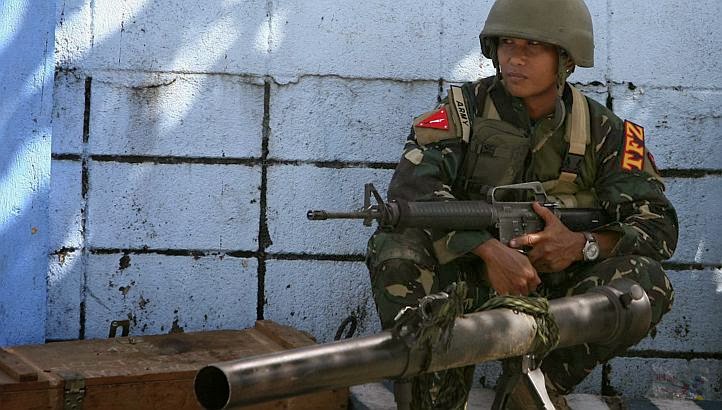
The Philippine Army still uses the M68 90mm recoilless rifle together with a few dozen of the smaller and older M18 57mm recoilless rifles. A new requirement for rocket launchers to replace them is in the pipeline.


The PA currently has several US-made recoilless rifles in service that it uses for hard and soft target assault, including bunkers, strucutres, and vehicles. These are composed of the shoulder-fired M18 57mm and M68 90mm recoilless rifles, and pad-mounted 75mm M20 and 105mm M40 recoilless rifles. In addition, the PA also uses much more modern types, the German-designed Armbrust bought from Singapore and the American M72 LAW, both disposable aim-and-shoot rocket launchers that are used by the PA's mechanized infantry and special operations operators.


The PA also uses the Armbrust rocket launcher, but this is a disposable one-shot system. The PA is looking for a reuseable system which is more cheaper in the long run.
Photo taken from Wikipedia.


Due to the size and weight of the M18 and M68 recoilless rifles, they are difficult to carry and bring along operations that require infantry to maneuver in distances. Most of the time it requires at least 2 soldiers just to carry around the weapon and ammunition. Not only are they heavy, they are also long, and requires 2 persons to fire and reload. Imagine its effects to fire teams that will require maneuvers like scaling hills and miles of walking carrying these antique behemoths. They would also impede troops that are mounted on space-devoid vehicles like armored vehicles. With the PA's aim to increase the firepower of its standard infantry squad, it is necessary to provide them with a lightweight system that is also easy to use and maintain, and can be used several times instead of throwing away after a single shot.

Initial AFP reports indicate that there are actually 2 batches of rocket launcher acquisitions: a first batch of 355 units with 4,800 rounds of ammunition and a budget of around Php 95 million, and another batch of 744 units plus ammunition on a later date with a budget of around Php 407 million. Both batches are to be purchased under the US Foreign Military Sales (FMS) program, thus would be sourced from the Americans. With the budget allocated, it appears that each rocket launcher system will cost around Php 500,000, or around $11,500 which is actually small when viewed from a weapon cost's perspective.


MaxDefense initially believed the requirement as possibly the US-made SMAW system, but since this is a more costly weapon system, the budget allocated by the PA may not be enough for this. But the PMC may consider this in their own rocket launcher project


Due to this budget, there could only be a few American-sourced re-useable systems that can be considered. MaxDefense initially thought it to possibly be the Shoulder-launced, Multipurpose Assault Weapon, aka SMAW, which was based on the Israeli B-300 system. But it appears that each of these launchers may cost as much as 10 times as the budget allocated by the PA. MaxDefense sees only 1 such weapon that may fit the budget: the RPG-7.

"But isn't the RPG-7 a Russian weapon?" Yes it is, but with its production license available for everyone to use, even the Americans found it interesting to produce. Enter Airtronics USA, a not so well known small arms and spare parts manufacturer that supplies the US Department of Defense and several foreign armed forces, including the Philippine armed forces. It produces several variants of the M203 40mm grenade launcher, M4 carbine, M2 machine gun, its versions of M16-based designated marksman rifle (DMR) and M5 carbine, RPG-7 based rocket propelled grenade launchers and magazines for M16-based rifles.


Airtronic USA's RPG-7(USA) may be considered by the PA as this fits the requirements and budget that they allocated.
Photo taken from Airtronic USA's website.


Information provided by MaxDefense sources indicate that the AFP uses M203 40mm grenade launchers and M4A1 carbines for the PA SOCOM made by Airtronics USA with the latest deliveries only a few years ago. Airtronics USA has developed their own versions of the Russian RPG-7 which they market as the RPG-7 USA and the lighter and simpler Mk. 777. The RPG-7 USA is actually an RPG-7 with several components found on M16-based rifles, like a quad-rail system, AR15-type pistol grips and fore-grips, and an M4-style collapsible stock.


Another Airtronic USA product that may fit the bill is the Mk. 777 system, which is lighter than the RPG-7(USA) but is cheaper and has less lifespan.
Photo taken from Airtronic USA's website.

MaxDefense believes that the PA chose to acquire the RPG-7(USA) for this project, on the basis of source of product, budget, and reuseablility. 

1. Source - being an FMS, it is expected to be an American product. Currently the US Armed Forces only uses the Swedish-made AT4, the Israeli-based SMAW-D (aka M141 by the US Army) and M153 SMAW of the USMC, and the obsolete M72 LAW. There are also missile systems like the FGM-148 Javelin and FGM-172 Predator systems. And there's the RPG-7 (USA) and Mk. 777 that the US military doesn't use but is produced by the US defense industry.

2. Reuseablity - of the products above, only the SMAW, Javelin, Predator, RPG-7 (USA) and Mk.777 are reuseable. 

3. Cost - with what the PA allocated, missile systems would definitely be out of the running. The SMAW may also not fit even if the launching system may fit the budget because of the cost of ammunition. Thus only the RPG-7 (USA) and Mk. 777 remains.


Bulgarian troops operating with RPG-7 during a joint exercise with US troops. Imagine the PA's own troops using this. It was highly unlikely several years ago, just goes to show the changes in planning and thinking by PA top-brass.
Photo taken from Wikipedia.

With the latest information from the Philippine Army spokesman that 400 launchers plus ammunition will be purchased as compared to the earlier 300+ units in previous news reports indicates that there were indeed changes in the previous acquisition plans. It is still worth checking if the final numbers will still be the same. MaxDefense sources indicated that although the manufacturer and product is unknown, the PA already confirmed that the first batch has already been finalized and will be delivered starting the middle of this year.

If the RPG-7 series is indeed chosen, this would be an interesting development since the weapon is something unexpected to be chosen by the PA even if such RPG weapons are already in the market for several decades.


==========
UPDATES:
==========
August 23, 2016:

MaxDefense received some updates on ongoing projects of the Philippine Army, and among those covered are for the acquisition of Rocket Launcher Light (RLL) which covers the acquisition of RPG-7.

There are currently two projects involving the RLL acquisition, the first is under RA 7898 which involves the acquisition of 335 rocket launchers and 3,272 rockets (called RLL Phase 1), while the second project is under RA 10349 (Horizon 1) involving 744 rocket launchers and will commence immediately upon the implementation of RLL Phase 1. It is expected that both projects will be awarded to the same company for commonality and practicality reasons.

Originally we covered that the Philippine Army could be acquiring the RPG-7USA made by Airtronic USA, since both projects actually involves the Joint US Military Assistance Group (JUSMAG) and will be done through Foreign Military Sales (FMS).

A few months ago, MaxDefense, in its Facebook page, confirmed that the deal with Airtronic USA was called off for unknown reasons, and no updates were made afterwards.

Its only now that MaxDefense was given an update through the Army's program updates, that the Rocket Launcher Light acqusition project is still a go, but as confirmed before, will not involve Airtronic USA. Instead, it would still be an FMS but there is a decision made involving a US-accredited, Bulgarian-based manufacturer, which MaxDefense believes is Armaco JSC based in Sofia, Bulgaria. Armaco appears to be the largest, if not, the only legitimate arms manufacturer in Bulgaria capable of manufacturing the RPG-7 and its ammunition.

It turns out that originally, the ammunition for the RPGs would also be sourced from Bulgaria, and it was decided that the RPG-7 would be better sourced from the same manufacturer as well instead of separating the acquisition between two separate suppliers (one for launcher, one for ammunition).

Armaco JSC manufactures their own variant of the RPG-7, which followed the type's original design rather than making innovations like what Airtronic USA's PSRL-1 (which is the new name of RPG-7USA) has like Piccatiny rails, sights, and use of lightweight materials.

As for the deal itself, processing of the FMS deal is still ongoing, and no award has been made as of this writing. But it is expected that an award will be made before the end of the year, and it is expected that deliveries could only be completed by 2nd quarter of 2018. Originally it was expected that the Philippine Army would have its first RPG-7s by as early as 2016 and replace its old and heavy recoilless rifles.

Since this project is still un-awarded to any supplier, MaxDefense expects more updates to be made available within the year.

Tuesday, January 14, 2014

C-295 Only Eligible Bid for PAF's Medium Lift Fixed Wing Aircraft Acquisition Program

The bid submission and opening for the Philippine Air Force's requirement for 3 Medium Lift Fixed Wing Aircraft has seen Airbus Military (EADS-CASA) and PT Dirgantara Indonesia (PT DI) fighting for the project, offering the C-295 and the CN-235, respectively. Noted was the absence of another expected bidder, Alenia Aermacchi with its C-27J Spartan aircraft, which made a previous complaint regarding supposed communication flaws by the DND last year. Of the 2 bids submitted, it was found that Airbus Military's C-295 is the lowest eligible bid, with a quote of Php 5.289 billion, or a little lower than the Php 5.3 billion budget allocated by the PAF and DND.


Airbus Military's C-295 transport aircraft, as used by the Spanish Air Force.
Airbus Military recently submitted the lowest compliant bid for the PAF's Medium Lift Fixed Wing Aircraft Acquisition Project, which will complement and ultimately replace the PAF's ageing Fokker F-27 aircraft.
Photo taken from Milavia.net


Early notes from people present in the bid opening process confirmed that only the bid of Airbus Military was found as eligible, with PT DI planning to file for motion for reconsideration. MaxDefense later found out that the CN-235, as previously reported by an earlier MaxDefense blog regarding this project, was non-compliant as it cannot carry the specified number of pallets, passengers, paratroopers, and stretchers as required by the technical specifications. It was also non-compliant on the payload requirements, making all these a strong reason for the aircraft to be disqualified.


A C-295 transport aircraft delivered to the Mexican Air Force.
Photo taken from shepherdmedia.com

As for Alenia Aermacchi's concerns, the Department of National Defense (DND) has vowed to answer all their earlier complaints separately. 


The CN-235 offered by PT DI was disqualified for failing to meet payload and space requirements. In a twist of fate, the winning bidder Airbus Military is one of the original manufacturers of the CN-235, together with PT DI.

It is expected that the post qualification process will start soon, and may involve DND and PAF personnel to check EADS-CASA-Airbus Military's facilities and C-295 production in Spain. No word though if PT DI will be involved in any way as they are also a licensed assembler of the C-295 for the Indonesian Armed Forces (TNI) and a strategic partner of Airbus Military. If everything goes as planned, it is expected that the planes will be available to the PAF after 26 months after opening of letter of credit which may be provided to Airbus Military by around March or April this year. Thus the latest the PAF can have their planes will be around May, 2016. The PAF would be luckier if Airbus Military can deliver earlier as their production of the C-295 is still in full blast. It is still unconfirmed though if Airbus Military offered the newer C-295W version, or the older C-295M.

With the choice of the C-295, it would be interesting to see next what would be the PAF's choice on the future Long Range Maritime Patrol Aircraft (LRMPA) acquisition project, wherein the a modified C-295 is said to be one of the contenders as well. Although it was confirmed by the DND and PAF sources that the LRMPA project might be US-sourced, it is still possible for the C-295 to steal the show as everything is not yet final on that project.


A C-295 in MPA form used by the Chilean Navy. With the C-295 choice of the PAF, the C-295 bid for the LRMPA project may be possible as well.

MaxDefense will provide updates on this project up until we can finally see a contract signed between the PAF and Airbus Military.

Tuesday, December 31, 2013

Year-Ender: A Brief Summary of 2013 Accomplishments of the AFP Modernization Program

(Bloggers note: Due to a few requests for a year-ender at a time when we also try to celebrate and rest, we'll give a short and brief one. MaxDefense still hopes that this fast-break will be good enough to brief some of our readers who are still blur on updates on the AFP Modernization Program.)


MaxDefense celebrates the end of 2013 with a brief summary of the AFP Modernization Program's major accomplishments for the entire year. Being a program that has been hampered by so many delays, scandals, political maneuvering and financial difficulties, MaxDefense is confident to say that 2013 might have been the best year for the Modernization Program since 1995. Numerous programs have started to roll this year, and some of them have been awarded or even delivered within the year.

Here's a recap of what was accomplished this year. Click on the title of each item for a link to either a previous MaxDefense blog or a MaxDefense @ Facebook discussion:


PHILIPPINE NAVY & PHILIPPINE MARINE CORPS
1. Commissioning of the BRP Ramon Alcaraz (PF-16) frigate with the Philippine Fleet - the 2nd Gregorio del Pilar-class frigate will be a further addition to the limited capability of the Philippine Navy's surface fleet. Upon commissioning it was immediately sent to Leyte to assist in the HADR operations for Typhoon Haiyan/Yolanda vicitims. Although it is only similar in capability to an offshore patrol vessel due to lack of sufficient sensors and missile weaponry, the PN is planning to install these when the ships go for a Service Life Extension Program (SLEP) soon, which may include 3D surveillance radar systems, anti-ship missiles, and other defense and offensive systems that will transform this patrol frigate into something that can fight and defend itself while giving the navy the eyes and ears in the vast Philippine EEZ.


The BRP Ramon Alcaraz (PF-16) leaving port right after the commissioning rites.


2. Commissioning of 3 AW109 Power naval multirole helicopters for the Naval Air Group - these helicopters will be based on navy ships and will be used in a variety of missions including surveillance, search and rescue (SAR), utility, and MEDEVAC. Future capability may include surface search, over the horizon target (OTHT) acquisition for naval ships, and probably even limited anti-submarine warfare (ASW) duties. We are expecting the delivery of 2 more helicopters, which according to the PN will be more capable than the 1st 3 units, being armed and with electronic warfare (EW) capability. 


The PN's AW109 Power naval helicopters during the commissioning ceremonies as part of the AFP's 78th Anniversary celebrations.
Photo taken from the Manila Times' Facebook page.


3. Awarding of the National Coast Watch Center system to Raytheon - this year also saw the awarding of a contract to Raytheon to construct and integrate the National Coast Watch Center. This include construction of the center, acquisition of related systems, andintegration of the entire Coast Watch system to different government agencies, including the AFP and the PN. The PN intends to complete several Coast Watch projects, including the Coast Watch South, Coast Watch North, and the main Coast Watch Project along the West Philippine Sea area.


Raytheon was awarded a contract to construct and integrate the National Coast Watch Center.
Photo taken fro Raytheon website.


4. Arrival of 6 Riverine Patrol Boats for the Philippine Marines - these Small Unit Riverine Craft (SURC) from Silver Boats USA will replace the some river armored crafts that the PMC previously used until they were turned-over to the Philippine Navy. They are armed with machine guns and best employed on river and coastal areas. The USMC operates a similar version of the boat for their riverine operations. 


The PMC's SURC during the presentation to public and commissioning rights.
Photo taken from Reuters.


5. Arrival of New 5-ton Kia KM-500 Artillery Prime Movers from South Korea, and other EDA Trucks from the US - the PMC displayed their new KM-500 trucks during the AFP 78th Anniversary, which will be used as prime movers for the impending 155mm Towed Howitzer purchase which is still ongoing. Aside from this new asset, the PMC also received some of the Excess Defense Article trucks provided by the US this year which can be used to increase the mobility capability of the corps. 


One of the PMC's KM-500 5-ton trucks on display during the AFP's 78th Anniversary celebrations.
Photo taken from Sandy @ Timawa Defense Forum.


PHILIPPINE AIR FORCE:
1. Arrival of the last 2 W-3A Sokol helicopters from Poland - the final batch of the W-3A Sokol helicopters from PZL Swidnik of Poland arrived early in 2013 to complete the contract for 8 units. Although criticized by the Aquino government, the helicopters found a new mission as search and rescue (SAR) helicopters for the 505th Search and Rescue Group. Near the end of its warranty period, it is expected that the PAF will upgrade these helicopters for them to perform their SAR duties better, like installation of hoists, search lights and transponders. A new paint scheme may also follow soon, probably in white and yellow.


One of the W-3A Sokols now sporting a new paint scheme as rescue helicopters for the 505th Search and Rescue Group.
Photo taken from Sandy @ Timawa Defense Forum.


2. Refurbishing of S-76A helicopters to air ambulances for the 505th Search and Rescue Group - the former gunships of the PAF are also getting another lease of life being air ambulances for the 505th Search and Rescue Group. Being air ambulances, they are equipped with mobile life support systems and will be used in transporting critically injured soldiers or victims to hospitals. Although not all S-76A in PAF inventory underwent this transformation, this is a good sign that these helicopters can still continue service with the PAF for several more years. Reportedly there are around 6 helicopters in operational service with the PAF, and we hope to see more of those stored airframes to be revived within the year.


One of the PAF's S-76A Air Ambulances from the 505th Search and Rescue Group.
Photo taken from Sandy @ Timawa Defense Forum.

3. Awarding of Attack Helicopter Acquisition Project to AgustaWestland for AW109 Power helicopters - The major acquisition project for 2013 is this, which will complement the smaller and older MD-520MG gunships of the PAF. This might also be the platform that will eventually replace these "Defenders" in the future. Armed with rocket and gun pods, these helicopters can also be configured as anti-tank platforms following further upgrades to make them compatible to fire guided missiles. In the meantime, the MD-520MG could also begin its SLEP program to extend their life for several more years.


AgustaWestland was awarded to supply 8 AW109 armed helicopters to the PAF.
Photo taken from malaysiaflyingherald blog site.


4. Notice of Award for Supply of 21 UH-1H Helicopters to Rice Aircraft Services and Eagle Copter - just before the year ended, the PAF finally awarded the supply the long delayed 21 refurbished UH-1H Huey combat utility helicopters to a joint venture of US-based Rice Aircraft Services and Canadian-based Eagle Copter. The helicopters are expected to arrive starting June next year. This will strengthen the helicopter fleet of the PAF while it waits for new assets to be procured in the near future. 13 of the UH-1H will be standard refurbished units, while 8 units will be upgraded versions.


Rice Aircraft Services and Eagle Copter finally gets a notice of award from the DND and PAF for the supply of UH-1H combat utility helicopters.
Photo taken from Rice Aircraft Services website.


PHILIPPINE ARMY:
1. Introduction of the M69B 81mm Mortars - Up to 100 units of the Bosnian-Serbian mortars were delivered to the Philippine Army (PA) this year to increase the firepower of all its infantry brigades and complement existing but older mortars in the service. More are expected to be procured of the type by the PA.


The M69B mortars displayed during the AFP's 78th Anniversary celebrations.
Photo taken from Hukbong Katihan ng Pilipinas' Facebook page.

2. Introduction of Raptor and Knight Falcon Unmanned Aerial System (UAS) - the Zamboanga City Crisis saw these UAS being deployed in action and successfully providing the needed information to the operators on the ground. The UAS are simple, small, cheap, yet effective enough for limited surveillance use and can be deployed in numbers for field operating units. The PA's Research and Development Center is still developing more advanced versions of the UAS and might be available by next year.


The Raptor and Knight Falcon UAS displayed during the AFP's 78th Anniversary celebrations.
Photo taken from Hukbong Katihan ng Pilipinas Facebook page.


3. Awarding of the Assault Rifle Acquisition Project to Remington Arms for the R4 rifle - together with the Philippine Marines (PMC), the PA will be receiving new Remington R4 carbines (M4) starting next year. These rifles will be issued to front line troopers, probably starting with the Mechanized Infantry Division troops (due to the need for a shorter rifle for those riding armored personnel carriers). Remington may also provide technical assistance to the Government Arsenal (GA) in developing future M16-derived rifles for the AFP. 


The Remington R4 carbine will be delivered starting next year.
Photo taken from Remington Defense website.


4. Introduction of M16A1 (enhanced) and M16A1 Dissipator from the Government Arsenal - several batches of refurbish and upgraded M16A1 rifles were handed over by the GA to the AFP, with majority of the rifles being delivered for the PA. The enhanced M16A1 rifles gives a new lease of life to the venerable M16A1, while the Dissipator 16" is a prelude to the proposed GA rifles to be provided to standard infantry units but still using the M16A1 as a base. More rifles are being refurbished by the GA, and we may also see M1911 refurbished pistols by next year.


M16A1 Dissipators on display during hand-over of 1 batch to the AFP.
Photo taken from Government Arsenal Facebook page.

5. Arrival of excess Armored Humvees M1114, and assorted trucks M939 and M35 series from the US - several utility vehicles were distributed to the Philippine Army from US Army EDA stocks, including armored Humvee M1114 series, and several 5-ton M939 and 2 1/2-ton M35 trucks in assorted variants like cargo & troop carrier, tractor heads, wreckers, dump trucks and van bodies. These armored Humvees saw action in the Zamboanga City Crisis providing armor and fire support for the troops.


M1114 Uparmored Humvees still in desert tan colored were utilized by the PA during the Zamboanga City Crisis. Several were delivered to the PA from US Army EDAs.


Special mention also to the modernization efforts of the Government Arsenal, which received several important items to improve their capability like the Universal Weapon Rest from SABER UK and Weighing and Gauging Machine from Waterbury Farrel of Canada delivered this year, and ongoing procurement for Electronic Pressure, Velocity, Action Time Testing Machine (EPVAT), and other items which will be procured by next year.


The Universal Weapon Rest procured from SABER of the United Kingdom.
Photo taken from Government Arsenal, DND Philippines Facebook page.


Aside from the programs realized and awarded this year, there are several ongoing bidding programs, G-2-G and FMS deals that are expected to be finalized and awarded or completed by next year. Major ticket items include, but not limited to the following:

- The Army's M113A2 delivery, Armored Recovery Vehicles, Shore-launched Anti-Ship Missile system;
- The Navy's Strategic Sealift Vessel (SSV), Frigates, procurement of additional MPAC, LCU, and SLEP for the Gregorio del Pilar-class frigates;
- The Marine Corp's Amphibious Assault Vehicle and Small Amphibian Vehicle;
- The Air Force's Light and Medium Lift Aircraft, Search and Rescue Seaplane, Flight Simulators, the FA-50 SAA/LIFT aircraft and ammunition, air defense radars, Maritime Patrol Aircraft, additional C-130s, new CUH, and bases development;
- The Army and Marines' 155mm Towed Howitzers, Night Fighting Optics, Force Protection Equipment, Mortars, Grenade Launchers, Light Rocket Launchers, additional Trucks and vehicles, additional MilSpec Radios, and various ammunition.


The awarding of the Frigate Acquisition Project is expected to be made next year, together with several other big ticket items for the entire AFP.


MaxDefense expects that 2014 would even be a better year for the AFP Modernization as many of the projects will reach the awarding stage, and there are also several programs that will have deliveries commencing in 2014. We also expects more new project announcements, many which are big-ticket items that will definitely give the AFP its needed boost. If MaxDefense sources are correct, additional funds may also boost the program with emphasis on defending the Philippines' energy-related territories in the West Philippine Sea, and equipment for Humanitarian Assistance and Disaster Relief (HADR) operations.


MaxDefense expects more big-ticket items to be announced in 2014, including the purchase of Maritime Patrol Aircraft, additional C-130s and transport planes, and more naval vessels and aircraft.

Aside from new procurements, MaxDefense expects the revival of several decommissioned or non-serviceable AFP assets due to the self-reliance and enhancement of maintenance capabilities gained these past few years. It may include additional C-130 aircraft, UH-1H and S-76A helicopters, and S-211 jets for the PAF, and armored vehicles and infantry weapons for the PA and PMC.


MaxDefense hopes that the PAF could revive another C-130 aircraft from the boneyard this 2014.

MaxDefense, as always, will try to keep its readers updated on the latest in Philippine and related defense matters, including updates on the AFP Modernization Program for 2014.  We will also try to tackle different defense issues pertaining to the Philippines and its neighbors. 

Wishing everyone a Happy New Year and we welcome a great 2014 for the AFP and the Filipino people!!

Philippine Navy Modernization Projects

Philippine Air Force Modernization Projects