Your 1st for Philippine Defense

Austal leads Philippine Navy's OPV Acquisition Project!

SecDef Lorenzana confirms Austal is still the preferred OPV supplier for the PN

The Philippine Navy commissions its 2nd Jose Rizal-class frigate!

The Philippine Navy welcomes BRP Antonio Luna (FF-151), its newest frigate!

The Philippine Navy selects Shaldag Mk. V for Fast Attack Interdiction Craft!

The DND has awarded the FAIC-M Acquisition Project to Israel Shipyards

The Philippine Air Force wants more Black Hawk helicopters!

The Philippine Air Force asks for more Black Hawks to allow the retirement of their Bell UH-1 Huey fleet

The Philippine Army orders the Sabrah Light Tank System from Israel!

Israel's Elbit Systems was declared the winner to supply light tanks to the PA

The Philippine Air Force receives full order of Hermes 900 and Hermes 450 UAVs!

All 9 Hermes 900 and 4 Hermes 450 MALE UAVs have been received by the PAF!


Sunday, September 21, 2014

Philippines-France Defense Cooperation Agreement - Easing the Supply of Military Equipment for the AFP

Philippine president Benigno Aquino III's official visit to France from September 17 to 19, 2014, concluded with several discussions and deals with the French government and France-based multinational companies. In relation to defense and security, Aquino was able to push for the signing of an updated Defense Cooperation Agreement between France and the Philippines, as well as meeting with Airbus top officials.


President Aquino meets French president Francois Hollande in Paris.
Photo taken Mr. Christian Hartmann c/o Reuters.


France-Philippines Defense Cooperation Agreement (DCA)
The 2 countries already have a previous DCA and the one signed in France this week updates and further strengthen this defense agreement. This paves the way for the the French government to assist the modernization program of the Armed Forces of the Philippines (AFP), and for allowing French companies to supply the Philippines with weapons platforms, systems, and defense-related goods and services. This also allows the Philippines to tap French assistance in other defense-related issues like training and education, warship visits and military aircraft stop-overs, and others.

Previously, the Department of National Defense (DND) indicated that a DCA is important in paving the way for defense acquisitions with certain companies and governments where the supplier is based. Such examples of previous DCA signed by the Philippine with other countries are those with Canada, South Korea, Indonesia, and the United States. This paved the way for the AFP and DND to acquire military assets from the said countries, with the Bell 412 CUH and VIP helicopters from Bell Textron Canada, FA-50 Fighting Eagle jets from Korea Aerospace Industries, and Strategic Sealift Vessels from PT PAL of Indonesia.


What the French are (and possibly) offering:
Current defense acquisitions and awards made by the DND and AFP include the C-295 medium lift tactical transport aircraft from Airbus Military, based in France. Aside from Airbus Military, French or part-French companies like MBDA Systems, Thales Group, STX France, Dassault Aviation, Airbus Helicopters (formerly Eurocopter), Nexter Group, and DCNS have shown interest, are offering, or are competing for contracts to supply various defense systems to the AFP.

Airbus Military, aside from its offer to supply the Philippine Air Force's (PAF) requirement for Long Range Maritime Patrol Aircraft (LRPA), has reportedly offered "a newly designed aircraft for disaster management", which can be provided by the French government through a possible Official Government Assistance loan to the Philippine government. MaxDefense sources, and analysis of previous plans of the AFP points to an offer for 2 units of the Airbus A400M Atlas transport aircraft, which can be considered as a dual-use asset for combat support and humanitarian Assistance and Disaster Relief (HADR) operations. MaxDefense previously tackled the need to more dual-use military assets for this requirement in a previous MaxDefense entry. Airbus has also recently won to supply the PAF with medium tactical transports with its C-295 aircraft.


Airbus was reportedly offering the A400M Atlas to the Philippines through the French government assistance.


STX France is one of the shipbuilders qualified to bid to construct the Philippine Navy's (PN) 2 new light frigates. Aside from that, STX France and other French shipbuilders like DCNS are offering or preparing for a possible tender for the long awaited Offshore Patrol Vessel requirement and other combat and support vessels for the Philippine Navy.


DCNS and other French shipbuilders are interested in upcoming projects for the Philippine Navy. Photo above shows DCNS' Gowind-class Offshore Patrol Vessel design.


MBDA Systems are currently offering assorted missile systems to the Philippine Navy for their upcoming and current naval and air assets, the Philippine Air Force, and to the Philippine Army (PA) for air defense systems. According to MaxDefense's PN sources, MBDA has a strong chance of getting some or all the missile system requirements for the upcoming new frigates. MaxDefense believes that the offers include the MM40 Exocet anti-ship missile, and any of their 3 naval anti-aircraft missile systems: the Mistral short range man-portable air defense missile, the vertical launch (VL) version of the longer ranged Mica missile, and the newer Common Anti-Air Modular Missile system (CAMM).

The Mistral is also being offered to provide air defense systems for the PN's current major naval assets; and the Lightweight Multirole Missile and Sea Viper for their AW109 Power naval helicopters and the upcoming ASW helicopters. They are also offering the Exocet anti-ship missile coastal battery version and Mistral to the PA for their missile system requirements. The PAF was also being offered to use the air-launched version of the Exocet missile for its upcoming LRPA acquisition.


A computer generated illustration of an AgustaWestland AW159 Wildcat fitted with both the Lightweight Multirole Missile (LMM) and the Sea Viper missile.
Photo taken from IHS-Jane's website.


The Thales Group has been also actively involved in offering its defense and security products, mostly on electronics, radars, sensors and surveillance systems, command and control systems, system integration and subsystems. It is involved and actively pushing its products for several of the AFP's current and upcoming projects, including the PAF's LRPA, surveillance systems, and aircraft subsystems; PN's new frigates & SSV, and ship upgrades for its current assets, GHQ-AFP and PA's C4ISR and battlefield radars system, and many others.


Thales' Captas towed array sonar might be one of the products being offered to the Philippine Navy.


Aside from new defense systems, the agreement paves the way for the French government to also possibly offer excess defense articles to the AFP. As a major military power that is experiencing some economic downhill like other European countries , it is expected that France has a lot of EDAs or systems that are about to be taken out French military service that they can offer at a lower price or as grants should the Philippines not be able to afford brand new systems.


A Georges Leygues-class frigate, which are to be withdrawn from French Navy service as more Aquitaine-class (FREMM) frigates come online. Used ships like this can boost the Philippine Navy's combat fleet in the face of Chinese aggression.
Photo taken from Wikipedia. 


This deal definitely helps the Philippine government pursue its plans to modernize the Armed Forces of the Philippines, and provide a closer defense relationship between the two republics.


Airbus A400M Atlas being offered?:


Comparing the 3 foremost large transport aircraft of the Western world: the Boeing C-17 Globemaster III (left), the Lockheed Martin C-130J Super Hercules (middle), and the Airbus Military A400M Atlas (right).
Photo taken from Key Publishing website.


This can be considered as a surprise move by Airbus and the French government. If confirmed as offered through official French government loans, this could actually be a win-win situation both for the Philippines and France for several reasons. Aside from the announced reason of assisting the Philippine government in increasing and improving its HADR capability, the move can actually be considered as both economically and politically for the French government for the following reasons:

1. Accepting the offer means a successful sale for France. By loan or not, the Philippines will still be paying for them, thus can still be considered a positive economic news and export for France and Airbus. This will definitely make a small share of revenue and jobs for France. 

2. With lowered sales numbers for the A400M from its original buyers like Spain, Germany and the UK, and South Africa cancelling their previous orders, Airbus and the French government together with its partners are looking for ways to find other customers to acquire the aircraft and re-build the numbers it needs. Getting the Philippines to join its current customers is one way of reducing the burden of reduced sales and growing unit costs to cope up with the projected profit and cover development costs of the aircraft. If France decides to offer those it previously committed to buy but decided to cancel, it definitely helps France to share its burden to the Philippines.

3. Getting more customers to have A400M in their inventories will help market the aircraft further to other countries. This is a proven sales strategy that is also applicable to military aircraft. Being considerably more expensive than the smaller Lockheed Martin C-130J Super Hercules and the soon available Embraer KC-390 from Brazil, only a few countries showed actual interest on the Atlas. Making it easy for countries to afford the aircraft by providing financial assistance may help increase the the number of users of the A400M. 

4. Airbus might be betting that having the A400M in PAF's inventory will definitely allow the Airbus to possibly get additional orders later on should the PAF replace the legacy C-130 Hercules in its fleet, or if money becomes a non-issue to enlarge the heavy transport fleet from its current numbers. 

5. The deal gives France the moral and political vote of confidence and support from the Philippine government and its people, while also gaining positive points to President Francois Hollande, his administration, and the French people for its generosity. 


If France really wanted to just assist the Philippines to have a reasonable capability to airlift goods and services during HADR operations, there are several other alternatives they could have offered instead of the hulking A400M. For ODA, they can offer the Airbus Military C-295 transport aircraft similar to what what the PAF ordered recently, although technically the C-295 is more of a Spanish product (being from CASA, now part of Airbus Military). France can also offer larger helicopters than what the PAF currently uses like the Airbus Helicopters EC725 Super Cougar which have good range and capable of airlift operations from hard to reach areas, although these are also expensive. The French government could also provide alternative means to aid the Philippines aside from ODA, like granting retired but still usable and immediately available assets like ex-Armee de l'Air C-160 Transall transport aircraft or Puma helicopters. 


Instead of the Airbus A400M, why not more of the smaller, more practical and already upcoming Airbus C-295? Although being a Spanish product, the French may prefer to sell something that they really can say as theirs.

Whatever the real reason is, the A400M is still a well-desired asset of any air force, and having them in PAF service is better than nothing at all. 


=============
MaxDefense is happy to report to its readers that it reached 2 million views last September11, 2014, or after 16 months and 9 days from its beginning. Thank you for your continued support of MaxDefense blogs!!
=============


=============
UPDATES:
=============
September 22, 2014:
To clarify MaxDefense readers: Official Development Assistance (ODA) is not applicable to warfighting equipment. It is only applicable to promote economic development and welfare assistance. HADR operations can be considered a welfare assistance, thus only dual-use military equipment can be considered, which includes airlifters like the Airbus A400M. Fighter aircraft, frigates, and the like can't be considered for ODA loans.

============
September 26, 2014:
MaxDefense realized that there are a lot of readers who are not familiar with the Airbus Military A400M Atlas. With this, MaxDefense refers you to these websites for further reading:

- Airbus Defense and Space website (official Airbus website for A400M)
- Military Factory website;
Global Security website;
- Military Today website;
- Flight Global website (news related to A400M)

MaxDefense suggests its readers to read more about the aircraft, its capabilities, and comparison to other similar aircraft like the Lockheed Martin C-130B-H and C-130J, Boeing C-17 Globemaster III, etc.

============
September 27, 2014:
Project Philippines strikes again, copying some of the contents of this blog almost word per word. Any idea on who runs this copycat blog? 

Tuesday, September 2, 2014

Philippine Navy Interested with US-made SWATH Vessel, and Proposal for Other Alternatives

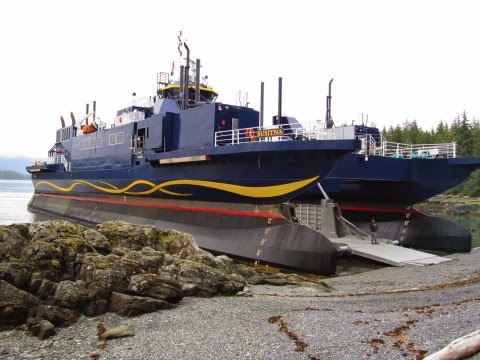
News of the Philippine Navy showing interest in an Alaskan borough-owned ferry has surfaced recently on several defense forums and groups after news reports from Alaska identified the Philippine Navy as one of the possible buyers. Currently the Matanuska-Susitna (Mat-Su) Borough owns the said vessel, M/V Susitna, and wanted to sell it off.


M/V Susitna during operational testing. Note the cargo hold is lifted during normal cruising.
Photo taken from Vigor Industrial website. 


The M/V Susitna:
M/V Susitna is actually a half-scale prototype for a proposed  Expeditionary Landing Craft (E-Craft) requirement for the US Navy, and was made by Alaska Ship & Drydock using a design from Guido Perla & Associates and concept from Lockheed Martin for the Office of Naval Research in 2010, and costed $78 million to build. It was reportedly planned as a "3-in-1" vessel, being a High Speed Catamaran that uses the SWATH (small waterplane area twin hull) design, with a variable draft system that allows the ship to shift from SWATH mode to barge mode by lowering or raising the center deck which carries the cargo, using an advanced hydraulic system. The ship was also designed with icebreaking capability (the first icebreaking SWATH ship in the world), and has the capability to beach and used on unprepared docks.


The MV Susitna is beachable, which is very important for use on damaged or unprepared docks.
Photo taken from gCaptain website.


Basic specifications of the ship are as follows:
Crew: 5 men
Range: 800nmi @ 16 knots, 1,600nmi @ 10 knots;
Length (overall): 59.54 meters;
Beam (overall): 18.29 meters;
Design Draft: 3.66 meters;
Design Displacement: 940 long tons (955 metric tons);
Maximum Speed: 20 knots;
Propulsion: 4 x MTU 12V4000 M70 (2,435hp each) Diesel Engines;
Radars: Kelvin Hughes Manta 30kw S-band, 10kw X-band;
Depth Sounders: Furuno FE700 echo sounder

The ship's payload details are as follows:
Center Barge (cargo hold): 160' x 35', approx. 5,400ft²  (around 501m²)
Capacity: 35 tons normal load
 * 129 passengers plus 20 standard vehicles or 1 tractor-trailer rig
 * No passenger, 1 M1A1 Abrams tank or multiple smaller combat vehicles


The lower and upper deck plans of the M/V Susitna.
Drawing taken from Mat-Su Borough Purchasing Division RFI document.


Most on the ship's basic specifications can be seen on the link HERE:

Although the ship was being evaluated by the US Navy, it was intended to be used as a civilian ferry for a local Alaskan government unit and service between the city of Anchorage to Port MacKenzie. But the ferry project failed and the ship was left with the Matanuska-Susitna Borough, who currently maintains it until a buyer can be found. It is reportedly being sold for only $6 million, just enough to help the borough pay for their bills and free them of maintenance costs.


The M/V Susitna before launching from Alaska Ship & Drydock's facility in 2010.
Photo taken from Valor Industrial website.


Enter the Philippine Navy:
MaxDefense has been monitoring this development for some time, and so far no confirmation was made by the Philippine Navy or the Philippines' Department of National Defense if they will acquire the vessel or not. So far PN sources confirmed that they have sent representatives to Alaska to inspect the vessel together with US Navy representatives last August 29, 2014. No word yet regarding their findings and evaluation. The presence of US Navy representatives might mean that the ship could be acquired with US Navy or government partcipation either through FMS, or will be possibly be shouldered by the US government under a US defense grant or part of its annual defense aid it gives to the country. No confirmation though on how the acquisition will be done should there be an agreement between the PN and the US government.

According to the PN sources, they are looking at the vessel due to its versatility and capability to deliver men and materiel directly to the beach, or on unprepared docks which are essential features of a capable transport ship during peacetime Humanitarian Assistance and Disaster Relief (HADR) operations and military and civilian supply missions, and in support of wartime amphibious operations. Aside from the ship's capabilities, the reported $6-8 million pricetag plus logistics support, training and other expenses, with regards to the technology it possess and its age (the ship is only 4 years old and was barely used), was a major factor of the PN's interest on the ship. Also, the PN sources confirmed to MaxDefense that the budget to acquire the ship, should it happen, will be from other sources and not from the AFP Modernization program. 

It should be remembered that the DND and AFP are looking to increase their HADR capability during the aftermath of the back-to-back disasters the Philippines faced in 2013 (Typhoon Haiyan and Bohol Earthquake), with calls for the AFP to have better capability to quickly respond to emergencies. The situation in the Kalayaan Group of Islands, with the absence of prepared docks and presence of Chinese Coast Guard patrol vessels, make the ship an effective platform for resupply missions. This vessel, if acquired, will be one of these dual-use equipment that can immediately be delivered to the PN should a confirmation be made soon. 


Parts of Samar were destroyed after Typhoon Haiyan hit the island. Unprepared or damaged docks, or beaches similar to that shown in the photo, can still be serviced by ships like the M/V Susitna.


Aside from the PN, there are many other interested buyers on the ship, mostly private corporations and oil companies, so a decision to acquire the ship or not will probably be made in a few months.


MaxDefense's Analysis:
The ship is actually cheap for the technology and capability it possess: a variable geometry, variable draft transport ship that is beachable, with ice breaking capability, and speeds of 20 knots, and almost new and barely used for $6 to 8 million (probably without transfer and other ancillary expenses). Findings during inspection of 3rd party valuation inspector found the ship in excellent condition. And best of all, it is readily available for transfer to whoever buys it. It would be best to compare the ship to its nearest equivalent to the Philippine Navy: the BRP Tagbanua (AT-296).


The BRP Tagbanua (AT-296) (above), the PN's newest transport asset, is the best platform to compare the M/V Susitna as they have almost comparable capabilities.


1. Price and Age:
The M/V Susitna originally costs $78 million in US taxpayer's money to construct, and they're selling it between $6 to $8 million ++ after 4 years of moored in cold Alaskan waters, barely used only for tests and trial runs, and for maintenance. The BRP Tagbanua was acquired by the Philippine Navy for a contract price of Php 178,900,000.00 (around $4.2 million in 2011). Both are almost the same age, with the M/V Susitna only more than a year older, still quite young for a used vessel. Based on this, the Alaskan ship is actually cheap considering that the price is not much different from the locally made and less technologically advanced BRP Tagbanua. It is also worth noting that Tagbanua is also actually cheap if compared to similarly but foreign built vessels of the same class.


Looking at the recent photo of the M/V Susitna above, it really does look immaculate.


2. Speed, Range, and Sea State Level:
The design of the M/V Susitna's hull was supposed to cut through the water more efficiently than standard transport ships, the Tagbanua included. The Susitna's maximum speed of 18 knots is barely higher than the Tagbanua's designed maximum speed of 15 knots, although it is expected that the twin-hull design of the US-made ship is more stable and less drag than the PN's LCU. The catamaran has a designed range of 1,600nmi @ 10 knots and is certified to operate to up to Sea State 3 although there were claims that the ship operated well in higher sea states. No range and sea state certification was found for the AT-296, although it is expected to be in the same range as the catamaran.

3. Payload:
This is where the M/V Susitna fails to beat the BRP Tagbanua. While the Susitna has a larger cargo deck of 501m² compared to the Tagbanua's 250m², the LCU beats in payload capacity as it can carry up to 110 tons of cargo versus the catamaran's measly 35 tons. With the catamaran having a higher displacement than the LCU, the design of heavy icebreaking hull is actually be a disadvantage since there's no use for this capability in tropical waters, while increasing the total weight of the ship and reducing its payload capacity as well.


The BRP Tagbanua's cargo deck is narrow and smaller than that of the M/V Susitna, yet it can carry heavier equipment unlike the catamaran. But the Susitna's capacity is good enough to carry lighter loads.
Photo taken from Rappler.


In this case, the Susitna may not be a good transport vessel for heavy equipment like tanks and bulldozers, although it could be a good asset to carry light vehicles and relief goods, or using the large deck to transport people for short distances. 

4. Fuel Efficiency, Maintenance:
The heavier M/V Susitna is powered by four 2,400hp MTU 12V4000 M70 engines, while the 40% lighter BRP Tagbanua is driven by a single Caterpillar CAT C32 ACERT 1,600hp diesel engine. You decide who drinks more fuel.

With more mechanical parts than a standard military or civilian transport ship, plus the vaunted advanced hydraulic lifting system for the cargo hold, it is also expected that the M/V Susitna may require more maintenance checks, spare parts, and a more complicated maintenance program that equates to more costs. 


Conclusion:
The M/V Susitna is a very nice ship to have, with technological features and extra capabilities that the PN might be happy to have. Technology-wise, having it means access for the PN to study for its self-reliance programs, and with the ship already awaiting a buyer, it is actually the best to have if the need is very immediate. In the case of the PN, they might be in a hurry to acquire an HADR-capable vessel very soon as the super typhoon season is fast approaching. 

Politically speaking, it is also worth looking at the US Navy's involvement in the acquisition. While we do not know how the PN intends to acquire the ship should they be interested, the US Navy might be instrumental to the acquisition, and it might be possible that they would grant the ship just to help the Mat-Su Borough get though with the pain of paying for its continuous upkeep without generating anything for the local government unit.

But it is also worth considering the PN's track record in terms of paying for acquisition and maintenance expenses. At the reported offer price, it is actually cheap, and the national government may already have the budget ready and only awaiting for the PN's approval. But the expected maintenance cost, coupled with the possible high operating cost might be a strong reason for the PN to decline the offer. MaxDefense's proposal is for the PN to only maximize the use of this ship in emergency situations, where money is not an issue when time is of the essence and lives are at stake.

MaxDefense believes that the PN should study this offer very well, although they must do it fast as there are many other possible candidates who might be willing to acquire the ship. 


The Australians have started taking out their Balikpapan-class heavy landing crafts. The PN could take them in if they are still in good condition.
Photo taken from Wikipedia.


Other proposals include the acquisition of other readily-available assets from other sources. The Australians have recently decommissioned their Balikpapan-class heavy landing crafts, which could be sold for cheap due to their age, while the Koreans have already started disposing some of their older landing crafts, with one example already reportedly recently donated to the PN. Also, it is expected that the Republic of Korea Navy (ROKN) is about to take-out some of their Go Jun Bong-class landing ship tanks to give way to newer ships that are coming in soon. The PN should take advantage of these assets not only to for HADR operations, but also to replace the already delapidated World War II US-made LSTs sisterships of the BRP Sierra Madre that the PN continues to operate. For long term, the PN must continue to acquire new LCUs similar to its BRP Tagbanua, which is said to have some identified flaws that could be rectified in newer derivatives of the ship class.


The PN is scheduled to receive a used Korean-made Landing Craft Utility from the ROKN. There are more of these in ROKN's stocks that are expected to be taken out of service very soon.
The PN should also take a closer look at the Korean Go Jun Bong-class LST to replace the PN's WW2-era LSTs. These are good long term solutions to replace old PN transport assets.
Photo taken from Wikipedia.


===============
UPDATES:
===============
September 7, 2014:
A recent news report from the Alaska Dispatch News indicated that the Mat-Su Borough is really in a hurry to dispose the M/V Susitna due to mounting upkeep expenses, and is hoping that the recent visit by Philippine Navy officials will bear fruit. Due to the ship being a previous project by the US Navy, it is expected that any acquisition of the ship by foreign governments may require it to be done through their supervision. 

It was also indicated that should the PN acquire the ship, it would be modified from a day-only vessel to an asset that has provisions for all-day operations, including enclosed passenger compartments for troops or civilian evacuees. This means that the costs of acquiring the ship may go up from the original $6 million, with the additional costs going to logistics support and spare parts, training of ship crew and maintenance teams, modifications based on Philippine Navy requirements, and shipping from Alaska to the Philippines. MaxDefense believes that this would probably double the total acquisition cost of the ship.

Sunday, August 31, 2014

Israeli Firm Confirmed Winner for Force Protection Equipment for the Philippine Army and Marine Corps

After post qualification was done by the Philippines' Department of National Defense, it was determined that a joint venture between Israeli protective equipment manufacturer Achidatex Nazareth Elite and Filipino shipbuilder Colorado Shipyard Corp. won the tender for the Force Protection Equipment Acquisition Project for the Philippine Army and Philippine Marine Corps. A Notice of Award was provided to the joint venture last July 28, 2014, with Colorado Shipyard being the local proponent on behalf of the Israeli manufacturer.

Aside from Achidatex Nazareth Elite, other participants of the bidding were Serbian company UM-Merkata DOOMKU Private Limited of India, and Korean conglomerate Kolon Global Corp.


Only a few Philippine Army and Philippine Marine Corps units wear complete personal protective gear of at least a Kevlar helmet and bullet proof vest even in frontline duties. The Force Protection Equipment will try to change that with regards to bullet proof vests.


The Approved Budget for the Contract (ABC) for this project is Php 1,763,200,00.00, and the amount submitted by the joint venture was at around Php 1.4 billion. 44,080 body armors were required by the DND, and the Invitation to Bid was issued on February 2013. Delivery was stated by the DND to be 365 days from the opening of Letter of Credit. So far, a formal contract signing between the DND and the joint venture has not yet been made, but it is expected that the initial batch of protection vests will be delivered to the AFP by around 3rd quarter of 2015.

Each Force Protection Equipment (as named by the DND and AFP) is said to weigh between 5.8-6.8 kilograms each, with consideration to the standard body structure of a typical Filipino soldier. 


Achidatex has several bullet proof vest designs in its product line, including the AC-331D design seen above.

This is actually the second attempt by the DND to bid out the requirement. The first attempt was done last 2012 and the lowest bid was made by UM-Merkata DOO, although they failed the post qualification inspections and according to MaxDefense sources, the PA and PMC also slightly revised the specifications that were used in the latest bidding.

For this specific tender, Korean company Kolon Global Corporation was originally declared the lowest bidder, whose submitted bid amount was at only around Php 894,000,000.00. But they failed the post-bid qualifications after the DND found that the vests offered by Kolon was non-compliant, specifically the ballistic protection plate was shorter than required by the Technical Specifications. Kolon believes their product was compliant as their plate was curved and the DND inspection team measured using a straight line method from end to end of the plate, and no following the length of the arc, thus the measurement was by somewhere between 1 to 2 centimeters. There were concerns from Kolon Global that the DND BAC was favoring certain companies for the project.


Philippine Army troopers during the Zamboanga City siege of 2013. No helmets, no bullet proof vest. This increases the number of injuries and casualties during firefights.


Achidatex Nazareth Elite is a company under the DFNS Group, which specializes in protective equipment and services. Achidatex specializes in personal, vehicle, and building protection systems, and produces their own armoring systems although the entire DFNS Group may provide all the necessary ancillary items included in the product.

It is not yet confirmed though on what is the actual participation of the  local shipbuilder Colorado Shipyard Corp. with regards to this project. Aside from their affiliate company Philippine Rigid Construction Corp., MaxDefense has not yet confirmed if they have started expanding their business into other businesses aside from shipyard and construction. 

Although this project is already late and should have been given one of the top priorities of the AFP Modernization Program, its award to Achidatex represents and important step towards modernizing the basic infantry of the PA and PMC together with the acquisition of new combat boots (which is still pending after the failure of the new locally made Kubar combat boots), more Kevlar helmets, tactical vests and communications equipment, new assault rifles, and heavier infantry weapons. 


= = = = = = = = = =
U P D A T E S :
= = = = = = = = = =
September 3, 2015:

It was reported on July 2015 that the Philippine Army has yet to receive the first batch of 20,000 force protection equipment from the joint venture of Achidatex Nazareth Elite of Israel, and Colorado Shipyard of the Philippines. The original deadline should have been on the first week of March 2015, but the DND approved a requested 120 days extension which expired on 29th June 2015.

After more than 2 months, the DND has still not made any decision on the matter, since the joint venture still failed to deliver. Normally, the DND should have already taken action by now by announcing the issue to the press, and start preparation for contract termination. But until now MaxDefense has not receive any information of a move to terminate the contract.

So why is it taking too long to terminate the contract and award it to the next lowest calculated bidder, when other projects were very fast in doing such move?

= = = = = = = = = =
July 12, 2016:

MaxDefense received an update regarding the Acquisition of Force Protection Equipment which was previously awarded to the Achidatex Nazareth Elite - Colorado Shipyard Joint Venture. This project is part of the AFP Modernization Program funded under RA 7898.

Sources confirmed that Achidatex Nazareth Elite and Colorado Shipyard cannot deliver the body armour vests due to lack of funding to manufacture 44,000+ vests, resulting to a fall-out between the two companies. 

While it was previously mentioned as a cancelled project due to the failure of the joint venture to deliver the products within the specified timeframe, it appears that the project is currently under arbitration and wil take some time before a decision can be made.

Meanwhile, the DND has awarded a contract to supply another project covering 3,480 body armour vests, previously awarded to Um Merkata DOO but was declared a bid failure by the DND after declaring that the vests from Um Merkata DOO did not meet the specified requirements of the Philippine Army.

For this project, MKU Pvt. Ltd. of India was declared the new winner, and will supply the 3,480 body armour vests to the Philippine Army.

MKU was actually also among the bidders for the project that Achidatex Nazareth Elite-Colorado Shipyard JV wn, but was not actually the next lowest bidder. They appear to still be interested to take the job when the DND decided to look for a replacement for Achidatex-Colorado JV if the arbitration goes in the DND's favour.

No timeline was provided, but this is certainly good news after more than a year of delay.


MKU Pvt. Ltd. of India was declared the new winner to supply Force Protection Body Armour Vests to the Philippine Army and Philippine Marine Corps.
Photo taken from MKU's website.

= = = = = = = = = =


Friday, August 22, 2014

Upgrades for the Philippine Navy's Gregorio del Pilar-class Frigates on the way

The Philippine Navy is expected to proceed with the upgrades for their Gregorio del Pilar-class frigates soon, with the program already more than a year delayed. The program will be divided into several scopes, but major emphasis will be given on up-arming the ships and providing them with a reasonable surveillance and detection capability.


The two Gregorio del Pilar-class frigates of the Philippine Navy during naval exercises with the US Navy.
Photo taken from the US Navy via Wikipedia.


There are earlier indications from MaxDefense sources that the separation of the new frigate weapons acquisition from the original frigate acquisition project can closely be attributed to other weapons system requirements of the PN. This includes the upgrade for the Gregorio del Pilar-class frigates and other weapons systems for upcoming PN naval assets.

Currently, the lead ship BRP Gregorio del Pilar (PF-15) is better armed compared to its sistership BRP Ramon Alcaraz (PF-16), which as of this writing is headed to Northern Australia to participate in the bi-annual KAKADU 2014 exercises. Compared to the PF-16, the PF-15 is armed with a single Mk.38 Mod. 0 chain gun, positioned where the Phalanx CIWS was previously located. It is also armed with two 20mm Oerlikon guns, which the PF-16 currently lacks.


Weapons Systems:
Latest information from the Philippine Navy suggests that the BRP Gregorio del Pilar will undergo the 1st phase of the up-arming program, which is to install two (2) BAE Mk. 38 Mod. 2 MGS (Machine Gun Systems), one each on the port and starboard midship decks. The Mk.38 Mod. 2 MGS is a remote-controlled weapons system mounting the 25mm M242 auto cannon, with a 2.5km range to defend the ship against small, fast surface threats. Although this can be considered as a Close-in Weapons System (CIWS), it is not designed to shoot fast aircraft and incoming anti-ship missiles like the Phanalx. 


The BAE Mk.38 Mod.2 25mm MGS are to be installed on the Gregorio del Pilar-class frigates, and probably with other upcoming naval assets.
Photo taken from Wikipedia.


The gun systems are reportedly now with the PN, and were originally planned to be installed on the BRP Ramon Alcaraz, but the decision to shift to the leadship was made by the PN leadership. Any plans to install the same weapons to the PF-16 means that the PN would made an order with the US government, possibly under the US Foreign Military Sales (FMS) program similar to how the 2 earlier guns were acquired. No definite new orders were made yet, although MaxDefense expects the PN to acquire not just 2 MGS, since the upcoming new frigates and Strategic Sealift Vessles (SSV) requires similar systems as well. A bulk buy might be the course for the PN.

MaxDefense sources also confirmed that the PN is "strongly interested" in acquiring the Raytheon Phalanx CIWS for the Gregorio del Pilar-class an "a number of other ships". The Phalanx is the US Navy's premier short range hard kill system against anti-ship missiles and aircraft, and uses a 20mm 6-barrel M61 Vulcan gatling gun. It is the best CIWS system that can be fitted to the Gregorio del Pilar-class, as they were previously armed with this one each, but was removed as it was not part of the deal between the Philippine and US governments for the transfer of the ships to the PN. The Phalanx does not require lengthy deck penetration works, allowing for easy installation and avoid costly modifications.


The Raytheon Phalanx mutli-barrel CIWS is eyed by the PN for its major naval assets.
Photo taken from Wikipedia.


The PN's decision was due to considerations for ship survivability issues, as the greatest threats they expect to face would probably be from anti-ship missile attacks from surface, air, or sub-surface platforms, or torpedo attacks from submarines. Should they be acquired for the Gregorio del Pilar-class, the Phalanx would probably be installed on the ship's aft where the US Coast Guard previously installed a similar CIWS. The PN has even included the Phalanx in its training systems, including the new multi-mission tactical simulator, as an integral weapons system of the frigate.

The PN has long announced its desire to arm the frigates with anti-ship missiles (AShM) which would give them a long range striking capability against hostile surface assets. Surprisingly, the PN has not yet made a final decision on this part, even if they made their announcement of plans to acquire such systems as early as 2012. According to MaxDefense sources, the PN's top choise is the US-made Boeing RGM-84 Harpoon missile system, although they are also open to use alternative missile systems offered by other countries, with special mention of those from Israel. 


A Harpoon missile launched from the Australian frigate HMAS Warramunga. A similar system may find its way to the PN's Gregorio del Pilar-class frigates.
Photo taken from Seaforces.org. 


The Gregorio del Pilar-class is not a stranger to the Harpoon missile system as well, with the ships fitted by the USCG with the said system a few decades ago as part of their capability improvement in support of the US Navy during the late part of the Cold War. These were removed when the USCG's mission profile did not require the missiles, which are considered as offensive weapons. According to PN sources, their 2 frigates can easily be re-installed with the system, and will be mounted on the deck space between the 76mm main gun and the bridge area.


The former USCGS Hamilton (WHEC-715), now the BRP Gregorio del Pilar (PF-15), with the two quadruple Harpoon missile launchers on its deck. This is preferably the best position should the PN acquire Harpoons for the ships.

Air Defense systems, using short range man-portable anti-aircraft missile systems, are being planned as well, although it was also learned by MaxDefense that a possible bulk-acquisition for such systems for other current PN warships is being planned. Possible recipients of such missile systems include the lone Cyclone-class inshore patrol vessel BRP Mariano Alvarez (PS-38), the entire Jacinto-class offshore patrol vessels, and the reported upcoming former ROKN Pohang-class corvette. Among those looked at by the PN are the French Mistral from MBDA, the Korean Chiron from LIG Nex1, the American FIM-92 Stinger from Raytheon, and the Russian 9K38 Igla-S (these are among the weapons systems offered by Russia recently). These missiles would be mounted on a manually-operated multiple-missile launch platforms.

Although the frigates were also previously armed with anti-submarine torpedoes, plans to acquire such weapons for the Gregorio del Pilar-class are still unconfirmed as of this writing. The PN already made an indication of interest for such, but this would probably be at the back-burner as far as up-arming programs are concerned. 


Surveillance and Detection Sensors:
The PN is actually also looking at improving the "eyes and ears" of the ships by installing surveillance radar systems that can detect threats from the surface and air. Currently the ships are installed with a commercial-spec'ed  navigational radar system, and are equipped with the Mk.92 Mod.1 fire control systems. Previously, the ships were equipped with the AN/SPS-40 air search radar, which were removed by the USCG before handing-over the ships to the PN. 

Previous information from sources indicated that the frigate may likely receive the same radar systems being planned for the upcoming new frigates. Since the PN has not yet decided on the new frigate's would-be shipbuilder, system integrator and systems suppliers, there is no final decision yet on what the PN may be getting for the Gregorio del Pilar-class. But the chances of getting at least a 3D search radar as indicated in previous MaxDefense blog entries are high.


The PN may opt for a 3D air-surface search radar system, although it may be dependent on the type they intend to install on the upcoming new light frigates. The PN may do a wise decision of making a bulk-acquisition to include additional units for the GdP-class frigates.
Photo taken from Thales Nederland website.


Installation of missile systems on the frigates may also include the installation of new fire control radar systems, which may either complement or replace the currently installed gun-only Mk. 92 Mod.1 system.

Although the PN has highlighted the importance of anti-submarine warfare in its future capability, they may not immediately provide the frigates with an inboard sonar system although there are plans to have them on the entire class. There are no word yet if the PN may opt to go for a hull-mounted system, a towed array sonar, or for both systems to be available on the ships. It is possible though, that the PN may only opt for 1 of the possible systems. It would also probably be dependent on the type on sonar system to be used on the upcoming new light frigates.


A towed-array sonar system like the CAPTAS system (above), may be considered by the PN for upgrading the ASW capabilities of the Gregorio del Pilar-class frigates.
Photo taken from Thales website.


The Philippine Navy has already taken steps in pursuing these plans for the Gregorio del Pilar-class frigates, and it would not take long for them to finally award these systems to respective manufacturers. The PN and DND may opt to directly negotiate for the acquisitions, either through a Government-to-Government (G2G) or Foreign Military Sales (FMS) deal, or a direct commercial sale depending on the source of the systems. 

These upgrades would also render the ships out of action for some months from patrol duties in the West Philippine Sea and other disputed areas. So MaxDefense expects these upgrades to be carefully scheduled and will be done on a one-by-one basis. Should the PN actually get the reported donation of a Pohang-class corvette, it would be expected to take some of the burden of the frigates' missions, and its presence would enable the PN to allow at least one of the frigates to be out of service for a few months.

It would be interesting to note that the upcoming new light frigates being tendered by the Philippine Navy would have a possible strong influence on the choices of weapons and surveillance systems to be acquired for the current frigates. As an early advice for those surprised by the split of the weapons from the new light frigate acquisition program, that was nothing new and was just formality to enable the PN to acquire the system it prefers for the new frigates, while freeing up the burden from the shipbuilders. This would be further discussed on upcoming MaxDefense blog entries regarding updates on the PN Frigate Acquisition Program.

==========
UPDATES:
==========
August 23, 2014:
IHS Jane's recently reported and confirmed that the PN is already preparing the weapons and electronics upgrades for the Gregorio del Pilar-class. The report specified that the PN wanted the ships to have at least the systems it had during their service with the USCG, including having the Phalanx CIWS and Harpoon anti-ship missiles.

==========


Philippine Navy Modernization Projects

Philippine Air Force Modernization Projects