Your 1st for Philippine Defense

Austal leads Philippine Navy's OPV Acquisition Project!

SecDef Lorenzana confirms Austal is still the preferred OPV supplier for the PN

The Philippine Navy commissions its 2nd Jose Rizal-class frigate!

The Philippine Navy welcomes BRP Antonio Luna (FF-151), its newest frigate!

The Philippine Navy selects Shaldag Mk. V for Fast Attack Interdiction Craft!

The DND has awarded the FAIC-M Acquisition Project to Israel Shipyards

The Philippine Air Force wants more Black Hawk helicopters!

The Philippine Air Force asks for more Black Hawks to allow the retirement of their Bell UH-1 Huey fleet

The Philippine Army orders the Sabrah Light Tank System from Israel!

Israel's Elbit Systems was declared the winner to supply light tanks to the PA

The Philippine Air Force receives full order of Hermes 900 and Hermes 450 UAVs!

All 9 Hermes 900 and 4 Hermes 450 MALE UAVs have been received by the PAF!


Showing posts with label C-130. Show all posts

Wednesday, January 14, 2015

More on the Philippine Air Force C-130T Acquisition: Is the PAF Acquiring Aerial Refueling Tanker?

The US Embassy released information last January 9, 2015 that the Philippine Air Force has completed a second inspection of two C-130T that are being offered for transfer to the aforementioned armed service. Photos from the US Embassy press release shows the Philippine officials with one of the aircraft with number 022, and was said to be in Joint Reserve Naval Air Station Fort Worth in Texas. The press release also indicated that the Philippine government, through Maj. Gen. Victor Bayani, has already signed the Letter of Offer and Acceptance signifying the approval to procure the inspected aircraft. Expected delivery was placed by 1st quarter of 2016, although no exact month was specified. 


PAF and US officials during the 2nd inspection of C-130T aircraft at Fort Worth, Texas.
Photo taken from US Embassy in the Philippines website.


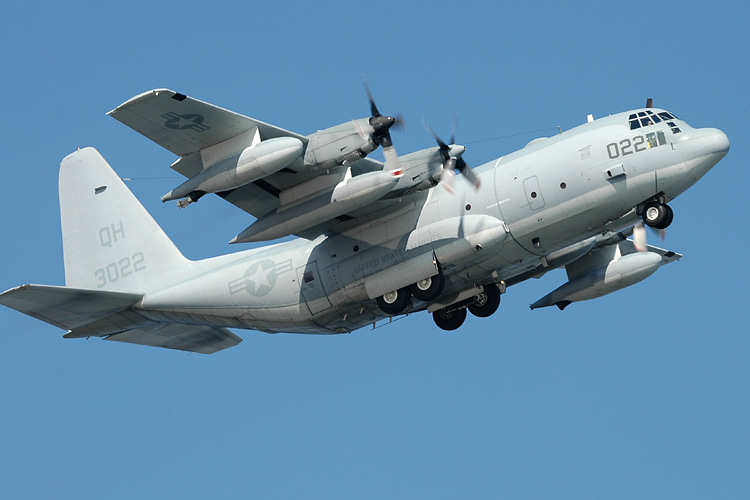
Upon further checking with open sources, it appears that the said aircraft (#022) is not a US Navy aircraft C-130T as earlier expected, but is a US Marine Corps unit, with tail number 163022, and is actually a KC-130T multipurpose transport-tanker aircraft. It is also assumed that the second aircraft may also be the same type and may come from the same source. A second photo from the press release also showed the interior of one of the aircraft being inspected, and it does not have the updated glass cockpit done on the US Navy C-130T aircraft. Too bad that the photos provided by the US Embassy in the Philippines did not show the wing portion to confirm if the underwing refueling pod are still there.


More photos from the inspection of aircraft no. 022. Note the analog cockpit on the aircraft, whereas the expected US Navy aircraft were already modified to use glass cockpit types.
Photo taken from US Embassy in the Philippines website.


These KC-130T are actually former C-130H aircraft converted to be aerial refueling-capable in support of US Marines air operations. Open sources like C-130.net indicated that the 163022 was built in 1984, and was modified to be able to carry the probe-and-drogue refueling system which is currently used by the US Marines aviation assets like the F/A-18C/D Hornet and AV-8B Harrier as well as CH-53 Super Stallion large helicopter series. This is the same system used by the Saab's JAS-39 Gripen. But this system is different from those used by the F-16 Fighting Falcon and F-15 Eagle fighters, which uses the Flying Boom system. (More of these can be found in open sources for further information.)


KC-130T "022" with the wing-mounted aerial refueling system on the far end of the wings.
Photo taken from usamimi.info website.


Being KC-130T Means....
For the uninitiated readers, the "K" in the KC-130T designation means it is a tanker-capable aircraft in US military parlance. So it means the Philippine Air Force is acquiring an aerial refueling capable aircraft. BUT it doesn't necessarily mean the PAF is acquiring tanker aircraft.

What's the difference? 

The KC-130Ts (or we can currently call C-130T until further notice) might be aerial refueling-capable aircraft, but it is still unknown and unconfirmed if the deal to acquire them include having the refueling system intact and usable upon the aircraft's hand-over to the PAF. But not having the aerial refueling system does not mean the PAF cannot have them in the future. With the aircraft already made to be capable of such, any future decision by the PAF to return the aircraft to tanker-capable status is very much possible and easy, as compared to other C-130 aircraft without this current capability.


A KC-130 probe and drogue underwing refueling pod. The PAF may opt to have the aerial refueling system retained when they acquire the USMC C-130T.
Photo taken from Wikimedia.


Having them retained, which is very much possible, means that the PAF will be having an added capability of aerial refueling, a first in its history. 


How About Transport Missions?
Being a multi-purpose transport aircraft, it will retain its cargo-carrying capability for other purposes, including Humanitarian and Disaster Relief (HADR) operations. This is possible by removing the fuel tank system in the cargo hold, in which the KC-130 can easily be converted from a tanker aircraft to a standard transport aircraft, with almost the same load and space capacity as a regular C-130 Hercules. The underwing refueling pod can remain even when doing transport duties.


The KC-130's fuselage fuel tank, which can easily be carried or removed from the aircraft's cargo space to convert the C-130 from a tanker to a standard transport aircraft. This is the same unit used by the US Navy and US Marine Corps on their KC-130s.
Photo taken from ar-15.net.


Why Need for an Air Refueling Tanker Capability?
The Philippine Air Force currently has no aircraft capable of aerial refueling. But they can use the aircraft to train the organization in tanker and aerial refueling operations in anticipation of future requirements. Training early is actually good as it takes time to learn and master this system, and doing it early gives them this needed time to learn and be capable of using the system well by the time the first aerial refueling receiving aircraft arrive in PAF's inventory. This can be done by having aerial tankers participate to support US military aircraft during joint US-Philippines military exercises like Balikatan, while doing standard military and HADR transport missions. Its rapid fuel transfer system can also be used in ground operations when necessary, which can be both applicable in combat and HADR support operations.

Some of the incoming new assets for the PAF can be specified or modified to be capable of receiving fuel using probe-and-drogue aerial refueling. This includes the Airbus C-295 medium tactical transport aircraft, and probably the KAI FA-50 Fighting Eagle lead-in fighter trainers. Particularly for the FA-50 with its limitations in terms of range, endurance, and load capacity, having the capability of aerial fueling can extend its reach and enable it to carry more at long distances like in the possible conflict areas in the West Philippine Sea. Future maritime patrol aircraft (MPA), airborne early warning & control aircraft (AEWC), and multirole fighters (MRF) that the PAF aspires to acquire in the next few years can also benefit from such capabilities, especially with these assets are also expected to operate in the vast Philippine EEZ and ADZ.


With its small size, MaxDefense believes that the FA-50 Fighting Eagle must be given the capability to refuel on air, with installing a refueling probe system. It is possible that the PAF has already considered this requirement.


So, is the PAF acquiring aerial refueling tankers? Possibly, but still unconfirmed. But even if the PAF won't be getting the aircraft with the aerial refueling system intact, this is the closest they can get from having one, as making them have one is due to the inherent capability the aircraft already have for as long as support and budget is provided. So why not? Here are some examples of which platforms are compatible with the KC-130's probe-and-drogue system:


So let's see, who can use the probe-and-drogue aerial refueling system of the KC-130?
The Gripen can....


...Super Hornets also can use them....
(Photo taken from chinalakealumni.com)
...legacy F/A-18C Hornets also are compatible...
(Photo taken from Wikimedia)
...even the C-295 is OK with it!


Friday, August 1, 2014

Initial Details on the Upcoming ex-US Marine Corps C-130T Hercules for the Philippine Air Force

The US Defense Security Cooperation Agency (DSCA) has recently issued a news release pertaining to the possible Foreign Military Sale (FMS) of 2 Lockheed C-130T Hercules to the Philippine government, with an estimated worth of $61 million. This deal may include 10 Rolls Royce Allison T56-16 aircraft engines (8 installed and 2 spares), logistical sustainment support for 3 years, modification equipment and labor costs, spare and repair parts, support equipment, publications and technical documentations, aircraft ferry support, personnel training and training equipment, US government and contractor logistics and technical support services, and other related of logistics and program support.

MaxDefense sources from the DND confirms that the airframe was granted by the US government, and the estimated $61 million costs under FMS may cover the refurbishing and ancillary works included together in the deal, similar to what was done on the 2 Hamilton-class cutters received by the Philippines a few years ago. Being an estimated value, MaxDefense believes that the costs may still increase due to unseen circumstances, or additional expenses incurred during actual refurbishing works. Previous deals with other countries on the sale of EDA legacy C-130 Hercules aircraft shows such increase in actual costs.


A US Navy C-130T doing touch-and-go runs.
Photo taken from Goleta Air & Space Museum website.


The Lockheed C-130T Hercules are actually limited in numbers, with only around 20 units produced and are used by either US Navy and US Marine Corps for logistics support requirements and aerial refueling operations. They were built between 1991 and 1996, and are the last legacy C-130s delivered to the US military before Lockheed Martin proceeded to build the new C-130J Super Hercules. 19 units are operated by various US Navy logistics support squadrons, while 1 was used with the Blue Angels precision aerobatic team as the current "Fat Albert". 19 units were upgraded by BAE Systems with a glass cockpit system, and are equipped with a Garmin GNS 480 GPS system, an electronic flight bag, electronic horizontal situation indicator and engine instrument display system. One unit was reportedly not included in the said upgrades, and MaxDefense believes that unit is the Blue Angels' "Fat Albert".


The Blue Angels' "Fat Albert" exhibition aircraft, although with USMC markings, the aircraft is actually with the US Navy.
Photo taken from Airliners.net c/o Kevin Scott - Jetwash Images.


Upgrades made by Lockheed Martin to the C-130T is said to extend the mission capabilities of the aircraft for another 20 years - and that's according to US standards. This means the PAF has a modern C-130 in its hands, systemtically almost comparable to early Super Hercules at a small fraction of the price.

US Navy C-130T are different from the KC-130T being operated by the US Marine Corps, although both are closely related to the Air Force's C-130H. The US Navy intends to replace the C-130T with the newer C-130J Super Hercules, and it is expected that more C-130Ts will be retired from service, which can also be offered for FMS or grants to friendly countries like the Philippines. Previous MaxDefense blog entries discussed these plans for more C-130s and this current deal might be the first of few more to come.

Being an additional transport asset, it is expected to be operated by the the 220th Airlift Wing based in Benito Ebuen Air Base in Cebu. MaxDefense sources confirms that the offer was made by the US government in the aftermath of the Typhoon Haiyan, although there was a long standing request for EDA C-130s by the Philippines to the US government. It is expected that the US government will offer more C-130s in the near future, depending on the Philippine government's capacity to acquire and maintain more. There are also reports of acquiring C-130H from Australia, but may prove false since Indonesia has reportedly paid for the acquisition of all 9 excess units formerly operated by the Royal Australian Air Force even after the spying scandal between Australia and Indonesia cooled down.


The C-130T's updated cockpit, which was changed to glass cockpit recently by Lockheed Martin. This is a huge difference from the PAF's own C-130B & H models.
Photo taken from Lockheed Martin website
.


Although there were reports that the upcoming C-130T are being optimized for dual mission duties as a heavy tactical transport and a long range maritime patrol and surveillance aircraft using palletized systems, MaxDefense has not received confirmation on this. If this was true, MaxDefense will provide updates on the blog entry. But this set-up won't be impossible as Lockheed Martin already made earlier confirmation of offering the DND and PAF of using its C-130s or any other aircraft as a platform to integrate maritime patrol surveillance systems. 


Not really an SC-130J, but a C-130T fitted with palletized MPA mission systems can be a welcome addition to the PAF's capability, although smaller aircraft like the C-295 can be a cheaper and more practical alternative.
Photo taken from Lockheed Martin website
.


MaxDefense believes though that the C-130 is not the best platform for MPA duties for the PAF, even with its proven track record, reliability, range and stability on adverse weather. This is due to the lack of enough transport assets within the PAF where additional C-130s in the transport role are sorely needed. Its massive size and higher operating costs makes it impractical, especially when compared to contemporary new MPA platforms being offered for the upcoming Long Range Patrol Aircraft. Still, it would be a welcome addition to the PAF's limited capability, and the responsibility to make decision would be PAF's call as they know their requirements better than those outside the system, including MaxDefense. 


==========
UPDATES:
==========
January 12, 2015:
The US Embassy released information last January 9, 2015 that the Philippine Air Force has completed a second inspection of two C-130T that are being offered for transfer to the aforementioned armed service. Photos from the US Embassy press release shows the Philippine officials with one of the aircraft with number 022, and was said to be in Joint Reserve Naval Air Station Fort Worth in Texas. The press release also indicated that the Philippine government, through Maj. Gen. Victor Bayani, has already signed the Letter of Offer and Acceptance signifying the approval to procure the inspected aircraft. Expected delivery was placed by 1st quarter of 2016.

Also, there appears to be changes in the C-130T the PAF will be acquiring. Originally is was reported that it would come from the US Navy, but photos show that the C-130T are actually coming from former US Marine Corps stock. The aircraft 022 is actually a 1984-built KC-130T formerly with the USMC, and may not sport the glass cockpit we discussed in the main blog article.

More of this will be discussed in a new MaxDefense blog entry.


PAF and US officials during the inspection of C-130T at Fort Worth, Texas.
Photo taken from US Embassy in the Philippines website.


There appears to be differences from expected several months ago, which will better be tackled more on a separate MaxDefense blog entry coming out soon.

==========
October 7, 2016:

Media outlets reported the departure of the second C-130T Hercules heavy tactical transport aircraft from the Davis-Monthan Air Force Base in Tucson, Arizona on the way to the Philippines.

It is expected that the aircraft will arrive in Benito Ebuen Air Base in Mactan, Cebu on Sunday, October 9, 2016.

Originally MaxDefense received information that the C-130 T was supposed to arrive in the Philippines in late September. No reason was given on the change or delivery date.

The C-130Ts are sporting a different paint scheme from the rest of the PAF's C-130 fleet and is expected to conduct dual mission as transport aircraft, and surveillance missions upon the arrival of roll-on/roll-off palletized Intelligence, Surveillance and Reconnaissance (ISR). These ISR kits were promised by the US government under its Maritime Security Initativr for Southeast Asia announced early this year. 

With the rocky PH-US relations now, this remains to be seen, although the C-130T on its own will be very useful for transport and support missions for the Armed Forces of the Philippines. The PAF is expected to acquire more C-130s in the near future.

Check out our main FB page wall for more details on the aircraft's arrival.


Tuesday, March 4, 2014

PAF Confirms Acquisition of C-295 as its Medium Lift Fixed Wing Transport Aircraft

After finally getting confirmation from DND sources, MaxDefense is confident to announce the recent award of the medium lift fixed wing aircraft procurement project by the Armed Forces of the Philippines (AFP) to Airbus Military/CASA for the C-295 aircraft. This was after Airbus Military was chosen over PT Dirgantara Indonesia (PTDI - Indonesian Aerospace) with its CN-235, and Alenia Aermacchi of Italy with its ATR-42 (yes, they did not offer the C-27J) for the 2nd bidding attempt made by the DND. PT DI and Alenia Aermacchi's bids were found unacceptable by the DND's Bids and Awards Committee. Airbus Military's bid was at Php 5,288,609,983.99, which is lower than the budget allocated by the AFP.


Airbus Military's C-295, which was awarded recently by DND for the PAF's Medium Lift Fixed Wing Aircraft acquisition project.


The project is currently being questioned by losing bidder Alenia Aermacchi over its claim that both of its competitors in the project, Airbus Military and PT DI, are actually strategic partners and are linked together by the production of CN-235 (PT DI's offer) and C-295 (Airbus Military's offer) by both aircraft manufacturer's facilities. Although Alenia's complaints have been brought to the DND, there was no formal complaint filed by them against the decision of the DND to award the project to Airbus Military. PT DI's bid was rejected by the DND as the aircraft being offered was not compliant, the CN-235 cannot carry the required number of passengers and paratroopers due to its shorter fuselage size. Alenia Aermacchi did not submit a bid due to its ongoing complaint, although they submitted the ATR-42 during the 1st bid attempt. More of this issue was discussed in an earlier MaxDefense blog entry, which can be found on the following links:

C-295 Only Eligible Bid for PAF's Medium Lift Fixed Wing Aircraft Acquisition Program (January 14, 2014)
Tech Specs Released for PAF's Medium Lift Fixed Wing Transport Aircraft - Is there a Sure Winner? (October 25, 2013)
PAF's Medium Lift Fixed Wing Aircraft Program - A Simple Analysis of the 3 Contenders (October 23, 2013)


Poland is a user of the Airbus Military C-295.


It is expected that the aircraft will be operated by the PAF's 220th Airlift Wing based in Benito Ebuen Air Base in Mactan, Cebu, probably with the 221st Airlift Squadron which operates the Fokker F-27 Friendship that the C-295 intends to complement and replace in the near future. It is also expected that follow-up orders will be exercised by the PAF, which may see the fleet increase from the initial 3 ordered. Per contract, the expected delivery of the 1st aircraft will be by May 2016, but this can be moved earlier depending on Airbus Military's production schedule. Based on the post bid qualification  inspections, it also appears that the PAF orders will be manufactured by the CASA-Airbus Military facility in Seville, Spain rather than with PT DI's facility in Bandung, Indonesia.


The C-295 is expected to compliment and eventually replace the Fokker F-27 Friendship with the 220th Airlift Wing of the PAF.

It is expected that the actual contract will be signed between the AFP and Airbus Military within March, 2014. 

With the C-295's win, it also solidify its chances in getting shortlisted for the PAF's Maritime Patrol Aircraft project. MaxDefense sources confirmed that the US-route that was being sought after by the PAF is not yet 100% confirmed, and the C-295 and other new models could still be chosen. To simplify training, logistics and maintenance, aircraft commonality might be considered, this recent win will push the C-295 forward in the race. Previous reports confirmed that Alenia Aermacchi is offering an ATR-42 or ATR-72 based MPA platform for the PAF, while PT DI's CN-235 platform is also being offered. 


Chile's C-295 Maritime Patrol Aircraft.

MaxDefense will provide further updates on this project as the project progresses from production to delivery.


==========
UPDATES:
==========
January 23, 2015:
A heads-up information from one of our readers lead us to a photo taken by Juanfco Mayoral and posted on Jetphotos.net. Taken on October 2014 based on the information from the website, showing an Airbus Military C-295 in Philippine Air Force markings undertaking flight testing in Spain.


The said photo of the PAF-bound C-295.
Photo by Juanfco Mayoral c/o Jetphotos.net.


It sports the specified white over grey body paint similar to what the PAF's Fokker F-27 Friendships are currently using. Unfortunately, it appears that the PAF C-295 doesn't have the winglets on the tip of the wings that are meant to improve the performance of the aircraft, even if there are news that Airbus Military will be having such winglets on all new-build C-295s starting 2014. It is assumed based on the photo that the PAF-bound C-295 in the photo, with tail number 129, was built within 2014.

With the presence of this aircraft, it is now expected that Airbus Military will be able to deliver far earlier than what was expected from them, with this aircraft probably in PAF's hands by within the 1st half of 2015. It could also be possible that a 2nd aircraft can be delivered within the year.


==========
April 1, 2015:

The Department of National Defense and the Philippine Air Force formally accepted the first of three brand new Airbus Military-CASA C-295M medium tactical transport aircraft in a formal ceremony last March 30, 2015 at Villamor Air Base, Pasay City. It would be assigned with the 220th Airlift Wing based in Benito Ebuen Air Base in Mactan, Cebu.


The PAF's 1st C-295M aircraft during the acceptance ceremonies.
Photo taken from GMA News.


The aircraft, with tail number 129, was delivered several months in advance, and has already embarked on its first mission when it delivered supplies from Villamor Air Base to Benito Ebuen Air Base in Cebu, then to Edwin Andrews Air Base in Puerto Princesa, Palawan.

It is expected that the rest of the ordered aircraft will be arriving in advance as well, probably within this year.
==========

Saturday, November 30, 2013

Fulfilling the Immediate Needs for Additional C-130s for the Philippine Air Force

The Lockheed C-130 Hercules aircraft has shown its versatility to the general public recently after being the main aircraft in use to deliver humanitarian assistance and disaster relief (HADR) in the aftermath of Typhoon Haiyan (Yolanda)'s wrath in the Visayas. As discussed in an earlier blog, C-130 aircraft from the Philippine Air Force (PAF) and other military air units from other countries joined together to support the massive HADR operations. 


A PAF C-130H Hercules arriving in Tacloban City in the aftermath of Typhoon Haiyan.
Photo taken from the Armed Forces of the Philippines. c/o UN News Center.

Questions arose on why the PAF only had 3 C-130 transport aircraft, and with calls from the general public and government officials to acquire more of these aircraft, MaxDefense decided to look back and update the blog with the plans of the government and the military to acquire more of these useful behemoths.


Commissioned PAF C-130s:
Currently there are 3 C-130s in PAF service: 2 C-130H models and a single C-130B model under the care of the 220th Airlift Wing based in Benito Ebuen Air Base in Mactan, Cebu. The "B" model with tail no. 3633, was recently recommissioned with the PAF after refurbishing by the 410th Maintenance Wing under the assistance of Lockheed Martin technicians, while one of the "H" model with tail number 4704 was recently recommissioned after undergoing a Periodic Depot Maintenance by BAE Systems in the US. The other "H" model with tail number 


A PAF C-130H Hercules being prepared for to return to the Philippines after a Periodic Depot Maintenance was done by BAE Systems in Nevada, USA.
Photo taken from The Philippine Embassy in the USA.

There are also 3 more C-130s in Benito Ebuen Air Base that are parked on the apron for still unknown reasons: 2 C-130B models and a single L-100-30 civilian variant of the stretched Hercules.

Each of the C-130s can deliver almost 20 tons of goods and equipment that can fit its cargo hold of around 12.3 meters (length) x 3.1 meters (width) x 2.74 meters (height). Its versatility was shown as C-130s took in vehicles, relief goods, equipment, and evacuees to and from disaster areas. Not only are they good for HARD operations, but are also primarily design to transport high volume of military supplies, light vehicles, troops and paratroopers to and from the front lines. The PAF once had dozens of these assets but dwindled due to lack of financial support from the government and poor maintenance by the PAF in keeping them in good shape, or at least in proper storage when mothballed.


Mothballed C-130s in Cebu:
MaxDefense indicated in an early blog that these 3 mothballed C-130s in Cebu are said to be candidates for refurbishing and re-commissioning to the PAF's transport fleet. Although it is still unclear if all can indeed by refurbished and put back to service, MaxDefense's sources already indicated that at least 1 unit is being prepared for refurbishing by the 410th Maintenance Wing, and is already funded by the government. There are also some conflicts in information regarding the status of the 2 other C-130s, with some open sources and defense forums with PAF sources saying that they are not suitable for revival, while some information gathered by MaxDefense from other PAF sources say that all can be refurbished and revived but will require a varying degree of refurbishing that will also require varying budget allocations. The only thing certain is that they are all in poor condition as the PAF was unable to put the airframes in proper storage.


The 3 C-130 Hercules transport planes in Cebu, currently mothballed and awaiting for its fate.
Photo taken from Mr. Jake Nelson @ Pinoy Daily Journal. 

Recently Sen. Ralph Recto supported the plan to provide funding to refurbish the mothballed C-130s, although he did not give specifics if he was referring to the 3 units in Cebu. According to him, a PAF source provided an estimate that the cost to refurbish a C-130 run at around Php 500 million, thus refurbishing 3 mothballed C-130 could cost at around Php 1.5 billion which he supports to be added in the 2014 National Budget. MaxDefense believes that due to the poor condition of the 3 aircraft plus the varying level of refurbishment needed for the 3 aircraft, it may even run higher than the value Sen. Recto was pushing. Also, it would take more than a year toc complete refurbishing of a single C-130, and 1 unit may only be available by 2015.


The men of the 410th Maintenance Wing was able to refurbish a C-130B in house with the help of specialists from Lockheed Martin. It won't be impossible for them to do it again to further enhance their skills and to save on cost rather than sending a mothballed plane to a private aircraft company for revival.
Photo taken from Mr. Thomas Diez's Facebook page.


PAF to Buy 2 More C-130s:
With the questions raised on why the PAF only has 3 C-130s in its fleet, the Department of National Defense (DND) through Secretary Voltaire Gazmin, announced that they the PAF is in the process of procuring 2 more C-130 aircraft for Php 1.6 billion ($37 million) starting next year. This was also echoed by AFP Chief of Staff Lt. Gen. Emmanuel Bautista in a separate interview


Excess C-130s of the US military stocked in the "boneyard" at Davis-Monthan Air Force Base in Arizona. The Philippine government could negotiate with the US for sale and/or grant used C-130s and other military aircraft to fulfill its immediate requirements.
Photo taken from the Tucson Sentinel.

The budget would be Php 800 million or $18.5 million per aircraft, and will probably include and integrated logistics support (ILS) package, training and some spare parts. With that amount, the PAF could only afford to buy a refurbished legacy C-130 model, and not a brand new or even used new generation C-130J Super Hercules version. This would probably be sourced from a friendly country, and MaxDefense believes that if negotiations will be completed by 1st quarter of next year, the C-130s could only be commissioned with the PAF by either late 2014 or early 2015. This option is still faster to complete as compared to refurbishing the mothballed C-130s in Cebu.


Even More C-130s?:
There was also a report from a local news organization saying that according to their source from the AFP, there was a plan by the US government to grant 3 legacy C-130 Hercules aircraft to the Philippine government that was supposed to be announced during the scheduled visit of US President Barack Obama last October. Although the visit was cancelled, such program can be revisited by both governments, especially that US Secretary of State John Kerry is pushing through with his visit to the Philippines before the end of the year. But MaxDefense believes that finalizing such deal doesn't need Sec. Kerry's presence so it would be a matter of how the Philippine government presents its request.

This runs similar to an earlier MaxDefense blog on PAF C-130s wherein MaxDefense sources from DND indicated that at least 3 units are planned to be transferred from US Excess Defense Articles (EDA) stocks. Latest information from these sources confirm that there is a standing request from the PAF for additional C-130s, and may be sourced from friendly countries.


There are reports that the US was to grant 3 C-130 aircraft to the Philippines as part of the agenda of President Obama's cancelled visit to the Philippines. Although there's no confirmation yet, this can be a welcome addition should it happen.
Photo taken from Philippines Today.

Aside from this, the PAF still has plans to get additional C-130 planes in the next phase of the AFP Modernization Program after 2017. This may include the option of getting new birds, which may include the new generation C-130J Super Hercules to complement the legacy Hercules in PAF service and probably replace them in the long term. No numbers for now though.

C-130J Super Hercules in the future? Not impossible if the government is consistent in putting emphasis to a stronger and better responding Armed Forces of the Philippines even after the term of President Aquino.
Photo taken from Wikimedia.


If all these negotiations are indeed happening and becomes a reality, the PAF will end up with a minimum of 6 to a maximum of 9 working C-130 aircraft by the time President Aquino steps down, which is close to MaxDefense's earlier estimate in an earlier blog entry. According to CSAFP, the PAF is "happy" to obtain 9 more C-130s. While all this is not entirely impossible, it is up to the government's political will, backed by the DND, AFP and PAF's effective lobbying that will ultimately bring this to reality.

Tuesday, November 26, 2013

Building-up the AFP's Equipment Needs for Disaster Response and Military Operations

It took a massive storm and devastation in the Visayas region to expose the government's inability to respond and provide government services and delivering massive volumes of personnel, humanitarian assistance and disaster relief (HADR) goods, light and heavy equipment and temporary facilities to a wide coverage area due to several reasons. One of them is the Armed Forces of the Philippines' (AFP) lack of these necessary tools and equipment, which is an issue that has not been given much attention for several decades now.

The scale of devastation brought by Super Typhoon Haiyan (local name Yolanda) was unprecedented in Philippine history, and is nowhere near the dozens of storms the country experiences in a year. Normally the Philippine government has contingencies and preparations for disasters, and this includes bringing in the capabilities of the AFP with its men, materiel, experience and capability in rapid deployment and handling rescue and relief operations. But as the sheer coverage of the disaster was known, so is the inability of the AFP to reach out on these areas all at the same time.


The typhoon showed how military forces can be used in humanitarian assistance and disaster relief operations. Shown above are USMC MV-22 Osprey tilt-rotor aircraft bringing in relief supplies from Cebu to Tacloban then returning to Cebu with evacuees.
Photo taken from Lt. Col. Francis Neri's Facebook page.

It exposed the AFP's capabilities, or the lack of it, to the general public, and brought it closer to the attention of our citizens and lawmakers alike. People became aware on the military's lack of assets to transport large amounts of aid to a large area of responsibility like almost the entire Visayas region.


What does the AFP have?
Currently the Philippine Air Force (PAF) only has 3 C-130B/H Hercules heavy tactical transport planes, 3 units of the smaller Fokker F-27 Friendship tactical transports and N-22B Nomad light utility aircraft, and a few dozen UH-1H Huey and W-3A Sokol utility helicopters in its inventory, and not all of these assets can be used for a single air operation due to requests for air assets for other purposes. The Philippine Navy has the same dilemma, with only a handful of naval transports in the form of the 2 Bacolod City-class logistics support vessels (LSVs), a few World War 2-era landing ship tanks (LSTs), and a couple of large landing craft utilities (LCUs), and a few BN-2 Islander and BO-105 utility aircraft at its disposal. In this type of situation, these assets are not enough.

PAF's lack of C-130s was exposed during the relief operations after Typhoon Haiyan hit the Visayas, The 3 units were working hard for 2 weeks now, and was lucky to be reinforced by more C-130s and C-17s from several foreign air forces.
Photo taken from Lt. Col. Francis Neri's Facebook page.

Not only is the military lacking in air and naval transport capabilities, it also lack the ground assets and support facilities that are both needed for normal military operations as well as humanitarian and disaster relief missions. The Philippine Army and Marine Corps, like the rest of the Armed Forces, does not have enough trucks and utility vehicles, engineering and construction equipment, and amphibious vehicles It also does not have or only have minimal temporary facilities like power generation, water treatment equipment and tanking, mobile hospitals, temporary airfield facilities, and communications equipment. It is surprising that there are still calls by many people to bring in relief aid to communities accessible by land transport until more than a week after the storm hit, but was not aided due to lack of these assets.


The AFP recently received several ex-US Army surplus trucks, like those above still in desert paint scheme after being used in Middle East campaigns. The AFP can continue getting more of these, or even new trucks, classified as civil defense equipment that can also be used for military operations.
Photo taken from IPMS Philippines website.

Thankfully, all these shortages were filled-in by the international community's contributions to the relief effort, as seen on the capabilities they brought in to assist the AFP and the Filipino people as a whole (a special MaxDefense blog article was made specifically to showcase the international help provided, see HERE). But this international aid is a temporary solution and will only be available until the Philippine government musters enough capability to stand alone to provide its people the necessities and return to normalcy. The capability brought upon by the international community can be a template for the Philippine government, the National Disaster Risk Reduction and Management Council (NDRRMC), other related government agencies, and by the AFP as it build up its own capability for future disasters. The Philippines cannot always just rely on foreign aid every time a similar unfortunate event happens; it must be prepared to face similar threats in the future, and it must also be prepared to answer the call to aid of other countries in need just as they answered our call for help.


Lawmaker's Questionable Solutions?
There are already earlier calls by a certain congressman who used to be the AFP's Chief of Staff to purchase more helicopters and transport planes in expense of purchasing fighter jets and territorial defense assets like the KAI FA-50 Fighting Eagle, and recent calls by another neophyte senator calling for the same route of purchasing more transports for the AFP by cancelling the FA-50 and AW109 acquisitions.

MaxDefense believes that both lawmaker's intentions of increasing the capability of the AFP to respond to civil defense duties is correct and commendable, but the plan to cancel the procurement of fighter jets and other territorial defense assets to divert the funds is absolutely wrong and irresponsible. These lawmakers did not take into consideration the importance of having a minimum deterrent that will give the Philippine government some semblance of capability to enforce its territorial and foreign affairs policies. The fighter jets are not just for shooting down enemy aircraft, but are also meant for air policing duties and enforce our territorial jurisdiction from foreign aircraft. It's not about the numbers, but the willingness of the Philippines to be responsible of its territorial integrity that matters.


Purchasing the FA-50 should be left untouched by those pushing for more dual-use military equipment that can be used in military and disaster relief operations. Both are equally important and must be funded by the national government altogether.
Photo taken from koreaaero.com.

The Compromise:

The best compromise to avoid undermining every AFP capability from another is to increase funding of the armed forces, as well as strengthening the mandate and capability of the NDRRMC (which is also under the Department of National Defense). This can be done through separation of the systems being procured by the AFP: defensive weapons systems like fighter aircraft and frigates can be financed through the AFP Modernization Program, and dual-use equipment like transport planes, trucks and utility helicopters can be classified as HADR equipment and financed by a separate funding scheme, reinforced by the AFP Modernization Program budget. It is expected that public opinion will be calling for the improvement of disaster relief capability of the government, and although lawmakers are not very keen on military capability improvement but will have no choice but to definitely support improvements in the military's ability to respond to HADR operations.


Recommended HADR Purchases for the AFP: The following are MaxDefense's recommendations on what the government and AFP must improve to cope up with similar disasters in the future. Instead of relying on the AFP Modernization Program budget, the DND and AFP must push for another funding scheme that will solely focus of acquiring capabilities that can be used for both military and civil defense/disaster response purposes. Due to the special nature of disaster response, the DND and AFP can make use of this loophole to request for further funding using alternative sources to improve disaster response capability while also improving the military's overall transport and mobility capability. This can be divided into several sub-programs:

Philippine Air Force:
  • The PAF can request for expanding the aerial transport capability improvement, which includes increasing the budget for its current procurement on the following projects: Combat Utility Helicopters (CUH), Light & Medium Fixed Wing Transport Aircraft, Search and Rescue Seaplane, and used UH-1H Helicopters. The PAF currently has a standing requirement for at least 100 CUH available at any time, and will require more or less 130 units of CUH in their inventory. There are plans to increase the number of air assets in the next round of AFP Modernization Program budgeting for 2017 and beyond, these programs can be accelerated by increased funding. The PAF can also make use of procuring more interim UH-1H helicopters from US military stocks which can be made available faster than new helicopters. The PAF could opt to go for more than 21 units.
  • The PAF could also include the request for the following: Procurement of additional new or used (or both) C-130 Hercules transport planes and procurement of Medium Lift Utility Helicopters which can be used to enhance the transport capability of the PAF; Emergency Airport Facilities (mobile air traffic controllers and radar systems, temporary lighting and signalling equipment, and mobile air monitoring radar systems) which can be deployed to immediately re-activate damaged or disabled airports and air bases; Cargo handling ground equipment like rough terrain and heavy forklifts; and even Firefighting Buckets and slinging equipment for helicopters. 
Additional C-130 aircraft, which are used not only for military transport but also for bringing in supplies and relief goods, and evacuation of victims and even trapped OFWs abroad. The operations after the typhoon are testaments to the importance of C-130s and other transport aircraft even in peacetime operations.
Photo taken from Lt. Col. Francis Neri's Facebook page.
  • Modernization of current assets can also be included, which may include installation of rescue winches on the W-3A Sokol helicopters (which are already transferred to the 505th SAR Group) and remaining S-76 helicopters; upgrading of several CUH to be able to carry firefighting water buckets;
One of the PAF's W-3A Sokol helicopter delivering food aid to affected citizens. The PAF require at least 100 combat utility helicopters operational at any point in time. The current numbers are far from that requirement.
Photo taken from Lt. Col. Francis Neri's Facebook page.
 

Philippine Navy:
  • The PN can opt to request for a separate funding to accelerate the purchase of more landing platform docks (LPD) or strategic sealift vessels (SSV) in addition to the 2 units already on the pipeline. Originally the PN plans to have at least 4 SSVs in its future inventory and accelerating this program can hasten the availability of these ships as early as possible. It can also do the same for the LCU acquisition project, which also requires more that a dozen more in the next Modernization Program phases.
  • To support the SSV/LPDs, the PN must also request for medium lift helicopters to be procured at the same time as the ships they are intended to be used with. 
Additional assets that can bring in supplies and disaster relief aid like amphibious vessels (photo shows PN's LSV) can be funded by a separate program that focuses on disaster preparedness.
Photo taken from US Navy.


Philippine Army and Philippine Marine Corps:
  • The need for more mobility assets like cargo and utility trucks to bring in troops, people, goods and for other purposes can be requested through this funding. These can either be used assets from the US military, or new trucks similar to the ones bought from Korea recently;
  • Amphibian transport vehicles, similar to the GKN Aquatrack that  the PMC and NDRRMC currently operates. These vehicles can be used during floods and has a large capacity for carrying people or goods; 
The GKN Aquatrack being used by the PMC is an example of equipment that can be used for HDMR operations, as shown above. The PMC is operating 2 units of behalf of the NDRRMC.
  • Rescue equipment like search robots, personal protection equipment for rescuers, additional K9 units, first aid kits, heat signature scanners, and other related equipment that are also not available or not enough numbers within the Philippine ground forces;
Search and Rescue robots similar to the one above, can be used to look for victims underneath rubble and debris, and can reach areas that are inaccessible to humans. They can also be fitted with camera to access dangerous places.
Photo taken from Robocup 2009 website.
  • Requirements for field hospitals, power generators, water filtration systems, field kitchens, satellite and high frequency communications, tents and field shelters, portable water and oil storage facilities, first aid kits, meals ready to eat (MRE), and water supplies.These items are actually needed by our ground forces during long deployments outside major camps, and are also not even available on minor army and marine camps. It would be best to acquire such capability and to allocate enough for HADR operations;
The lack of field hospitals in operation areas are always brought out whenever there are major military operations involving the AFP, resulting to unnecessary deaths. It can be improved if these are provided to the AFP via funding for civil defense and dual-use equipment as they can also be used for peacetime operations like disaster relief.
Photo taken from Wikipedia.
  • Engineering and construction equipment like payloaders, backhoe, loaders, dump trucks, and also mechanical handtools like chainsaws. These can be used in clearing and rebuilding, and even during normal civic-military operations which the Philippine military already specializes even in non-crisis times. It would be best to expand and improve in this matter;
  • Combat engineering equipment like pontoon bridges can also be classified, and also materials for erecting temporary bridges to replace destroyed ones.
Water filtration equipment similar to those used by the Canadian Forces in Iloilo, are actually needed by military ground units even for military operations outside major camps.
Photo taken from Combatcamera / Canadian Forces website.
Engineering equipment like backhoes and loaders are also necessary for disaster relief and reconstruction operations, and are also needed by the army's engineering and construction battalions for their usual missions.
Photo taken from Combatcamera / Canadian Forces website.


Government Response:
Although its too late for the government to react for this specific calamity, it is not too late for the government to prepare for the future. There is already a call from Senator Ralph Recto to include the funding of reactivation of at least 3 mothballed C-130s of the PAF with the 2014 National Budget, and even considering the purchase of new C-130 aircraft using multi-year funding schemes. He also supported the purchase of more naval vessels including strategic sealift vessels and logistics support vessels. 

The DND has also recently announced the purchase of 2 more used C-130 aircraft from an "unspecified source" with a budget of Php 1.6 billion, and has plans to start a acquisition program for a new Combat Utility Helicopter to replace the W-3A Sokols. And there is mounting support from the public as well as local government units for the national government to increase funding for the purchase of more military equipment that can be used for HADR operations. There are even calls by some lawmakers to create a separate Cabinet Office for Emergency Response.


These C-130s in Mactan, Cebu, previously discussed in another MaxDefense blog, can be the proposed candidates for refurbishing as brought out by Senator Ralph Recto.
Photo taken from Mr. Jake Nelson @ Pinoy Daily Journal.

But these plans are not enough. It must be pursued immediately without being caught up with the usual red tape and politics affecting military and civilian expenditures, as these are emergency items that are needed as soon as possible without waiting for a new crisis to arrive. The Philippine government has the capacity to fund for these requirements if it wants to, and will only need political will of the national government and cooperation from the different sectors of government. Money can't be a reason anymore for the government, as disasters won't wait for a chance for the Philippines to be wealthy enough before it strikes again. Not only will it improve the AFP's capability to respond to HADR, it will also improve the AFP's capability to respond to the internal security and territorial defense posture of the country. 


Opportunity to Return the Favor:
It must also be taken into consideration that the Philippines now owes the world for the aid and assistance they gave to the country in this time of need, even if they do not ask anything in return. The best way for the Philippines to return the favor is for it to be better prepared in the future to minimize the need for another massive foreign assistance. At the same time, the country must be prepared to assist other nations that will encounter similar crisis in the future. 


The PAF's C-130s working hand-in-hand with C-130s of other nations. It would be best if the PAF could return the favor in the future by participating in delivering aid and support to other countries should the need arise.
Photo taken from Lt. Col. Francis Neri's Facebook page.

Having a well prepared and well equipped military and disaster response teams that has the ability to be deployed in times of calamity anywhere in the world would bolster the Philippines' relations with the international community, improve its foreign policy standing, and can be a source of pride to the Filipino people. Just look at Indonesia: In 1963 the Philippines provided them with aid and medical assistance delivered by several C-47 transports of the PAF when Mount Gunung Agung erupted. Now they have returned the favor by sending several tons of relief aid brought in by several TNI-AU (Indonesian Air Force) C-130s, a shipload of Red Cross aid, equipment and personnel, and an LPD from the TNI (Indonesian National Armed Forces) is on the way to bring in more aid and more medical teams with their respective equipment (further discussed HERE) This is a source of pride for Indonesians to be able to help a friend in need even if they are also facing disasters in their own country and is also coping with financial issues. Can the Philippines do the same in the future? Yes, it can.


Indonesia is not a wealthy country as compared to its Western counterparts, and is almost in the same political, economical and military dilemma as the Philippines. But it has the willingness to help a friend in need, whatever it's situation it is. We are indebted to the international community, and must be ready to stand up to assist others in need in the future as well.
Photo taken from Liputan6.com website.


Philippine Navy Modernization Projects

Philippine Air Force Modernization Projects