


The Philippine Navy (PN) has been pursuing the acquisition of new guided-missile Corvettes as it continues to improve its combat capability as part of the service's modernization program.
Two new corvettes are eyed under the Corvette Acquisition Project (CAP), as part of the Horizon 2 Priority phase of the Revised AFP Modernization Program (RAFPMP) which covers acquisition projects between 2018 to 2022.
Currently, the CAP is delayed based on the Philippine Navy's programming, as they were hoping that a contract would be signed by 2020 to allow the first ship of the class to be delivered by late 2023. But COVID-19 pandemic has affected the program, including the sourcing of funding by the Philippine Government.
But lately, MaxDefense Philippines received information from sources that it appears that the program has progressed quietly but significantly, and that the Philippine Navy and Department of National Defense may have already decided on who the winning shipbuilder would be as of this writing.

The Corvette Acquisition Project:
The acquisition of new corvettes are among the priority projects of the Philippine Navy, and has been in its Desired Force Mix procurement plan since the early 2010s. According to the PN plans, they intend to have at least 12 corvettes completed and/or ordered by the time the Horizon 3 phase of the RAFPMP is completed by 2028.
 |
| This is part of the Philippine Navy's planned acquisitions under Horizons 1, 2 and 3 phases of the RAFPMP, indicating their desire to acquire 6 corvettes under Horizon 2. In the end, funding for only 2 new corvettes were approved for funding by the Duterte administration. Photo credits to Philippine Navy. |
Under the Horizon 2 phase of the RAFPMP, the Philippine Navy originally requested for the acquisition of 6 corvettes back in 2016, which was reduced to 4 in 2017, before the approved quantity was reduced further to just 2 in June 2018.
The Philippine Navy has been conducting pre-procurement preparations for the Corvette Acquisition Project since the start of the Horizon 2 phase of the RAFPMP in 2018.
Back in May 2018, MaxDefense Philippines released a blog entry discussing some of the preliminary technical requirements for the project as provided publicly by the Philippine Navy. For those who have not read it yet, you may do so on link provided below:
"Philippine Navy releases Basic Requirement for the Horizon 2 Corvette Acquisition Project" - first published 12 May 2018.
The technical requirements provided in that list has evolved over the past few years, with MaxDefense Philippines receiving updates from sources although we were asked not to publish it since there are differences in how the Corvettes would be procured compared to the Frigate Acquisition Project back in the Horizon 1 phase in 2015-2016.
While the Frigate Acquisition Project was a public bidding where technical requirements are published as required by RA 7898 Revised Government Procurement Act, the Corvette Acquisition Project will be procured via Negotiated Procurement through Government-to-Government (G2G) process, as allowed also by RA 7898 and by RA 10349 Revised AFP Modernization Act.
Being a G2G project, the technical requirements and specifications need not be published publicly, although we were allowed by sources to see what are required by the program.
Possible Corvette Technical Equipment Fit-out:
The Basic Requirements released by the Philippine Navy back in 2018 is believed to have evolved for the last 4 years, so we expect the requirements back then to have changed.
But while changes were made, we expect some requirements to remain the same. The experience in acquiring the Jose Rizal-class frigates from South Korea's Hyundai Heavy Industries (HHI) could be also used as a template for the Corvette project, due to commonality concerns.
Thus, it is possible to use the Jose Rizal-class frigates as template on what the corvette may look like.
This includes the following requirements and characteristics:
Hull:
* Length: previously the PN proposed that the corvette should be more than 80 meters minimum, but the PN is expected to favour a larger ship, preferably close or even similar to the size of its Jose Rizal-class frigates.
* Displacement: this will be dependent on the final size and fit-out of the ship, but we expect the PN to to shift its requirements, probably having a ship weighing at least 2,000 tons.
* Speed: to keep purchase and sustainment costs down, it is expected that the PN would stick to its original requirement of having a maximum speed of at least 25 knots, preferably more at 80% maximum continuous rating (MCR), similar to the Jose Rizal-class. This allows them to skip the need for a gas turbine engine.
* Propulsion: as mentioned above, the PN may prefer to use a purely diesel-only propulsion set-up, or at best, a hybrid diesel-electric system. But most likely no gas turbines as the PN is still allergic to using them due to fuel cost and efficiency issues.
* Endurance: the PN is expected to have the new corvette to have at least 3 weeks (21 days) minimum of endurance, although it is preferred to have at least 4 weeks (28 days) and will depend on final design.
* Range: a typical minimum requirement of up to 4,000 to 4,500 nautical miles at cruising speed is expected, typical to most warships of this size.
* Aviation Facilities: a multipurpose hangar and helicopter landing deck are definitely required, and are expected to have capacity for at least a 10-ton naval helicopter which would allow operating helicopters like the AW-159 Wildcat and AW-109 Power (already in service with PN), and larger helicopters including the S-70/SH-60/MH-60 Seahawk and the NH90 naval helicopters operated by allies and close security partners like the US, Japan, and Australia. It is also expected that the ship design should also allow for operating Unmanned Aerial Vehicles (UAV).
Weapons:
* Main Gun: 76mm Oto Melara Super Rapid naval gun, which makes more sense than shifting to the slower (100 rounds per minute) Hyundai WIA 76mm gun, as the PN already operates Oto Melara 76mm guns for decades. The Hyundai WIA gun remains a possibility if the PN selects a Korean design, and the shipbuilder insists to stick to it considering the acquisition is through G2G process, giving the shipbuilder some sort of power over the PN.
* Secondary Gun/s: 30mm automatic cannon. This could be dependent on the ship's supplier, but could potentially be either the ASELSAN SMASH, the BAE Systems Mk. 38 Mod. 3, or the MSI Defence Seahawk DS30. The SMASH in already in service with the Jose Rizal-class, while the Mk. 38 Mod. 3 and Seahawk DS30 are similar to the Mk. 38 Mod. 2 and Seahawk DS25 that are already in service in other PN ships.
* Gun-type CIWS: the PN is expected to have the winning shipbuilder offer a CIWS for the corvettes. While the PN expressed its preference for the US-made Phalanx 20mm CIWS, this could again be dependent on the ship's country of origin, considering the countries shortlisted to supply the corvettes have their own national CIWS programs.
* Torpedo Tubes: two triple 324mm anti-submarine torpedo tubes, which could be the SEA TLS-TT similar to those installed on the Jose Rizal-class. Torpedoes to be used would be dependent on ship supplier's country of origin but there is a big chance that the PN may stick to LIGNex1's K745 Blue Shark lightweight anti-submarine torpedoes from South Korea for commonality with the PN's current inventory.
* Anti-Ship Missiles: should a Korean shipbuilder win, it is expected that the LIGNex1 SSK-700 C-Star anti-ship missile would be the staple offer. But it is also possible for the MBDA MM40 Exocet Block II due to the PN's preference for the missile.
* Air Defense Missile System: the PN is said to be looking for 16-cell VLS. Among those floated in the past include the use of Mk.41 VLS with Evolved Sea Sparrow Missile (ESSM), the MBDA VL-MICA or MBDA CAMM/Sea Ceptor system, or the K-SAAM using K-VLS system.
Sensors:
* Main Radar: it is expected that the PN will be requiring for a more powerful, much modern radar than the Hensoldt TRS-3D Baseline D air/surface 3D radar installed on the Jose Rizal-class. It would be remembered that HHI previously offered the much modern NS-100 series 3D AESA radar to the PN. It is expected that the Hensoldt TRS-4D or the Thales NS-1000 series AESA radar would be preferred for the corvettes.
* Secondary Surface Search Radar: it is also expected for the PN to stick to the Kelvin Hughes Sharpeye surface search/navigation radar system.
* Fire Control Radar: the PN currently operates the Leonardo Selex NA-25X with the Jose Rizal-class frigates, although for the corvettes it could be a much improved variant like the NA-30S which allows guidance for semi-active surface to air missiles (depends on what the SAM system the PN will select). French and Korean alternatives could also be a possibility, depending on the winning shipbuilder.
* Hull Mounted Sonar: since the PN is already using the Harris 997, and is installing the ELAC Nautic Hunter hull-mounted sonar on the Del Pilar-class frigates, it is possible that the PN may stick to either of the two models for commonality. Thales Underwater Systems Bluewatcher is another potential if PN and the shipbuilder sticks to Thales subsystems.
Other sensors that we expect to be installed on the new corvettes include Communications and Radar Electronic Support Measures (C-ESM and R-ESM), Electro-Optical Tracking System (EOTS), a Towed Array Sonar System (TASS), Countermeasures Launchers, Secondary Surface Search/Navigation Radar System, and Tactical Air Navigation System (TACAN).
The PN is also expected to specify for the ship, especially the Combat Management System (CMS), to be able to integrate to the US Tactical Data Link 16 (TDL16) and Tactical Data Link 22 (TDL22).
Competitors:
Back in 2018, MaxDefense Philippines listed down potential competitors for the project. This included Germany's ThyssenKrupp Marine Systems (TKMS) with their MEKO A100 corvette design, The Netherlands' Damen with their Sigma light warship design, South Korea's Hyundai Heavy Industries (HHI) with a modified design of their HDF-2600 used for the Jose Rizal-class frigate, Daewoo Shipbuilding & Marine Engineering (DSME) with a new design based on a reduced Daegu-class frigate, and India's Garden Reach Shipbuilders & Engineers (GRSE) with the same design offered to the PN before for the Frigate project based on a modified Kamorta-class design.
But this appears to have changed. MaxDefense Philippines received information from sources that only a few shipbuilders have made it into higher level of negotiations with the PN and DND:
1. Dutch shipbuilder Damen, which has offered its SIGMA light warship designs;
2. France's Naval Group, which offered its Gowind 2500 corvette design;
3. Turkish shipbuilder ASFAT made an offer based on its MILGEM family of warships including variants of the Ada-class corvette and Istanbul-class light frigate;
4. Hyundai Heavy Industries (HHI) has pitched its new HDC-3100 which is an improved variant of the Jose Rizal-class (HDF-2600) light frigate.
Damen's Offer:
It is unclear which specific design did Damen formally offered, although MaxDefense Philippines that it could be either the SIGMA the SIGMA 10514, which is the baseline design used for the Indonesian Navy's Martadinata-class frigate and Mexican Navy's Reformador-class ocean patrol vessel.
 |
| The SIGMA 10514 design, this example as the Martadinata-class frigate of the Indonesian Navy. Photo credits to original source. |
Combat and Sensor suites are said to be locked with using Thales products as Thales and Damen appears to have an arrangement of exclusivity. Thales products may include the TACTICOS Combat Management System, the NS-100 series AESA air/surface search radar system, STIR 1.2 EO Mk. 2 fire control radar, Kingclip hull-mounted sonar, CAPTAS-2 towed array sonar, and others. It is highly possible that the subsystems are similar to original offer made by HHI to the Philippine Navy for the Frigate Acquisition Project before it was switched (despite PN's disapproval) to a less-capable but cheaper alternatives.
Weapon systems include the 76mm Oto Melara Super Rapid gun, MBDA MM40 Exocet anti-ship cruise missiles, a choice of 30mm remote-controlled weapon system and gun/missile-type close-in weapon system, 12 or 16-cell MBDA VL-MICA air defense missile system, and a two triple torpedo tubes.
One of Damen's selling point is the potential to build one of the corvettes in the Philippines through a local partner. Currently Damen is represented in the Philippines by Propmech Corporation, but it remains to be seen who will they partner with to build a corvette as Propmech appears to be incapable of doing this on their own.
 |
| Damen's SIGMA series of light combat ships, with the SIGMA 9313 and SIGMA 10514 among those that could potentially fill the PN's requirements. Photo credits to Navy Recognition. |
Naval Group's Offer:
We received confirmation from Philippine Navy sources that Naval Group's offer is centered on the Gowind 2500 corvette design similar to the one being built for the Egyptian Navy as the El Fateh-class.
The ship is around 102 meters long, a maximum width of 16 meters, and a displacement of around 2,500 tons, and is powered by diesel engines using Combined Diesel and Diesel (CODAD) configuration. This allows a maximum speed of up to 25 knots, a range of around 4,0000 nautical miles at 15 knots, and an endurance of 21 days.
This is also a shorter, slightly smaller version of the Maharaja Lela-class light frigates being built for the Royal Malaysian Navy, which is based on the Gowind 3100 design.
 |
| While the original Gowind 2500 uses Combined Diesel and Electric propulsion configuration, the offer to PN was said to have been changed to Combined Diesel and Diesel (CODAD). Photo credits to Naval Group. |
The Gowind 2500 has a helicopter landing deck and hangar for a 10-ton helicopter or unmanned aerial vehicle.
The combat system revolves around the Naval Group's SETIS Combat Management System, and uses Thales subsystems including the NS-100 3D AESA radar or the non-AESA SMART-S Mk. II air/surface search radar, and other Thales sensors similar to those offered by Damen's corvette design.
Also like Damen, weapon systems include the 76mm Oto Melara Super Rapid naval gun, MBDA MM40 Exocet Block II anti-ship cruise missiles, a choice of 30mm RCWS, 16-cell MBDA VL-MICA air defense system, and two triple torpedo tubes.
Naval Group is also open to building one of the corvettes in the Philippines, and we were told that they have secured a local partner in case the Philippine Navy select them for the project.
 |
| The Gowind 2500 corvette. Photo credits to MBDA. |
ASFAT's Offer:
MaxDefense Philippines received confirmation from sources that Turkish state-owned defense group ASFAT, which represent several Turkish shipbuilders, has offered a variant of the Ada-class missile corvette for the Philippine Navy project.
The Ada-class is currently in service with the Turkish Naval Forces, and a derivative design was used for an order for the Pakistani Navy. The design offered to the Philippine Navy is said to be very similar to the export design used for the Pakistani Navy, which is slightly larger and heavier, uses a Combined Diesel and Diesel (CODAD) propulsion configuration, and includes a VLS system.
 |
| The Pakistan Navy's "initial" design variant of the Ada-class MILGEM I corvette shows several differences to the original Turkish variant, including the use of VLS, different weapons and sensors suite, etc. This design has been changed later on, although the general configuration of this variant is similar to the one offered to the Philippine Navy sans Western sensors and weapon suit. Photo credits to Defence Turkey Magazine. |
The Combat System revolves around the HAVELSAN GENESIS Combat Management System from Turkey, which is said to be open architecture. MaxDefense Philippines also received confirmation that Turkey was willing for the transfer of technology of the GENESIS CMS to allow the Philippine Navy to reconfigure it to its own needs without relying on HAVELSAN or ASFAT. This is one of its major advantages over other shipbuilders.
No specifics has been shared yet to MaxDefense Philippines with regards to the sensor suite, but it is expected that sensors from Thales or Leonardo would be used including the air/surface search radar system, fire control radar, electro-optical systems, and sonar.
As for weapons, it will have the 76mm Oto Melara Super Rapid gun, 30mm ASELSAN SMASH naval gun, a choice of anti-ship missiles that include the Boeing Harpoon and MBDA MM40 Block II Exocet, and a selection of VLS and VLS-launched air defense missiles from Europe or USA including the VL-MICA, Mk. 41 VLS with ESSM, and others.
Turkey may also offer its new ROKETSAN Atmaca, but the missile is still under development and may not be acceptable at the moment.
ASFAT has also opened the possibility of offering a derivative of the upcoming Istanbul-class light frigate as well, which is larger, heavier and longer than the Ada-class, but will have more space and endurance than the Ada-class.
The only issue with the Istanbul-class is said to be the price, which is beyond the Php14 billion/ship budget of the Philippine Navy. But considering the project is financed via soft-loan, additional funding might be allowed if the PN believes the larger ship is a better option.
Another advantage of ASFAT is their offer to build one of the corvettes in the Philippines through a local partner.
 |
| A comparison between the Ada-class corvette (above) and Istanbul-class frigate (below), both of which are products of the Turkish Navy's MILGEM programme. Take note the specs of the Ada-class shown above is based on Turkey's domestic model. Offer to PN is said to be slightly larger, slower and heavier. |
Hyundai Heavy Industries' Offer:
MaxDefense Philippines has received confirmation from industry and Philippine Navy sources that HHI has indeed offered their HDC-3100 (also known as HDF-3100) design for the PN's Corvette Project.
The design is an improved and enlarged version of the HDF-2600 design, which was the baseline design used for the Jose Rizal-class frigates built for the Philippine Navy in 2017.
Of the shipbuilders shortlisted, only HHI was able to publicize their design, and according to our sources, HHI was very specific on the CGI they released to what the proposal is to the Philippine Navy.
As expected, the ship's combat systems revolve around the Hanwha Systems Naval Shield Integrated Combat Management System (I-CMS), and will be having its latest Baseline 3 variant similar to those to be used on the Republic of Korea Navy's FFX-III frigates.
It would be remembered that Hanwha Systems presented the Naval Shield Baseline 3 to the Philippine Navy during ADAS 2018.
 |
| Photo shows former PN FOIC Vice Adm. Robert Empedrad (ret) being briefed on the Naval Shield Baseline 3 ICMS by a Hanwha Systems official during ADAS 2018. Photo taken from Hanwha Systems. |
MaxDefense Philippines is still waiting for further confirmation on the sensor and weapon systems suite offered by HHI, but was told that those seen in the CGI from HHI is exactly what HHI offered to the Philippine Navy. So with this, we'll use HHI's HDC-3100 CGI for basis of our analysis.
The ship is larger than the Jose Rizal-class frigates - with a length of at least 114 meters and a width of 14.8 meters, with a displacement of around 3,100 tons. Compare this to the Jose Rizal-class at around 107.5 meters long, 13.8 meters wide, and displaces at around 2,600 tons.
 |
| Comparison between the HDC-3100 (above), the HDF-3000 frigate aka Incheon-class (middle), and the HDF-2600 frigate aka Jose Rizal-class (bottom). The HDF-2600 and HDC-3100 both have a maximum speed of only around 25 knots due to lack of gas turbine engines, while the HDF-3000 is equipped with a GE LM2500 gas turbine in CODAG configuration allowing for higher speeds. Photo credits to HHI. |
Looking at the CGI, starting from the front end:
Main gun is a 76mm caliber, with a choice of either the Hyundai WIA 76mm gun with 100 rounds per minute capacity, or the Oto Melara 76mm Super Rapid gun with a 120 rounds per minute capacity. Most likely the Philippine Navy will insist on Oto Melara as it is already in service with the PN, although as mentioned earlier, HHI may insist to use the Hyundai WIA gun considering the project is financed through soft loan and the South Korean Government may have an upper hand during negotiations.
A 16-cell Vertical Launching System (VLS) can be found behind the 76mm main gun, and it appears to be the VLS for the MBDA VL-MICA air defense missile system, capable of firing 16 VL-MICA surface-to-air missiles.

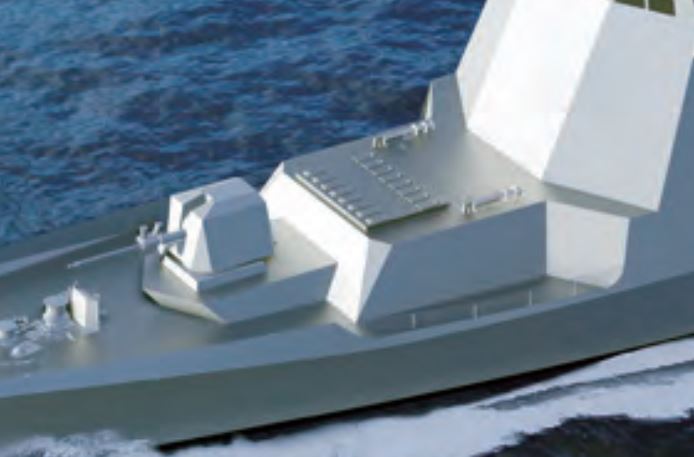 |
| The front end of the HDC-3100, with the CGI showing what appears to be a Hyundai WIA 76mm naval gun, and a 16-cell VLS that fits the appearance of the MBDA VL-MICA air defense system. Cranes are also visible beside the VLS launchers, which will assist in loading/reloading launching boxes on the VLS system. Photo taken from HHI. |

It also shows four Countermeasures Launchers, most likely the Terma C-Guard system.
 |
| Mast and bridge section of the HDC-3100 design. Photo taken from HHI. |
Superstructure midsection shows an open deck before the funnel, but covered from the funnel to the rear, which improves reducing radar cross section compared to the HDF-2600 / Jose Rizal-class.
Two rigid-hull inflatable boats (RHIBs) are seen but covered by a retractable gate, while the triple torpedo launchers were moved to a lower deck and is covered also by a retractable gate.
Also seen are two quadruple launchers for anti-ship missiles, most likely the LIGNex1 SSM-700K C-Star anti-ship cruise missiles.
Another retractable gate can be seen behind those for the RHIBs, which are open-able during launching of anti-ship missiles and not burn the ship's superstructure walls.
 |
| Midsection of the HDC-3100 design. Photo credits to HHI. |
At the hangar superstructure, the upper deck features a gun-based Close-in Weapon System (CIWS), which appears to be similar to Hanwha Systems' CIWS-II design, although there is no visible medium-caliber RCWS.
MaxDefense Philippines believes that a redesign of the hangar's upper deck would be made to allow the CIWS to sit on a higher platform, and allowing a RCWS to be at a lower position.
 |
| Hangar section of the HDC-3100 design. Photo credits to HHI. |
A helicopter landing deck can be found on the aft, expected to have a capacity of at least 10 tons, enough to allow the AgustaWestland AW-159 Wildcat, Sikorsky MH-60 Seahawk, or even the NH Industries NH90 naval helicopter.
 |
| The helideck section. Photo credits to HHI. |
Take note that since this is a basic CGI of the HDC-3100 design, further improvements can be made once the Critical Design Review (CDR) is done. One would remember that the pre-CDR CGI of the Jose Rizal-class is slightly different from the final output.
Compared to its other competitors, HHI did not offer to build any corvette in the Philippines. Instead, all work will be in HHI's Ulsan naval shipyard. Apparently, this allows to lower down cost, compared to providing technology transfer which is expensive vis a vis the project's budget.
Why Focus on HHI's Corvette Offer?:
Readers may have noticed that our analysis for the corvette offerings of the 4 companies are more comprehensive on HHI's HDC-3100 compared to the 3 other offerings from Turkey, France and The Netherlands.
This is because so far, HHI has released more information publicly than the other 3 companies. This could only mean 1 thing - that HHI may have already reached a certain level of advancement on the project compared to the other 3 companies.
This is not just because of the availability of a CGI of its offer, but also based on information provided by Philippine Navy and industry sources to MaxDefense Philippines.
Apparently, HHI and the South Korean Ministry of National Defense (MND) has already advanced more in its negotiations with the Philippine Navy and Philippines Department of National Defense (DND), to the point that Terms of Reference (TOR) is already being prepared, which would lead to a Notice of Award (NOA) being given to HHI.
Terms of Reference is the document that is a guideline that would be part of the contract between the two parties, and having this arranged with a certain company only means that deal is almost nearing completion.
Not only that, we also received confirmation from South Korean sources indicating that HHI's naval shipyard in Ulsan has already started preparation in anticipation of an award and eventual construction of the new corvettes (MaxDefense Philippines thanks its South Korean sources for this information).
This can be also corroborated by the lack of further discussion between the Philippine Navy / DND team and the 3 other shipbuilders. In comparison, HHI's executive vice president and director for Marketing and Sales Mr. Moon Young Park was meeting the Philippine Navy leadership as late as 03 August 2021.
 |
| HHI Executive VP and Director for Marketing and Sales Mr. Moon Young Park meets PN leadership on 03 August 2021 in Manila. Photo credits to Philippine Navy. |
Does this mean HHI is the Winning Shipbuilder?:
Not necessarily, or not yet. While they have the highest chance of getting the project, until a Notice of Award is given, a Contract signed and the Notice to Proceed issued, everything can still happen.
The biggest obstacle though is lack of funding from the national government - if the Department of Budget and Management (DBM) does not release the initial funding for the Php28 billion project, the deal won't push through. This can happen even if Malacanang approves the deal to proceed.
Another is on the delays in implementing the project. This could be due to lack of funding (as stated earlier), or because of bureaucratic red tape. If this project does not reach contract signing before the end of the 2021, it can be considered a "midnight deal" if still pushed just months before the national elections in May 2022.
But another factor that can delay the project will depend on the Philippine Navy - will HHI and the PN reach an agreement on the deal's details while it is still clear for a deal to proceed?
We expect that HHI would be pushy on its offer, and may steamroll the Philippine Navy's Technical Working Group (TWG) and Leadership especially now that the deal is through soft loans by the shipbuilder's country of origin. If both parties agree on the final inclusions of the deal, then the Philippine Navy can pass the burden to complete the deal to the DND and the National Government.
=============
MaxDefense Philippines will continue to monitor the developments on this project, especially that the Philippine Navy is not publicizing the details of the project due to its G2G nature, unlike the previous Frigate Acquisition Project that was acquired through public bidding.
We are still hopeful that the government would finalize the deal before the end of year 2021, no matter who the winning shipbuilder and corvette design would be selected.
===============
First edit and release: 09 August 2021
Copyright MaxDefense Philippines


