


MaxDefense is again pleased to have a good friend, eminent defense analyst and historian Prof. Jose Antonio A. Custodio, share his piece here in our blog pages, this time discussing historical background of Japan's militaristic past, its past conflicts with China and the rest of Asia, and why Japan's foray into the territorial issues in the West Philippine Sea could likely make China more concerned and furious against its longtime regional nemesis.
Posting the entirety of the 3-part series altogether in a single entry, first published in Interaksyon.com starting last July 16, 2015. Photos were added by MaxDefense according to its own interpretation of Prof. Custodio's article.
# # # # # # # # # #
Part 1: Japan in WPS: Beyond China evoking World War II atrocities:
Japan’s entry into the West Philippine Sea has been fully supported by the Philippines and vigorously protested by China. This action by Tokyo has revived memories of the Second World War as Beijing has been using the records of Japan’s transgressions and atrocities during the previous global conflict as propaganda to counter Japanese security initiatives in the region.
The Philippines, which ironically had been a country occupied by Imperial Japan, is now rapidly finding itself marching in step with what may turn into its strongest ally after the United States should anything formally be drawn up between Manila and Tokyo. It has also used the World War II past but not against the Japanese but against Beijing.
Philippine President Benigno S. Aquino III had stated that China has been acting very much in the same manner that Germany had been treating its neighbors in the 1930s leading to the outbreak of war in Europe. Oversensitive Chinese took exception to this declaration by the Philippine president overlooking the fact that what was compared was the similarity in the bullying tactics and unilateral actions of Germany with what China has been doing for the past decade and it was never alleged or claimed that the Chinese ruling elite were a bunch of murderous genocidal maniacs which the Nazis were.
Despite of course the fact that Beijing is systematically destroying Tibetan culture and Maoist tenets do have a tinge of genocidal tendencies itself as seen in the massive deaths caused by the Great Leap Forward in the 1950s and the Cultural Revolution in the 1960s.
The thing is, while everyone is harking back to the Second World War to warn about what either China and Japan are doing, one of the most essential factors that led to the outbreak of war here in Asia in 1941 seems to be overlooked especially by the Chinese.
China and Japan: It’s personal
For centuries, both China and Japan have been at each other’s throats.
In many instances the Korean Peninsula had been the real estate where the two squared off against each other.
However following the reclusive Tokugawa Shogunate, the newly modernized Japan fought and pulverized the armies of the decaying Manchu Dynasty and won the 1895 Sino Japanese War. The next decades would see Japan carve out territory after territory at the expense of China.
In 1910, Japan annexed Korea and in the next decade firmly established itself in Manchuria. This made war inevitable and it broke out after being instigated by Japan in 1937.
The brutality of that war has left a lasting impression on the Chinese and atrocities like the Nanking Massacre, the Burn All-Kill All-Loot All anti-guerrilla punitive operations by the Japanese and the notorious Unit 731 chemical and biological weapon experiments have never been forgotten.
Following the war, Japan really did drag its feet in acknowledging and apologizing for its atrocities and it is indeed true that for every effort by Japan to extend remorse for its wartime past, there was an attempt within the country to justify the reasons why Japan went to war.
That obviously did not sit well with many Asian countries, most especially the Chinese. Those are the reasons why it had become personal between the two countries.
The trigger of World War II in Asia
As mentioned, Japan had been deeply involved in China following the undeclared Sino-Japanese War in 1937 and even much earlier than that, and the bulk of the Imperial Japanese Army was deployed in operations against the Chinese.
The Imperial Japanese Navy was also involved in the war with its warships and aircraft effectively conducting a blockade of China by seizing strategic ports and locations along the coast. Although the war was localized it was sending a chilling effect on the rest of the region and the Europeans and Americans took steps to ensure that its interests in Shanghai and Hong Kong were safe from any spillover from the conflict.
In June 1940 when the Germans vanquished the French, the Japanese sensed that France’s colonial possessions were ripe for the picking. After browbeating the Vichy French authorities to accept Japanese military presence in Indochina, Tokyo then began establishing bases in that French colony. Simultaneously, the Japanese entered into the notorious Tripartite Agreement with Rome and Berlin and became a member of the Axis alliance. These two actions were the straws that practically broke the camel’s back for Washington and London. Economic sanctions were immediately called for by the Americans against the Japanese. The British together with the Western European governments in exile supported that US initiative and a crippling economic blockade of strategic materials such as rubber, metals, and most especially of oil was imposed on the Japanese.
As Japan had no such resources, this embargo would have a devastating effect on Tokyo’s national interests. Japan’s war leaders were now in a dilemma. Should they buckle under the pressure of the Americans and Europeans and cease their operations in China and lose face in the process, or should they continue with the war and run out of the means to conduct it?
For quite some time, the Japanese high command was undergoing a debate as to which front to expand next as there were those who favored concentrating against the Soviet Union while others cast covetous eyes on the rich possessions of the colonial powers in Southeast Asia. Following a series of defeats against the Soviet Union at Mongolia in the late 1930s, and the pressures and demands of the war in China, the focus shifted towards the colonies at Southeast Asia. Now with the US led embargo in full effect against Japan, the capacity for the Japanese military to conduct operations was measured in several months before oil and other essentials run out. The plan then was to strike southwards and conquer the rich colonies there. The trigger then that started the war for Japan was the reality of being starved to submission by the economic embargo.
Part 2: The strength of Japan: the second type of island-nation mentality:
There are two types of island nations. The first is the type that, because of its isolation brought about by the seas surrounding it, tends to look inward and have little or no comprehension of external developments. The second is the type that seeks to go beyond the seas that confine it and in the process build large empires whether by conquest or economic activity.
Japan is the latter type of island nation and is very similar to the United Kingdom in that regard. The Japanese view the sea lanes as fundamental for their national survival as commerce, vital to the viability of their economic life, and depend on its unhampered flow into and out of Japan. No ifs or buts about that.
Hence, China as a nation located in the Asian mainland may have difficulty in understanding that very fundamental aspect of Japan’s existence as a powerful maritime nation state, which had already caused it to go to war 70 years ago. Simply put, one cannot mess around with Japan’s contact with the outside world and get away with it.
While postwar Japan strove to learn the lessons of the Second World War by embracing peaceful economic development, it also created a powerful naval capability that would check the Soviet Union’s submarine force during the Cold War - this, in order to avoid a repeat of its disastrous experience when the United States strangled the Japanese through prewar economic sanctions and the wartime naval and submarine blockade.
In fact, former officers of the Imperial Japanese Army and Imperial Japanese Navy joined the newly established Japan Self Defense Force ensuring that lessons learned during the war years would remain codified in the new military organization. One such individual was Minoru Genda, the officer who planned the air assault on Pearl Harbor. After the war, he joined the Japan Air Self Defense Force and became its commanding general from 1959-1962.
On the other hand, these very lessons of the Second World War seem to have been forgotten by China in its haste to establish suzerainty over this part of the world; and it seems to have not properly assessed the Japanese response to what it is doing in the West Philippine Sea.
Many observers and analysts fail to realize that Japan is a nation composed of several large island groups that has a deep and historical appreciation of the maritime domain and its role in the country’s survival and viability as a powerful and influential state. This has been a recurring theme in Japan’s history from the 19th Century onwards, and felt very keenly by the Japanese during the Second World War. Just like Great Britain which 19th Century Japan looked up to as a model worth emulating, the Japanese first attempted to establish a traditional empire that ended with the disaster of the Second World War; and, following that, an economic empire: both attempts required a strong maritime tradition and capability to protect and advance their interests.
However, by the tailend of the Cold War, Japan could already see the handwriting on the wall regarding United States presence in the Asia Pacific, and since the late 1980s it began modernizing its power projection capabilities.
The first indicator of that was the appearance of a new type of vessel in the Japan Maritime Self Defense Force, the LST 4001 Osumi in 1995. Although the Japanese made great effort to explain the ship as a Landing Ship, it somewhat resembled a small aircraft carrier with its flat deck and island superstructure. Japan built three vessels of this type.
In the early 1990s, the Japanese military was already participating in peacekeeping operations in Cambodia and this, too, was another indicator of Japan’s increasing shift toward projection of forces as such activities familiarized Japan with operations outside of the Home Islands and in the logistic needs for such.
The last time the Japanese had projected their forces was in 1945 and there was a lot of catching up to do.
By the 21st Century, Japanese combat aircraft were being deployed further and further away in exercises with their American ally in the Pacific region. Then in 2006, the Japan began the construction of DDH 181 Hyuga.
Hyuga on the day of its launch was the biggest warship in the JMSDF; although it looked like an aircraft carrier and approaching the size of a World War 2 era fleet carrier, it was designated as a destroyer. This then made it the largest destroyer in the world at 646 feet in length, and Japan built two and named the later one DDH 182 Ise.
The names Hyuga and Ise were once carried by two battleships of the Imperial Japanese Navy that entered service in World War I and saw extensive combat in World War II and were both modified as hybrid battleship/aircraft carriers.
DDH181 and DDH 182, however, both lost the distinction of being the largest “destroyers” afloat when Japan commissioned the DDH 183 Izumo in 2015 that, again, despite it being designated as such, had all the appearances of an aircraft carrier. At 814 feet in length, it is also as large or if not larger than many World War II-era fleet carriers, thus making it theoretically possible to operate fixed-wing aircraft if modified with a ski jump and with the flight deck reinforced.
Although Japan is part of the consortium that is developing the Lockheed F-35 Lighting II and has agreed to order 42 of the F-35A variant, should it opt in the future for the B variant - which is the Vertical and Short Take Off model - then it will really raise suspicions about the true intention of all these flat decks in service with the JMSDF.
What the reefs represent for Japan:
When China declared an Air Defense Identification Zone (ADIZ) that swallowed up the East China Sea, Japan was one of the countries that vigorously protested. Each time Beijing did a provocative action, the Japanese did not flinch from facing off with them.
Today, Chinese incursions into Japanese airspace have so become a regular occurrence that the Japan Air Self Defense Force maintains a round-the-clock alert status in areas the Chinese aircraft regularly intrude into. China - no longer Russia - is effectively the number one violator of Japan’s airspace.
Now that China has undertaken an artificial island construction spree at the West Philippine Sea - something only the most naïve or the most treasonous will view as anything but military outposts designed to curtail and control movement into the area and to project Chinese military power - the impact of this to Japan is not something that is hard to guess, as all these lie astride Japanese shipping.
Of course, the Japanese are aware of the Chinese First and Second Island Chain strategy, but it is doubtful that they will wait for that to transpire before they take any action.
Part 3: Why China is apprehensive about Japan's entry into the West Philippine Sea:
In 2014, Japanese Prime Minister Shinzo Abe led a Cabinet decision to lift Japan’s restrictions on the use of force overseas. This is the concept of collective self-defense which although being challenged by the political opposition is being used as a means to eventually redraw the Japanese Constitution. The collective self-defense concept contains three conditions which are as follows:
The first is in a case where a nation with close ties to Japan comes under attack and the lives, freedom, and right of Japanese nationals to pursue happiness are clearly endangered. The second condition specifies that force may be used only if there is no other effective way to protect the lives of Japanese citizens. The final condition is the limitation of the use of force to the minimally required level. These standards open up the way for Japan’s Self-Defense Forces, under certain conditions, to aid an allied nation that is under attack, even if Japan itself is not.
Since then the Japanese have ramped up not only their government to government contacts with the countries in dispute with China in the West Philippine Sea, but they are also working to become a regular and strong presence in the area. Consider that the Japanese Maritime Self Defense Force has conducted two exercises with the Philippine military within the month while at the same time it is widely reported that a maritime patrol aircraft will be provided to the Philippines by Japan.
A Memorandum on Defense Cooperation and Exchanges was signed between the two countries on January 2015 which set the stage for Japanese activities with their Filipino counterparts that ranges from exercises to assistance programs. By June of 2015, the maritime agencies and navies of the two countries had undertaken two joint exercises which underlie the rapid manner in which the defense and security relationship between Tokyo and Manila is developing.
Just to put emphasis, prior to those two exercises, there was practically no activity between the two militaries. The last one between the two was in 1945, and both the Filipinos and Japanese were trying to kill each other! In fact, it can be said that Japan’s current activities in the Philippines have the potential to approach the level of the security relationship that Manila has with Washington DC.
The Japanese mindset: not a puppet of the Americans:
Conventional thinking has it that the Japanese are a cog in the grand plans of the United States in the region and that Japan is a puppet of the US. That would be an oversimplification of the relationship between the two countries and disregards the fact that Japan, just like the Philippines and Vietnam, is a frontline state against China’s territorial ambitions and considers the situation a clear and present danger and a direct threat to its survival.
That situation then creates the favorable climate upon which the lessons of history and the historical experience of Japan will come to play.
Many analysts tend to view Japan’s posture as either the effect of ultranationalism or as being subordinate to Washington DC, as if the survival of Japan is only the preserve and concern of so called ultranationalists and puppets of the US. It definitely is not.
Ultranationalism or unabashed pro-Americanism will not spur the construction of aircraft carrier type ships in the JMSDF, and it would also not be the driver for Japan’s reaching out to countries in the region to establish a coordinated multinational effort to face China.
Given the experience of Japan during World War II, it is safe to assume that the destructive air and naval blockade that the United States imposed on the Home Islands during that conflict would leave an indelible mark in the minds of generations of Japanese national security policy makers and military planners.
These people are the architects responsible for building and reorienting the Japanese military through the past decades to its current state, which is now benefiting the current term of Prime Minister Shinzo Abe and is allowing the Japanese government the capability to respond decisively to China’s ambitions now and in the years to come.
With that traumatic historical experience at the back of their minds, and the fact also Japan is a frontline state, it may just turn out to be more forceful than the US in asserting its agenda and interests in the region especially when it comes to facing off against China.
China’s achieving its strategic goals as becoming the dominant power in the region will not sit well with Japan as it will result in it becoming a subordinate state to Beijing. That will not be in the national interest of Japan.
Thus Japan will most likely push back against China with or without US support as it not only has the economic capability to stand up to pressure from Washington DC should the leadership there become less sympathetic to Tokyo, but it also has the military capability to do unilateral actions. Which is probably why Chinese political and military officials are very apprehensive of Japan’s entry into the West Philippine Sea.
Hence it will be in Japan’s interests that countries like the Philippines that are sympathetic to it or have common issues against China be made capable of spreading Chinese capabilities thin so as to cause Beijing to limit itself to occupying a few artificial islands and nothing anymore grander than that as a reminder of its folly of trying to take on so many opponents at once.
What China has to realize is that it has stirred up a hornet’s nest in its actions against Japan. Although China has used history by raising Japan’s atrocities during and before the Second World War as a means to drive a wedge between Tokyo and countries that had once felt the boot of Japanese imperialism, what it forgets is that in modern and contemporary history, the Japanese have never lost a war against the Chinese.
China cannot claim to have won the war against Japan during World War II when it was ultimately Russian forces that destroyed the Japanese Kwantung Army in China. That fact provides a very strong psychological boost for the Japanese against the Chinese.
Contrast that with the defeatism and feeling of inferiority so prevalent among many Filipinos when it comes to dealing with China as a regional power.
What now Philippines?
Although it is an oft repeated statement that each country is guided by its own national interests, the question that needs to be asked is if the Philippines truly understands the undercurrents that shape Japanese strategic perceptions and objectives.
Does Manila really understand how far the Japanese will go to defend their interests and that throughout history the Japanese - when they feel besieged - have the ability to strike out without warning against an enemy?
Consider that in the span of a few decades, Japan has carefully built up its power projection capabilities and modified its security outlook to engage and defeat threats way before they reach Japanese shores. That in a span of a few years, from a strict assistance program limited to aid to the Philippine Coast Guard and others of a civilian nature, Japan is now emerging as a potential provider of military assistance to Manila.
The Philippines has to realize that it is not dealing with a dithering easily distracted ally like the United States of America, but a country that has a suppressed martial tradition that may just reappear due to China’s rapacious territorial ambitions.
Posting the entirety of the 3-part series altogether in a single entry, first published in Interaksyon.com starting last July 16, 2015. Photos were added by MaxDefense according to its own interpretation of Prof. Custodio's article.
 |
| Japanese and Philippine warships in a joint naval exercise in the West Philippine Sea in 2015. More exercises between the 2 strategic partners are expected, with the strengthening of bilateral economic, defense, and political relations between the Philippines and Japan. Photo taken from the Japan Ministry of Defense. |
# # # # # # # # # #
Part 1: Japan in WPS: Beyond China evoking World War II atrocities:
Japan’s entry into the West Philippine Sea has been fully supported by the Philippines and vigorously protested by China. This action by Tokyo has revived memories of the Second World War as Beijing has been using the records of Japan’s transgressions and atrocities during the previous global conflict as propaganda to counter Japanese security initiatives in the region.
The Philippines, which ironically had been a country occupied by Imperial Japan, is now rapidly finding itself marching in step with what may turn into its strongest ally after the United States should anything formally be drawn up between Manila and Tokyo. It has also used the World War II past but not against the Japanese but against Beijing.
Philippine President Benigno S. Aquino III had stated that China has been acting very much in the same manner that Germany had been treating its neighbors in the 1930s leading to the outbreak of war in Europe. Oversensitive Chinese took exception to this declaration by the Philippine president overlooking the fact that what was compared was the similarity in the bullying tactics and unilateral actions of Germany with what China has been doing for the past decade and it was never alleged or claimed that the Chinese ruling elite were a bunch of murderous genocidal maniacs which the Nazis were.
Despite of course the fact that Beijing is systematically destroying Tibetan culture and Maoist tenets do have a tinge of genocidal tendencies itself as seen in the massive deaths caused by the Great Leap Forward in the 1950s and the Cultural Revolution in the 1960s.
The thing is, while everyone is harking back to the Second World War to warn about what either China and Japan are doing, one of the most essential factors that led to the outbreak of war here in Asia in 1941 seems to be overlooked especially by the Chinese.
China and Japan: It’s personal
For centuries, both China and Japan have been at each other’s throats.
In many instances the Korean Peninsula had been the real estate where the two squared off against each other.
However following the reclusive Tokugawa Shogunate, the newly modernized Japan fought and pulverized the armies of the decaying Manchu Dynasty and won the 1895 Sino Japanese War. The next decades would see Japan carve out territory after territory at the expense of China.
In 1910, Japan annexed Korea and in the next decade firmly established itself in Manchuria. This made war inevitable and it broke out after being instigated by Japan in 1937.
The brutality of that war has left a lasting impression on the Chinese and atrocities like the Nanking Massacre, the Burn All-Kill All-Loot All anti-guerrilla punitive operations by the Japanese and the notorious Unit 731 chemical and biological weapon experiments have never been forgotten.
 |
| A photo said to be taken during the Nanking Massacre (aka. Rape of Nanking) during the Second Sino-Japanese War in 1937. Although the event is now being questioned for its authenticity and accuracy, whatever the real numbers are, China still holds grudges against Japan for its humiliation and defeat by Japan. Photo taken from topsecretwriters website. |
Following the war, Japan really did drag its feet in acknowledging and apologizing for its atrocities and it is indeed true that for every effort by Japan to extend remorse for its wartime past, there was an attempt within the country to justify the reasons why Japan went to war.
That obviously did not sit well with many Asian countries, most especially the Chinese. Those are the reasons why it had become personal between the two countries.
The trigger of World War II in Asia
As mentioned, Japan had been deeply involved in China following the undeclared Sino-Japanese War in 1937 and even much earlier than that, and the bulk of the Imperial Japanese Army was deployed in operations against the Chinese.
The Imperial Japanese Navy was also involved in the war with its warships and aircraft effectively conducting a blockade of China by seizing strategic ports and locations along the coast. Although the war was localized it was sending a chilling effect on the rest of the region and the Europeans and Americans took steps to ensure that its interests in Shanghai and Hong Kong were safe from any spillover from the conflict.
In June 1940 when the Germans vanquished the French, the Japanese sensed that France’s colonial possessions were ripe for the picking. After browbeating the Vichy French authorities to accept Japanese military presence in Indochina, Tokyo then began establishing bases in that French colony. Simultaneously, the Japanese entered into the notorious Tripartite Agreement with Rome and Berlin and became a member of the Axis alliance. These two actions were the straws that practically broke the camel’s back for Washington and London. Economic sanctions were immediately called for by the Americans against the Japanese. The British together with the Western European governments in exile supported that US initiative and a crippling economic blockade of strategic materials such as rubber, metals, and most especially of oil was imposed on the Japanese.
As Japan had no such resources, this embargo would have a devastating effect on Tokyo’s national interests. Japan’s war leaders were now in a dilemma. Should they buckle under the pressure of the Americans and Europeans and cease their operations in China and lose face in the process, or should they continue with the war and run out of the means to conduct it?
For quite some time, the Japanese high command was undergoing a debate as to which front to expand next as there were those who favored concentrating against the Soviet Union while others cast covetous eyes on the rich possessions of the colonial powers in Southeast Asia. Following a series of defeats against the Soviet Union at Mongolia in the late 1930s, and the pressures and demands of the war in China, the focus shifted towards the colonies at Southeast Asia. Now with the US led embargo in full effect against Japan, the capacity for the Japanese military to conduct operations was measured in several months before oil and other essentials run out. The plan then was to strike southwards and conquer the rich colonies there. The trigger then that started the war for Japan was the reality of being starved to submission by the economic embargo.
 |
| The US embargo of critical war materials in 1940 brought almost brought Japan to its knees, and made it realize that it needs to strike fast and capture alternative sources of resources and control of trade routes. If China keeps control of the West Philippine Sea based on its so-called historical claim, Japan might be brought back to the same condition. History shows that Japan won't hesitate to act fast if this happens to her. |
Part 2: The strength of Japan: the second type of island-nation mentality:
There are two types of island nations. The first is the type that, because of its isolation brought about by the seas surrounding it, tends to look inward and have little or no comprehension of external developments. The second is the type that seeks to go beyond the seas that confine it and in the process build large empires whether by conquest or economic activity.
Japan is the latter type of island nation and is very similar to the United Kingdom in that regard. The Japanese view the sea lanes as fundamental for their national survival as commerce, vital to the viability of their economic life, and depend on its unhampered flow into and out of Japan. No ifs or buts about that.
Hence, China as a nation located in the Asian mainland may have difficulty in understanding that very fundamental aspect of Japan’s existence as a powerful maritime nation state, which had already caused it to go to war 70 years ago. Simply put, one cannot mess around with Japan’s contact with the outside world and get away with it.
While postwar Japan strove to learn the lessons of the Second World War by embracing peaceful economic development, it also created a powerful naval capability that would check the Soviet Union’s submarine force during the Cold War - this, in order to avoid a repeat of its disastrous experience when the United States strangled the Japanese through prewar economic sanctions and the wartime naval and submarine blockade.
In fact, former officers of the Imperial Japanese Army and Imperial Japanese Navy joined the newly established Japan Self Defense Force ensuring that lessons learned during the war years would remain codified in the new military organization. One such individual was Minoru Genda, the officer who planned the air assault on Pearl Harbor. After the war, he joined the Japan Air Self Defense Force and became its commanding general from 1959-1962.
 |
| Even with its purely defensive policy, Japan maintained a large, modern, well equipped and well trained naval and coast guard forces to safeguard their trade lifelines, exclusive economic zones, and be ready to project power if needed. That is expected to increase further now that Japan has allowed its self defense forces to act like a normal armed forces. |
On the other hand, these very lessons of the Second World War seem to have been forgotten by China in its haste to establish suzerainty over this part of the world; and it seems to have not properly assessed the Japanese response to what it is doing in the West Philippine Sea.
Many observers and analysts fail to realize that Japan is a nation composed of several large island groups that has a deep and historical appreciation of the maritime domain and its role in the country’s survival and viability as a powerful and influential state. This has been a recurring theme in Japan’s history from the 19th Century onwards, and felt very keenly by the Japanese during the Second World War. Just like Great Britain which 19th Century Japan looked up to as a model worth emulating, the Japanese first attempted to establish a traditional empire that ended with the disaster of the Second World War; and, following that, an economic empire: both attempts required a strong maritime tradition and capability to protect and advance their interests.
However, by the tailend of the Cold War, Japan could already see the handwriting on the wall regarding United States presence in the Asia Pacific, and since the late 1980s it began modernizing its power projection capabilities.
The first indicator of that was the appearance of a new type of vessel in the Japan Maritime Self Defense Force, the LST 4001 Osumi in 1995. Although the Japanese made great effort to explain the ship as a Landing Ship, it somewhat resembled a small aircraft carrier with its flat deck and island superstructure. Japan built three vessels of this type.
 |
| The JDS Osumi, a landing ship tank with a flat deck, of the Japan Maritime Self Defense Force (JMSDF). Japan has 3 of this type of vessel in its inventory and are considered as LST. Photo from seaforces.org. |
In the early 1990s, the Japanese military was already participating in peacekeeping operations in Cambodia and this, too, was another indicator of Japan’s increasing shift toward projection of forces as such activities familiarized Japan with operations outside of the Home Islands and in the logistic needs for such.
The last time the Japanese had projected their forces was in 1945 and there was a lot of catching up to do.
By the 21st Century, Japanese combat aircraft were being deployed further and further away in exercises with their American ally in the Pacific region. Then in 2006, the Japan began the construction of DDH 181 Hyuga.
Hyuga on the day of its launch was the biggest warship in the JMSDF; although it looked like an aircraft carrier and approaching the size of a World War 2 era fleet carrier, it was designated as a destroyer. This then made it the largest destroyer in the world at 646 feet in length, and Japan built two and named the later one DDH 182 Ise.
 |
| The JDS Hyuga, which was described by the Japanese as a helicopter destroyer. But it closely resemble a helicopter carrier. The JMSDF has 2 of these ships. Photo taken from seaforces.org. |
The names Hyuga and Ise were once carried by two battleships of the Imperial Japanese Navy that entered service in World War I and saw extensive combat in World War II and were both modified as hybrid battleship/aircraft carriers.
DDH181 and DDH 182, however, both lost the distinction of being the largest “destroyers” afloat when Japan commissioned the DDH 183 Izumo in 2015 that, again, despite it being designated as such, had all the appearances of an aircraft carrier. At 814 feet in length, it is also as large or if not larger than many World War II-era fleet carriers, thus making it theoretically possible to operate fixed-wing aircraft if modified with a ski jump and with the flight deck reinforced.
Although Japan is part of the consortium that is developing the Lockheed F-35 Lighting II and has agreed to order 42 of the F-35A variant, should it opt in the future for the B variant - which is the Vertical and Short Take Off model - then it will really raise suspicions about the true intention of all these flat decks in service with the JMSDF.
 |
| The JDS Izumo, currently Japan's largest warship, which closely resemble an aircraft carrier and is even larger than some fleet carriers of the Imperial Japanese Navy of the past. Technically, the JMSDF has 3 aircraft carriers as of now, and is building another Izumo-class ship. |
What the reefs represent for Japan:
When China declared an Air Defense Identification Zone (ADIZ) that swallowed up the East China Sea, Japan was one of the countries that vigorously protested. Each time Beijing did a provocative action, the Japanese did not flinch from facing off with them.
Today, Chinese incursions into Japanese airspace have so become a regular occurrence that the Japan Air Self Defense Force maintains a round-the-clock alert status in areas the Chinese aircraft regularly intrude into. China - no longer Russia - is effectively the number one violator of Japan’s airspace.
Now that China has undertaken an artificial island construction spree at the West Philippine Sea - something only the most naïve or the most treasonous will view as anything but military outposts designed to curtail and control movement into the area and to project Chinese military power - the impact of this to Japan is not something that is hard to guess, as all these lie astride Japanese shipping.
Of course, the Japanese are aware of the Chinese First and Second Island Chain strategy, but it is doubtful that they will wait for that to transpire before they take any action.
 |
| The illustration above shows the crude oil trade flows in the South China Sea/West Philippine Sea as of 2011. All crude oil from the Persian Gulf, Africa and other countries west of Japan passes through the disputed waters. A Chinese control on these waters could be devastating for the Japanese , thus their interest in keeping the area check from Chinese domination. Photo taken from the US Energy Information Administration. |
Part 3: Why China is apprehensive about Japan's entry into the West Philippine Sea:
In 2014, Japanese Prime Minister Shinzo Abe led a Cabinet decision to lift Japan’s restrictions on the use of force overseas. This is the concept of collective self-defense which although being challenged by the political opposition is being used as a means to eventually redraw the Japanese Constitution. The collective self-defense concept contains three conditions which are as follows:
The first is in a case where a nation with close ties to Japan comes under attack and the lives, freedom, and right of Japanese nationals to pursue happiness are clearly endangered. The second condition specifies that force may be used only if there is no other effective way to protect the lives of Japanese citizens. The final condition is the limitation of the use of force to the minimally required level. These standards open up the way for Japan’s Self-Defense Forces, under certain conditions, to aid an allied nation that is under attack, even if Japan itself is not.
Since then the Japanese have ramped up not only their government to government contacts with the countries in dispute with China in the West Philippine Sea, but they are also working to become a regular and strong presence in the area. Consider that the Japanese Maritime Self Defense Force has conducted two exercises with the Philippine military within the month while at the same time it is widely reported that a maritime patrol aircraft will be provided to the Philippines by Japan.
A Memorandum on Defense Cooperation and Exchanges was signed between the two countries on January 2015 which set the stage for Japanese activities with their Filipino counterparts that ranges from exercises to assistance programs. By June of 2015, the maritime agencies and navies of the two countries had undertaken two joint exercises which underlie the rapid manner in which the defense and security relationship between Tokyo and Manila is developing.
Just to put emphasis, prior to those two exercises, there was practically no activity between the two militaries. The last one between the two was in 1945, and both the Filipinos and Japanese were trying to kill each other! In fact, it can be said that Japan’s current activities in the Philippines have the potential to approach the level of the security relationship that Manila has with Washington DC.
The Japanese mindset: not a puppet of the Americans:
Conventional thinking has it that the Japanese are a cog in the grand plans of the United States in the region and that Japan is a puppet of the US. That would be an oversimplification of the relationship between the two countries and disregards the fact that Japan, just like the Philippines and Vietnam, is a frontline state against China’s territorial ambitions and considers the situation a clear and present danger and a direct threat to its survival.
That situation then creates the favorable climate upon which the lessons of history and the historical experience of Japan will come to play.
Many analysts tend to view Japan’s posture as either the effect of ultranationalism or as being subordinate to Washington DC, as if the survival of Japan is only the preserve and concern of so called ultranationalists and puppets of the US. It definitely is not.
Ultranationalism or unabashed pro-Americanism will not spur the construction of aircraft carrier type ships in the JMSDF, and it would also not be the driver for Japan’s reaching out to countries in the region to establish a coordinated multinational effort to face China.
Given the experience of Japan during World War II, it is safe to assume that the destructive air and naval blockade that the United States imposed on the Home Islands during that conflict would leave an indelible mark in the minds of generations of Japanese national security policy makers and military planners.
These people are the architects responsible for building and reorienting the Japanese military through the past decades to its current state, which is now benefiting the current term of Prime Minister Shinzo Abe and is allowing the Japanese government the capability to respond decisively to China’s ambitions now and in the years to come.
With that traumatic historical experience at the back of their minds, and the fact also Japan is a frontline state, it may just turn out to be more forceful than the US in asserting its agenda and interests in the region especially when it comes to facing off against China.
China’s achieving its strategic goals as becoming the dominant power in the region will not sit well with Japan as it will result in it becoming a subordinate state to Beijing. That will not be in the national interest of Japan.
Thus Japan will most likely push back against China with or without US support as it not only has the economic capability to stand up to pressure from Washington DC should the leadership there become less sympathetic to Tokyo, but it also has the military capability to do unilateral actions. Which is probably why Chinese political and military officials are very apprehensive of Japan’s entry into the West Philippine Sea.
Hence it will be in Japan’s interests that countries like the Philippines that are sympathetic to it or have common issues against China be made capable of spreading Chinese capabilities thin so as to cause Beijing to limit itself to occupying a few artificial islands and nothing anymore grander than that as a reminder of its folly of trying to take on so many opponents at once.
What China has to realize is that it has stirred up a hornet’s nest in its actions against Japan. Although China has used history by raising Japan’s atrocities during and before the Second World War as a means to drive a wedge between Tokyo and countries that had once felt the boot of Japanese imperialism, what it forgets is that in modern and contemporary history, the Japanese have never lost a war against the Chinese.
China cannot claim to have won the war against Japan during World War II when it was ultimately Russian forces that destroyed the Japanese Kwantung Army in China. That fact provides a very strong psychological boost for the Japanese against the Chinese.
Contrast that with the defeatism and feeling of inferiority so prevalent among many Filipinos when it comes to dealing with China as a regional power.
 |
| Although considered as one of the strongest bilateral partnerships, the Japanese would not allow the Americans to be completely in control, and has started distancing itself from the policies the Americans implemented as part of Japanese defeat in World War 2. Push comes to shove, with or without American support, Japan would assert itself against China using its own capacity. |
What now Philippines?
Although it is an oft repeated statement that each country is guided by its own national interests, the question that needs to be asked is if the Philippines truly understands the undercurrents that shape Japanese strategic perceptions and objectives.
Does Manila really understand how far the Japanese will go to defend their interests and that throughout history the Japanese - when they feel besieged - have the ability to strike out without warning against an enemy?
Consider that in the span of a few decades, Japan has carefully built up its power projection capabilities and modified its security outlook to engage and defeat threats way before they reach Japanese shores. That in a span of a few years, from a strict assistance program limited to aid to the Philippine Coast Guard and others of a civilian nature, Japan is now emerging as a potential provider of military assistance to Manila.
The Philippines has to realize that it is not dealing with a dithering easily distracted ally like the United States of America, but a country that has a suppressed martial tradition that may just reappear due to China’s rapacious territorial ambitions.
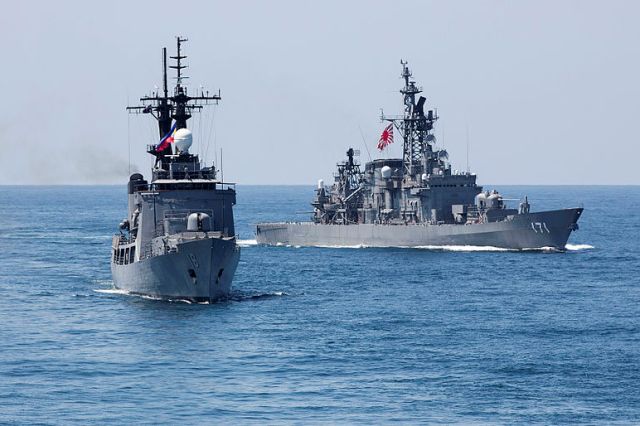 |
| Philippine Navy frigate BRP Ramon Alcaraz (left) and Japanese Maritime Self Defense Force destroyer JDS Hatakaze during KAKADU 2014 exercises off Australia. Photo taken from Australian Navy. |


