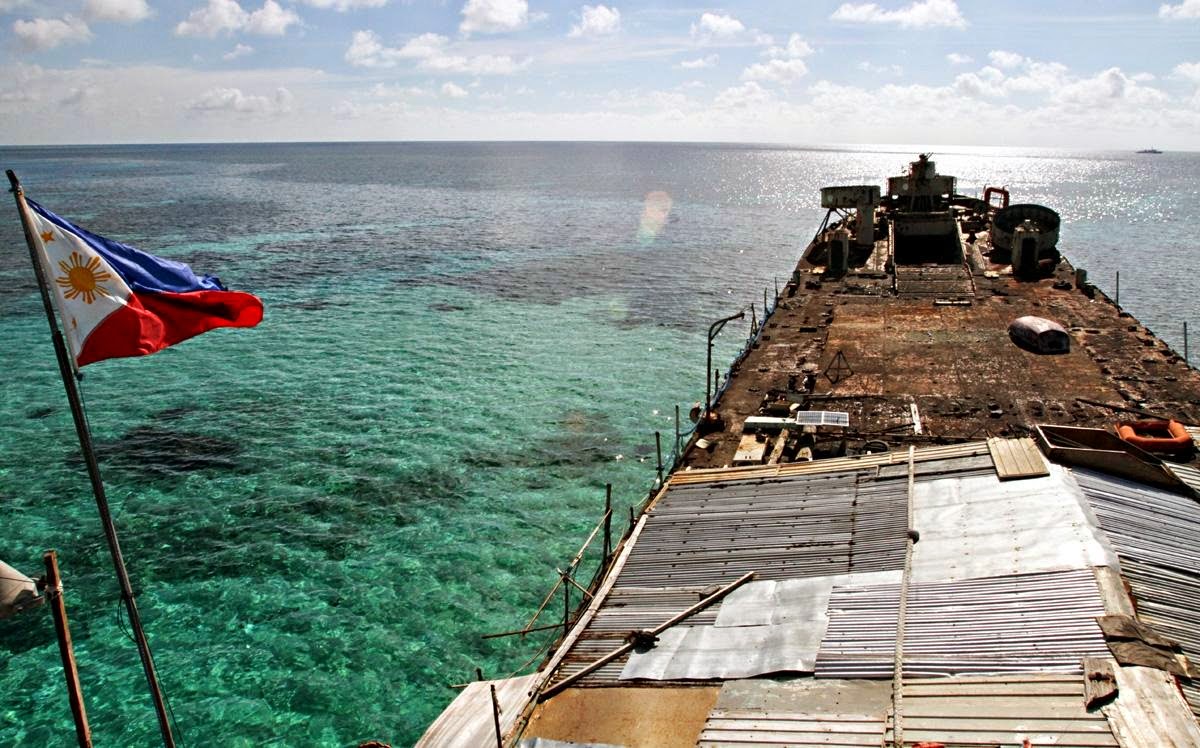
MaxDefense is borrowing an analysis made by one of the Philippines' foremost defense and security analyst, Prof. Jose Antonio Custodio, who has extensive knowledge on the dispute of the Philippines with China in the West Philippine Sea and along the so-called "10-dash line". This analysis was earlier posted as a special with TV5's Interaksyon.com last week (May 25 to 27, 2015). As this analysis would be better kept for re-reading and record for a longer period of time, it was decided to post the entire article (3 part series) in the MaxDefense blogs rather than just posted on the MaxDefense @ Facebook page.
This discusses the current situation in the West Philippine Sea, debunks the assumption made by Philippine politicians and policymakers, and provide an attainable and practical solution for the Philippine government without being too much dependent on a singular proposal in nature. Many, including those with military and political experience and knowledge, think that China, a military and economic powerhouse, is an invincible force that would be impossible to counter or stop from doing whatever it wants in the West Philippine Sea, including stumping without regard on the historical and lawful backgrounds of its fellow claimants, and the emphasis on peace, stability, and rule of law by the world's major powers. MaxDefense and Prof. Custodio thinks otherwise, and here is the full script of the entire post.
(Special thanks to Prof. Jose Antonio Custodio for allowing MaxDefense to make this possible. Photos, and the words underneath them, are provided by MaxDefense, and does not in any way represent Prof. Custodio's own views.)
PART 1 - WHAT'S NEXT IN DISPUTE WITH CHINA? Let's start with assessment of current situation:
The massive construction and reclamation activities being done by the People’s Republic of China at the West Philippine Sea have caused widespread concern in the international community.
The Philippine government has seen fit to elevate the threat of Chinese territorial ambitions as the most serious one affecting the country which is a clear break of the nearly half a century prioritization of internal security concerns by the Philippine defense establishment. There has been a slow but steady move to refocus the Armed Forces of the Philippines away from internal security towards external defense in the past few years. It is hoped that eventually this will provide the Philippines the capability to deal with external threats much more effectively.
Although the Philippine government has filed a case against the Chinese government, it is obviously not enough to prevent Beijing from continuing its expansion into the West Philippine Sea and complementary actions have to be done by Manila to defend its territorial claims in the area and its Western Exclusive Economic Zone.
A look at the maps provides a clearer picture as to the threat posed by China’s reclamation and base building activities in the West Philippine Sea.
Reclamation not only directed at PH
Although there has been much debate in the Philippines about the reason for the construction and reclamation of the Chinese with one side stating that it is Beijing’s retaliation for the arbitration case and the other side contesting that assertion, the scope of their activities reveals that it is not only directed against the Philippines but at the much more comprehensive installations established by the Vietnamese in the same area.
Hence once these Chinese bases become fully operational, it will not just make life more difficult for the Philippines but also pose a clear threat to Vietnam’s own garrisons.
In fact, in comparison to Vietnam’s installations, those of the Philippines have remained rudimentary in nature and will not require excessive pressure from the Chinese to dislodge and would not seem to justify Beijing’s expenditure of resources.
Once China neutralizes the installations of its rivals at the West Philippine Sea, what role in area denial will these new bases of theirs play?
These then raises the question as to who else are these reclamation activities by Beijing directed against and obviously the ultimate target is not just the Philippines, nor Vietnam but eventually the United States of America.
PH garrisons for dropping of international case?
For the Philippines, it will be hard-pressed to deal with the increased operational tempo of Chinese vessels and aircraft operating from the new installations and if it does not improve on its capability soon then a nightmare scenario will ensue.
This may in the future, result in the elimination of most of the Philippine installations from the West Philippine Sea either through Chinese actions or voluntarily by Manila itself or the Chinese may allow the Filipino garrisons to stay in exchange for onerous terms advantageous to Beijing such as the exploitation of our EEZ, the dropping of all cases filed in international courts and even unrestricted passage of Chinese military vessels through our internal waters and airspace towards the Pacific Ocean to challenge the Americans.
Threat at Scarborough Shoal
While focus has been maintained on the Chinese reclamation at the West Philippine Sea, Beijing reactivated another front against Manila by undertaking aggressive actions against Filipino fishermen at Scarborough Shoal which had been seized from the Philippines in 2012.
What is disturbing about Scarborough Shoal is that it lies 138 miles from Zambales, Luzon and it is very near Philippine centers of gravity such as the capital city of Manila and the political and economic complex of Central Luzon, National Capital Region, and the Southern Luzon and the major ports and airports at Manila, Subic, and Clark.
From there, the Chinese can easily interdict and harass Philippine lines of communication and movement.
Although China denies that it will develop the shoal as a military installation, given Beijing’s penchant for doublespeak, it would be foolish to not consider such a possibility in the near future because the shoal provides the Chinese the best possible opportunity to bottle up not just Philippine air and maritime assets but also to monitor, contain and restrict United States military movements.
PART 2 - IS CHINA INVINCIBLE? Debunking Philippine assumptions on the territorial dispute:
Manila has consistently resorted to diplomatic protests against Beijing’s unilateral actions and frequently shies away from direct confrontation with Chinese maritime vessels at the West Philippine Sea.
Oftentimes, Filipino fishermen are left to their own devices in confrontations with Chinese maritime vessels as there is no escort provided by the Philippine Coast Guard.
The question then is why is the Philippine response conducted in such a manner? The following Philippine assumptions in the territorial dispute are the reasons that explain that response:
Overstreched Chinese military capabilities:
In the case of China, the Philippines does have a tendency to excessively exaggerate Chinese capabilities without a realistic assessment and an understanding of the environment. Filipinos tend to bean-count when it comes to Chinese capabilities and strength and look at it from a strict Philippines against China framework. The fact that China is facing multiple opponents is seldom taken into consideration or if ever is quickly dismissed with the statement that “Beijing will buy them off eventually.”
Aside from the Philippines, China has territorial disputes with three major regional powers and these are Japan, India, and Vietnam. The navies and maritime capabilities of both Japan and India are individually superior in many aspects to that of the Chinese.
Although China did make much noise about the launch of its aircraft carrier, in contrast, the Indian Navy has been operating carriers for half a century while the Japanese Maritime Self Defense Force has commissioned at least three ships they euphemistically call destroyers but are almost similar to light aircraft carriers.
In fact the most recent ship to be commissioned, the Izumo is as big as the carriers of the Second World War Imperial Japanese Navy.
Furthermore, the important thing to remember is China’s military modernization is in transition and in absorption of new military hardware whereas its rivals are already advanced not just in the possession of equipment but also in the operational uses of such.
Also, China’s aggressive moves has resulted in its assets experiencing overstretch as it has to deal with neighbors who have been angered by Beijing’s brazen activities.
In the case of Vietnam, the Philippines seems to fail to recognize that despite the Vietnamese being very confrontational with China and figuring in many incidents since the 1970s and most importantly having no tangible military alliance with a superpower, Beijing cannot impose its will with finality on Hanoi’s scattered outposts in the West Philippine Sea.
That then is an indication of Beijing’s weakness which should be clear for all to see but unfortunately the Philippines has become accustomed to the habit of scaring itself witless in the face of China and is averse to taking on the Chinese physically in defense of its territorial integrity.
It is true that aside from the hundreds of warships in the Chinese Navy, there are also approximately more than 400 China Marine Surveillance vessels that implement Beijing’s territorial ambitions in the West Philippine Sea and elsewhere.
Against this huge Chinese armada, the Philippines can only commit several dozen ships of varying capabilities and hence the belief that the country is weak and can never overtake or even face off against China is firmly engrained in the minds of many Filipinos.
What again Filipinos fail to realize is that these Chinese assets are also deployed elsewhere especially against the formidable Japanese and redoubtable Vietnamese and not even mentioning the goliath that is the United States Navy.
China has obviously bit off more than it can chew and is obviously trying to bluff its way into a de facto situation favorable to it in the West Philippine Sea which no other nation is buying into except unfortunately the Philippines which remains consistently mortified of Beijing.
3. A fixation on the military solution when coast guard can be used instead
There seems to be an overemphasis by the Philippines on facing the challenge posed by China through a military solution and because of the sorry state of the Armed Forces of the Philippines it results in two situations.
The first is that the modernization of the armed forces especially the navy and the air force will take at least 10 years and even then it is not a guarantee that modern military capabilities will be used in a confrontation with China because the political leadership can just decide not to provoke the Chinese out of fear.
The second is because the military is taking too long to modernize and the belief is that it is the crucial lynchpin upon which all else lies, the tendency then is not to actively engage the Chinese because the country is defenseless.
It really has not sunk it that one of the most effective ways of frustrating the Chinese is through the use of the coast guard as the primary instrument. Just looking at the way Vietnam and Japan block Chinese incursions through the use of low-tech coast guard vessels that given their nature do not raise the ante to high as to warrant the use of military force should provide a guide as to how to deal with China in the WPS.
Furthermore, not unless the Philippine defense establishment has modified its defense strategy for the Philippines, the concept of defense in depth at the West Philippine Sea that first appeared during the modernization discussions in the 1990s and sometimes appears in current discussions on strategy has always been rendered moot and academic by the insertion of Chinese installations behind and in between Philippine installations.
PART 3 - BEYONG DIPLOMATIC PROTESTS: A proposed approach on territorial dispute with China
Scarborough Shoal more than Ayungin should have been the line in the sand for the Philippines vis a vis China. Now that it is gone, great effort must be taken that the Philippines should not take one more step backward as it has been prone to do in the past. To do that, the Philippines must undertake a combination of actions that will aim to stop China in its tracks in the West Philippine Sea aside from the arbitration case and the diplomatic offensive.
Aside from the raising international awareness through its current diplomatic offensive, the Philippines should ensure that appropriate steps are done to take advantage of China's territorial disputes with many of its neighbors by establishing coordination and support among the maritime and naval agencies of countries such as Japan, Vietnam, India, and Indonesia - aside from the United States.
This will then not just be the task of diplomats but also of the entire Philippine government including Congress, the Department of National Defense, and the AFP.
There is a need to project to China the message that other countries are not just committed but also coordinating in a multilateral effort to squash Beijing's ambitions. As it is Beijing's desire to drive a wedge between countries in the region either through bribery or intimidation then it is important not just to establish a multilateral diplomatic effort but more importantly a working multilateral maritime effort that does not necessarily have to be within existing frameworks of multilateral engagements such as ASEAN and the ASEAN Regional Forum.
Overstretch China
Multinational patrols and coordinated actions are one sure way of overstretching China's maritime and naval assets to the point that Beijing will run the risk of suffering the fate of the Soviet Union (when Moscow wasted its resources in catching up militarily to the United States in the 1980s) if it decides to try to pour additional funds to increase capabilities.
China can be frustrated through such an effort which is why this early it has already been trying to bluff its neighbors to deal with it bilaterally so it can divide and conquer.
Also for the Philippines, calling out allies for mobilizing support against China divides Beijing's attention and buys time for capability buildup whether in the Philippine Coast Guard or the Philippine Navy.
There must be added emphasis on the buildup of capabilities for the Philippine Coast Guard. Compared to the Philippine Navy and Philippine Air Force which have to go by modern military and technological standards in hardware acquisition, vessels for the PCG do not necessarily have to be state of the art.
All they need to be is be robustly constructed, have good communication equipment, equipped with non-lethal capabilities (i.e. water cannons), and large and strong enough to withstand being rammed by Chinese maritime vessels.
PH ships, Filipino sailors
It is very much within the capabilities of Philippine shipyards to churn out several dozen of such low tech vessels within a year and there are enough personnel graduating from maritime schools looking for jobs who can man those ships.
The personnel advantage of the Philippines as a major supplier of seamen for international shipping and as a builder of sea vessels are being overlooked. Costs will be significantly lower compared to the modernization of the AFP and this will allow the Philippines to establish a presence in its EEZ (exclusive economic zone) quickly and cheaply.
Just as important is that not only will these vessels protect Filipino fishermen but they will also particiapte in the efforts to break through expected Chinese blockades of Philippine garrisons at the West Philippine Sea.
Alhough much effort is being put increating a monitoring capability for the Philippines but knowing is useless if there is no capability to challenge.
The role of the PCG is to cover the gaps and buy time as the Philippine military undergoes its protracted modernization that is has been trying to do so for the past 25 years since the Philippine Senate kicked out the US bases.
In this regard, it may be advisable to remove the PCG from the Department of Transportation and Communication that already has its hands full in the traffic and transportation situation of Metro Manila alone and turn it over to the Coastwatch Council which itself may be transformed into a Department for better focus in lieu of the heightened role of the PCG in the preservation of the country's territorial integrity.
Turning the KIG installations into hedgehogs
The garrisons of the Philippines must be strengthened and their capacity to withstand protracted periods of Chinese blockades and harassment. Provisions must be stockpiled especially that of water and food.
If need be, defenses must also be improved. The issue of the survivability of Ayungin must be addressed and decisions must be made and carried out to improve the outpost there.
Most important of all is to look at Philippine garrisons as a threat to China and not to look at China’s garrisons as a threat to the Philippines.
From turning them into monitoring posts with equipment sourced from friendly nations and to turning Pagasa with its Rancudo airfield and the other smaller installations into power projection bases for the PCG, PN, and PAF.
As China wants to cut the KIG garrisons off from the Philippines, these very garrisons which are in between Hainan and Beijing’s WPS installations can threaten China’s overextended links that stretch much longer and are more vulnerable to disruption.
A shift in Philippine attitude
Although the Philippines will and should commit great effort to win over more and more allies and take advantage of its defense alliance with the United States the primary responsibility for the defense of Philippine territory rests with the Philippines itself.
In the current pivot to Asia that the United States has announced, the Philippines must not raise its expectations too high as to what the Americans will do for the Philippines.
Even with Japan declaring that it will study the issue of using its forces abroad in situations that they will consider as a threat to their national security and the Indians also echoing the same thing, none of these nations will physically assist the Philippines if the Chinese continue to harass Filipino fishermen.
That responsibility rests with the Philippines alone and it is expected that the Chinese will continue to deny the Philippines the use of its own EEZ.
Hence, multinational efforts may derail China’s strategic ambitions for the 9-dash line and the 1st and 2nd island Chains but it will not prevent them from committing acts of mischief against Philippine interests in the WPS.
Furthermore, as the Philippines has for whatever reason, chosen to always remain doubtful of American reliability in the mutual defense treaty, the same guessing game also pervades the Chinese and they too have no idea what the US will do if China attempts to use military force against the Philippines and this can be used by Manila against Beijing.
Hence the Philippine side should not blink at China in its run-ins with that country at the West Philippine Sea. It must understand that China is still in no position to wage war and is bound to lose one given the strength just of the United States alone not to mention Japan and others deeply suspicious of Beijing.
China’s hubris
This discusses the current situation in the West Philippine Sea, debunks the assumption made by Philippine politicians and policymakers, and provide an attainable and practical solution for the Philippine government without being too much dependent on a singular proposal in nature. Many, including those with military and political experience and knowledge, think that China, a military and economic powerhouse, is an invincible force that would be impossible to counter or stop from doing whatever it wants in the West Philippine Sea, including stumping without regard on the historical and lawful backgrounds of its fellow claimants, and the emphasis on peace, stability, and rule of law by the world's major powers. MaxDefense and Prof. Custodio thinks otherwise, and here is the full script of the entire post.
(Special thanks to Prof. Jose Antonio Custodio for allowing MaxDefense to make this possible. Photos, and the words underneath them, are provided by MaxDefense, and does not in any way represent Prof. Custodio's own views.)
 |
| Photos taken by a Philippine Air Force patrol aircraft as of February 19, 2015 shows the reclamation works done by the Chinese in the Spratlys. Photo taken from Inquirer.net. |
PART 1 - WHAT'S NEXT IN DISPUTE WITH CHINA? Let's start with assessment of current situation:
The massive construction and reclamation activities being done by the People’s Republic of China at the West Philippine Sea have caused widespread concern in the international community.
The Philippine government has seen fit to elevate the threat of Chinese territorial ambitions as the most serious one affecting the country which is a clear break of the nearly half a century prioritization of internal security concerns by the Philippine defense establishment. There has been a slow but steady move to refocus the Armed Forces of the Philippines away from internal security towards external defense in the past few years. It is hoped that eventually this will provide the Philippines the capability to deal with external threats much more effectively.
Although the Philippine government has filed a case against the Chinese government, it is obviously not enough to prevent Beijing from continuing its expansion into the West Philippine Sea and complementary actions have to be done by Manila to defend its territorial claims in the area and its Western Exclusive Economic Zone.
A look at the maps provides a clearer picture as to the threat posed by China’s reclamation and base building activities in the West Philippine Sea.
Reclamation not only directed at PH
Although there has been much debate in the Philippines about the reason for the construction and reclamation of the Chinese with one side stating that it is Beijing’s retaliation for the arbitration case and the other side contesting that assertion, the scope of their activities reveals that it is not only directed against the Philippines but at the much more comprehensive installations established by the Vietnamese in the same area.
Hence once these Chinese bases become fully operational, it will not just make life more difficult for the Philippines but also pose a clear threat to Vietnam’s own garrisons.
In fact, in comparison to Vietnam’s installations, those of the Philippines have remained rudimentary in nature and will not require excessive pressure from the Chinese to dislodge and would not seem to justify Beijing’s expenditure of resources.
Once China neutralizes the installations of its rivals at the West Philippine Sea, what role in area denial will these new bases of theirs play?
These then raises the question as to who else are these reclamation activities by Beijing directed against and obviously the ultimate target is not just the Philippines, nor Vietnam but eventually the United States of America.
 |
| Chinese reclamation at South Johnson Reef, also known as Mabini Reef, which is part of the Kalayaan Group of Islands in the West Philippine Sea. Photo from the Armed Forces of the Philippines. |
PH garrisons for dropping of international case?
For the Philippines, it will be hard-pressed to deal with the increased operational tempo of Chinese vessels and aircraft operating from the new installations and if it does not improve on its capability soon then a nightmare scenario will ensue.
This may in the future, result in the elimination of most of the Philippine installations from the West Philippine Sea either through Chinese actions or voluntarily by Manila itself or the Chinese may allow the Filipino garrisons to stay in exchange for onerous terms advantageous to Beijing such as the exploitation of our EEZ, the dropping of all cases filed in international courts and even unrestricted passage of Chinese military vessels through our internal waters and airspace towards the Pacific Ocean to challenge the Americans.
Threat at Scarborough Shoal
While focus has been maintained on the Chinese reclamation at the West Philippine Sea, Beijing reactivated another front against Manila by undertaking aggressive actions against Filipino fishermen at Scarborough Shoal which had been seized from the Philippines in 2012.
What is disturbing about Scarborough Shoal is that it lies 138 miles from Zambales, Luzon and it is very near Philippine centers of gravity such as the capital city of Manila and the political and economic complex of Central Luzon, National Capital Region, and the Southern Luzon and the major ports and airports at Manila, Subic, and Clark.
From there, the Chinese can easily interdict and harass Philippine lines of communication and movement.
Although China denies that it will develop the shoal as a military installation, given Beijing’s penchant for doublespeak, it would be foolish to not consider such a possibility in the near future because the shoal provides the Chinese the best possible opportunity to bottle up not just Philippine air and maritime assets but also to monitor, contain and restrict United States military movements.
 |
| Philippine lawmakers and soldiers placing a Philippine flag on the exposed portion of the Scarborough Shoal years before the Chinese Coast Guard took permanent position around it since 2012. |
PART 2 - IS CHINA INVINCIBLE? Debunking Philippine assumptions on the territorial dispute:
Manila has consistently resorted to diplomatic protests against Beijing’s unilateral actions and frequently shies away from direct confrontation with Chinese maritime vessels at the West Philippine Sea.
Oftentimes, Filipino fishermen are left to their own devices in confrontations with Chinese maritime vessels as there is no escort provided by the Philippine Coast Guard.
The question then is why is the Philippine response conducted in such a manner? The following Philippine assumptions in the territorial dispute are the reasons that explain that response:
1. China is strong and US is weak:
It is a widespread belief in the Philippines that China is a rising power and the tendency is to overstate the capabilities of China either due to ignorance or to pro-Beijing advocacies.
China's economic strength is trumpeted as a sign that it will overtake the United States which because of prolonged economic troubles is then automatically designated a weakening power.
The fact that the Chinese government strives to provide positive data to project its strength while taking steps to cover up or suppress not so flattering data that some economists have pointed out as serious flaws in China’s economy is frequently overlooked in the Philippines.
Meanwhile, the economic problems of the United States has been added to a litany of perceived grievances by Filipinos on American reliability as an ally thus making the Philippines question the military alliance that it has with the US instead of figuring out ways to derive opportunities for the Philippines. Unfortunately, the Philippines in general has a very black and white appreciation of the alliance it has with the US.
An example of this is the recent US willingness to deploy ships to monitor the establishment of Chinese bases at the West Philippine Sea has boosted the morale of the Philippines however it must be determined as to what exactly will be the mission of these American vessels.
It would not be wise to assume that the United States suddenly took up the cudgels for the Philippines as it is not expected that the US will accost Chinese ships or physically prevent the continuation of construction at the reefs.
They are there to remind the Chinese not to threaten the flow of global commerce and not to establish an Air Defense Identification Zone or ADIZ at the WPS. It is doubtful that they are there to protect the EEZ of the Philippines nor to escort Filipino fishermen.
Filipino fishermen and the EEZ will continue to remain vulnerable to Chinese depredation. The danger is that it is raising expectations so high in the Philippines and if the US fails to deliver from the point of view of what Filipinos expect, a new round of recriminations will ensue.
Meanwhile, the economic problems of the United States has been added to a litany of perceived grievances by Filipinos on American reliability as an ally thus making the Philippines question the military alliance that it has with the US instead of figuring out ways to derive opportunities for the Philippines. Unfortunately, the Philippines in general has a very black and white appreciation of the alliance it has with the US.
An example of this is the recent US willingness to deploy ships to monitor the establishment of Chinese bases at the West Philippine Sea has boosted the morale of the Philippines however it must be determined as to what exactly will be the mission of these American vessels.
It would not be wise to assume that the United States suddenly took up the cudgels for the Philippines as it is not expected that the US will accost Chinese ships or physically prevent the continuation of construction at the reefs.
They are there to remind the Chinese not to threaten the flow of global commerce and not to establish an Air Defense Identification Zone or ADIZ at the WPS. It is doubtful that they are there to protect the EEZ of the Philippines nor to escort Filipino fishermen.
Filipino fishermen and the EEZ will continue to remain vulnerable to Chinese depredation. The danger is that it is raising expectations so high in the Philippines and if the US fails to deliver from the point of view of what Filipinos expect, a new round of recriminations will ensue.
 |
| Chinese naval destroyers during a military exercise. Although China has become stronger than ever, it does not necessarily mean the US has become weak just because of their delayed movement and decisions in the WPS issue. |
In the case of China, the Philippines does have a tendency to excessively exaggerate Chinese capabilities without a realistic assessment and an understanding of the environment. Filipinos tend to bean-count when it comes to Chinese capabilities and strength and look at it from a strict Philippines against China framework. The fact that China is facing multiple opponents is seldom taken into consideration or if ever is quickly dismissed with the statement that “Beijing will buy them off eventually.”
Aside from the Philippines, China has territorial disputes with three major regional powers and these are Japan, India, and Vietnam. The navies and maritime capabilities of both Japan and India are individually superior in many aspects to that of the Chinese.
Although China did make much noise about the launch of its aircraft carrier, in contrast, the Indian Navy has been operating carriers for half a century while the Japanese Maritime Self Defense Force has commissioned at least three ships they euphemistically call destroyers but are almost similar to light aircraft carriers.
In fact the most recent ship to be commissioned, the Izumo is as big as the carriers of the Second World War Imperial Japanese Navy.
Furthermore, the important thing to remember is China’s military modernization is in transition and in absorption of new military hardware whereas its rivals are already advanced not just in the possession of equipment but also in the operational uses of such.
Also, China’s aggressive moves has resulted in its assets experiencing overstretch as it has to deal with neighbors who have been angered by Beijing’s brazen activities.
In the case of Vietnam, the Philippines seems to fail to recognize that despite the Vietnamese being very confrontational with China and figuring in many incidents since the 1970s and most importantly having no tangible military alliance with a superpower, Beijing cannot impose its will with finality on Hanoi’s scattered outposts in the West Philippine Sea.
That then is an indication of Beijing’s weakness which should be clear for all to see but unfortunately the Philippines has become accustomed to the habit of scaring itself witless in the face of China and is averse to taking on the Chinese physically in defense of its territorial integrity.
 |
| The Philippines is not the only country China is in a disagreement with, there are bigger and powerful regional countries like Japan (above) and India who are also in the game, that are probably bent in containing China's aggressiveness in the region. |
2. China is too powerful while the Philippines is too weak:
There are other limitations to the Philippine’s appreciation of China’s ambitions despite overwhelming evidence that points to a much grander geopolitical objective. One of the fallacies entertained by the Philippine side is that the Chinese are only after economic resources in the South China Sea/West Philippine Sea and nothing else.
The First and Second Island Chain strategy of China, the establishment of obviously military installations at the West Philippine Sea by Beijing, and even the blatant implementation of an Air Defense Identification Zone at the area in all aspects but in name only as seen in the harassment of a Philippine Air Force airplane and recently a US Navy reconnaissance aircraft by Chinese installations and vessels all cannot seem to convince quite a number of public figures and even academics that the objective is more than just fishes and energy resources.
The First and Second Island Chain strategy of China, the establishment of obviously military installations at the West Philippine Sea by Beijing, and even the blatant implementation of an Air Defense Identification Zone at the area in all aspects but in name only as seen in the harassment of a Philippine Air Force airplane and recently a US Navy reconnaissance aircraft by Chinese installations and vessels all cannot seem to convince quite a number of public figures and even academics that the objective is more than just fishes and energy resources.
It is true that aside from the hundreds of warships in the Chinese Navy, there are also approximately more than 400 China Marine Surveillance vessels that implement Beijing’s territorial ambitions in the West Philippine Sea and elsewhere.
Against this huge Chinese armada, the Philippines can only commit several dozen ships of varying capabilities and hence the belief that the country is weak and can never overtake or even face off against China is firmly engrained in the minds of many Filipinos.
What again Filipinos fail to realize is that these Chinese assets are also deployed elsewhere especially against the formidable Japanese and redoubtable Vietnamese and not even mentioning the goliath that is the United States Navy.
China has obviously bit off more than it can chew and is obviously trying to bluff its way into a de facto situation favorable to it in the West Philippine Sea which no other nation is buying into except unfortunately the Philippines which remains consistently mortified of Beijing.
 |
| The Philippine military might be weak, but with proper decisions, support, and commitments by the government to improve its condition and provide what it needs, it would still be possible to make it a force to be reckoned with even by a regional power like China. Photo by the US Navy, taken from Wikipedia. |
3. A fixation on the military solution when coast guard can be used instead
There seems to be an overemphasis by the Philippines on facing the challenge posed by China through a military solution and because of the sorry state of the Armed Forces of the Philippines it results in two situations.
The first is that the modernization of the armed forces especially the navy and the air force will take at least 10 years and even then it is not a guarantee that modern military capabilities will be used in a confrontation with China because the political leadership can just decide not to provoke the Chinese out of fear.
The second is because the military is taking too long to modernize and the belief is that it is the crucial lynchpin upon which all else lies, the tendency then is not to actively engage the Chinese because the country is defenseless.
It really has not sunk it that one of the most effective ways of frustrating the Chinese is through the use of the coast guard as the primary instrument. Just looking at the way Vietnam and Japan block Chinese incursions through the use of low-tech coast guard vessels that given their nature do not raise the ante to high as to warrant the use of military force should provide a guide as to how to deal with China in the WPS.
Furthermore, not unless the Philippine defense establishment has modified its defense strategy for the Philippines, the concept of defense in depth at the West Philippine Sea that first appeared during the modernization discussions in the 1990s and sometimes appears in current discussions on strategy has always been rendered moot and academic by the insertion of Chinese installations behind and in between Philippine installations.
 |
| The Philippine government must make use of its Coast Guard to avoid giving the Chinese a reason to use their navy against our forces. All the coast guard needs is more attention and funding for it to be able to acquire the skills, men, structure, and equipment that it needs. |
PART 3 - BEYONG DIPLOMATIC PROTESTS: A proposed approach on territorial dispute with China
Scarborough Shoal more than Ayungin should have been the line in the sand for the Philippines vis a vis China. Now that it is gone, great effort must be taken that the Philippines should not take one more step backward as it has been prone to do in the past. To do that, the Philippines must undertake a combination of actions that will aim to stop China in its tracks in the West Philippine Sea aside from the arbitration case and the diplomatic offensive.
Aside from the raising international awareness through its current diplomatic offensive, the Philippines should ensure that appropriate steps are done to take advantage of China's territorial disputes with many of its neighbors by establishing coordination and support among the maritime and naval agencies of countries such as Japan, Vietnam, India, and Indonesia - aside from the United States.
This will then not just be the task of diplomats but also of the entire Philippine government including Congress, the Department of National Defense, and the AFP.
There is a need to project to China the message that other countries are not just committed but also coordinating in a multilateral effort to squash Beijing's ambitions. As it is Beijing's desire to drive a wedge between countries in the region either through bribery or intimidation then it is important not just to establish a multilateral diplomatic effort but more importantly a working multilateral maritime effort that does not necessarily have to be within existing frameworks of multilateral engagements such as ASEAN and the ASEAN Regional Forum.
Overstretch China
Multinational patrols and coordinated actions are one sure way of overstretching China's maritime and naval assets to the point that Beijing will run the risk of suffering the fate of the Soviet Union (when Moscow wasted its resources in catching up militarily to the United States in the 1980s) if it decides to try to pour additional funds to increase capabilities.
China can be frustrated through such an effort which is why this early it has already been trying to bluff its neighbors to deal with it bilaterally so it can divide and conquer.
Also for the Philippines, calling out allies for mobilizing support against China divides Beijing's attention and buys time for capability buildup whether in the Philippine Coast Guard or the Philippine Navy.
There must be added emphasis on the buildup of capabilities for the Philippine Coast Guard. Compared to the Philippine Navy and Philippine Air Force which have to go by modern military and technological standards in hardware acquisition, vessels for the PCG do not necessarily have to be state of the art.
All they need to be is be robustly constructed, have good communication equipment, equipped with non-lethal capabilities (i.e. water cannons), and large and strong enough to withstand being rammed by Chinese maritime vessels.
 |
| Above shows Japan Coast Guard and Philippine Coast Guard ships in a joint maritime exercises recently. If improved and combined in coordinated action with other friendly coast guards in the region, the PCG can become a major role player in maintaing peace and stability, and enforcing the Philippines' sovereign rights and laws over its territories and interests in the WPS. |
PH ships, Filipino sailors
It is very much within the capabilities of Philippine shipyards to churn out several dozen of such low tech vessels within a year and there are enough personnel graduating from maritime schools looking for jobs who can man those ships.
The personnel advantage of the Philippines as a major supplier of seamen for international shipping and as a builder of sea vessels are being overlooked. Costs will be significantly lower compared to the modernization of the AFP and this will allow the Philippines to establish a presence in its EEZ (exclusive economic zone) quickly and cheaply.
Just as important is that not only will these vessels protect Filipino fishermen but they will also particiapte in the efforts to break through expected Chinese blockades of Philippine garrisons at the West Philippine Sea.
Alhough much effort is being put increating a monitoring capability for the Philippines but knowing is useless if there is no capability to challenge.
The role of the PCG is to cover the gaps and buy time as the Philippine military undergoes its protracted modernization that is has been trying to do so for the past 25 years since the Philippine Senate kicked out the US bases.
In this regard, it may be advisable to remove the PCG from the Department of Transportation and Communication that already has its hands full in the traffic and transportation situation of Metro Manila alone and turn it over to the Coastwatch Council which itself may be transformed into a Department for better focus in lieu of the heightened role of the PCG in the preservation of the country's territorial integrity.
 |
| The Philippines is a natural seafaring nation, a potential maritime power, with the men and knowledge as a backbone to support and attain this goal. All it needs to reach this is the support of the Filipino people and the government. |
Turning the KIG installations into hedgehogs
The garrisons of the Philippines must be strengthened and their capacity to withstand protracted periods of Chinese blockades and harassment. Provisions must be stockpiled especially that of water and food.
If need be, defenses must also be improved. The issue of the survivability of Ayungin must be addressed and decisions must be made and carried out to improve the outpost there.
Most important of all is to look at Philippine garrisons as a threat to China and not to look at China’s garrisons as a threat to the Philippines.
In that manner, there will be ways upon which the strengthening of the capabilities and survivability of the garrisons can be done.
As China wants to cut the KIG garrisons off from the Philippines, these very garrisons which are in between Hainan and Beijing’s WPS installations can threaten China’s overextended links that stretch much longer and are more vulnerable to disruption.
 |
| The Philippine should improve its facilities, structures and defenses in the Kalayaan Group of Islands, and maintain them in top condition. This is the only way to keep its foothold on the remaining islands it holds. |
A shift in Philippine attitude
Although the Philippines will and should commit great effort to win over more and more allies and take advantage of its defense alliance with the United States the primary responsibility for the defense of Philippine territory rests with the Philippines itself.
In the current pivot to Asia that the United States has announced, the Philippines must not raise its expectations too high as to what the Americans will do for the Philippines.
Even with Japan declaring that it will study the issue of using its forces abroad in situations that they will consider as a threat to their national security and the Indians also echoing the same thing, none of these nations will physically assist the Philippines if the Chinese continue to harass Filipino fishermen.
That responsibility rests with the Philippines alone and it is expected that the Chinese will continue to deny the Philippines the use of its own EEZ.
Hence, multinational efforts may derail China’s strategic ambitions for the 9-dash line and the 1st and 2nd island Chains but it will not prevent them from committing acts of mischief against Philippine interests in the WPS.
Furthermore, as the Philippines has for whatever reason, chosen to always remain doubtful of American reliability in the mutual defense treaty, the same guessing game also pervades the Chinese and they too have no idea what the US will do if China attempts to use military force against the Philippines and this can be used by Manila against Beijing.
Hence the Philippine side should not blink at China in its run-ins with that country at the West Philippine Sea. It must understand that China is still in no position to wage war and is bound to lose one given the strength just of the United States alone not to mention Japan and others deeply suspicious of Beijing.
China’s hubris
China is trying to bluff its way into the greatest theft of territory since the 1940s and Manila should call Beijing’s bluff.
Some years back, a senior Chinese officer boasted of a so called “cabbage strategy” that saw to the strengthening and gradual improvement of China’s garrisons in the WPS and the effective isolation and neutralization of those of the Philippines.
With regard to that, once the Philippines decides to call China’s bluff and takes a more active role in defending its territory and EEZ both unilaterally and in coordination with allies, Beijing will see its cabbages simmered and boiled in a stew of its own hubris.
Some years back, a senior Chinese officer boasted of a so called “cabbage strategy” that saw to the strengthening and gradual improvement of China’s garrisons in the WPS and the effective isolation and neutralization of those of the Philippines.
With regard to that, once the Philippines decides to call China’s bluff and takes a more active role in defending its territory and EEZ both unilaterally and in coordination with allies, Beijing will see its cabbages simmered and boiled in a stew of its own hubris.