Your 1st for Philippine Defense

Austal leads Philippine Navy's OPV Acquisition Project!

SecDef Lorenzana confirms Austal is still the preferred OPV supplier for the PN

The Philippine Navy commissions its 2nd Jose Rizal-class frigate!

The Philippine Navy welcomes BRP Antonio Luna (FF-151), its newest frigate!

The Philippine Navy selects Shaldag Mk. V for Fast Attack Interdiction Craft!

The DND has awarded the FAIC-M Acquisition Project to Israel Shipyards

The Philippine Air Force wants more Black Hawk helicopters!

The Philippine Air Force asks for more Black Hawks to allow the retirement of their Bell UH-1 Huey fleet

The Philippine Army orders the Sabrah Light Tank System from Israel!

Israel's Elbit Systems was declared the winner to supply light tanks to the PA

The Philippine Air Force receives full order of Hermes 900 and Hermes 450 UAVs!

All 9 Hermes 900 and 4 Hermes 450 MALE UAVs have been received by the PAF!


Showing posts with label hamilton class. Show all posts

Friday, April 30, 2021

Philippine Navy interested in acquiring another Hamilton-class cutter as stop gap measure

Back in March 2021, we mentioned in one of our social media posts  that the Philippine Navy is was offered by the US to transfer ships and boats as part of its Military Assistance to the Philippines. 

These offers were among those said to be listed in the US document sent to the Philippine Ambassador to the US Babes Romualdez, which in turn was sent to President Rodrigo Duterte as proof of US commitment to assist the improvement of the Philippines’ defense capabilities.

We previously said that we would not provide further details as requested by sources, but we confirmed in our blog entry released last 05 April 2021 that the Philippine Navy has been offered the Cyclone-class large patrol boats of the US Navy, some of which were already decommissioned by the US Navy recently.


But so far, we have not confirmed the “ships” portion of the offer. These Cyclone-class are covered by the “boats” offer.

Photo credits to Wikipedia.

Ship on offer to the Philippine Navy:

With the Philippine Navy announcing its intent to acquire the Cyclone-class patrol boats, it would be also worth noting that the service actually has an impending scheduled Joint Visual Inspection (JVI) of a larger ship in the US mainland, with the invitation released as early as 2020.

But the inspection was not conducted yet by the Philippine Navy Technical Working Group (TWG) due to the COVID-19 pandemic affecting both countries.

The offer was actually for another Hamilton-class high endurance cutter of the US Coast Guard, the former USCGC Mellon (WHEC-717)
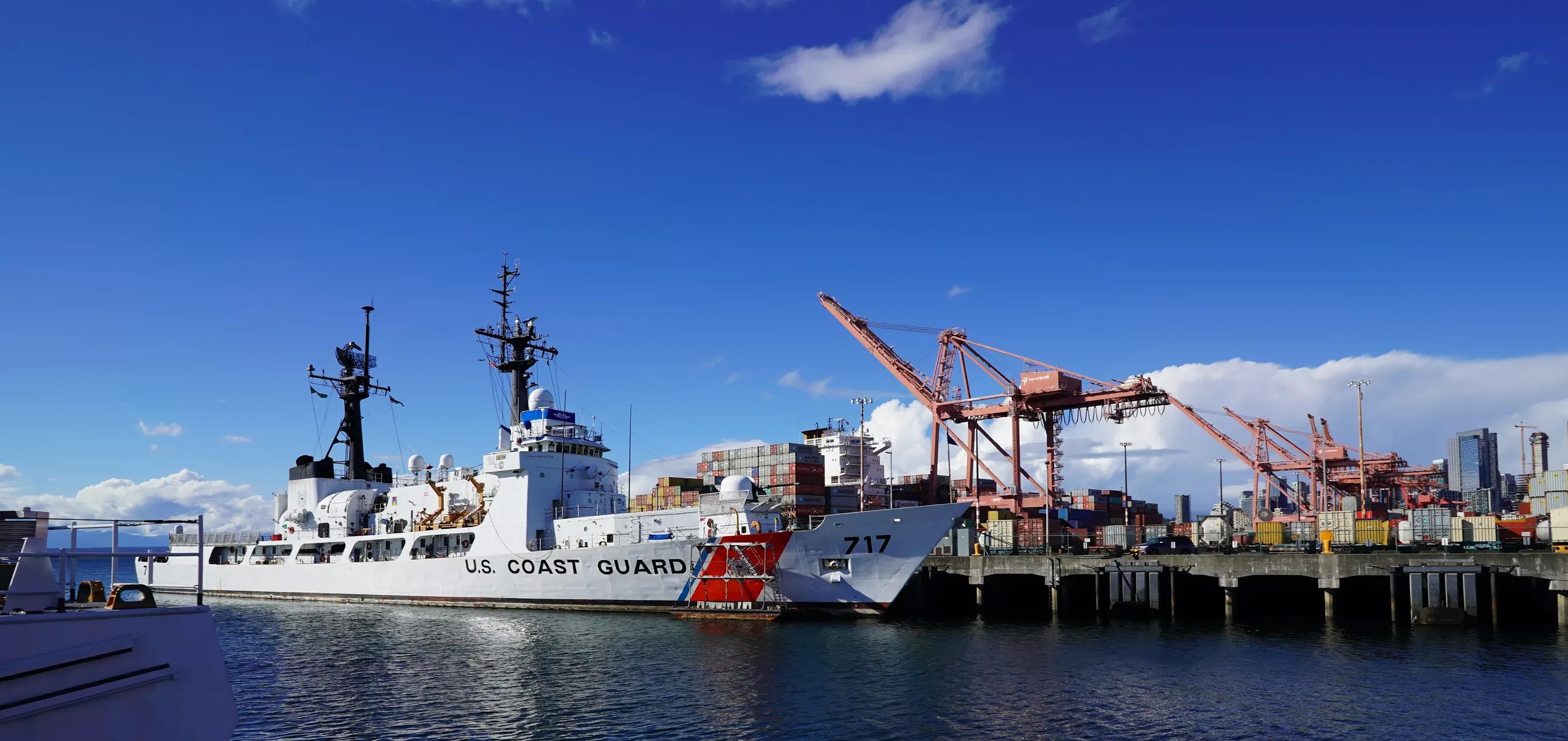
The USCGC Mellon (WHEC-717). Photo credits to Wikipedia.

The former USCG Mellon is the sistership of the Philippine Navy’s three Del Pilar-class patrol frigates, and was decommissioned from the USCGC on 20 August 2020.

It remains the only Hamilton-class ship still with the US government that has not been taken by a new enduser. Previously, it was believed that the ship was offered to the Royal Bahrain Naval Force, but it appears that even as early as 2019, the Bahraini government has already shown less interest in the ship.

The USCGC Mellon (WHEC-717):

The USCGC Mellon is the 3rd Hamilton-class high endurance cutter of the US Coast Guard, completed in February 1967, and commissioned with the US Coast Guard on January 1968.

The USCGC Mellon (WHEC-717) firing a Harpoon anti-ship missile during exercises. Photo credits to Wikipedia.

While it is true that the ship is already old at more than 50 years old, the Philippine Navy itself can attest the capabilities of the ship, with the type remaining as one of the fleet’s most capable ships despite the arrival of new frigates lately.

The USCGC Mellon showing its high sea state capability as it overcomes a swell. Photo credits to original source.

The Philippine Navy requested for a 4th Hamilton-class ship as early as late 2018, after realizing that the BRP Gregorio del Pilar (PS-15) will only be ready for service by 2020 after damaging its propellers and propeller shaft assembly in an accident in the West Philippine Sea.

The US made an official offer to the Philippines by 2019, although an invitation was only made to inspect the ship in 2020.

Being an existing operator of the ship class since 2011, it was only logical for the Philippine Navy to take in another ship of the class, which could benefit from the service’s existing supply and maintenance chain for the ships.

Stop Gap Measure:
 
The Philippine Navy believes that the ship would still be good to use for another 10 years, long enough for the service to be able to obtain a replacement for it as part of its Capability Upgrade Program (CUP).

This means the former USCGC Mellon would only serve as a stop-gap measure while the Philippine Navy tries to build up its fleet after decommissioning World War 2-era ships and delays in its Horizon 2 acquisition plans.

It is also noted that the addition of the former USCGC Mellon would help the Philippine Navy sustain naval operations while its sisterships undergo the Del Pilar-class Upgrade Project which is slated to start later this year.

It should be noted that BRP Gregorio del Pilar (PS-15) and BRP Andres Bonifacio (PS-17) are both in dry dock for different reasons, thus affecting fleet availability.

In the longer term and if the Philippine Navy decides to retain the ship despite new ships already available, the platform becomes a force multiplier for the service, as it can still conduct patrol missions or even be used for training purposes similar to how other navies make use of older ships for training cadets and new seamen.

BRP Andres Bonifacio (L) and BRP Gregorio del Pilar (R) on drydock for repairs and maintenance works. Photo credits to community member sharing to MaxDefense PH.

Why Old Hamilton-class ships again?:

To those asking, so why not get something much younger, much modern warships like the Oliver Hazard Perry-class or the Littoral Combat Ships (LCS), rather than old Hamilton-class ships with not much firepower and combat capability?

First of, the US has been offering the Oliver Hazard Perry-class frigates to the Philippine Navy for more than 20 years now since the late 1990s, with MaxDefense PH even reporting that the US made its offer again during the RIMPAC 2020 exercises in Hawaii. 

USCGC Mellon (WHEC-717) with Oliver Hazard Perry-class frigate USS Robert G. Bradley (FFG-49) during an exercise in Indonesia in 2010. Photo credits to DVIDS.

But it appears that the Philippine Navy is uninterested in the ships due to its lack of a diesel engine and its utilization of gas turbine engines which are most costly to operate than diesel engine-powered ships.

In short, it was PN's decision to skip on Oliver Hazard Perry-class frigates.

A GE LM2500 marine gas turbine engine. Despite the PN having this type of engine, ships without diesel engines remain as the PN's "kryptonite" up to this day. Photo credits to original source.

Secondly, while the US Navy is planning to retire the first batches of the Freedom-class and Independence-class Littoral Combat Ships, it has not done so yet.

Also, there are fears from the Philippine Navy leaders and planners that they would cost a lot not just to acquire (despite expected to be offer for cheap), but could be expensive to sustain and maintain due to its complicated systems.

But based on previous information we received from sources, the Philippine Navy is indeed expected to receive an offer for either of the LCS classes under US Foreign Military Sales (FMS) of Excess Defense Articles.

The Freedom-class LCS. Photo credits to Wikipedia.

Cyclone-class littoral patrol vessels:

In the meantime, the Philippine Navy appears to be gunning to acquire several Cyclone-class littoral patrol vessels from the US Navy, with PN FOIC Vice Adm. Bacordo even confirming that there is an outstanding offer from the US government under its Excess Defense Article (EDA) program, and that they are waiting for the official approval from the State Department on the authority to transfer the ships to the Philippines.

Also being waited are the approval on the PN’s request for Price & Availability (P&A) which would allow the PN to prepare for the planning and programming of the acquisition, including preparing the costs for its transfer.

Cyclone-class littoral patrol vessels of the US Navy. Photo credits to Wikipedia.

The FOIC has mentioned at least twice that the PN wanted to get at least 5 units, which will allow them to have a total of 6 including the BRP Gen. Mariano Alvarez (PS-38) already with them since 2004. 

But there is also possibility that the PN may get more, but that would depend on the avaiaibility of ships for transfer from the US government, as well as results of inspections that make it acceptable for the PN to receive them, as well as financial capability of the Philippine government to pay for them.

The Philippine Navy's sole Cyclone-class patrol vessel BRP Gen. Mariano Alvarez. Photo credits to Peter @ Flickr.

The acquisition of these additional ships would also allow the Philippine Navy to bridge the gap left by retiring older littoral patrol ships like the Gen. Emilio Aguinaldo-class, and also allow them to retire old remaining ships like the Kagitingan-class.

=========================

In the end, while the Philippine Navy goes for old ships again, they are replacing much older ships that were retired or in need for immediate retirement. 

Also, these are only stop gap measures considering the PN already has a program to acquire new combat and patrol vessels as part of their modernization efforts.

These old ships may stay with the PN fleet beyond the arrival of new ships, but that is not something bad especially if the PN can afford their sustainment.

===============
===============
First release: 30 April 2021
Copyright MaxDefense Philippines


Tuesday, May 5, 2015

Is the Philippine Navy's BRP Gregorio del Pilar (PF-15) having its Mk.38 Mod.2 guns installed soon?


One of our MaxDefense reader recently confirmed that the BRP Gregorio del Pilar (PF-15), the Philippine Navy's flagship, is currently dry-docked in Subic Freeport. According to him (who wishes to remain anonymous), the ship has already been in dry dock for the past 2 to 3 months, and was docked for some time in Subic before entering dry dock. 


The BRP Gregorio del Pilar (PF-15), the Philippine Navy's flagship. The Navy is planning to have Mk.38 Mod.2 secondary 25mm autocannons fitted on the ship soon.


Below are photos he took recently, and although the dry dock is far from his point of view, it is very obvious that the ship inside the dry dock is indeed a Gregorio del Pilar-class / Hamilton-class ship. To the untrained eyes, the double mast can be clearly seen on the first photo.


Both photos taken recently were taken at Subic Freeport. Although very small, it shows the BRP Gregorio del Pilar (PF-15) dry docked.
Photo taken and shared by one of MaxDefense readers.


Several months ago (last year), MaxDefense posted a news article from PTV-4 and Philippine News Agency (PNA) regarding the BRP Ramon Alcaraz and its new Mk.38 Mod.2 25mm remote weapons station. In that article, it confirmed that the BRP Gregorio del Pilar was scheduled for dry docking betweem February and June of 2015. This might be the scheduled dry docking indicated in the said news report. It is also impossible for its sistership, the BRP Ramon Alcaraz, to be dry docked this time as it just recently had its turn late last year.

The interesting part is that the report confirmed that the BRP Gregorio del Pilar is also scheduled to have Mk.38 Mod.2 25mm RWS installed during its dry docking. Originally, reports surfacing about the Philippine Navy acquiring Mk.38 Mod.2 guns from BAE was only for 2 units. So far, 2 units were already installed on the BRP Ramon Alcaraz last year.


The BRP Ramon Alcaraz (PF-16) already got its Mk.38 Mod.2 guns last year, and both guns were visible during its port visit to Cebu early this year.
Photo above taken from Timawa.net, photo below taken by an anonymous MaxDefense reader.


So did the Philippine Navy receive 2 more Mk.38 Mod.2 guns from the US? If yes, are the guns being installed on the PN's flagship now?

Only time will tell. It is expected that the PN will be bringing out the ship to the public again once it goes back to sea. And by then we can confirm 100% if such upgrade is indeed made on the ship.


==========
UPDATES:
==========
May 11, 2015:
The Philippine News Agency released an updated, as reported here by PTV News, confirming the undocking of BRP Gregorio del Pilar within this week. But it did not confirm the installation of any new system to the ship other than "preserve hull condition and servicing of machineries" which is typical to any drydocking activity.

MaxDefense will wait for any new information or photos after the drydocking which will confirm if there are anything new on the ship or not.

Sunday, January 25, 2015

Finally, the Philippine Navy's BRP Ramon Alcaraz got its Mk.38 Mod.2 Guns

After a long wait, the Philippine Navy's BRP Ramon Alcaraz (PF-16) finally got its 25mm Mk. 38 Mod. 2 close-in weapons system installed. It was reported more than a year ago that the PN's foremost naval asset will be receiving these 25mm gun weapon stations after a US report that there were 2 orders for the systems for the Philippine Navy. This is the Philippine Navy's first Mk. 38 Mod. 2 system, and the first Hamilton-class ship to have such mount.


The BRP Ramon Alcaraz in Cebu. For those with very good eyesight, the Mk. 38 Mod. 2 gun platform on the port side can be seen on this angle. It is just behind the red-colored RHIB.
Photo taken from Cebu Daily News / Inquirer.net


Since the report regarding the acquisition of this gun system involves only for 2 units, it was even anticipated that the PN would either arm one gun system each to the BRP Gregorio del Pilar (PF-15) and the BRP Ramon Alcaraz, or only 1 of the ships will have both guns. Previous statements coming from Navy officials even pointed out that the older Gregorio del Pilar was the chosen ship to get both guns, without mention if the Ramon Alcaraz will also be getting as well.


The actual Mk.38 Mod.2 gun on BRP Ramon Alcaraz. This looks like on the starboard side.
Photo taken from Geminirecon @ Timawa Forum.
The port side of the ship also shows the presence of the Mk.38 Mod.2 weapons mount.
Thanks to one of our MaxDefense reader who wants to remain anonymous, who went inside the ship and took some photos.


Rear photo of the gun showing the ammunition loading system.
Photo shared by a MaxDefense reader.


But here we now have some evidence that the BRP Ramon Alcaraz was indeed fitted with the guns. Several online social media sources, including those from MaxDefense readers who shared their photos confirming that there are indeed 2 guns in the said ship, both fitted on the midship port and starboard deck sides. The ships was available for viewing to the public as it was docked in Cebu after providing naval and air security during Pope Francis' visit in Tacloban City last week.


An Mk. 38 Mod.2 weapons system installed on a US Navy vessel.
Photo taken from Wikimedia,


It is worth noting that aside from the Oto Melara 76mm Compact main gun, the PF-16 has no other weapons before the installation of the 25mm chain guns other than several 50-caliber machine guns. Meanwhile its sistership PF-15 has two 20mm gun at the superstructure midships and a manually-operated Mk.38 Mod.0 chain gun at the ship's tail end.


The BAE-Rafael Mark 38 Mod. 2 Close-in Weapons System:

For the uninitiated, the Mk. 38 Mod. 2 gun system is a remote manually controlled 25mm gun station commonly found on US Navy ships. Produced by BAE Systems and Rafael and of Israel, two units were ordered as part of a larger order made by the US Navy. This is the newer and remote-control capable version of the Mk. 38 Mod. 0 gun system which is used by the Philippine Navy on several of its Andrada-class patrol boats, the Cyclone-class BRP Gen. Mariano Alvarez, and the secondary gun mounted on the aft of the PF-15. It uses a 25mm Bushmaster M242 chain gun and was designed to protect the ship at close range from small fast surface and slow aerial threats. US Coast Guard personnel were reportedly part of the installation team as the PN doesn't have the adequate experience to do the job on their own. For further information, MaxDefense recommends the manufacturer's website (link HERE).


A closer look of the PN's new Mk.38 Mod.2 gun mounted on the BRP Ramon Alcaraz.
Thumbs up to the PN and to our friend who went there and share these photos to us.


Each of the gun mount has its own EO system that allows the gun to be used on day & night and all weather conditions. Controls of the gun is done on a console with its own video feed screen, and the gun is trainable by joysticks. 


An example of what the Mk.38 Mod.2 control console looks like.


Aside from the Mk. 38 Mod. 2, the other remote-operated close-in weapons system the Philippine Navy currently uses is the MSI 25mm Seahawk mounted on the Jacinto-class patrol corvettes, which also uses the same 25mm M242 Bushmaster gun.

With the entry of this system into the Philippine Navy, it is expected that the same system might be acquired to arm several types of upcoming ships, including the Strategic Sealift Vessel which has already started construction and requires at least 2 mounts per ship, and the new light frigates which are being tendered. 


Other Interesting Finds on the Ship:
Aside from the installed guns, there are other points of interest that MaxDefense wants to share here:

A photo of the display console of the ship's Kelvin Hughes MantaDigital surface search and navigation radar system was also made available again. Until more capable radar systems become available for the ship, this would remain as the main eyes of the ship. 


A PN crew member discuss the use of the surface radar display console to the visitors.
Photo shared by one of our MaxDefense readers who wants to remain anonymous
.

Another interesting photo involves the shipboard AW-109 naval helicopter. It appears to be a normal now to see the helicopters paired together with the frigates. It may also be interesting to take note on how the aircraft is restrained on the flight deck when not in use. 


The AgustaWestland AW-109 Power naval helicopter on the ship's flight deck.
Photo shared by one of MaxDefense's readers.


Finally, although already confirmed before, the Philippine Navy has changed the Philippine Fleet's sub-unit's name where the frigates are assigned under their recently made restructuring program based on capability. Previously known as Patrol Force, it is now known as the Offshore Combat Force, in anticipation of the greater role the unit will undertake in the near future as more assets arrive. Its logo can been seen on the PF-16's superstructure near the Mk.38 Mod.2 guns. The other Philippine Fleet units that were also renamed as the Littoral Combat Force (formerly the Coastal Patrol Force), and the Sealift & Amphibious Force(formerly the Service Force).


With the BRP Ramon Alcaraz having its close-in gun systems, we now wait for its sistership BRP Gregorio del Pilar to have a similar weapons system, as well as for the 2 ships to get their highly-anticipated long-range surface and air search radar systems, and the defense/offensive missile systems as discussed in previous MaxDefense blog entries. With the year 2015 still in its infancy, expect more news on the upgrade of the 2 ships, especially with the impending awarding of the PN's new frigates coming very soon.

Friday, August 22, 2014

Upgrades for the Philippine Navy's Gregorio del Pilar-class Frigates on the way

The Philippine Navy is expected to proceed with the upgrades for their Gregorio del Pilar-class frigates soon, with the program already more than a year delayed. The program will be divided into several scopes, but major emphasis will be given on up-arming the ships and providing them with a reasonable surveillance and detection capability.


The two Gregorio del Pilar-class frigates of the Philippine Navy during naval exercises with the US Navy.
Photo taken from the US Navy via Wikipedia.


There are earlier indications from MaxDefense sources that the separation of the new frigate weapons acquisition from the original frigate acquisition project can closely be attributed to other weapons system requirements of the PN. This includes the upgrade for the Gregorio del Pilar-class frigates and other weapons systems for upcoming PN naval assets.

Currently, the lead ship BRP Gregorio del Pilar (PF-15) is better armed compared to its sistership BRP Ramon Alcaraz (PF-16), which as of this writing is headed to Northern Australia to participate in the bi-annual KAKADU 2014 exercises. Compared to the PF-16, the PF-15 is armed with a single Mk.38 Mod. 0 chain gun, positioned where the Phalanx CIWS was previously located. It is also armed with two 20mm Oerlikon guns, which the PF-16 currently lacks.


Weapons Systems:
Latest information from the Philippine Navy suggests that the BRP Gregorio del Pilar will undergo the 1st phase of the up-arming program, which is to install two (2) BAE Mk. 38 Mod. 2 MGS (Machine Gun Systems), one each on the port and starboard midship decks. The Mk.38 Mod. 2 MGS is a remote-controlled weapons system mounting the 25mm M242 auto cannon, with a 2.5km range to defend the ship against small, fast surface threats. Although this can be considered as a Close-in Weapons System (CIWS), it is not designed to shoot fast aircraft and incoming anti-ship missiles like the Phanalx. 


The BAE Mk.38 Mod.2 25mm MGS are to be installed on the Gregorio del Pilar-class frigates, and probably with other upcoming naval assets.
Photo taken from Wikipedia.


The gun systems are reportedly now with the PN, and were originally planned to be installed on the BRP Ramon Alcaraz, but the decision to shift to the leadship was made by the PN leadership. Any plans to install the same weapons to the PF-16 means that the PN would made an order with the US government, possibly under the US Foreign Military Sales (FMS) program similar to how the 2 earlier guns were acquired. No definite new orders were made yet, although MaxDefense expects the PN to acquire not just 2 MGS, since the upcoming new frigates and Strategic Sealift Vessles (SSV) requires similar systems as well. A bulk buy might be the course for the PN.

MaxDefense sources also confirmed that the PN is "strongly interested" in acquiring the Raytheon Phalanx CIWS for the Gregorio del Pilar-class an "a number of other ships". The Phalanx is the US Navy's premier short range hard kill system against anti-ship missiles and aircraft, and uses a 20mm 6-barrel M61 Vulcan gatling gun. It is the best CIWS system that can be fitted to the Gregorio del Pilar-class, as they were previously armed with this one each, but was removed as it was not part of the deal between the Philippine and US governments for the transfer of the ships to the PN. The Phalanx does not require lengthy deck penetration works, allowing for easy installation and avoid costly modifications.


The Raytheon Phalanx mutli-barrel CIWS is eyed by the PN for its major naval assets.
Photo taken from Wikipedia.


The PN's decision was due to considerations for ship survivability issues, as the greatest threats they expect to face would probably be from anti-ship missile attacks from surface, air, or sub-surface platforms, or torpedo attacks from submarines. Should they be acquired for the Gregorio del Pilar-class, the Phalanx would probably be installed on the ship's aft where the US Coast Guard previously installed a similar CIWS. The PN has even included the Phalanx in its training systems, including the new multi-mission tactical simulator, as an integral weapons system of the frigate.

The PN has long announced its desire to arm the frigates with anti-ship missiles (AShM) which would give them a long range striking capability against hostile surface assets. Surprisingly, the PN has not yet made a final decision on this part, even if they made their announcement of plans to acquire such systems as early as 2012. According to MaxDefense sources, the PN's top choise is the US-made Boeing RGM-84 Harpoon missile system, although they are also open to use alternative missile systems offered by other countries, with special mention of those from Israel. 


A Harpoon missile launched from the Australian frigate HMAS Warramunga. A similar system may find its way to the PN's Gregorio del Pilar-class frigates.
Photo taken from Seaforces.org. 


The Gregorio del Pilar-class is not a stranger to the Harpoon missile system as well, with the ships fitted by the USCG with the said system a few decades ago as part of their capability improvement in support of the US Navy during the late part of the Cold War. These were removed when the USCG's mission profile did not require the missiles, which are considered as offensive weapons. According to PN sources, their 2 frigates can easily be re-installed with the system, and will be mounted on the deck space between the 76mm main gun and the bridge area.


The former USCGS Hamilton (WHEC-715), now the BRP Gregorio del Pilar (PF-15), with the two quadruple Harpoon missile launchers on its deck. This is preferably the best position should the PN acquire Harpoons for the ships.

Air Defense systems, using short range man-portable anti-aircraft missile systems, are being planned as well, although it was also learned by MaxDefense that a possible bulk-acquisition for such systems for other current PN warships is being planned. Possible recipients of such missile systems include the lone Cyclone-class inshore patrol vessel BRP Mariano Alvarez (PS-38), the entire Jacinto-class offshore patrol vessels, and the reported upcoming former ROKN Pohang-class corvette. Among those looked at by the PN are the French Mistral from MBDA, the Korean Chiron from LIG Nex1, the American FIM-92 Stinger from Raytheon, and the Russian 9K38 Igla-S (these are among the weapons systems offered by Russia recently). These missiles would be mounted on a manually-operated multiple-missile launch platforms.

Although the frigates were also previously armed with anti-submarine torpedoes, plans to acquire such weapons for the Gregorio del Pilar-class are still unconfirmed as of this writing. The PN already made an indication of interest for such, but this would probably be at the back-burner as far as up-arming programs are concerned. 


Surveillance and Detection Sensors:
The PN is actually also looking at improving the "eyes and ears" of the ships by installing surveillance radar systems that can detect threats from the surface and air. Currently the ships are installed with a commercial-spec'ed  navigational radar system, and are equipped with the Mk.92 Mod.1 fire control systems. Previously, the ships were equipped with the AN/SPS-40 air search radar, which were removed by the USCG before handing-over the ships to the PN. 

Previous information from sources indicated that the frigate may likely receive the same radar systems being planned for the upcoming new frigates. Since the PN has not yet decided on the new frigate's would-be shipbuilder, system integrator and systems suppliers, there is no final decision yet on what the PN may be getting for the Gregorio del Pilar-class. But the chances of getting at least a 3D search radar as indicated in previous MaxDefense blog entries are high.


The PN may opt for a 3D air-surface search radar system, although it may be dependent on the type they intend to install on the upcoming new light frigates. The PN may do a wise decision of making a bulk-acquisition to include additional units for the GdP-class frigates.
Photo taken from Thales Nederland website.


Installation of missile systems on the frigates may also include the installation of new fire control radar systems, which may either complement or replace the currently installed gun-only Mk. 92 Mod.1 system.

Although the PN has highlighted the importance of anti-submarine warfare in its future capability, they may not immediately provide the frigates with an inboard sonar system although there are plans to have them on the entire class. There are no word yet if the PN may opt to go for a hull-mounted system, a towed array sonar, or for both systems to be available on the ships. It is possible though, that the PN may only opt for 1 of the possible systems. It would also probably be dependent on the type on sonar system to be used on the upcoming new light frigates.


A towed-array sonar system like the CAPTAS system (above), may be considered by the PN for upgrading the ASW capabilities of the Gregorio del Pilar-class frigates.
Photo taken from Thales website.


The Philippine Navy has already taken steps in pursuing these plans for the Gregorio del Pilar-class frigates, and it would not take long for them to finally award these systems to respective manufacturers. The PN and DND may opt to directly negotiate for the acquisitions, either through a Government-to-Government (G2G) or Foreign Military Sales (FMS) deal, or a direct commercial sale depending on the source of the systems. 

These upgrades would also render the ships out of action for some months from patrol duties in the West Philippine Sea and other disputed areas. So MaxDefense expects these upgrades to be carefully scheduled and will be done on a one-by-one basis. Should the PN actually get the reported donation of a Pohang-class corvette, it would be expected to take some of the burden of the frigates' missions, and its presence would enable the PN to allow at least one of the frigates to be out of service for a few months.

It would be interesting to note that the upcoming new light frigates being tendered by the Philippine Navy would have a possible strong influence on the choices of weapons and surveillance systems to be acquired for the current frigates. As an early advice for those surprised by the split of the weapons from the new light frigate acquisition program, that was nothing new and was just formality to enable the PN to acquire the system it prefers for the new frigates, while freeing up the burden from the shipbuilders. This would be further discussed on upcoming MaxDefense blog entries regarding updates on the PN Frigate Acquisition Program.

==========
UPDATES:
==========
August 23, 2014:
IHS Jane's recently reported and confirmed that the PN is already preparing the weapons and electronics upgrades for the Gregorio del Pilar-class. The report specified that the PN wanted the ships to have at least the systems it had during their service with the USCG, including having the Phalanx CIWS and Harpoon anti-ship missiles.

==========


Friday, September 6, 2013

Is the Philippine Navy experiencing fund shortage for it's new frigate program?

The cancellation of the option to purchase a third Hamilton-class WHEC from the US Coast Guard was announced by the Department of National Defense (DND) last week. Although this was not new since there was already an earlier announcement, the reason this time is different from the first.

Background:
Initially the DND decided to forego the purchase of another Hamilton-class vessel after it decided to instead use the ship purchase budget for capability upgrade for the 2 ships already in Philippine Navy (PN) service. These are the BRP Gregorio del Pilar (PF-15) and BRP Ramon Alcaraz (PF-16), both were stripped of their surface and air search radars, close in weapons systems, electronic surveillance measures (ESM) systems, tactical air navigation (TACAN) system, and other essential equipment before handing-over to the PN. The PN then installed new systems including additional light guns, a new commercial off-the-shelf (COTS) navigation and search radar, a new command and control suit with link with the Coast Watch System, VSAT and new satellite communications equipment and an Electronic Surveillance Measures (ESM) system. But the ships are still short on combat and surveillance capabilities, and the PN is contemplating of installing surveillance and combat systems that will increase the ship's war-fighting capabilities. But nothing much was done on this plan.


MaxDefense expected the USCGC Rush (WHEC-723) as possibly the 3rd PN WHEC.
Photo taken from USCG website.

Surprisingly the DND shifted back to the original plan of getting a 3rd Hamilton-class ship from the US, without mention of anything about the upgrade plan for the two ships already with the PN. This plan was also against earlier DND and PN statements on policy against buying "second-hand"ships, which according to them sealed the Maestrale-class frigate purchase plan's fate.

But again the new announcement to cancel the purchase of a 3rd WHEC is now directed on diverting the ship purchase budget to support the existing Php 18 billion budget for the PN's project for 2 brand new frigates.


Comparable Projects:
Previously MaxDefense brought out the issue of budgeting for the new frigates since there are doubts on what the PN can get based on comparable foreign warship project costs. For those unfamiliar with earlier MaxDefense blogs, please see these earlier posts for reference:

An In-Depth Look at the Philippine Navy Frigate Program of 2013
http://maxdefense.blogspot.com/2013/05/an-in-depth-look-at-philippine-navy.html

and

Proposed Designs Offered for the Philippine Navy Frigate Program 2013
http://maxdefense.blogspot.com/2013/05/proposed-designs-offered-for-philippine.html

Looking back on those previous assessments, it already shows that the PN budget is way lower than those of comparable regional frigate projects. MaxDefense provided some examples, but let us take another stab on the costing of the exemplified ships with the closest cost as the PN budget, as an update from last time:

Damen Schelde Shipbuilding's SIGMA-class
Based on earlier MaxDefense blogs, the Indonesian PKR Project based on Damen Schelde's SIGMA 10514 platform has the closest allocated budget as the PN at $220 million. But there are some information indicating that the Indonesian PKR SIGMA 10514 cost may only cover the hull, and the ship's mechanical and integral electronics systems plus technology transfer, and actual cost may reach closer to $280 million if including weapons and sensors. Also, the contract between Damen Schelde and Royal Moroccan Navy for 3 SIGMA ships (2 SIGMA 9813 version and 1 SIGMA 10513 version) was said to have cost $816 million as of 2008, or around $272 million per ship average although the 10513 version is expected to be more expensive than the shorter 9813 version due to the addition of an additional segment. Take note that the Indonesian PKR is slightly larger than those for Morocco.


Projected SIGMA 10514 frigate for Indonesia's PKR project.


Latest offer of Damen Schelde to Vietnam for 2 corvettes based on SIGMA 9814 was quoted by IHS Janes to probably reach $668 million, or $334 million per ship average, with one probably to be built in Vietnam and the entire contract may include technology transfer clauses.

(Note: The Damen Schelde SIGMA class is classified by a unique numbering system. The first 2 or 3 numbers signifies the length and the last 2 numbers signifying the beam, all in meters. Example: Indonesia's PKR based on 10514 means it is 105m length and 14m beam. Morocco's 10513 is 1m narrower than Indonesia's PKR.)

Hyundai Heavy Industry's Incheon-class:
Earlier information indicated that the price for the initial Incheon-class frigate for the Republic of Korea Navy (RoKN) costed $106.5 million for the hull made by Hyundai and a total cost of $232 million for the entire ship. It is still unclear if this includes Integrated Logistics Support (ILS) packages that is required by the DND/PN, and if Hyundai may opt for selected pricing premium for foreign clients like the Philippine Navy. It is expected that the amount does not include any form of technology transfer, although it is believed that the PN and DND are after this incentive.


Korea's Incheon-class frigate.

MaxDefense now expects the Philippine-offer price of the RoKN-standard Incheon-class frigate to be nearer to $250-$280 million. But the PN may always opt to remove certain items that may not be required, like RoKN-specific systems, and the land attack cruise missile Hyunmoo-3 option. The PN may also opt to replace some more-expensive systems with cheaper ones, like the installation of an OTO Melara 76mm Super Rapid gun instead of the larger and more expensive BAE 127mm Mk. 45 Mod. 4 gun.


So is there a funding shortage?

MaxDefense believes that the PN and DND may have found out that the budget they allocated for the 2 new frigates is not enough to get what they specified the ships to be capable of doing. MaxDefense sources say that the budget is already very tight as it is, and has not much allowance for the PN for additional systems that they may have overlooked. It is worth noting that the DND and PN already added Php 6 billion to the original Php 12 billion allocated for the 2 used Maestrale-class frigates without increasing the Php 75 billion allocated by the government for the Revised AFP Modernization Law for the first 5 years. 

Not only is the budget small, but it is also getting smaller everyday with the value of the Philippine Pesos falling against the US Dollar. The Php 18 billion budget for the frigate program was crafted early this year and was based on an exchange rate of $1 = Php42 ($214 million = Php 9 billion). Presently the exchange rate is around $1 = Php44.5 ($202 million = Php 9 billion), with the Peso down by more than 6% from its value a few months ago, and is still expected to fall in the next few months. It is expected that foreign shipbuilders and system providers will ask payment in US Dollars, and the PN has already lost $12 million per ship due to the declining value of the Peso.


Take note the exchange rate posted by MaxDefense on May 2, 2013 is at $1=Php41.19, while on September 6, 2013 is at $1=Php44.49, a sharp 7.5% fall of peso value already.
Photos taken from MaxDefense blog (top) and Bloomberg website (below).

Opinions and Options:
There are many ways to skin a cat, so they say. And MaxDefense sees three options for the Philippine government to solve this concern:

1. Increase budget allocation for the purchase of new frigate, to meet the budget as specified by the PN's frigate requirements.

This is actually the best solution, but the hardest to attain. The Philippine government may use Executive-sourced funding (so-called "Presidential Pork Barrel") like Fund 151 or Malampaya Special Account, which has been done before to fund AFP-related projects like the purchase of Hamilton-class cutters. There is even a growing consensus on both the government and private sector to use the Priority Development Assistance Fund (PDAF, aka "Pork Barrel") to boost modernization of the entire AFP, so if that happens this might be another source of funding.


An infographic from ABS-CBN shows what Php 10 billion from Legislative PDAF can do for the AFP (photo shows only for PN). Such amount could have given the PN enough room for improvements on the new frigate requirement.
Photo taken from ABS-CBN News website.

In some way, the cancellation of the 3rd Hamilton-class ship was another way to increase funding, this time by realignment of defense project priorities. MaxDefense does not see this as a good option, as we support the purchase of more Hamilton-class ships that are made available for the PN.


2. Avail of soft-loans offered by specific countries like South Korea to fund the ship's purchase.

There were reportedly standing offers for the Philippine government to avail soft loans, the most well-known is the offer from South Korea to avail their goods. Although a downside is the limitations to using that to buy the specific country's products, these countries have likely a strong defense industry and wide product range that the PN or the entire AFP can choose from. The only problem with this is President Aquino's previous statement from SONA 2013 of not availing loans that will become a problem of the next administration.


3. Remove or reduce expensive line items within the frigate program for separate budgeting, but building the ship to be fitted for but not with these items.

This is a common practice for military systems either to save on costs, or if a new technology still under development is expected to be placed on a certain platform. On our case it's the obviously the former. The PN may opt to build the frigate hull according to their expected capability, plus all the important items that will enable the ship to be minimally capable. Some major line items that can be separated are the surface-to-air missile systems, half of the expected anti-ship missile numbers, torpedo systems, anti-ship missile hard kill systems, and one of two possible sonar systems. 

These can already reduce the cost of the ship by around 30%-50%, and can be purchased separately should funding be available. The PN is familiar with this concept and is actually a policy for their purchase of Offshore Patrol Vessels (OPV), which has the option to be heavily armed in case of crisis or emergencies.


The Gregorio del Pilar-class frigates are actually examples of "fitted for but not with" ships. They have the capability to accept additional weapons and sensors when needed.
Photo taken from Philippine Embassy in Washington DC website.

A fourth option is possible, that is for the PN to decrease the specified requirements of the new frigate, either by decreasing its size, reducing the capability, or both, effectively making the ship more of a corvette or OPV rather than a frigate. But MaxDefense does not recommend this option at all as it does not make sense to do such option if the PN believes that they really need a frigate and not a smaller or less capable vessel.

Philippine Navy Modernization Projects

Philippine Air Force Modernization Projects