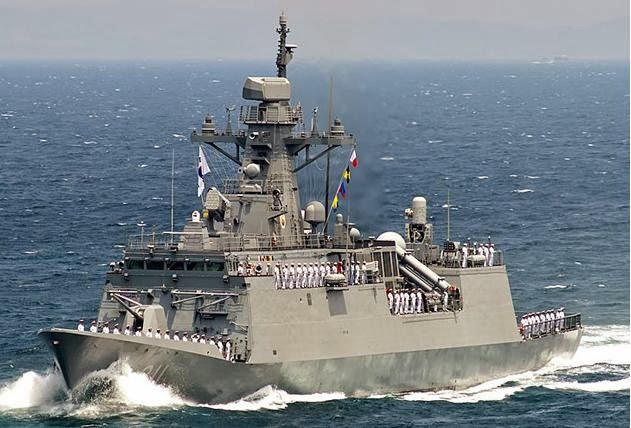
For all the doubting Thomases following the Armed Forces of the Philippines (AFP) Modernization Program, the question whether the Philippine Navy's budget of Php 18 billion (around $400 million) for 2 brand new frigates is enough has been asked for almost forever since they announced the existence of such acquisition project. With the DND recently announcing that awarding for the project is not possible within this year, it is timely to discuss the issue here @ MaxDefense.
Before anything else, MaxDefense suggests that readers go through earlier blog entries related to this project, listed as follows:
1. An In-Depth Look at the Philippine Navy Frigate Program of 2013 - an initial analysis made by MaxDefense in the absence of technical specifications, and basing it on the capabilities found on the Maestrale-class frigates.
2. Philippine Navy Frigate Acquisition Project - An Analysis of the 1st-Stage Bidding Specifications - discusses the background of the project, the initial technical specifications released by the PN and DND, and an analysis of what can be expected based on these information.
3. Updates on Philippine Navy's Frigate Acquisition: 6 Bidders Qualified for the 2nd Bid Stage - discussed the pre- and post- bidding results of the 1st stage bidding done on December 2013, and an analysis of what the bidders could be offering.
Further reading and research is also advised, as there are many discussions made with regards to the Philippine Navy Frigate Acquisition Project.
Corvette vs Frigate: which is which?
There is a very thin veil separating the classification of small warships as either corvettes or frigates, and the Philippine Navy's new frigate may fall somewhere in this category.
A discussion to explain this issue will actually take up a lot of reading, and MaxDefense would rather refer its readers to an interesting entry regarding the separation of Offshore Patrol Vessels from Corvettes from Frigates:
What is a Corvette? And What Next? - an entry for Center for International Maritime Security (CIMSEC), by Chuck Hill of Chuck Hill's CG Blog.
Based on the link above, it shows that size itself will not be a singular determinant on a ship's classification. It would not really matter much if the ship will actually be considered a large corvette or a light frigate, but will be determined more according to its mission profile. Since it is also up to the PN to determine if the ship is to be considered a corvette or a frigate, then this could probably be considered a light multipurpose frigate that will be tasked to do combat, patrol, and escort missions. Following the PN's own Fleet Desired Force Mix whitepaper, this specific frigate project is actually closer to their requirement for an Anti-Submarine Warfare (ASW) corvette as the requirement for frigates actually emphasizes the mission profile to specialize in Anti-Aircraft Warfare (AAW).
Per MaxDefense sources, the PN is likely to choose a design with a lot of future-proof capability to accept planned systems which was also indicated in the first stage bidding technical specifications, in a similar way that the British did with their Type 45 destroyers, or the Thais did with their Naresuan-class frigate. Also, the requirement for high sea state capability together with capability to mount more weapons systems plus allowance for future-proofing means that the ship should have sufficient size. It is expected that the ships would definitely be larger than most current corvettes in service with other navies like the Indonesian Diponegoro-class and even the new DSME-designed ships recently announced by the Royal Malaysian Navy.
Background of the Frigate Acquisition Project:
The Philippine Navy (PN) originally planned to acquire two used Maestrale-class frigates that the Italian Navy was planning to retire starting late 2013. The budget allocated by the PN and DND was Php 12 billion for the two ships, training of crew and shipyard maintenance teams, refurbishing works, replacement of several electrical, electronic, and mechanical systems, spare parts, and a limited logistics support package. But the Philippines dropped the plan in 2013, which was discussed in a previous MaxDefense blog. Although the PN and DND did not confirm the exact reasons, all those pointed out on the previous blog entry seem to support the decision.
1. The Hyundai Offer:
Apparently, the Koreans, be it the Korean government (or any of its agencies), or Hyundai Heavy Industries (HHI), provided details and solicited offers to the DND and PN to sell a variant of their HDF-3000 frigate design for around Php 18 billion for 2 units. A juicy offer, plus all other negative reasons regarding the Maestrale-class' physical condition and deal details, made the DND and PN decide to go for new frigates by just adding Php 6 billion to its war chest.
(The Hyundai HDF-3000 frigate is the base design used for the used for the Incheon-class frigate of the Republic of Korea Navy)
Based on this reason alone, it already shows that the Philippine Navy can get an Incheon-class frigate derivative with its budget, even without a bidding. Previous accounts suggest that a standard ROKN Incheon-class frigate cost slightly higher than Php 9 billion each, the Philippine variant can be worth less due to its minimum initial specifications as compared to its Korean variant, an example of which is having only a 76mm rapid firing main gun instead of a larger 127mm gun.
2. Others Answered the Philippine Navy's Call:
To further maximize its budget, the DND decided to go for tender acquisition process instead of going directly with HHI's offer. They used the same budget and technical specifications that was loosely based on the HDF-3000 offer, with hope that there are other shipbuilders and suppliers willing to provide a product within the same parameters as what HHI offered earlier within the allocated budget.
Based on the description provided on initial technical specifications, it can be categorized either as a corvette or a light frigate, depending on the size of the ship which was not provided. MaxDefense sources confirmed that the PN is giving priority to design allowances for future growth instead of a design that is compact, giving offers whose design exceed the marginal length of 100 meters. Nonetheless, this is not an issue as the ships are design-optimized for maritime patrol, anti-submarine warfare (ASW) and anti-surface warfare (ASuW), with limited anti-aircraft warfare (AAW) defensive capability. To note, the Philippine Navy's Fleet Desired Force Mix strategy whitepaper actually listed 12 anti-submarine corvettes or light frigates in its projected requirement together with 6 more frigates optimized for air defense.
With 6 shipbuilders from Korea, Spain, France and India confirming their ability to provide a ship that meets the PN's initial terms of reference and budget, it only proves that what the PN wanted can be had for around $400 million. These shipbuilders are not stupid to enter such tender without knowing the risks of swallowing a contract they can't complete. Thus, not only is the budget capable of getting a HHI frigate, it can also buy the PN a frigate made by any of the shipbuilders that passed the first stage bidding, namely Daewoo Shipbuilding and Marine Engineering, STX Offshore & Shipbuilding, STX France SA, Navantia-Grupo SEPI, and Garden Reach Shipbuilders & Engineers.
3. Separation of Budget to Acquire the Frigate Hull and Weapons Systems:
Another recent adjustments made by the PN and DND was to separate the budget to acquire the frigate hull from that of the weapons systems and ammunition.
After the presentations made by shipbuilders prior to finalization of the final terms of reference for the 2nd stage bidding, it was found out that they would encounter problems if shipbuilders will be tasked to acquire the weapons systems for frigates. There are unforeseen limitations on this acquisition set-up, and it was acknowledged by the DND that it would be best to have the weapons systems procured separately by the Philippine government, although installation can still be made by the winning shipbuilder or a selected systems integrator.
No doubt, there were deficiencies on the Technical Working Group (TWG) tasked with this acquisition project, which is attributed to their lack of experience in similar projects before. It should be taken note that this is the first time the PN is acquiring a modern surface combatant in its recent history, and prior to that all major surface combat assets of the PN were handed over by the US Navy and US Coast Guard. But this serves as an important lesson to the country's defense planners, which they could now consider for future similar acquisition projects.
This definitely delays the project, but it does not cancel it as speculated by many people including people with previous military and government background. The changes actually gave the DND and PN a chance to catch-up with all the delays to allow the awarding of the ship hull while the PN still decides and negotiates for the weapons system.
MaxDefense sources indicate that the Philippine government has already made several steps to overcome obstacles in acquiring advanced ship-based weapons systems. The recent signing of the Philippines-France Defense Cooperation Agreement this year is an example of such accomplishments to allow the Philippines to acquire weapons systems from France.
4. The Frigate Acquisition as a Major Priority Project of the Aquino Administration:
Among the major projects championed by President Benigno Aquino III includes this frigate acquisition project. This is evident by the continued announcements made by the president in his State of the Nation Addresses, speeches on major military and security events, and press releases by the government. Canceling this project for any reasons except from opposition from Congress or Senate will definitely have a negative impact on the current administration's ability to provide the Armed Forces of the Philippines the equipment they need to accomplish their mandate.
MaxDefense believes that the current administration will do all means necessary to push for the awarding and contract signing of this project within the 1st half of 2015 to allow for a major accomplishment (launching or delivery) of the first unit before Pres. Aquino steps down by mid-2016.
So is the PN Frigate Project just another OPV?
There were several opinions made by other analysts and discussions in several websites stating that the Philippine Navy's requirement might be more of an Offshore Patrol Vessel rather than a frigate. But MaxDefense beg to disagree on this.
In 2011, the US Naval Sea Systems Command released a Request for Information (RFI) regarding the possibility of a Philippine Navy acquisition of at least 2 Offshore Patrol Vessels. The projected specifications had a lot of difference from the PN's current frigate base specifications. The only similarity are the sea state requirement for operation, and the gun systems calibers and numbers. Differences can be seen on the requirements on speed, range, physical dimensions (the PN did not specified the exact dimension requirements for the frigate, but it is expected to be higher than what was requested in the RFI), guided weapons, and other details that were obviously less than those required on the frigate. The RFI actually gave a glimpse of what the PN might be looking for its future OPV requirement, and its dissimilarity from that of the current frigate requirement obviously separates the 2 projects as one and the same.
Also based on the RFI, it appears to be smaller compared to other OPVs in the region like the New Zealand Navy's Protector-class, the Royal Malaysian Navy's Kedah-class, and the Royal Thailand Navy's (RTN) Krabi-class, which was based on BAE Systems' own design with a similar design is used by Brazil as the Amazonas-class. According to multiple open sources, the Thais only spent around $85 million for each of the Krabi-class OPV, complete with its full systems complement. This is less than half of the budget allocated by the Philippine Navy for each of the frigates without weapons systems @ $175 million. The Amazonas-class were originally built by BAE Systems as the Port of Spain-class for Trinidad and Tobago Coast Guard, and each of the ships costed them £50 million ($81.5 million) each in 2009. Even if you consider inflation and price adjustments due to time, it is still far less than the frigate budget.
Another point of comparison is the recently chosen OPV for the Philippine Coast Guard (PCG) to be built by French shipbuilder OCEA, which will cost around $113 million together with 4 smaller 24-meter patrol boats. It is expected that the OPV-270 design will only be less than $75 million.
Based on the aspects of costs and previous specifications for OPV requirements, it is acceptable to say that the current frigate acquisition project is not for an OPV, but for a surface combatant, either a large corvette or a light frigate, but will also be capable of doing patrol and EEZ protection duties.
...But Other Frigate Projects Exceed $200 million apiece!
There are comparisons made during discussions to other frigate projects worldwide using the budget allocated by the DND and PN for the frigate acquisition. And it appears that the PN's budget of $200 million for a single frigate is too low.
Previous studies were made wherein they concluded that increasing the hull size was a cheap option, thus increasing the hull size to frigates size will not significantly increase the cost. But the bigger the hull, the heavier the ship is, and if the PN wanted a ship with speed to match its size, then a higher output engine aside from the usual cruising diesel engines is needed. This is where MaxDefense believes the ship's cost will escalate.Further price escalations will be coming from the electronics, mechanical, electrical, and sensors/detection system to be installed in the ship. Although the base specs indicated a minimum 2D search radar, MaxDefense believes that the PN would be getting at least a 3D air-surface search radar which is the current standard nowadays.
Without the weapons, $175 million would not give the PN much wiggle room, but would definitely be enough to build a frigate without its weapons systems. But it would depend on who will supply the ship as building it in Europe or other advanced countries may escalate the price due to production costs. This would have a negative impact for Navantia and STX France which are planning to build the ships in Europe. This could change if they are willing to build the ships on their partner shipyards in Asia.
What actually concerns MaxDefense is the $25 million allocated for the weapons systems and ammunition. But the separation of the weapons systems from the frigates may actually give a new hope that the PN could actually provide more to arm the ships properly. Being a separate project, the DND and PN has the option to improve the budget allocation without affecting the schedule of the frigate construction. If the PN cannot allocate enough budget to fully arm the ships upon its commissioning, then it would be capped in the meantime to limited roles although the allowances in its design will allow future growth should the budget allows.
Latest News Confirmed Earlier Analysis:
The latest press release made by the DND c/o USec. Fernando Manalo is a relieving news, a sign that the DND and PN has not abandoned the project after awarding has been delayed for several months now. It also confirmed that they are indeed using a revised terms of reference (which includes a technical specification molded by the inputs of all the shortlisted shipbuilders) which will give to rest to the speculation that the frigate will be nothing more but a OPV with bells and whistles.
With a new target of 2015, which collaborates with all other MaxDefense sources from both DND and PN, it is still possible to actually have a major accomplishment made by mid 2016. There are certain bidders that can actually complete an entire frigate from the ceremonial steel cutting until launching in less than a year, and delivery period can be also be a consideration on choosing the winning bidder.
So let us be more patient in awaiting for a positive outcome of this acquisition project. If this proves to be successful, succeeding major ship acquisition projects would definitely be easier and take shorter to complete next time.
==========
UPDATES:
==========
April 20, 2015:
For archive purposes, MaxDefense has decided to update the frigate project with the last information released to the public.
Hyundai Heavy Industries (HHI):
During the ADAS 2014 Exhibition, HHI executives confirmed to IHS Jane's that they were offering a variant of their HDF-3000 frigate design to the Philippine Navy. This is the design used by the Republic of Korea Navy for their Incheon-class frigate. According to HHI, the design will integrate specific requirements of the Philippine Navy, including the weapons and sensor systems they intend to install according to the mission profile intended.
Garden Reach Shipbuilders & Engineers (GRSE):
IHS Jane's confirmed that GRSE was indeed offering a variant of their Kamorta-class ASW corvette to the Philippine Navy. Further information revealed that they were offering the ship with the Tacticos combat management system from Thales, and that they have already teamed-up with a local shipyard to provide the long-term logistics and maintenance support should the contract be awarded to GRSE.
 |
| An Incheon-class frigate of the ROKN. photo taken from Flicker account of the Korean Ministry of Defense. |
Before anything else, MaxDefense suggests that readers go through earlier blog entries related to this project, listed as follows:
1. An In-Depth Look at the Philippine Navy Frigate Program of 2013 - an initial analysis made by MaxDefense in the absence of technical specifications, and basing it on the capabilities found on the Maestrale-class frigates.
2. Philippine Navy Frigate Acquisition Project - An Analysis of the 1st-Stage Bidding Specifications - discusses the background of the project, the initial technical specifications released by the PN and DND, and an analysis of what can be expected based on these information.
3. Updates on Philippine Navy's Frigate Acquisition: 6 Bidders Qualified for the 2nd Bid Stage - discussed the pre- and post- bidding results of the 1st stage bidding done on December 2013, and an analysis of what the bidders could be offering.
Further reading and research is also advised, as there are many discussions made with regards to the Philippine Navy Frigate Acquisition Project.
 |
| The Kamorta-class large ASW corvette. Garden Reach of India is among those bidding for the PN's frigate project, and MaxDefense believes that they could be offering a variant of this warship. |
Corvette vs Frigate: which is which?
There is a very thin veil separating the classification of small warships as either corvettes or frigates, and the Philippine Navy's new frigate may fall somewhere in this category.
A discussion to explain this issue will actually take up a lot of reading, and MaxDefense would rather refer its readers to an interesting entry regarding the separation of Offshore Patrol Vessels from Corvettes from Frigates:
What is a Corvette? And What Next? - an entry for Center for International Maritime Security (CIMSEC), by Chuck Hill of Chuck Hill's CG Blog.
Based on the link above, it shows that size itself will not be a singular determinant on a ship's classification. It would not really matter much if the ship will actually be considered a large corvette or a light frigate, but will be determined more according to its mission profile. Since it is also up to the PN to determine if the ship is to be considered a corvette or a frigate, then this could probably be considered a light multipurpose frigate that will be tasked to do combat, patrol, and escort missions. Following the PN's own Fleet Desired Force Mix whitepaper, this specific frigate project is actually closer to their requirement for an Anti-Submarine Warfare (ASW) corvette as the requirement for frigates actually emphasizes the mission profile to specialize in Anti-Aircraft Warfare (AAW).
Per MaxDefense sources, the PN is likely to choose a design with a lot of future-proof capability to accept planned systems which was also indicated in the first stage bidding technical specifications, in a similar way that the British did with their Type 45 destroyers, or the Thais did with their Naresuan-class frigate. Also, the requirement for high sea state capability together with capability to mount more weapons systems plus allowance for future-proofing means that the ship should have sufficient size. It is expected that the ships would definitely be larger than most current corvettes in service with other navies like the Indonesian Diponegoro-class and even the new DSME-designed ships recently announced by the Royal Malaysian Navy.
 |
| The closest comparison MaxDefense can make of the PN frigate is that of Indonesia's ongoing PKR Frigate Project based on Damen's SIGMA 10514 design, which was estimated to cost between $220-250 million. |
Background of the Frigate Acquisition Project:
The Philippine Navy (PN) originally planned to acquire two used Maestrale-class frigates that the Italian Navy was planning to retire starting late 2013. The budget allocated by the PN and DND was Php 12 billion for the two ships, training of crew and shipyard maintenance teams, refurbishing works, replacement of several electrical, electronic, and mechanical systems, spare parts, and a limited logistics support package. But the Philippines dropped the plan in 2013, which was discussed in a previous MaxDefense blog. Although the PN and DND did not confirm the exact reasons, all those pointed out on the previous blog entry seem to support the decision.
1. The Hyundai Offer:
Apparently, the Koreans, be it the Korean government (or any of its agencies), or Hyundai Heavy Industries (HHI), provided details and solicited offers to the DND and PN to sell a variant of their HDF-3000 frigate design for around Php 18 billion for 2 units. A juicy offer, plus all other negative reasons regarding the Maestrale-class' physical condition and deal details, made the DND and PN decide to go for new frigates by just adding Php 6 billion to its war chest.
 |
| The 2nd of class Incheon-class frigate, ROKS Gyeonggi (FFG-812) was built by Hyundai Heavy Industries. |
(The Hyundai HDF-3000 frigate is the base design used for the used for the Incheon-class frigate of the Republic of Korea Navy)
Based on this reason alone, it already shows that the Philippine Navy can get an Incheon-class frigate derivative with its budget, even without a bidding. Previous accounts suggest that a standard ROKN Incheon-class frigate cost slightly higher than Php 9 billion each, the Philippine variant can be worth less due to its minimum initial specifications as compared to its Korean variant, an example of which is having only a 76mm rapid firing main gun instead of a larger 127mm gun.
2. Others Answered the Philippine Navy's Call:
To further maximize its budget, the DND decided to go for tender acquisition process instead of going directly with HHI's offer. They used the same budget and technical specifications that was loosely based on the HDF-3000 offer, with hope that there are other shipbuilders and suppliers willing to provide a product within the same parameters as what HHI offered earlier within the allocated budget.
Based on the description provided on initial technical specifications, it can be categorized either as a corvette or a light frigate, depending on the size of the ship which was not provided. MaxDefense sources confirmed that the PN is giving priority to design allowances for future growth instead of a design that is compact, giving offers whose design exceed the marginal length of 100 meters. Nonetheless, this is not an issue as the ships are design-optimized for maritime patrol, anti-submarine warfare (ASW) and anti-surface warfare (ASuW), with limited anti-aircraft warfare (AAW) defensive capability. To note, the Philippine Navy's Fleet Desired Force Mix strategy whitepaper actually listed 12 anti-submarine corvettes or light frigates in its projected requirement together with 6 more frigates optimized for air defense.
 |
| Although Navantia's Avante 2200 Combatant design appear to be smaller than HHI's HDF-3000, as long as it meets the requirements set by the Philippine Navy for its light frigate requirement, then it is acceptable. |
With 6 shipbuilders from Korea, Spain, France and India confirming their ability to provide a ship that meets the PN's initial terms of reference and budget, it only proves that what the PN wanted can be had for around $400 million. These shipbuilders are not stupid to enter such tender without knowing the risks of swallowing a contract they can't complete. Thus, not only is the budget capable of getting a HHI frigate, it can also buy the PN a frigate made by any of the shipbuilders that passed the first stage bidding, namely Daewoo Shipbuilding and Marine Engineering, STX Offshore & Shipbuilding, STX France SA, Navantia-Grupo SEPI, and Garden Reach Shipbuilders & Engineers.
 |
| Garden Reach's latest product, the Kamorta-class large ASW corvette for the Indian Navy. MaxDefense speculated that they could be offering a variant of this design to the PN's frigate acquisition project. Photo taken from GRSE website. |
3. Separation of Budget to Acquire the Frigate Hull and Weapons Systems:
Another recent adjustments made by the PN and DND was to separate the budget to acquire the frigate hull from that of the weapons systems and ammunition.
After the presentations made by shipbuilders prior to finalization of the final terms of reference for the 2nd stage bidding, it was found out that they would encounter problems if shipbuilders will be tasked to acquire the weapons systems for frigates. There are unforeseen limitations on this acquisition set-up, and it was acknowledged by the DND that it would be best to have the weapons systems procured separately by the Philippine government, although installation can still be made by the winning shipbuilder or a selected systems integrator.
No doubt, there were deficiencies on the Technical Working Group (TWG) tasked with this acquisition project, which is attributed to their lack of experience in similar projects before. It should be taken note that this is the first time the PN is acquiring a modern surface combatant in its recent history, and prior to that all major surface combat assets of the PN were handed over by the US Navy and US Coast Guard. But this serves as an important lesson to the country's defense planners, which they could now consider for future similar acquisition projects.
This definitely delays the project, but it does not cancel it as speculated by many people including people with previous military and government background. The changes actually gave the DND and PN a chance to catch-up with all the delays to allow the awarding of the ship hull while the PN still decides and negotiates for the weapons system.
 |
| The MBDA MM40 Exocet anti-ship missile are among those being considered to be installed on the upcoming new frigates of the Philippine Navy. |
MaxDefense sources indicate that the Philippine government has already made several steps to overcome obstacles in acquiring advanced ship-based weapons systems. The recent signing of the Philippines-France Defense Cooperation Agreement this year is an example of such accomplishments to allow the Philippines to acquire weapons systems from France.
4. The Frigate Acquisition as a Major Priority Project of the Aquino Administration:
Among the major projects championed by President Benigno Aquino III includes this frigate acquisition project. This is evident by the continued announcements made by the president in his State of the Nation Addresses, speeches on major military and security events, and press releases by the government. Canceling this project for any reasons except from opposition from Congress or Senate will definitely have a negative impact on the current administration's ability to provide the Armed Forces of the Philippines the equipment they need to accomplish their mandate.
MaxDefense believes that the current administration will do all means necessary to push for the awarding and contract signing of this project within the 1st half of 2015 to allow for a major accomplishment (launching or delivery) of the first unit before Pres. Aquino steps down by mid-2016.
So is the PN Frigate Project just another OPV?
There were several opinions made by other analysts and discussions in several websites stating that the Philippine Navy's requirement might be more of an Offshore Patrol Vessel rather than a frigate. But MaxDefense beg to disagree on this.
In 2011, the US Naval Sea Systems Command released a Request for Information (RFI) regarding the possibility of a Philippine Navy acquisition of at least 2 Offshore Patrol Vessels. The projected specifications had a lot of difference from the PN's current frigate base specifications. The only similarity are the sea state requirement for operation, and the gun systems calibers and numbers. Differences can be seen on the requirements on speed, range, physical dimensions (the PN did not specified the exact dimension requirements for the frigate, but it is expected to be higher than what was requested in the RFI), guided weapons, and other details that were obviously less than those required on the frigate. The RFI actually gave a glimpse of what the PN might be looking for its future OPV requirement, and its dissimilarity from that of the current frigate requirement obviously separates the 2 projects as one and the same.
Also based on the RFI, it appears to be smaller compared to other OPVs in the region like the New Zealand Navy's Protector-class, the Royal Malaysian Navy's Kedah-class, and the Royal Thailand Navy's (RTN) Krabi-class, which was based on BAE Systems' own design with a similar design is used by Brazil as the Amazonas-class. According to multiple open sources, the Thais only spent around $85 million for each of the Krabi-class OPV, complete with its full systems complement. This is less than half of the budget allocated by the Philippine Navy for each of the frigates without weapons systems @ $175 million. The Amazonas-class were originally built by BAE Systems as the Port of Spain-class for Trinidad and Tobago Coast Guard, and each of the ships costed them £50 million ($81.5 million) each in 2009. Even if you consider inflation and price adjustments due to time, it is still far less than the frigate budget.
 |
| The Krabi-class OPV of the Royal Thai Navy. |
Another point of comparison is the recently chosen OPV for the Philippine Coast Guard (PCG) to be built by French shipbuilder OCEA, which will cost around $113 million together with 4 smaller 24-meter patrol boats. It is expected that the OPV-270 design will only be less than $75 million.
Based on the aspects of costs and previous specifications for OPV requirements, it is acceptable to say that the current frigate acquisition project is not for an OPV, but for a surface combatant, either a large corvette or a light frigate, but will also be capable of doing patrol and EEZ protection duties.
...But Other Frigate Projects Exceed $200 million apiece!
There are comparisons made during discussions to other frigate projects worldwide using the budget allocated by the DND and PN for the frigate acquisition. And it appears that the PN's budget of $200 million for a single frigate is too low.
Previous studies were made wherein they concluded that increasing the hull size was a cheap option, thus increasing the hull size to frigates size will not significantly increase the cost. But the bigger the hull, the heavier the ship is, and if the PN wanted a ship with speed to match its size, then a higher output engine aside from the usual cruising diesel engines is needed. This is where MaxDefense believes the ship's cost will escalate.Further price escalations will be coming from the electronics, mechanical, electrical, and sensors/detection system to be installed in the ship. Although the base specs indicated a minimum 2D search radar, MaxDefense believes that the PN would be getting at least a 3D air-surface search radar which is the current standard nowadays.
Without the weapons, $175 million would not give the PN much wiggle room, but would definitely be enough to build a frigate without its weapons systems. But it would depend on who will supply the ship as building it in Europe or other advanced countries may escalate the price due to production costs. This would have a negative impact for Navantia and STX France which are planning to build the ships in Europe. This could change if they are willing to build the ships on their partner shipyards in Asia.
What actually concerns MaxDefense is the $25 million allocated for the weapons systems and ammunition. But the separation of the weapons systems from the frigates may actually give a new hope that the PN could actually provide more to arm the ships properly. Being a separate project, the DND and PN has the option to improve the budget allocation without affecting the schedule of the frigate construction. If the PN cannot allocate enough budget to fully arm the ships upon its commissioning, then it would be capped in the meantime to limited roles although the allowances in its design will allow future growth should the budget allows.
Latest News Confirmed Earlier Analysis:
The latest press release made by the DND c/o USec. Fernando Manalo is a relieving news, a sign that the DND and PN has not abandoned the project after awarding has been delayed for several months now. It also confirmed that they are indeed using a revised terms of reference (which includes a technical specification molded by the inputs of all the shortlisted shipbuilders) which will give to rest to the speculation that the frigate will be nothing more but a OPV with bells and whistles.
With a new target of 2015, which collaborates with all other MaxDefense sources from both DND and PN, it is still possible to actually have a major accomplishment made by mid 2016. There are certain bidders that can actually complete an entire frigate from the ceremonial steel cutting until launching in less than a year, and delivery period can be also be a consideration on choosing the winning bidder.
So let us be more patient in awaiting for a positive outcome of this acquisition project. If this proves to be successful, succeeding major ship acquisition projects would definitely be easier and take shorter to complete next time.
==========
UPDATES:
==========
April 20, 2015:
For archive purposes, MaxDefense has decided to update the frigate project with the last information released to the public.
Hyundai Heavy Industries (HHI):
During the ADAS 2014 Exhibition, HHI executives confirmed to IHS Jane's that they were offering a variant of their HDF-3000 frigate design to the Philippine Navy. This is the design used by the Republic of Korea Navy for their Incheon-class frigate. According to HHI, the design will integrate specific requirements of the Philippine Navy, including the weapons and sensor systems they intend to install according to the mission profile intended.
Garden Reach Shipbuilders & Engineers (GRSE):
IHS Jane's confirmed that GRSE was indeed offering a variant of their Kamorta-class ASW corvette to the Philippine Navy. Further information revealed that they were offering the ship with the Tacticos combat management system from Thales, and that they have already teamed-up with a local shipyard to provide the long-term logistics and maintenance support should the contract be awarded to GRSE.